
Radio Control: Scale
Bob and Dolly Wischer S-221 Lapham Peak Rd. Delafield, WI 53018
Corrugations
The Boeing biplanes of the 1928–32 era, along with numerous other aircraft, are attractive model subjects. Many modelers have rejected these graceful aircraft as scale projects because of their corrugated metal ailerons and tail surfaces. The rounded corrugations, spaced on 2-in. centers on the full-size, were thought too difficult to reproduce in quantity. Adding to the dilemma, the corrugations begin and end in flat material and do not extend to the control-surface edges. Omitting the corrugations results in a model that loses a great deal of character.
Murrell E. Wald devised a tooling method to reproduce true-scale corrugations on control surfaces. He built a 1/8-scale Boeing P-12 using .005-in. lithoplate aluminum (used on small printing presses; different from the .010–.015-in. plate used for large presses). To obtain .005-in. plates, check with a small, local printing establishment — used lithoplate often has only scrap value. Any remaining printer’s ink is easily removed with a solvent such as lacquer thinner.
Grid construction
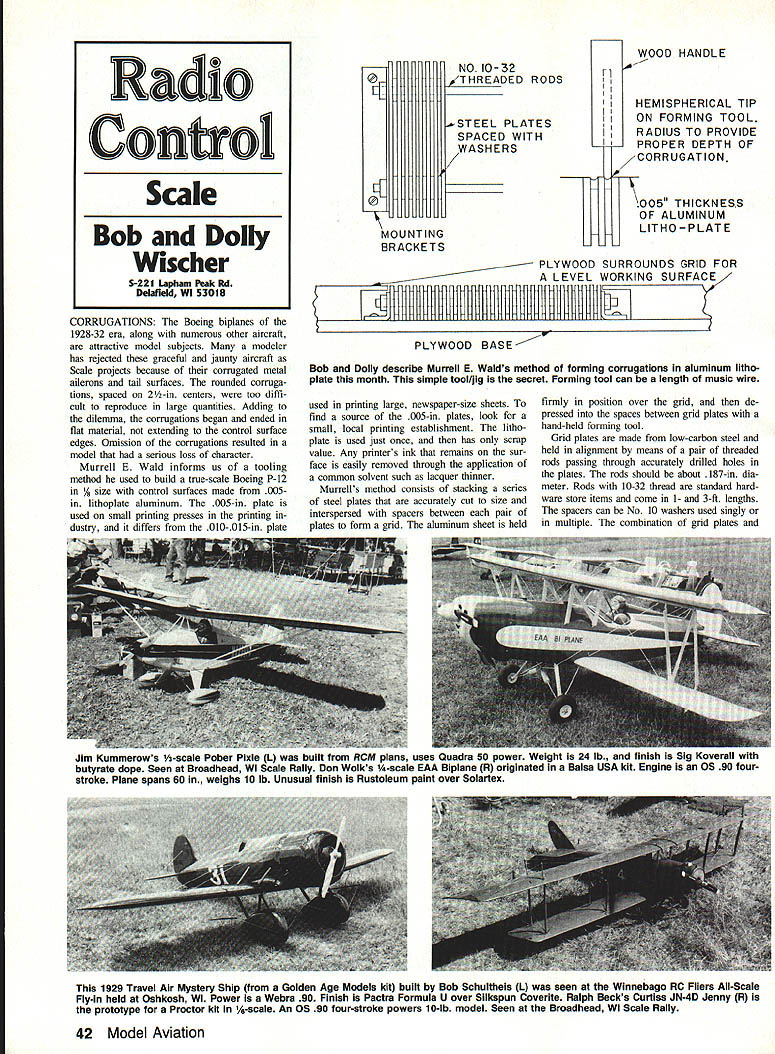
Murrell’s method consists of stacking a series of low-carbon steel plates accurately cut to size and separated by spacers to form a grid. Key points:
- Hold grid plates in alignment with a pair of threaded rods passing through accurately drilled holes. Use rods about .187 in. diameter (No. 10–32 threads are common hardware-store items, available in 1–3 ft. lengths).
- Spacers can be No. 10 washers used singly or stacked to achieve the desired corrugation depth and spacing.
- The combination of plate spacing and washer thickness determines corrugation size and spacing appropriate to the model’s scale.
- Mount the completed grid on a plywood base and build up a surrounding plywood frame so the top of the grid is flush with the work surface. Sanding the top may be necessary to assure flatness.
Forming tool
Murrell recommends a hand-held forming tool made of very hard steel with a wooden handle (similar to a file handle) so firm pressure can be applied. Examples:
- .093–.125-in. music wire with the end ground to a hemisphere.
- A discarded scriber reshaped for the purpose.
The rounded end is used to stretch the aluminum downward between the grid plates. Multiple strokes are necessary to reach the desired depth.
Procedure
- Tape the lithoplate down along the edges to prevent it from creeping while being formed.
- Draw pencil guide lines on the plywood surface to aid alignment.
- Place the aluminum sheet over the grid and use the forming tool to depress the sheet into the gaps between grid plates, working along the length to form corrugations.
- Make multiple strokes as needed to obtain uniform depth and smooth, rounded corrugations.
- Rather than making an excessively long grid, cut a small recess in the plywood adjacent to the grid to accept corrugations already formed at the end of the lithoplate.
- Work from one end of the lithoplate: when you reach the grid limit, remove the hold-down tape, shift the plate so completed corrugations fit into the recess, retape, and continue forming. The last corrugation made should be positioned into the space between the first pair of grid plates so spacing remains consistent.
- Repeat repositioning as needed until the full aileron (or control surface) length is corrugated.
A short practice session with the hand tool is advisable to produce a smooth and accurate scale effect. Murrell reports that modelers of only moderate skill can master this technique; his samples were of excellent quality and greatly enhance a scale project.
Tips and finishing
- For ease of handling, form corrugations in the center of a large sheet and trim excess material later to obtain the final shape.
- Where corrugations vary in length, perform layout directly on the aluminum before forming.
- Remove any remaining printer’s ink with lacquer thinner before forming.
Rigging wires and scale detail
There are several wire sizes used on full-scale biplanes, depending on function:
- Load-bearing flying wires (large biplane): about .625 in. (scale, as appropriate)
- Landing wires (support wings on the ground): about .50 in.
- Tail surface brace wires: can be as small as .375 in. streamlined, or round wire of .125–.187 in. diameter, depending on prototype
A scale modeler truly concerned with accuracy should obtain measurements from the prototype when possible. Photographs and three-view drawings do not always provide sufficient detail. The satisfaction of getting it right is a major reward of high-quality scale modeling, though the average observer (and sometimes contest judges) may not notice the difference.
Fillets
A common frustration when finishing a painted scale model is paint pulling away from a fillet, creating a void and an angular instead of a smooth semicircular fillet. This often occurs with sprayed finishes because the extra thinner required can penetrate and soften some fillet materials, leaving them rubbery even after they had been hard.
Recommended cure:
- Apply a coat of clear epoxy to the fillet before the final finishing schedule. This barrier can be brushed or sprayed.
- If brushed, lightly sand the edges of the epoxy with No. 180 silicon carbide paper to remove buildup.
- Clear epoxy is an effective barrier and is a useful item to keep in the workshop.
Data source
Many scale modelers lack a complete reference data bank for documentation. Dr. Lyle F. Pepino offers a 65-page catalog listing model-building plans, photo packs, drawing research service, and three-view drawings. His services include plan enlargement and reduction.
Contact: Scale Plans and Photo Service 3209 Madison Ave. Greensboro, NC 27403 Telephone: (919) 292-5239
Catalog price: $4 ($6 overseas). The catalog contains hundreds of miniaturized drawings (reductions of model construction drawings), plan reviews, and a listing of aviation VHS videos.
Errata
- In the September 1988 column we ran a photo credited to Hal Parenti as his Piper Comanche. The aircraft is actually a Beechcraft Baron, and we do not know the builder’s name. Our apologies to Hal.
- In the December 1988 column the photo caption claimed Bud Atkinson’s Hawker Hurricane engine was a Genoa G-38. This should have read Zenoah G-38.
Finis
As some readers may have surmised from our recent absences, this column marks the end of our efforts as authors of the "RC Scale" section. This also represents a second retirement (the first occurred 11 years ago when Bob left regular employment). We always desired more freedom, but monthly deadlines made that difficult.
We resisted taking the easy route of product reviews unless the product was specifically intended for scale models. Much of the column material originated from our own experiences and ideas gleaned from conversations at contests and rallies. Reader contributions were rare; the first portions of this month’s column were contributed by readers. We hope the replacement writer will succeed in obtaining more material from other scale modelers.
Writing the column has led to many new friends and the pleasure of repaying some of the enjoyment gained from modeling. As one friend put it: "Everything and everyone has a lifespan."
Nordic Championships (letter from Preben Norholm)
Norholm, who lives in Copenhagen, sent pictures and an interesting description. Excerpts of Preben’s letter follow:
- The green bird is the Grover, designed and flown by Joakim Stahl of Sweden. He was Nordic Champion in 1986 and 1987 and won again this year. Joakim is an excellent F3B pilot — cool, aggressive, and willing to take calculated risks.
- The white plane is Safir 2, designed and flown by Karsten Jeppesen of Denmark. Karsten was Nordic Champion in 1985 and runner-up this year. He led until the last round but was late ending the duration by his Primary Strategic Distance Task Helper (Preben). Preben led him to a thermal in the last distance flight but judged the lift weaker than it actually was, so speedup was initiated too late in the four-minute slot. Karsten had weather for 24 legs and lost with 22 to Stahl’s 23. It was reported to be the most spectacular slot of the contest.
- Languages at the Nordic Championships: English is commonly used when Finns or those who don’t speak Danish are present. Danish, Norwegian, and Swedish are closely related and mutually understandable when spoken slowly and clearly. Historically, the Nordic languages derive from a common source; Icelandic remains most like the old language.
- The F3B Nordics were held at the full-scale gliding center at Elverum, about 100 miles north of Oslo and near the Swedish border. Preben notes the Norwegian–Swedish border crossing is very simple, with signs indicating border, customs, and speed-limit changes in quick succession.
Eastern Iowa LSF Regional contest
Terry Edmands, co-CD of the regional, sent a photo of all the fliers and noted:
- Remnants of Hurricane Gilbert moved north with a front and produced very strong winds, which affected the two-day sailplane contest in Iowa.
Transcribed from original scans by AI. Minor OCR errors may remain.

