
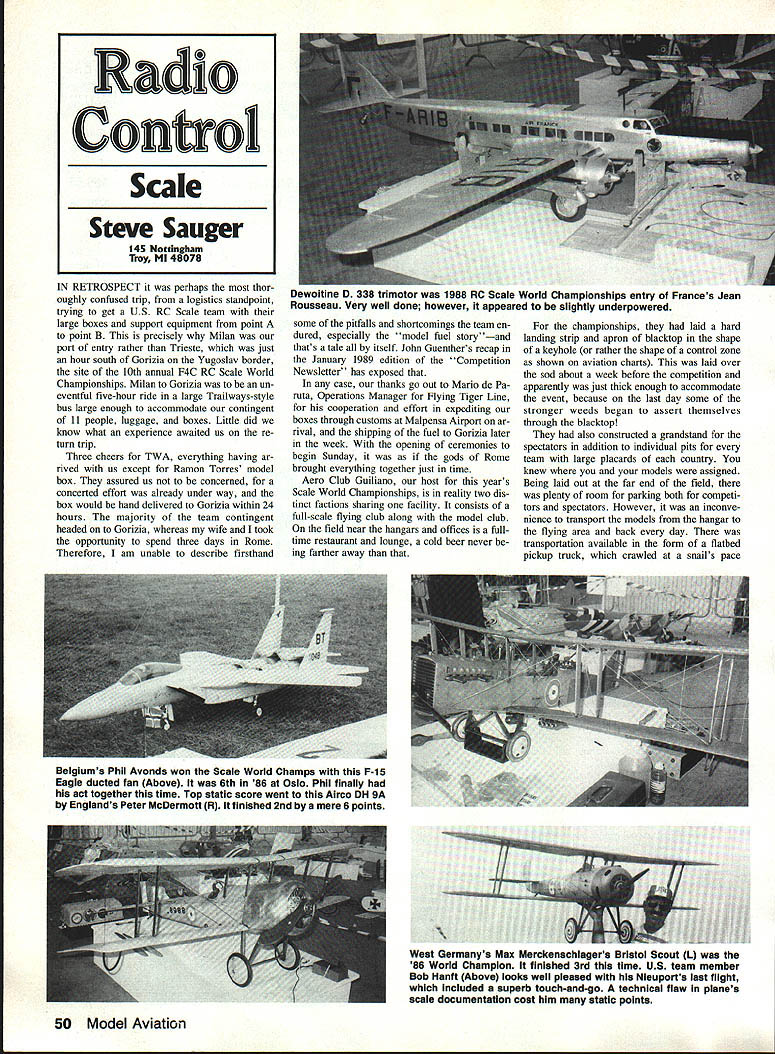
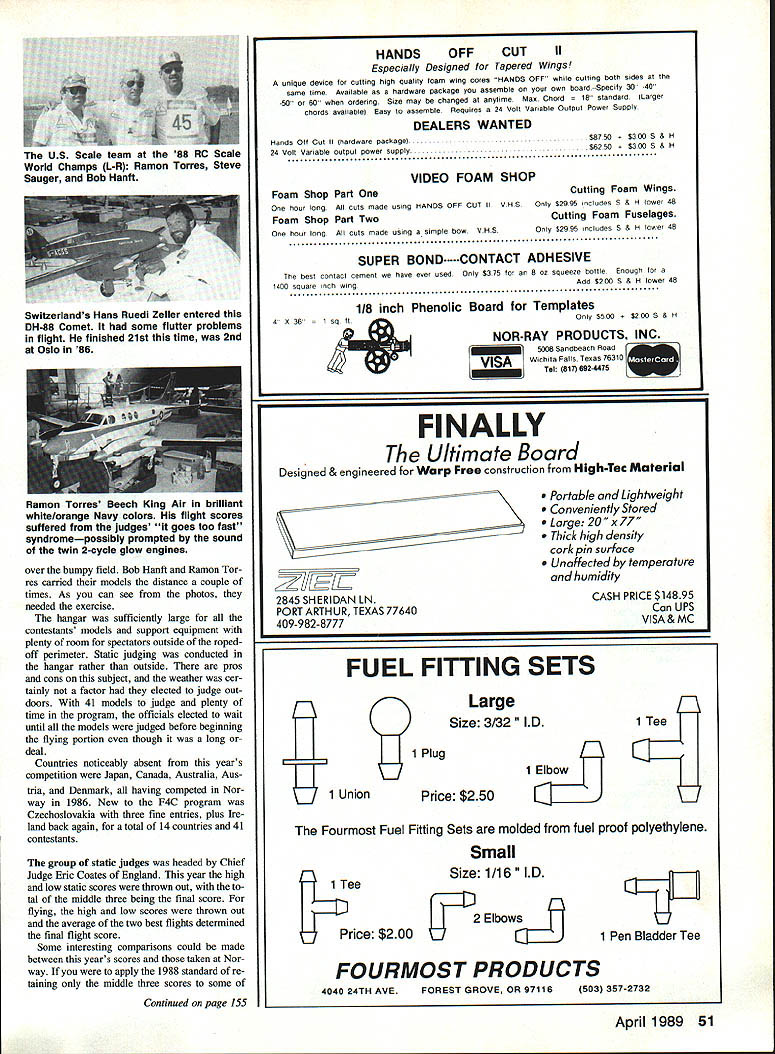
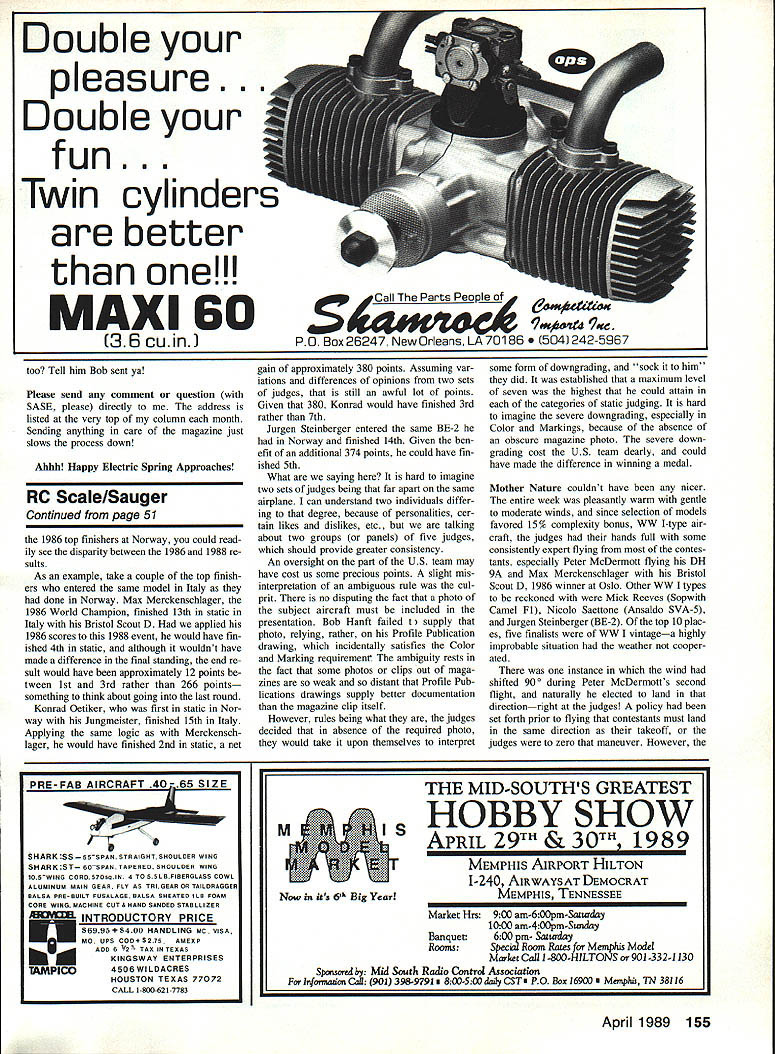
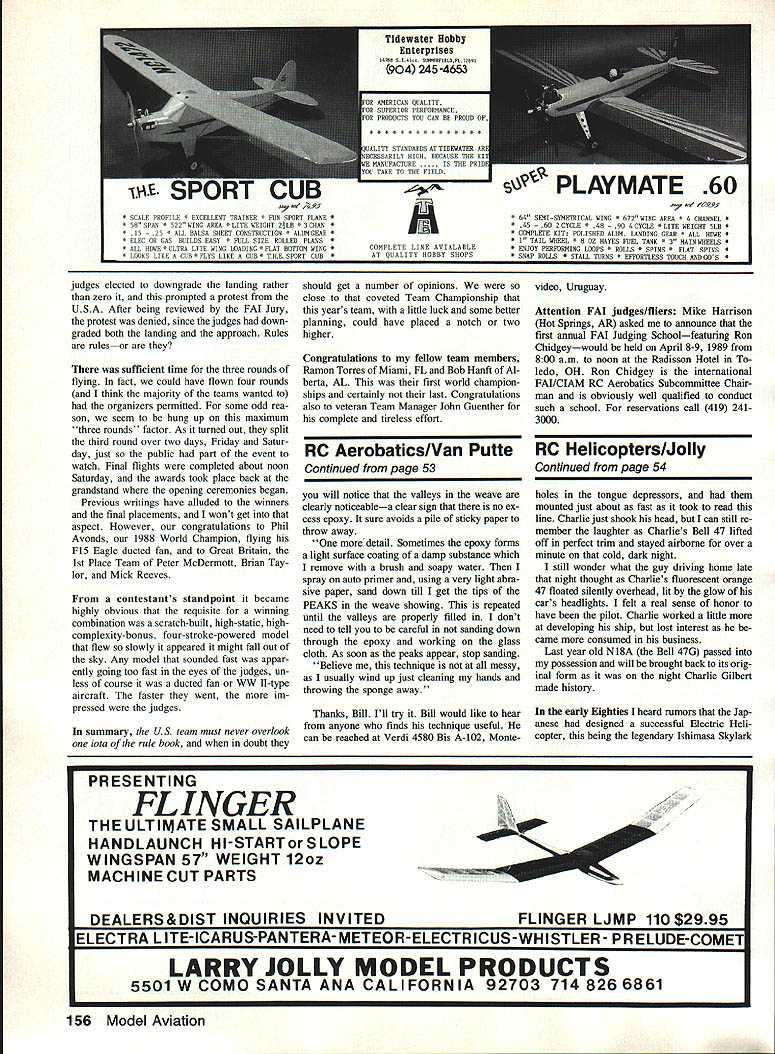
Radio Control: Scale
Steve Sauger
145 Nottingham Troy, MI 48078
Overview and Logistics
In retrospect, it was perhaps the most thoroughly confused trip, from a logistics standpoint, trying to get a U.S. RC Scale team and large boxes and support equipment from point A to point B. This is precisely why Milan was our port of entry rather than Trieste, which was just an hour south of Gorizia on the Yugoslav border, the site of the 10th annual F4C RC Scale World Championships. Milan to Gorizia was to be an uneventful five-hour ride in a large Trailways-style bus large enough to accommodate our contingent of 11 people, luggage, and boxes. Little did we know what an experience awaited us on the return trip.
Three cheers for TWA — everything had arrived with us except for Ramon Torres' model box. They assured us not to be concerned, for a concerted effort was already under way, and the box would be hand-delivered to Gorizia within 24 hours. The majority of the team headed on to Gorizia, whereas my wife and I took the opportunity to spend three days in Rome. Therefore, I am unable to describe firsthand some of the pitfalls and shortcomings the team endured, especially the model fuel story — and that's a tale by itself. John Guenther's recap in the January 1989 edition of the Competition Newsletter has exposed that case.
Our thanks go out to Mario de Paruta, Operations Manager for Flying Tiger Line, for his cooperation and effort in expediting our boxes through customs at Malpensa Airport on arrival, and the shipping of the fuel to Gorizia later in the week. With the opening of ceremonies beginning Sunday, it was as if the gods of Rome brought everything together just in time.
Venue and Facilities
Aero Club Giuliano, our host for this year's Scale World Championships, is in reality two distinct factions sharing one facility. It consists of a full-scale flying club along with the model club. On the field near the hangars and offices is a full-time restaurant and lounge — a cold beer was never farther away than that.
For the championships they had laid a hard landing strip and apron of blacktop in the shape of a keyhole (or rather the shape of a control zone as shown on aviation charts). This was laid over the sod about a week before the competition and apparently was just thick enough to accommodate the event, because on the last day some of the stronger weeds began to assert themselves through the blacktop.
They had also constructed a grandstand for the spectators in addition to individual pits for every team with large placards of each country. You knew where you and your models were assigned. Being laid out at the far end of the field, there was plenty of room for parking both for competitors and spectators. However, it was an inconvenience to transport the models from the hangar to the flying area and back every day. There was transportation available in the form of a flatbed pickup truck, which crawled at a snail's pace.
Static judging was conducted in the hangar rather than outside — pros and cons, weather certainly a factor. Forty-one models were judged and there was plenty of time in the program. Officials elected to wait until models were judged before beginning the flying portion, though that was no long delay.
Participation
Countries noticeably absent this year were:
- Japan
- Canada
- Australia
- Austria
- Denmark
All of the above had competed in Norway in 1986. New to the F4C program was Czechoslovakia with three fine entries, plus Ireland back again, bringing the total to 14 countries and 41 contestants.
Judging and Scoring
The group of static judges was headed by Chief Judge Eric Coates, England. This year the high and low static scores were thrown out, the middle three being the final static score. For flying, the high and low scores were thrown out and the average of the two best flights determined the final flight score.
Some interesting comparisons could be made between years' scores. If you apply the 1988 standard of retaining only the middle three scores to some of the 1986 top finishers at Norway, you can readily see the disparity between the 1986 and 1988 results.
Examples:
- Max Merckenschlager, the 1986 World Champion, finished 13th in static in Italy with his Bristol Scout D. Had we applied his 1986 scores to this 1988 event, he would have finished 4th in static. While it wouldn't have changed the final standing, the end result would have been approximately 12 points between 1st and 3rd rather than 26 points — something to think about going into the last round.
- Konrad Oetiker, who was first in static in Norway with his Jungmeister, finished 15th in Italy. Applying the same logic, he would have finished 2nd in static, a net gain of approximately 380 points. Given that, Konrad would have finished 3rd rather than 7th overall.
- Jurgen Steinberger entered the same BE-2 he had in Norway and finished 14th. Given the benefit of an additional 374 points, he could have finished 5th.
It is hard to imagine two groups of five judges being that far apart on the same airplane. Individual differences of opinion are understandable, but panels of five should provide greater consistency.
Static Presentation Rules Issue
An oversight on the part of the U.S. team may have cost us some precious points. A slight misinterpretation of an ambiguous rule was the culprit. There is no disputing the fact that a photo of the subject aircraft must be included in the presentation. Bob Hanft failed to supply that photo, relying instead on his Profile Publications drawing, which incidentally satisfies the Color and Marking requirement. The ambiguity rests in that some photos or clips of some models are so weak and distant that Profile Publications drawings supply better documentation than the magazine clip itself.
However, rules being what they are, the judges decided that in the absence of the required photo they would interpret some form of downgrading, and they applied a severe penalty. It was established that a maximum level of seven was the highest he could attain in each of the categories of static judging. It is hard to imagine such severe downgrading, especially in Color and Marking, because of the absence of an obscure magazine photo. The severe downgrading cost the U.S. team dearly, and could have made the difference in winning a medal.
Flying and Weather
Mother Nature couldn't have been any nicer. The entire week was pleasantly warm with gentle, moderate winds, and since selection of models took place under a somewhat relaxed schedule, WW I–type aircraft were well represented. The judges had their hands full with consistently expert flying from most contestants, especially Peter McDermott flying his Airco DH.9A and Max Merckenschlager with his Bristol Scout D, 1986 winner at Oslo.
Other WW I types to be reckoned with included:
- Mick Reeves — Sopwith Camel F.1
- Nicolo Scattone — Ansaldo SVA-5
- Jurgen Steinberger — BE-2
Of the top 10 places, five finalists were of WW I vintage — a highly improbable situation had the weather not cooperated.
There was one instance in which the wind had shifted 90° during Peter McDermott's second flight, and naturally he elected to abort the flight and return to the starting line. Consequently, the judges ruled this as an incomplete flight and awarded zero for that maneuver. However, the judges elected to downgrade the landing rather than zero it, and this prompted a protest from the U.S.A. After review by the FAI Jury, the protest was denied, since the judges had downgraded both the landing and the approach. Rules are rules — or are they?
There was sufficient time for the three rounds of flying. In fact, we could have flown four rounds (and I think the majority of the teams wanted to) had the organizers permitted. For some odd reason, we seem to be hung up on this maximum "three rounds" factor. As it turned out, they split the third round over two days, Friday and Saturday, just so the public had part of the event to watch. Final flights were completed about noon Saturday, and the awards took place back on the grandstand where the opening ceremonies began.
Results and Observations
Congratulations to Phil Avonds, our 1988 World Champion, flying his F-15 Eagle ducted fan, and to Great Britain, the 1st Place Team of Peter McDermott, Brian Taylor, and Mick Reeves.
From a contestant's standpoint it became highly obvious that the requisite for a winning combination was:
- A scratch-built, high-static model,
- A model with high complexity-bonus,
- Four-stroke power,
- A model that flew so slowly it appeared it might fall out of the sky.
Any model that sounded fast was instantly judged to be going too fast, unless of course it was a ducted fan or a WW II–type aircraft. The faster they went, the more impressed the judges were.
Conclusions and Congratulations
In summary, the U.S. team must never overlook one iota of the rule book, and when in doubt they should get a number of opinions. We were so close to that coveted Team Championship that this year's team, with a little luck and some better planning, could have placed a notch or two higher.
Congratulations to my fellow team members Ramon Torres of Miami, FL and Bob Hanft of Alberta, AL. This was their first world championships and certainly not their last. Congratulations also to veteran Team Manager John Guenther for his complete and tireless effort.
Transcribed from original scans by AI. Minor OCR errors may remain.

