
Radio Control: Scale
Cliff Tacie 49404 Michelle Ann Dr. Mt. Clemens, MI 48045
OOPS!
When it comes to deciding what material to use to cover your favorite Scale subject, the available selection is both wide and varied. Each modeler seems to have his favorite covering, and with the excellent materials available today from so many manufacturers, you just can't make a bad choice. My own favorite is Coverite's iron-on, heat-shrinkable material, Super Coverite.
Over the years, most of my Scale models and many of my sport models have been covered with Super Coverite. I've found it to be consistent in quality, and the models I've used it on have weathered the years in great shape. I'm a little lazy, and I really like the ability to iron on Super Coverite. Sometimes, however, I'm a little too lazy (or maybe it was that I was a little too thrifty).
When I started covering my Sig Spacewalker, I decided I could save fabric if I covered the wing panels by using the width dimension on the roll of Super Coverite to cover the length of each wing panel. It was a perfect match of sizes. There was only one problem that I didn't think about until both sides of one wing panel were completely covered—I hadn't paid any attention to the direction of the grain in the fabric!
Most fabrics have a grain. This is the strongest direction of the fabric, and it is an absolute rule of modeling (Coverite even warns you in the instructions) that the fabric should be applied with the grain running spanwise. This prevents excess sagging between the ribs. Well, guess what? The grain in Super Coverite runs in the direction of the roll. This means I had covered the wing panel with the grain running chordwise!
The frustrating thing about knowing you've messed up is when you try to fix it by tightening up with your heat gun, and the more you shrink it, the greater the dip becomes between the ribs! Needless to say, I had to face the fact that I was going to have to remove the covering and do it over again. This is where I've got a little tip for you if you've been as dumb as I have.
When removing the covering—partly by heating it and pulling it off, and partly just peeling it back—what was left was a lot of balsa framework with patches of Balsarite and Super Coverite glue. What a lumpy mess! Now you're faced with the dilemma of how to remove this glue easily. Sandpaper is out of the question since balsa is soft and you would end up with low spots.
There are two methods that will work.
- Brush out the lumps with a brush dipped in plain old butyrate dope thinner. The thinner tacks and thins the glue and spreads out nicely over the surface. Simply stroke the brush full of thinner over the entire surface and it will blend the edges of the glue right into the balsa. Give a smoothed-out surface coat of Balsarite and re-cover the proper way. Voila—nice smooth covering job.
- An effective thinner to use in smoothing out the mess is Coverite's own Ironex. Ironex, marketed by Coverite, was used to clean gunk off a tack iron and to thin Balsarite. Just goes to prove you're never too old to make stupid mistakes and learn new tricks.
On the subject of Coverite, you might be interested to know about another fine product the company markets to use with its covering material. It's called Primex. It's really a primer. In the sense you usually think of a primer, Primex prepares Super Coverite, Silkspun and polyester (Dacron) fabrics (Ceconite used on full-scale aircraft) to accept paint. Fabrics that absorb liquids when painting can present a problem in order to get good adhesion. What is necessary is to create a mechanical bond, and this is done by thinning Primex 50/50 with thinner and brushing or spraying a really wet fluid that penetrates the weave and wraps itself around individual fibers, thereby creating a bond. Use three coats (two probably sufficient) and it will give the adhesion needed for later masking and painting.
I'm sure all you Coverite users will find this tip from Henry valuable information, as I did. Give Primex a try; I'm using it on my Spacewalker.
The Overshoot
In the September 1988 issue of Replica, the newsletter of the National Association of Scale Aeromodellers (NASA), guest columnist Russ Knetzger discussed the Overshoot maneuver as performed by many of the contestants at the 1988 Nats. Russ is a USJPA (U.S. Pattern Judges Association) flight judge and regularly divides his time between judging Pattern and Scale. USJPA judges are a professional group who work hard to provide consistency in flight judging in accordance with the rule book.
Russ wrote:
"The Overshoot was another popular maneuver at this Nats, and well it might be, because it only has to simulate a landing approach to the runway that may turn out to be too high, so that the pilot must revise full power to go around and try the landing again. In effect it is another fly past with a slowing and descent portion before returning to full-power flight.
"But simple as that maneuver can be, pilots often place the maneuver poorly for good viewing by the judges, for example descending well before reaching the judges, and then being back to full power and level or climbing flight still prior to even reaching the judges. That kind of lack of concern for good placement of the maneuver can and does draw low scores from the judges."
Russ is rightfully concerned about the placement of the maneuver. It's also interesting to note how many competitors have not carefully read the rule book and really don't know just what this maneuver entails. When done correctly, it's a smooth, beautiful maneuver that flows from behind the pilot. When done incorrectly, it's just as Russ describes it.
Let's see what the rule book says about the Overshoot:
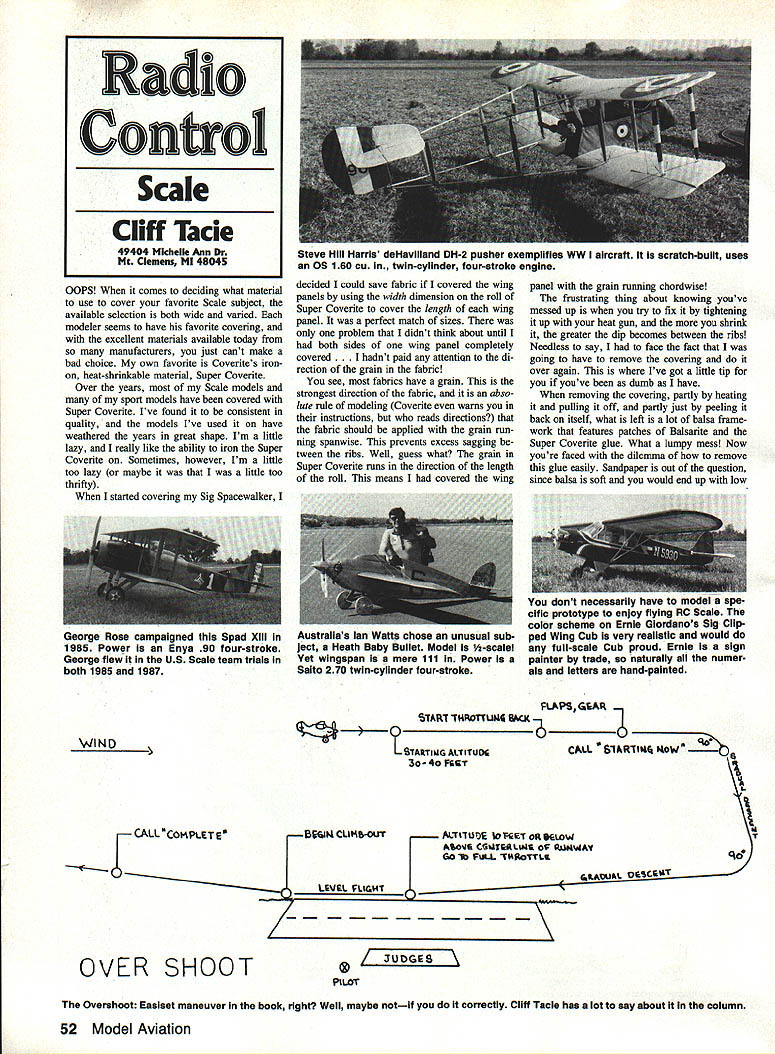
The model makes a landing approach at low throttle to below 10 ft. in altitude without touchdown, followed by a climb at full throttle to resume level flight. Model should commence by flying a final crosswind leg (missed by many pilots) followed by a turn onto a normal landing approach at low throttle, using flaps if applicable, until it reaches a point over the 100-ft.-diameter circle (or point immediately opposite the judges) at a height of 10 ft. or less. At this point full throttle is applied, and the model climbs straight ahead to resume level flight.
Errors:
- Model does not commence maneuver with the correct landing approach. Model must be descending until full throttle is applied.
- Model does not use flaps (if applicable).
- Model does not retract gear (if applicable).
- Landing gear is not retracted on climbout (if applicable).
Notice the comment about where the maneuver starts? Most pilots don't call the maneuver starting until they've turned onto final approach and have reached the point directly over the judges (or the 100-ft. circle). By then it's often too late to be at 10 ft. or less, and the pilot is forced to either descend too steeply or abort the attempt.
The correct procedure is to start as you enter the final crosswind leg of what would normally be a traffic pattern. The maneuver should be called "Starting now" as you turn onto this crosswind leg. The maneuver is not complete until you've climbed out the same as if you had just made a takeoff, and it should not be called "Complete" before then. In the FAI event, this maneuver is not complete until the turn-out is made, just as in an FAI takeoff.
The Overshoot is not meant to be a power dive or a "Fly Past." In actuality, the imaginary pilot in the model is attempting to make a landing on the spot in front of the judges, but as sometimes happens in full-scale, his approach has brought him in a little too high and too long. Realizing this when he's down to an altitude of less than 10 ft., with throttle at idle and no hope of hitting the spot, full throttle is applied. Level flight is maintained until climbing speed is attained, and then the model climbs out as if taking off.
The Overshoot is a maneuver well suited to any type aircraft. It's very pretty to watch when performed properly, and can garner you good flight points if you do it right. Do it wrong, however, and its supposed simplicity may earn you the wrath of the judges!
A little attention to where you call the maneuver and consistent practice will turn the Overshoot from an error-prone maneuver into one that scores well.
B.O.M.I. rule
What do the majority of today's Scale modelers really want? I've read editorials and rules proposals recently in favor of an event for Scale competition that would eliminate the Builder of the Model rule. Various names have been applied to these proposals, but the more I read of them, the more I wonder just how deeply the self-styled modelers proposing these events are actually involved in Scale modeling.
If they were interested enough in Scale to read their AMA rule books, they would realize that they have already been given what they're asking for! It's called RC Fun Scale (Event No. 520), and it's a Provisional event added last year with the express purpose of allowing modelers interested in enjoying the flying of Scale model aircraft to participate in competition without having built the models themselves. With the advent of so many prebuilt or ready-built Scale models on today's market, there are a great many modelers who have chosen to take this route.
When the cross section of Scale modelers is considered, however, I wonder how great the percentage of "nonbuilder" competition Scale fliers really is when compared against the percentage of those who enjoy the building aspect of Scale as much as, or maybe even more than, the flying? From what I've seen since the event was introduced, there doesn't seem to be much interest in it. I haven't seen the event run at some of the larger Scale contests such as the Mint Julep Scale Meet, or even the '88 Nats. In reviewing Scale Dimension, the newsletter of the Scale Squadron of Southern California, I haven't seen a great deal of interest in RC Fun Scale either. Does this mean there is no interest in it, or is it simply that today's modeler is not aware of it?
Next time you get a chance, turn to page 109 of the 1988–1989 AMA Competition Regulations book and read about RC Fun Scale. You just might find that what you've been asking for has already been given. It has Provisional status, so support it if you want to keep it!
May your skies remain Scale!
Transcribed from original scans by AI. Minor OCR errors may remain.

