
Scale
Bud Atkinson
YOU SAY YOU ARE having heat problems with your new super scale job? Don't feel badly; I'm sure you have plenty of company. Many of us have had this problem. First off, we are flying heavier models in most cases and should be using larger diameter props. By the way, I have found with most scale jobs, with the exception of a very large biplane or, say, a radial-engined craft—such as a Hellcat—a 12/6 prop will fly the model much better than a pattern prop in the range of 11/7 to 11/8. And, of course, to get the prop blades outside of the cowling on larger models, you need a 13- or even 14-in. prop—but keep the pitch lower.
Never install a new engine in your scale bird! Have it well broken in and, if possible, first fly your scale engine in a pattern or sport model to get it well broken in, and the idle set. Also fly it with the prop you will use on your scale model. I'm sure we all have seen at contests several fine scale birds that were, or seemed to be, under-powered. In most cases, engines are not broken in or are propped incorrectly, or there is a poor tank set-up, etc. This is common on scale biplanes. Scale biplanes are inherently tail-heavy and have all that drag. They need all the pulling power they can get.
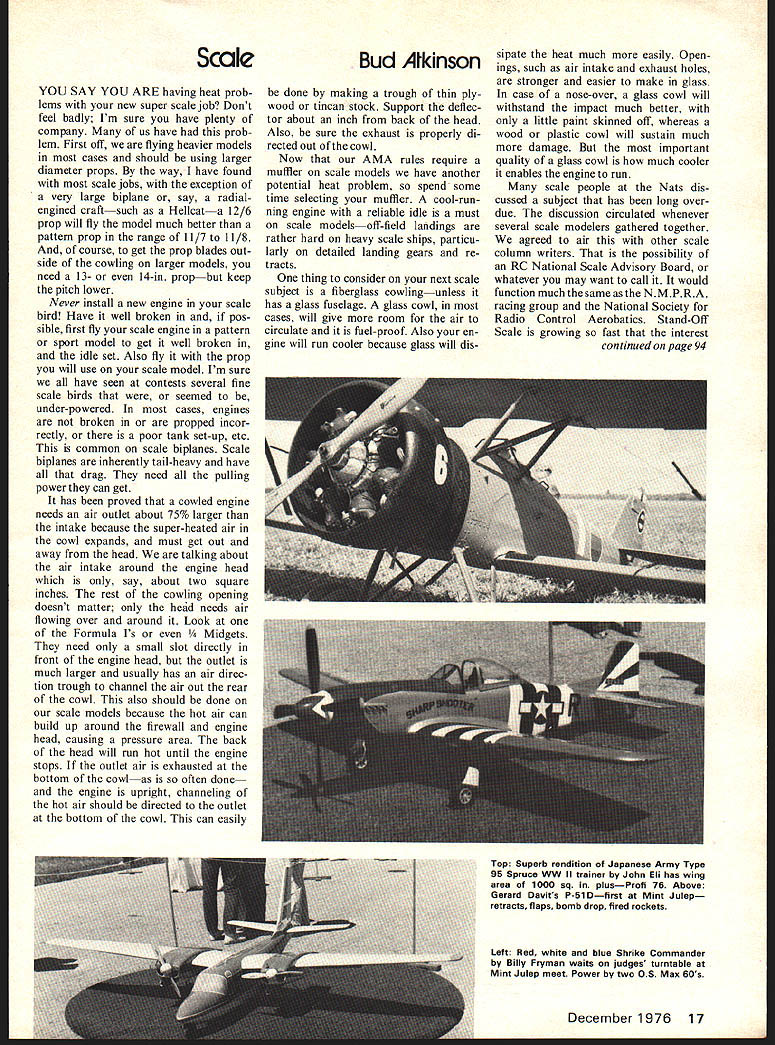
It has been proved that a cowled engine needs an air outlet about 75% larger than the intake because the super-heated air in the cowl expands, and must get out and away from the head. We are talking about the air intake around the engine head which is only, say, about two square inches. The rest of the cowling opening doesn't matter; only the head needs air flowing over and around it. Look at one of the Formula I's or even 1/2 A Midgets. They need only a small slot directly in front of the engine head, but the outlet is much larger and usually has an air direction trough to channel the air out the rear of the cowl. This also should be done on our scale models because the hot air can build up around the firewall and engine head, causing a pressure area. The back of the head will run hot until the engine stops. If the outlet air is exhausted at the bottom of the cowl—as is so often done—and the engine is upright, channeling of the hot air should be directed to the outlet at the bottom of the cowl. This can easily be done by making a trough of thin plywood or tincan stock. Support the deflector about an inch from back of the head. Also, be sure the exhaust is properly directed out of the cowl.
Now that our AMA rules require a muffler on scale models we have another potential heat problem, so spend some time selecting your muffler. A cool-running engine with a reliable idle is a must on scale models—off-field landings are rather hard on heavy scale ships, particularly on detailed landing gears and retracts.
One thing to consider on your next scale subject is a fiberglass cowling—unless it has a glass fuselage. A glass cowl, in most cases, will give more room for the air to circulate and it is fuel-proof. Also your engine will run cooler because glass will dissipate the heat much more easily. Openings, such as air intake and exhaust holes, are stronger and easier to make in glass. In case of a nose-over, a glass cowl will withstand the impact much better, with only a little paint skinned off, whereas a wood or plastic cowl will sustain much more damage. But the most important quality of a glass cowl is how much cooler it enables the engine to run.
Many scale people at the Nats discussed a subject that has been long overdue. The discussion circulated whenever several scale modelers gathered together. We agreed to air this with other scale column writers. This is the possibility of an RC National Scale Advisory Board, or whatever you may want to call it. It would function much the same as the N.M.P.R.A. racing group and the National Society for Radio Control Aerobatics. Stand-Off Scale is growing so fast that the interest is growing so fast that the interest warrants better communication among scale modelers. Helicopter people have a world-wide organization (National Radio Control Helicopter Assoc.) for this purpose, as does the International Miniature Aerobatics Club.
Stand-Off Scale has reached a level that justifies dividing it into several categories — such as WW I and WW II. WW II aircraft are becoming very popular and several noteworthy contests are emerging — such as the Morgan Hill WW II Scramble. Of course, a scale association would take a lot of work and time, but since other groups within RC have done it successfully, it may be the way to go for scale, so we hope the magazine editors take a good look at the possibilities. Be sure to write and let one of the older scale columnists hear from you too. How about the M.S.A.A. — Miniature Scale Aircraft Assoc. — grab ya?
Bud Atkinson 734 N. 6th Street Terrace Blue Springs, MO 64015
Transcribed from original scans by AI. Minor OCR errors may remain.

