
Radio Control: Scale
By Dan Parsons
11809 Fulmer Dr. Albuquerque, NM 87111
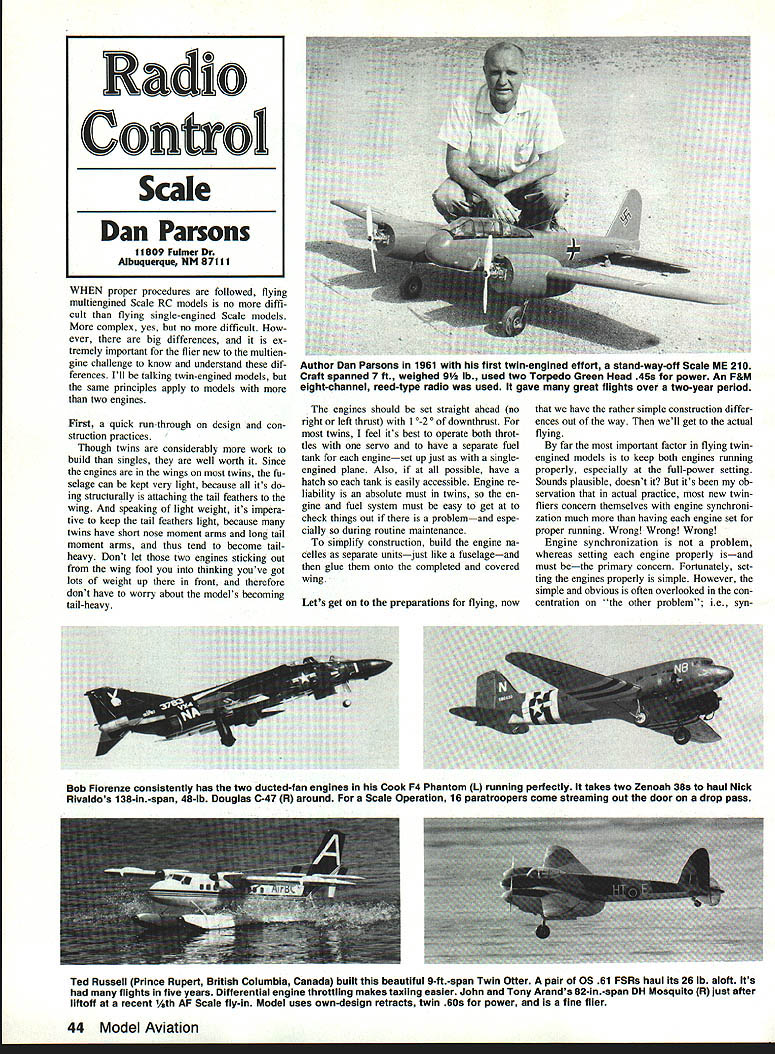
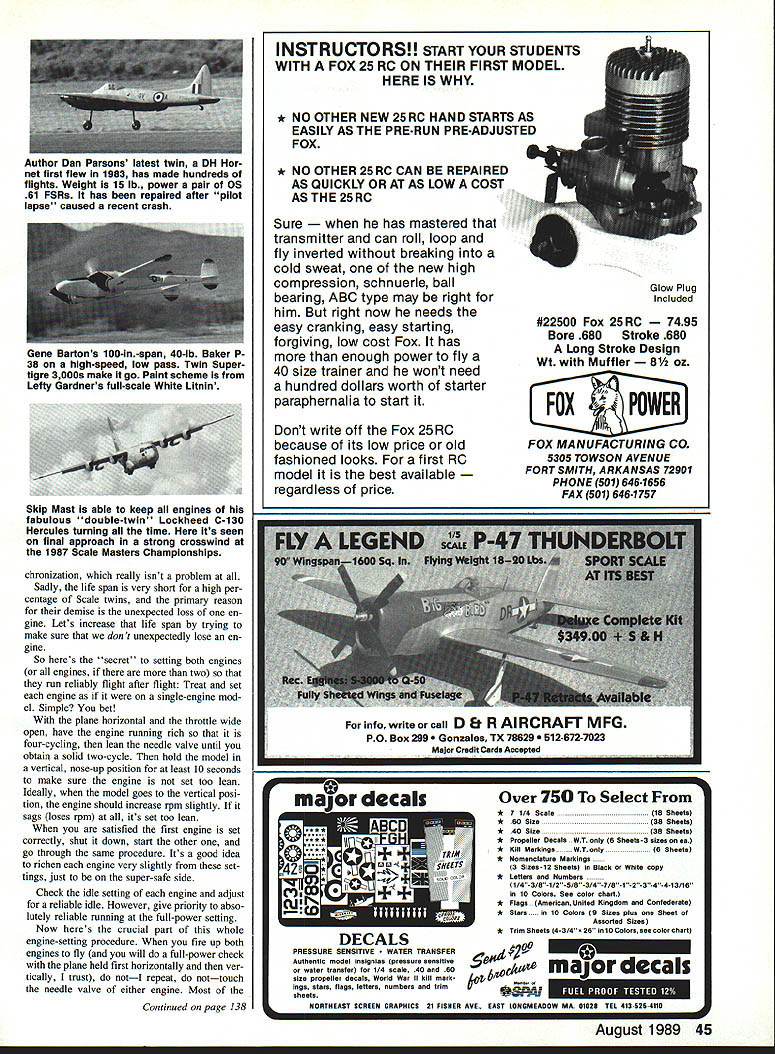
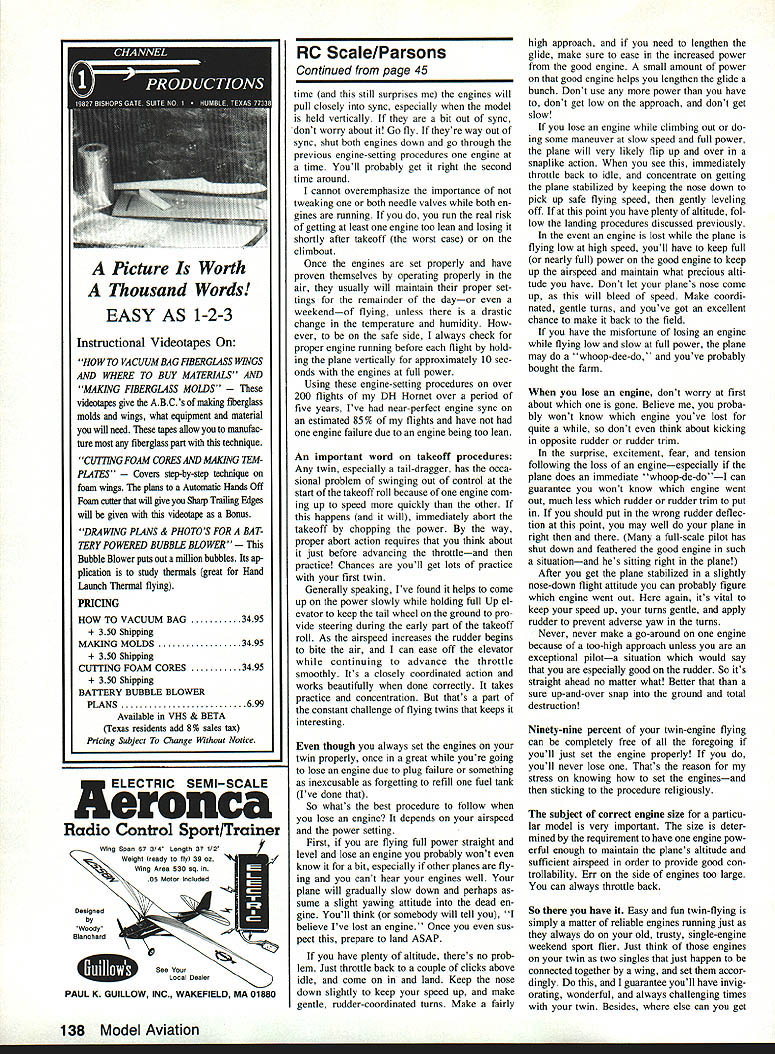
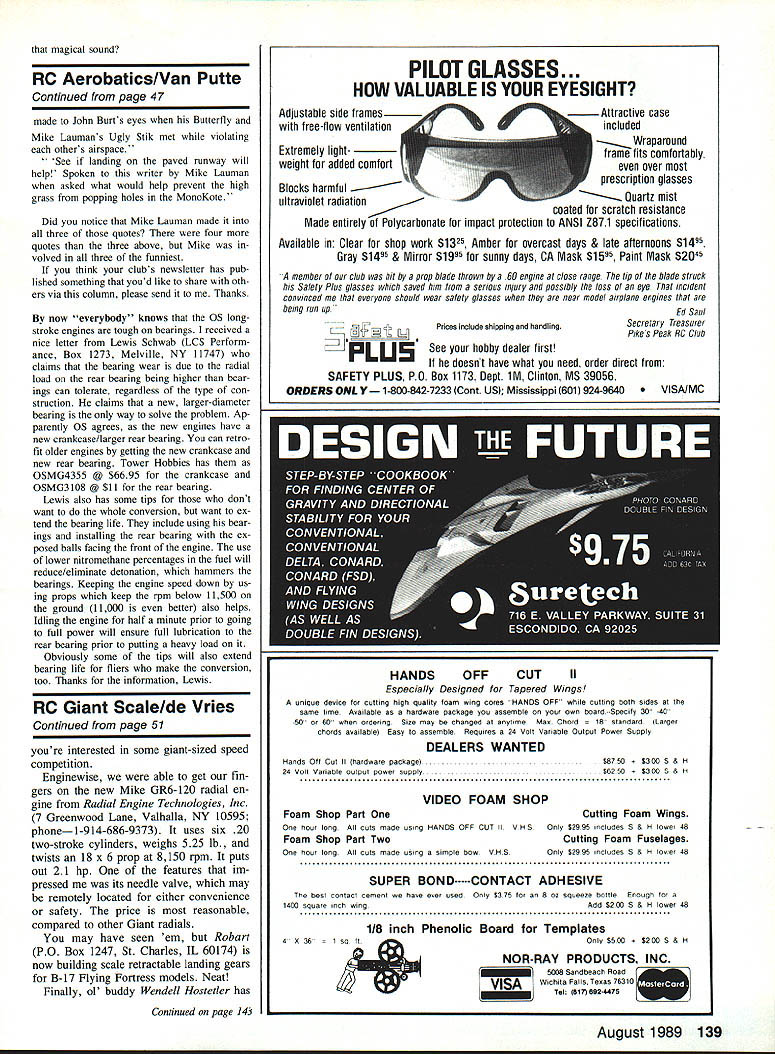
When proper procedures are followed, flying multi-engined Scale R/C models is no more difficult than flying single-engined Scale models. More complex, yes, but no more difficult. There are important differences the flier new to the multi‑engine challenge must know and understand. I’ll discuss twin‑engined models, though the same principles apply to models with more than two engines.
Design and construction
Though twins require considerably more work to build than singles, they are well worth it. Because the engines are usually in the wings, the fuselage can be kept very light — it primarily serves to attach the tail feathers to the wing. It is imperative to keep the tail surfaces light: many twins have short nose moment arms and long tail moment arms and thus tend to become tail‑heavy. Don’t let two engines sticking out of the wing fool you into thinking you have lots of weight up front.
Engines should be set straight ahead (no right or left thrust) with about 1°–2° of downthrust. For most twins, I recommend operating both throttles with one servo and having a separate fuel tank for each engine, set up just as with a single‑engined plane. If possible, provide a hatch so each tank is easily accessible. Engine reliability is an absolute must on twins, so the engines and fuel system must be easy to get at for checks, trouble‑shooting, and routine maintenance.
To simplify construction, build the engine nacelles as separate units — just like a small fuselage — and then glue them onto the completed, covered wing.
Preparations for flying
By far the most important factor in flying twin‑engined models is to keep both engines running properly, especially at full power. In actual practice, many new twin fliers focus on engine synchronization rather than ensuring each engine is set for proper running. That’s backwards: synchronization is not the primary problem — correct individual engine settings are.
Treat and set each engine as if it were on a single‑engine model. The following procedure has kept my twins reliable over hundreds of flights:
Engine‑setting procedure
- Hold the plane horizontal and open the throttle wide.
- Start with the engine running slightly rich so it four‑cycles.
- Lean the needle valve until you obtain a solid two‑cycle.
- Hold the model in a vertical, nose‑up position for at least 10 seconds to ensure the engine is not too lean. Ideally, the engine should increase RPM slightly in the vertical; if it sags (loses RPM) it’s too lean.
- When satisfied the first engine is set correctly, shut it down, start the other engine, and repeat steps 1–4.
- Richen each engine very slightly from these settings for an extra margin of safety.
- Check and adjust the idle on each engine for a reliable idle, but give priority to absolutely reliable running at full throttle.
When both engines are fired for ground checks, do not adjust either needle valve while both engines are running. On the ground one engine will often appear slightly richer than the other at idle, tempting you to tweak to make them match. If you match them at idle you may make one engine too lean at full power and risk losing it in flight. Instead, keep the full‑throttle settings as set and use small differential throttle settings or adjustable linkage to make the model steer straight on the ground. Differential throttling makes taxiing easier.
Over time the engines will often pull closely into sync, especially when the model is held vertically. If they are a bit out of sync, don’t worry — go fly. If they’re far out of sync, shut both down and re‑set each engine one at a time.
Always check for proper engine running before each flight by holding the plane vertically at full power for about 10 seconds.
Takeoff procedures
Any twin, especially a tail‑dragger, can swing out of control during the takeoff roll if one engine comes up to speed quicker than the other. If this happens, immediately abort the takeoff by cutting the power. Practice thinking about abort action just before advancing the throttle — you’ll probably get lots of practice with your first twin.
A generally successful technique:
- Come up on the power slowly while holding full up elevator to keep the tail wheel on the ground for steering during the early part of the roll.
- As airspeed increases and the rudder becomes effective, ease off the elevator while continuing to advance the throttle smoothly.
- Coordinate throttle, elevator, and rudder carefully — it takes practice and concentration.
What to do if you lose an engine
Even with proper settings, an engine can still fail due to plug failure, a clogged fuel line, or human error (for example, forgetting to fill a tank). The correct response depends on airspeed and power setting at the moment of failure.
If you lose an engine while straight and level at full power
- You may not notice at once. The plane will gradually slow and assume a slight yaw toward the dead engine.
- As soon as you suspect an engine loss, prepare to land as soon as practical.
- If you have plenty of altitude, throttle back to a couple of clicks above idle and come in to land. Keep the nose down slightly to maintain speed and make gentle, rudder‑coordinated turns.
- Make a fairly high approach. To lengthen the glide, ease in a small amount of power from the good engine — just enough to extend the descent. Don’t use more power than necessary, don’t get low on final, and don’t get slow.
If you lose an engine while climbing out or at slow speed/full power
- The model may flip up and over suddenly. If it does, immediately throttle back to idle and concentrate on keeping the nose down to regain flying speed, then gently level off.
- If you have sufficient altitude, follow the landing procedure above.
If you lose an engine while flying low at high speed
- Keep full or nearly full power on the good engine to maintain airspeed and whatever altitude you can.
- Don’t let the nose come up (which will bleed off speed). Make coordinated, gentle turns to return to the field.
General cautions on engine loss
- Don’t worry at first about which engine died; you probably won’t know right away. Don’t instinctively apply opposite rudder or rudder trim until the aircraft is stabilized and you can determine which engine is out.
- Applying the wrong rudder input or trimming the wrong way can cause a fatal loss of control.
- After stabilizing in a slightly nose‑down attitude, you can usually determine which engine is out and then use coordinated rudder to counter adverse yaw.
- Never attempt a go‑around on one engine unless you are exceptionally skilled at rudder control. It is usually safer to land straight ahead.
Ninety‑nine percent of twin‑engine problems are eliminated by setting the engines properly and sticking to the procedure.
Engine sizing
Choosing correct engine size is important. You need one engine powerful enough to maintain altitude and sufficient airspeed on one engine to preserve controllability. Err on the side of slightly larger engines rather than under‑powering the model.
Conclusion
Easy and fun twin‑flying is simply a matter of reliable engines running just as they would on your single‑engined sport flier. Think of each engine on your twin as a single that happens to be attached to the same wing, and set them accordingly. Do this and you’ll have many wonderful and challenging times with your twin — and enjoy that magical sound.
Transcribed from original scans by AI. Minor OCR errors may remain.

