
Radio Control: Scale
John Guenther Rt. 3, Box 297A Borden, IN 47106
FOR NEWCOMERS to Scale and experienced veterans alike, documenting your model and deciding how you'll finish it occupy a big part of your modeling time. I find researching the subject aircraft, obtaining the color chips, and locating quality photos of the full-size aircraft and its various details to be the hardest, most challenging, and yet the most fun part of a Scale project.
Another task that gives me great personal satisfaction is finishing or painting the model. If you're an experienced Scale modeler, you've probably developed a painting technique that works well and have a list of finishing materials that satisfies you. What I'd like to provide here are some personal insights and guidance for newcomers. Maybe somewhere along the line the experienced Scale modeler will also read something useful.
Paint schemes
Civilian aircraft typically have simple paint schemes and layouts — you can verify this by visiting a local airport. Civilian paints used on the full‑size subject are usually easy to obtain from the aircraft owner, hangar operations, or maintenance personnel. Getting color chips from them or from the paint manufacturer is usually straightforward and inexpensive. In fact, if the owner knows you are reproducing their pride and joy in miniature, they will often go out of their way to help. You may collect more photos and color chips than you can ever use.
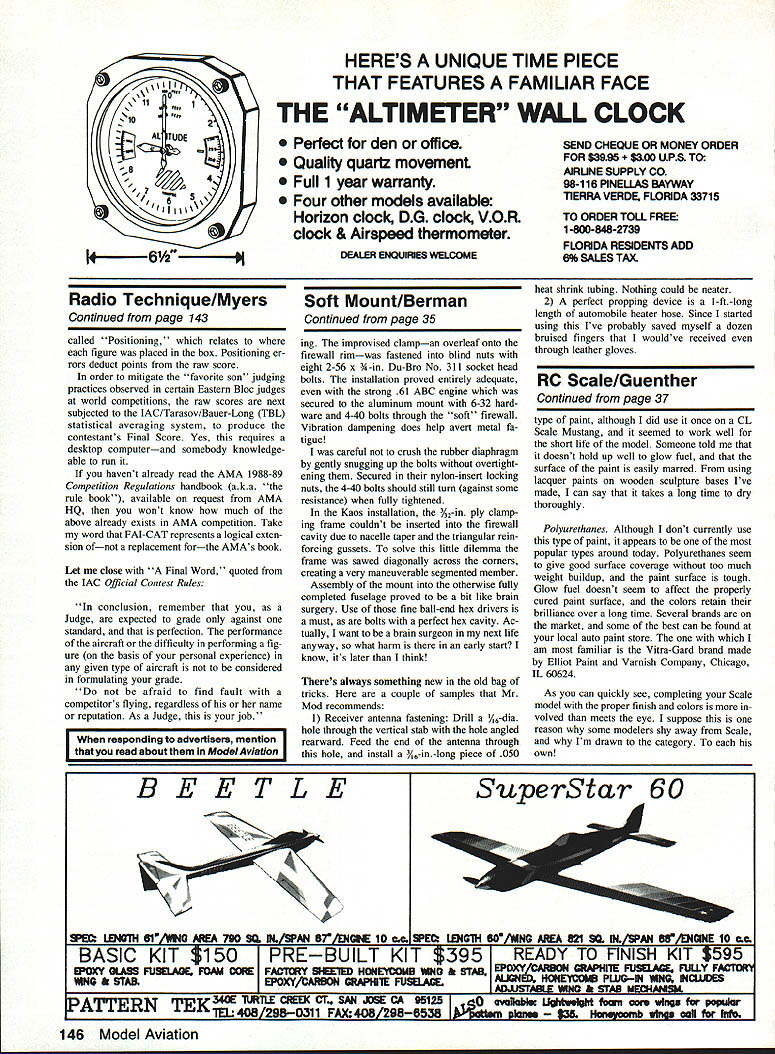
Military aircraft, however, present a wider range of problems. Camouflage schemes and military markings can be difficult to duplicate, and getting accurate information on colors and markings can be a real chore — even for recently restored warbirds.
If I had one tidbit to pass on to fellow Scale modelers it would be this: find out what paint colors were used on the actual aircraft, and obtain authentic color chips. At finishing time you will be looking at these chips to mix your paint.
As research sources for colors and markings, I recommend every serious modeler have the following references and resources:
- Federal Color Guide No. 595 — This inexpensive publication contains hundreds of 1 x 1/2‑inch color chips, each marked with a color name and reference number (for example: USAF & USN olive drab, shade 41 — FED. 595 No. 34087). To obtain a copy, write to: Superintendent of Documents, U.S. Government Printing Office, Washington, D.C. 20402, or call 1-202-783-3238 to order by phone. Include an SASE if requested.
- British Aviation Colors of WWII, Vol. 3 — Retails for about $17.95. The USAF Museum (Dayton, OH) may provide a copy; the RAF Museum (Hendon, London NW9 5LL) also has copies. I first saw this book at Hendon.
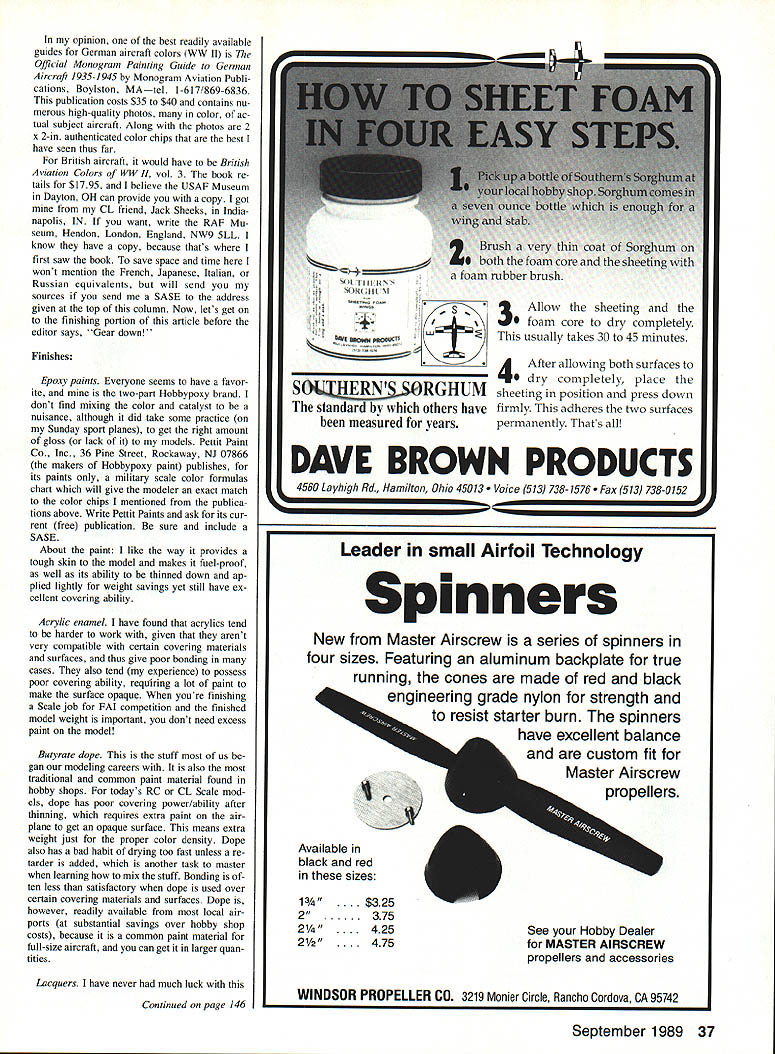
- Luftwaffe Painting Guide/Color Chart, J.R. Smith et al., Kookaburra Technical Publications — An excellent guide to German WWII aircraft colors.
- Official Monogram Painting Guide: German Aircraft 1935–1945, Monogram Aviation Publications (Boylston, MA). This publication (price roughly $35–$40) contains numerous high‑quality photos and 2 x 2‑inch authenticated color chips — among the best available.
To save space I won't list French, Japanese, Italian, or Russian equivalents here, but I will send sources if you send a stamped, self‑addressed envelope to the address at the top of this column.
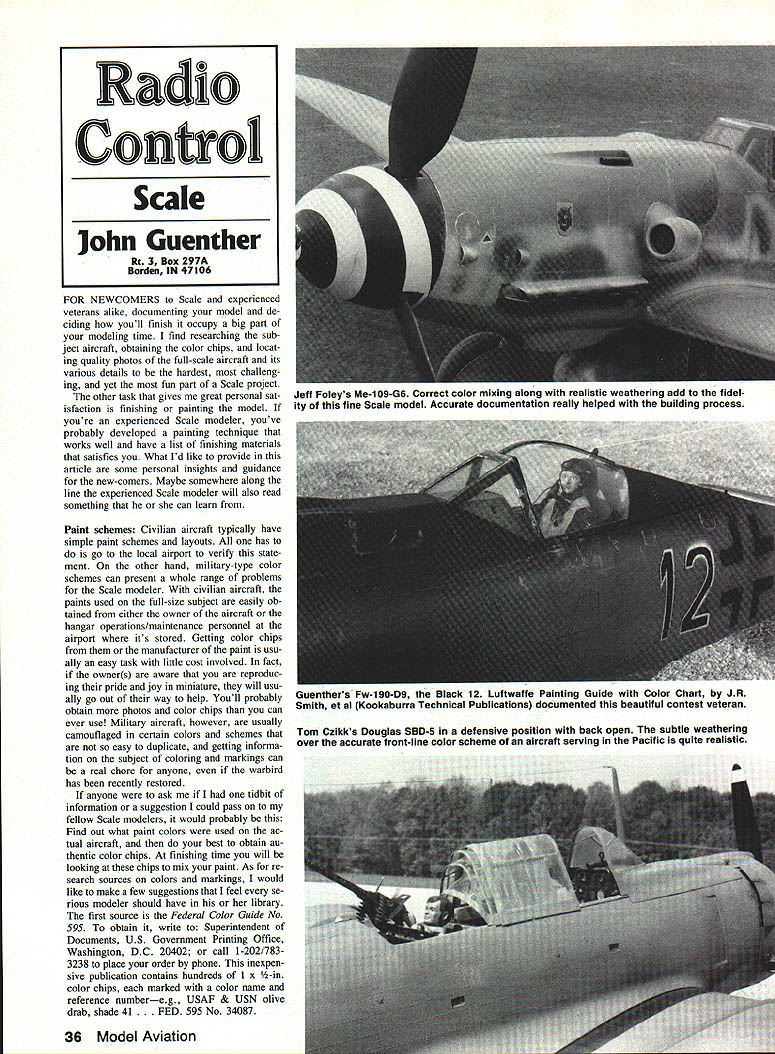
Correct color mixing along with realistic weathering add fidelity to a fine Scale model. Accurate documentation really helps the building process.
Finishes
Epoxy paints
Everyone seems to have a favorite; mine is the two‑part Hobbypoxy brand. I don't find mixing the color and catalyst a nuisance, although it did take practice to get the right amount of gloss (or lack of it). Pettit Paint Co., Inc., makers of Hobbypoxy, publish a military/scale color formulas chart which will give the modeler an exact match to the color chips mentioned above. Write Pettit Paints and ask for their current (free) publication — be sure to include an SASE.
About Hobbypoxy: I like the way it provides a tough skin to the model and makes it fuel‑proof. It can be thinned and applied lightly for weight savings yet still has excellent covering ability.
Pettit Paint Co., Inc. 36 Pine Street, Rockaway, NJ 07866
Polyurethanes
Although I don't currently use this type of paint, polyurethanes appear to be very popular. They give good surface coverage without excessive weight buildup, and the surface is tough. Gloss and semigloss finishes are available; newer two‑part varieties dry to a very durable finish. One brand I know of is Vitra‑Gard, made by Elliot Paint and Varnish Company, Chicago, IL 60624.
Acrylic enamel
I have found acrylics harder to work with in some cases. They can be incompatible with certain covering materials and surfaces, giving poor bonding. In my experience they also tend to have poorer covering ability, requiring more paint to achieve opacity. When finishing a Scale model for FAI competition where weight matters, excess paint is undesirable.
Butyrate dope
This is the material most of us began modeling with and remains common in hobby shops. For today's RC or CL Scale models, dope has relatively poor covering power and often requires extra coats (and thus extra weight) to achieve opacity after thinning. Dope also dries quickly unless a retarder is added, which is another mixing skill to learn. Bonding can be less than satisfactory over some covering materials. Dope is, however, readily available at many local airports (often at substantial savings compared to hobby shops), because it is used on full‑size aircraft and can be bought in larger quantities.
Lacquers
I have never had much luck with lacquers personally. (If you choose to use them, be aware they can behave differently than other paints and may require specific handling and surface preparation.)
As you can see, completing your Scale model with the proper finish and colors involves more than meets the eye. That is one reason some modelers shy away from Scale, and also why I am drawn to it. To each his own.
John Guenther Rt. 3, Box 297A Borden, IN 47106
Transcribed from original scans by AI. Minor OCR errors may remain.

