
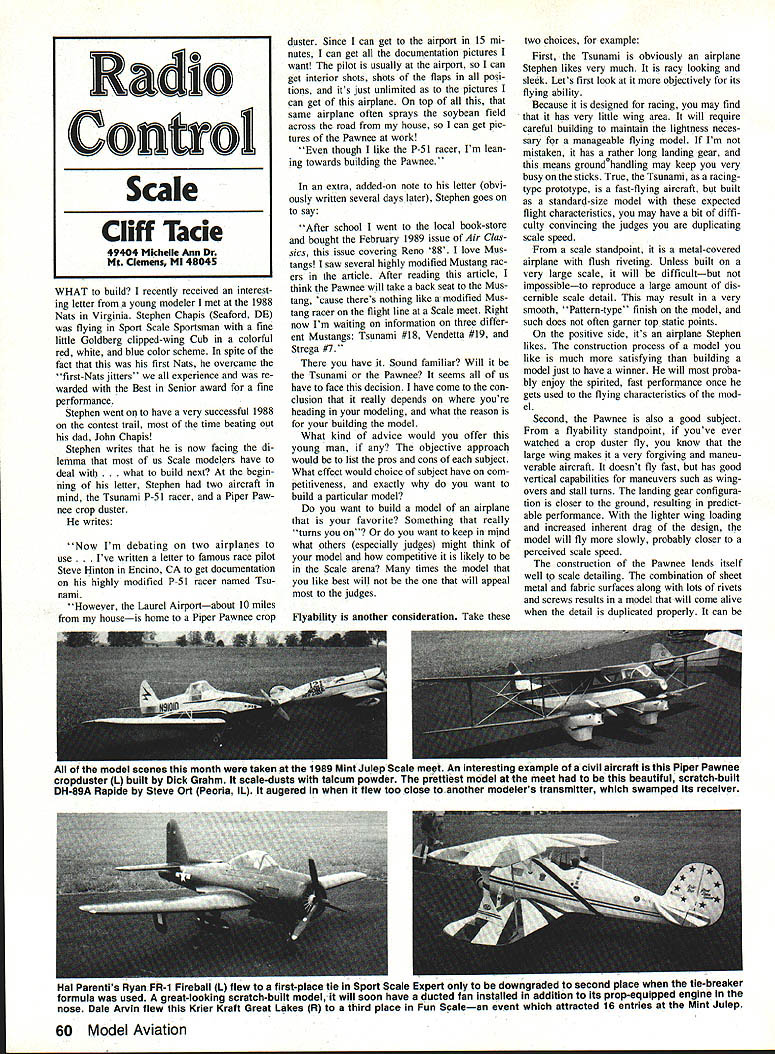
Radio Control: Scale
Cliff Tacie 49404 Michelle Ann Dr. Mt. Clemens, MI 48045
What to build?
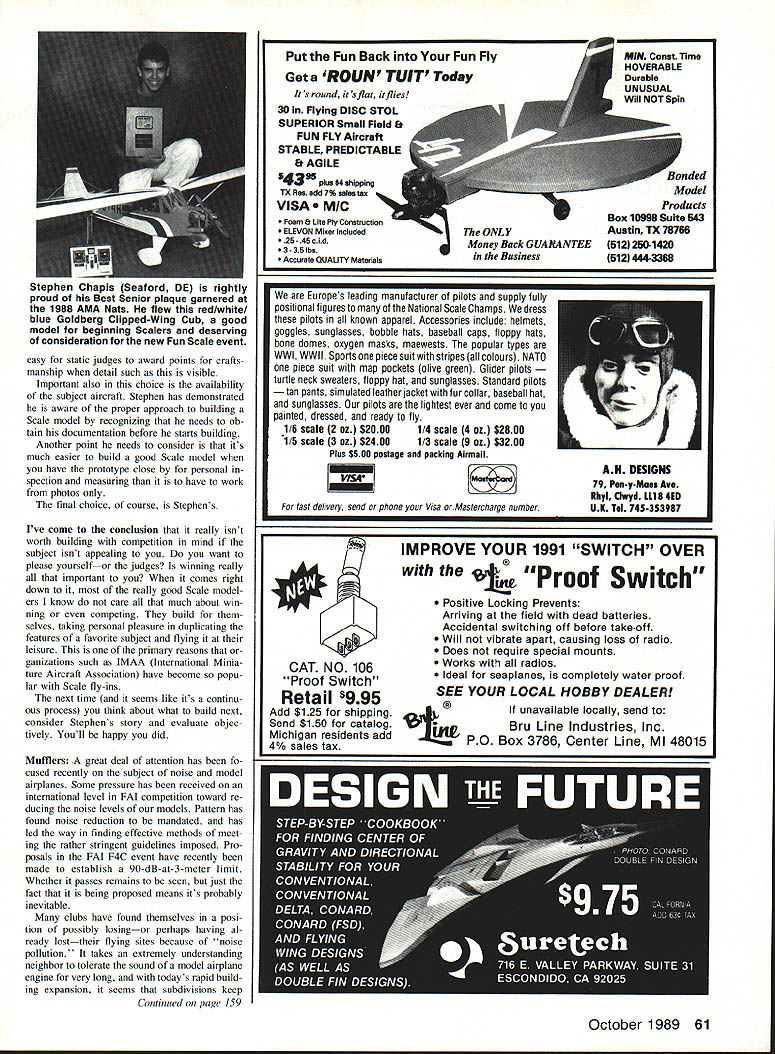
I recently received an interesting letter from a young modeler I met at the 1988 Nats in Virginia. Stephen Chapis (Seaford, DE) was flying in Sport Scale Sportsman with a fine little Goldberg clipped-wing Cub in a colorful red, white, and blue color scheme. In spite of the fact that this was his first Nats, he overcame the "first-Nats jitters" we all experience and was rewarded with the Best in Senior award for a fine performance.
Stephen went on to have a very successful 1988 on the contest trail, most of the time beating out his dad, John Chapis!
Stephen writes that he is now facing the dilemma that most of us Scale modelers have to deal with... what to build next? At the beginning of his letter, Stephen had two aircraft in mind: the Tsunami P-51 racer and a Piper Pawnee crop duster.
He writes:
"Now I'm debating on two airplanes to use... I've written a letter to famous race pilot Steve Hinton in Encino, CA to get documentation on his highly modified P-51 racer named 'Tsunami.'
"However, the Laurel Airport—about 10 miles from my house—is home to a Piper Pawnee crop duster. Since I can get to the airport in 15 minutes, I can get all the documentation pictures I want! The pilot is usually at the airport, so I can get interior shots, shots of the flaps in all positions, and it's just unlimited as to the pictures I can get of this airplane. On top of all this, that same airplane often sprays the soybean field across the road from my house, so I can get pictures of the Pawnee at work!
"Even though I like the P-51 racer, I'm leaning towards building the Pawnee."
In an extra, added-on note to his letter (obviously written several days later), Stephen goes on to say:
"After school I went to the local book-store and bought the February 1989 issue of Air Classics, this issue covering Reno '88. I love Mustangs! I saw several highly modified Mustang racers in the article. After reading this article, I think the Pawnee will take a back seat to the Mustang, 'cause there's nothing like a modified Mustang racer on the flight line at a Scale meet. Right now I'm waiting on information on three different Mustangs: Tsunami #18, Vendetta #19, and Strega #7."
There you have it. Sound familiar? Will it be the Tsunami or the Pawnee? It seems all of us have to face this decision. I have come to the conclusion that it really depends on where you're heading in your modeling, and what the reason is for your building the model.
What advice to offer?
What kind of advice would you offer this young man, if any? The objective approach would be to list the pros and cons of each subject. Consider what effect choice of subject would have on competitiveness, and exactly why you want to build a particular model.
- Do you want to build a model of an airplane that is your favorite? Something that really "turns you on"?
- Or do you want to keep in mind what others (especially judges) might think of your model and how competitive it is likely to be in the Scale arena?
- Many times the model that you like best will not be the one that will appeal most to the judges.
Flyability is another consideration. Take these two choices, for example:
Tsunami (P-51 racer)
The Tsunami is obviously an airplane Stephen likes very much. It is racy looking and sleek. Objectively, consider its flying ability:
- Because it is designed for racing, it may have very little wing area. This will require careful building to maintain the lightness necessary for a manageable flying model.
- It appears to have rather long landing gear, which can make ground handling more demanding.
- As a racing-type prototype it is a fast-flying aircraft; built as a standard-size model with these expected flight characteristics, you may have a bit of difficulty convincing the judges you're duplicating scale speed.
- From a scale standpoint, a metal-covered airplane with flush riveting—unless built very large scale—will be difficult, but not impossible, to reproduce with a large amount of discernible scale detail. This may result in a very smooth, "pattern-type" finish on the model which does not offer much in the way of static points.
On the positive side, it's an airplane Stephen likes. The construction process of a model you like is much more satisfying than building a model just to have a winner. He will most probably enjoy the spirited, fast performance once he gets used to the flying characteristics of the model.
Pawnee (Piper Pawnee crop duster)
The Pawnee is also a good subject.
- From a flyability standpoint, if you've ever watched a crop duster fly, you know that the large wing makes it a very forgiving and maneuverable aircraft. It doesn't fly fast, but has good vertical capability for maneuvers such as wing-overs and stall turns.
- The landing gear configuration is closer to the ground, resulting in predictable performance.
- With the lighter wing loading and increased inherent drag of the design, the model will fly more slowly, probably closer to a perceived scale speed.
The construction of the Pawnee lends itself well to scale detailing. The combination of sheet metal and fabric surfaces along with lots of rivets and screws results in a model that will come alive when the detail is duplicated properly. It can be made to look very convincing.
Happy "quiet power" landings to all!
Mufflers: Noise and model airplanes
A great deal of attention has been focused recently on the subject of noise and model airplanes. Some pressure has been received on the international level in FAI competition toward reducing the noise levels of our models. Pattern has been involved in finding effective methods of muffling the rather stringent proposals. Proposals in the FAI F4C event have been made to establish a 90-dB-at-3-meter limit. Whether it passes remains to be seen, but just the fact that it is being proposed makes it probably inevitable.
Many clubs have found themselves in a position of possibly losing—or perhaps having already lost—their flying sites because of "noise pollution." It takes an extremely understanding neighbor to tolerate the sound of a model-airplane engine for very long, and with today's rapid building expansion, it seems that subdivisions are crowding in on our flying sites. It's obvious that for our own good, we need to address this problem as quickly as possible.
Pattern fliers are leading the way in model-engine noise reduction. The methods they are using are varied, and many of these methods can be adapted to Scale, while some are not as practical. For instance, the Scale modeler does not always have the luxury of designing his fuselage shape around a tuned pipe, and large mufflers can be very difficult to conceal within a cowling. But some lessons can be learned from what Pattern fliers are doing.
- Lower engine rpm results in lower dB, so many fliers have chosen to go to smaller-diameter propellers with higher-pitch blades. The long-stroke and four-stroke engines have helped make this approach possible.
- Ingenuity in mounting methods has also provided gains in reducing noise levels. Rubber-based engine mounts have proven to be effective. There are many different methods of rubber mounting to be tried, but all seem to help to some degree.
- Scale modelers, like Pattern fliers, have already turned to the four-stroke engine, but for different reasons. Pattern fliers turned to it for the lower noise level and the high torque provided. Scale fliers have turned to it because the sound is more realistic on a Scale model. The perceived noise reduction is an added benefit.
- Many believe it's not unrealistic to see electric-powered models enter the competitive scene at some time in the future, based on recent performance gains.
Engine manufacturers have been relatively slow to respond to the modelers' needs in this area of noise reduction, but inevitably they will be forced to provide what we need. Some progress has become visible in just the last few months, and we can hope that product shows this year will have some examples of the new technology on display.
It's time for Scale modelers to band together and share their methods of noise reduction with each other. If you have any good ideas that have worked for you—or any news of products helpful in reducing model-airplane noise levels—please share them. I will be happy to make sure they get distributed to other modelers through the pages of Model Aviation or through the NASM (National Association of Scale Aeromodelers) newsletter, Replica. Please include good photos or good drawings when possible.
Until next time...
May your skies remain Scale!
RC Scale / Tacie
Transcribed from original scans by AI. Minor OCR errors may remain.

