

Radio Control
Soaring
Byron Blakeslee 3134 N. Winnebago Dr. Sedalia, CO 80135
Most soaring enthusiasts know the Great Race put on by Chicago's SOAR club is the granddaddy of cross-country races. It was begun in 1976 as Soaring's contribution to the National Bicentennial celebration, the course distance being (appropriately enough) 76 kilometers. The first contest director was Dan Pruss, who was the editor of this column from Model Aviation magazine's start-up in 1975 until he passed away in 1986.
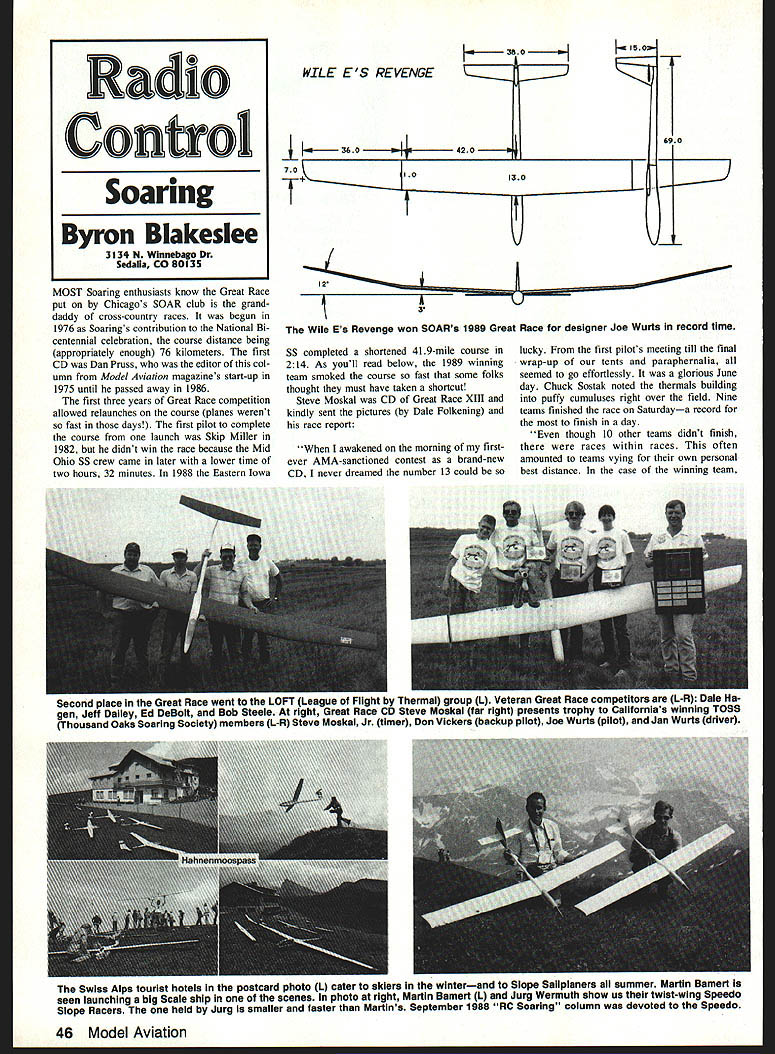
The first three years of Great Race competition allowed relaunches on the course (planes weren't so fast in those days). The first pilot to complete the course from one launch was Skip Miller in 1982, but he didn't win the race because the Mid-Ohio SS crew came in later with a lower time of two hours, 32 minutes. In 1988 the Eastern Iowa SS completed a shortened 41.9-mile course in 2:14. As you'll read below, the 1989 winning team smoked the course so fast that some folks thought they must have taken a shortcut.
Steve Moskal was CD of Great Race XIII and kindly sent the pictures (by Dale Folkening) and his race report.
When I awakened on the morning of my first-ever AMA-sanctioned contest as a brand-new CD, I never dreamed the number 13 could be so lucky. From the first pilots' meeting till the final wrap-up of our tents and paraphernalia, all seemed to go effortlessly. It was a glorious June day. Chuck Sostak noted the thermals building into puffy cumulus right over the field. Nine teams finished the race on Saturday—a record for the most to finish in a day. Even though 10 other teams didn't finish, there were races within races. This often amounted to teams vying for their own personal best distance.
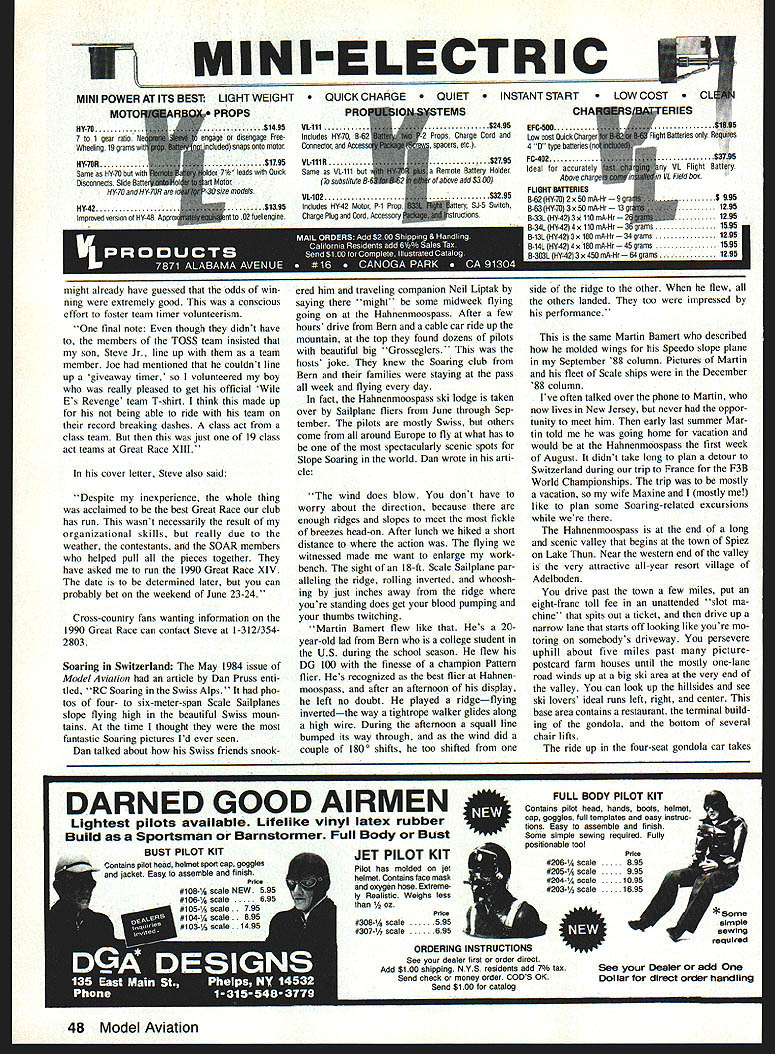
Joe Wurts and Thousand Oaks Soaring Society mates set a new course record — 1:33 — took a brief lunch break, then proceeded to break the record with a new time of 1:22. Radio Central, manned by an all-volunteer group of hams from the Argonne Lab Amateur Radio Club, confirmed the times. Knowing the presence of the best-of-the-best was the highlight. Wurts' victory celebration was memorable; Robert Smith of the Mid-Missouri Modelers remarked, "Wow — finished before we got started." Wurts did a victory roll after flying through the finish gate. The flight line was humming as teams finished. I walked out to congratulate SOAR's team finishing and heard fellow team member Rick Hixon say, "138 will be tough to beat."
Someone called a week before because he wasn't sure he was going to get the team from California. Other fliers talked to Joe about the flight, awestruck. He admitted he was worried about completing the course; he came down around 1,000 ft Sunday and we considered lengthening the course to have the first turnpoint at the St. Louis Arch. As it turned out, Sunday was a much poorer day for flying; the finishing times were slower. Yes, you're right — Joe's TOSS team did fly again, with a time of 2:26.
Lest you think Joe's performance a fluke, I'll refer to AMA RC Soaring Declared Open Distance national records set by Mr. Wurts on May 28, 1988: 140.67 miles. Joe called the week prior to the race asking advice on rental chase vehicles. Never having had the pleasure of chatting with Joe before, I hung up wondering — he seemed so relaxed. I told him the course distance was about 45 miles until I looked up the national record, the last thing prior to awarding cash prizes.
Great Race profit was given to the top three teams; trophies and the traditional raffle merchandise were donated by generous sponsors. We surprised the teams by giving the timers—those unsung heroes who timed two days—a chance to win an Airtronics Module radio. Renaud's Airtronics generously gave us two Module radios to raffle off along with major decals.
Steve included a cover letter with his report:
Despite my inexperience, the whole thing was acclaimed to be the best Great Race our club has run. This wasn't necessarily the result of my organizational skills, but really due to the weather, the contestants, and the SOAR members who helped pull all the pieces together. They have asked me to run the 1990 Great Race XIV. The date is to be determined later, but you can probably bet on the weekend of June 23–24.
Cross-country fans wanting information on the 1990 Great Race can contact Steve at 1-312/354-2803.
Radio Control: Scale
Joe Wurts and his Thousand Oaks Soaring Society mates set a new course record of 1:33, took a brief lunch break, and then proceeded to break the record with a new time of 1:22. When Radio Central (manned by an all-volunteer group of hams from the Argonne Lab Amateur Radio Club) confirmed the time, everyone knew we were in the presence of the best-of-the-best. A highlight of the Wurts victory celebration was Robert Smith of the Mid-Missouri Modelers remarking, "Wow! He finished before we even got started!" Wurts' victory roll after flying through the finish gate had the flight line humming.
One final note: even though they didn't have to, the members of the TOSS team insisted that my son, Steve Jr., line up with them as a team member. Joe had mentioned that he couldn't line up for a giveaway timer, so I volunteered my boy who was really pleased to get his official "Wile E's Revenge" team T-shirt. I think this made up for his not being able to ride with his team on their record-breaking dashes. As a class act from a class team. But then this was just one of 19 class-act teams at Great Race XIII.
Soaring in Switzerland: Hahnenmoospass
The May 1984 issue of Model Aviation had an article by Dan Pruss entitled "RC Soaring in the Swiss Alps." It had photos of four- to six-meter-span scale sailplanes slope flying high in the beautiful Swiss mountains. At the time I thought they were the most fantastic soaring pictures I'd ever seen.
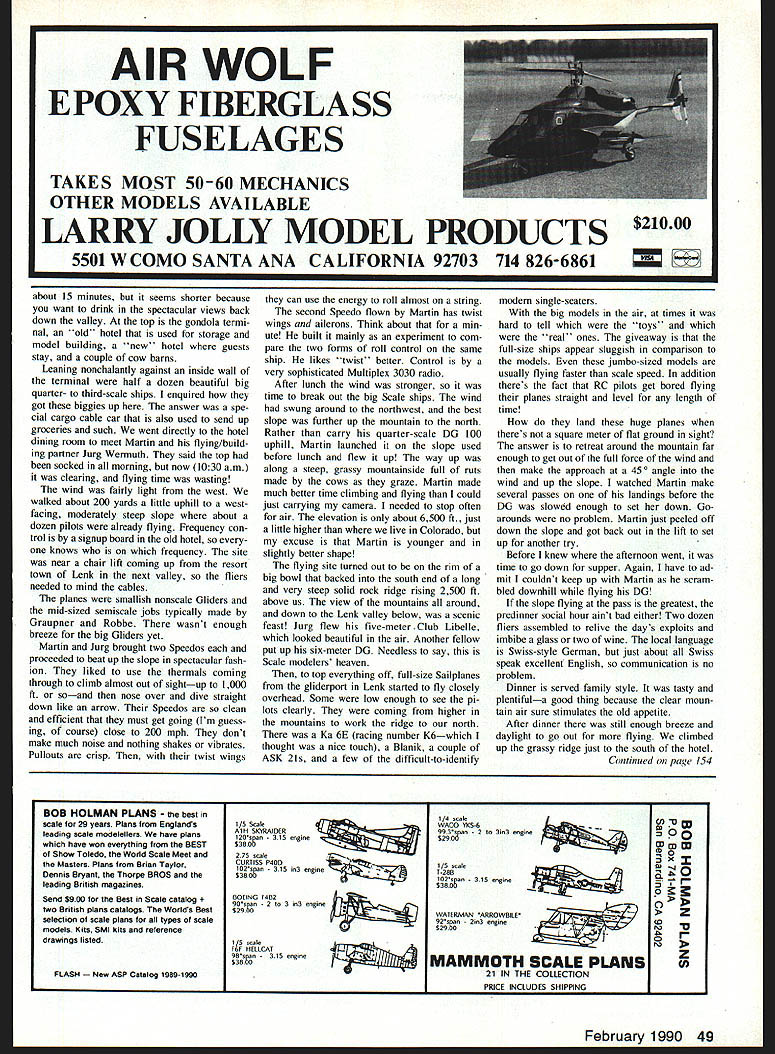
Dan talked about how his Swiss friends snookered him and traveling companion Neil Liptak by saying there "might" be some midweek flying going on at the Hahnenmoospass. After a few hours' drive from Bern and a cable car ride up the mountain, at the top they found dozens of pilots with beautiful big Grossseglers. The Hahnenmoospass ski lodge is taken over by sailplane fliers from June through September. The pilots are mostly Swiss, but others come from all around Europe to fly at what has to be one of the most spectacularly scenic spots in the world.
"The wind does blow. You don't have to worry about the direction, because there are enough ridges and slopes to meet the most fickle of breezes head-on. After lunch we hiked a short distance to where the action was. The flying we witnessed made me want to enlarge my workbench. The sight of an 18-ft. scale sailplane paralleling the ridge, rolling inverted, and whooshing by just inches away from the ridge where you're standing does get your blood pumping and your thumbs twitching."
Martin Bamert flew like that. He's a 20-year-old lad from Bern who is a college student in the U.S. during the school season. He flew his DG-100 with the finesse of a champion pattern flier and is recognized as the best thermal and ridge pilot at Hahnenmoospass. He played a ridge-flying inverted game—then, like a tightrope walker, glided along a high wire. During the afternoon, as a squall line bumped its way through and as the wind did a couple of 180° shifts, he too shifted from one side of the ridge to the other. When he flew, all the others landed. They too were impressed by his performance.
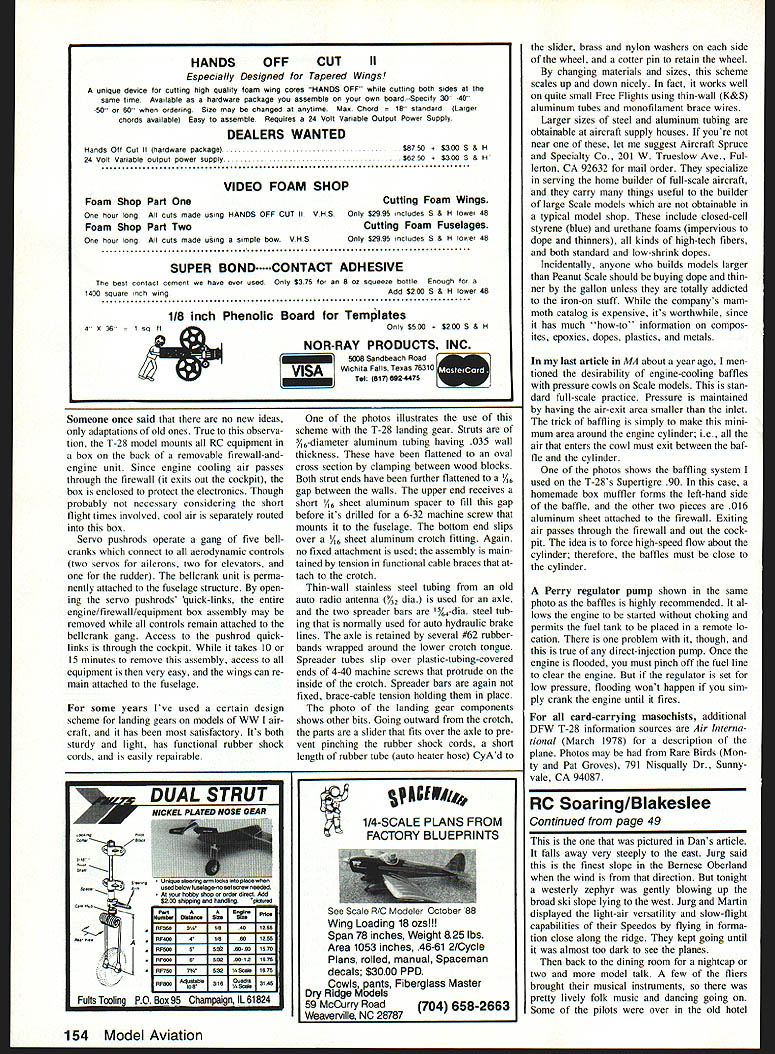
This is the same Martin Bamert who described how he molded wings for his Speedo slope plane in my September 1988 column. Pictures of Martin and his fleet of scale ships were in the December 1988 column.
I talked over the phone to Martin many times, who now lives in New Jersey, but I had never had the opportunity to meet him. Then, early last summer, Martin told me he was going home for vacation and wanted to take me to the Hahnenmoospass the first week of August. It didn't take long to plan a detour to Switzerland during our trip to France for the F3B World Championships. The trip was mostly a vacation, so my wife Maxine and I planned some soaring-related excursions while we were there.
The Hahnenmoospass is at the end of a long and scenic valley that begins at the town of Spiez on Lake Thun. Near the western end of the valley is the very attractive all-year resort village of Adelboden. You drive past the town a few miles, put an eight-franc toll fee in an unattended slot machine that spits out a ticket, and then drive up a narrow lane that starts off looking like you're motoring on somebody's driveway. You persevere uphill about five miles past many picture-postcard farm houses until the mostly one-lane road winds up at a big ski area at the very end of the valley. The base area contains a restaurant, the terminal of the gondola, and the bottom of several chairlifts.
The ride up in the four-seat gondola car takes about five minutes. When the gondola reaches the top, you step out and are at the top of the Hahnenmoospass. On a good day you will see pilots rigging models and flying along the ridges. There are slopes both large and small suitable for everything from Speed 400 slope ships to 18-foot scale sailplanes. The winds are generally strong and consistent, and you can also hike to more secluded launch points for different flying conditions.
At the top is the gondola terminal, an "old" hotel used for storage and model building, a "new" hotel where guests stay, and a couple of cow barns. Leaning nonchalantly against an inside wall of the terminal were half a dozen beautiful glider quarter- to third-scale ships. I enquired how they got these biggies up here. The answer was a special cargo cable car that is also used to send up groceries and such.
We went directly to the hotel dining room to meet Martin and his flying/building partner Jurg Wermuth. They said the top had been socked in all morning, but now (10:30 a.m.) it was clearing and flying time was wasting. The wind was fairly light from the west. We walked about 200 yards a little uphill to a west-facing, moderately steep slope where about a dozen pilots were already flying. Frequency control is by a signup board in the old hotel, so everyone knows who is on which frequency. The site was near a chair lift coming up from the resort town of Lenk in the next valley, so the fliers needed to mind the cables.
The planes were smallish nonscale gliders and the mid-sized semiscale jobs typically made by Graupner and Robbe. There wasn't enough breeze for the big gliders yet. Martin and Jurg brought two Speedos each and proceeded to leap up the slope in spectacular fashion. They liked to use the thermals coming through to climb almost out of sight—up to 1,000 ft. or so—and then nose over and dive straight down like an arrow. Their Speedos are so clean and efficient that they must get going close to 200 mph. They don't make much noise and nothing shakes or vibrates. Pullouts are crisp. Then, with their twist wings they can use the energy to roll almost on a string.
The second Speedo flown by Martin has twist wings and ailerons. He built it mainly as an experiment to compare the two forms of roll control on the same ship. He prefers twist. Control is by a very sophisticated Multiplex 3030 radio.
After lunch the wind was stronger, so it was time to break out the big scale ships. The wind had swung around to the northwest, and the best slope was further up the mountain to the north. Rather than carry his quarter-scale DG 100 uphill, Martin launched it on the slope used before lunch and flew it up. The way up was along a steep, grassy mountainside full of ruts made by the cows as they graze. Martin made much better time climbing and flying than I could just carrying my camera. I needed to stop often for air. The elevation is only about 6,500 ft., just a little higher than where we live in Colorado, but Martin is younger and in slightly better shape.
The flying site turned out to be on the rim of a big bowl that backed into the south end of the long and very steep solid rock ridge rising 2,500 ft. above us. The view of the mountains all around, and down to the Lenk valley below, was a scenic feast. Jurg flew his five-meter Club Libelle, which looked beautiful in the air. Another fellow put up his six-meter DG. Needless to say, this is scale modelers' heaven.
Then, to top everything off, full-size sailplanes from the gliderport in Lenk started to fly closely overhead. Some were low enough to see the pilots clearly. They were coming from higher in the mountains to work the ridge or to our north. There were:
- a Ka 6E (racing number K6),
- a Blanik,
- a couple of ASK 21s,
- and a few of the difficult-to-identify modern single-seaters.
With the big models in the air, at times it was hard to tell which were the "toys" and which were the real ones. The giveaway is that the full-size ships appear sluggish in comparison to the models. Even these jumbo-sized models are usually flying faster than scale speed. In addition there's the fact that RC pilots get bored flying their planes straight and level for any length of time.
How do they land these huge planes when there's not a square meter of flat ground in sight? The answer is to retreat around the mountain far enough to get out of the full force of the wind and then make the approach at a 45° angle into the wind and up the slope. I watched Martin make several passes on one of his landings before the DG was slowed enough to set down. Go-arounds were no problem. Martin just peeled off down the slope and got back out on the lift to set up for another try.
Before I knew where the afternoon went, it was time to go down for supper. Again, I have to admit I couldn't keep up with Martin as he scrambled downhill while flying his DG. At the slope the pre-dinner social hour ain't bad either. Two dozen fliers assembled to relive the day's exploits and imbibe a glass or two of wine. The local language is Swiss-style German, but just about all Swiss speak excellent English, so communication is no problem.
Dinner is served family style. It was tasty and plentiful—a good thing because the clear mountain air sure stimulates the appetite. After dinner there was still enough breeze and daylight to go out for more flying. We climbed up the grassy ridge just to the south of the hotel.
T-28 model and Scale construction notes
Someone once said that there are no new ideas, only adaptations of old ones. True to this observation, the T-28 model mounts all RC equipment in a box on the back of a removable firewall-and-engine unit. Since engine cooling air passes through the firewall (it exits out the cockpit), the box is enclosed to protect the electronics. Though probably not necessary considering the short flight times involved, cool air is separately routed into this box.
Servo pushrods operate a gang of five bellcranks which connect to all aerodynamic controls (two servos for ailerons, two for elevators, and one for the rudder). The bellcrank is permanently attached to the fuselage structure. By opening the servo pushrods' quick-links, the entire engine/firewall/equipment box assembly may be removed while all controls remain attached to the bellcrank gang. Access to the pushrod quick-links is through the cockpit. While it takes 10 or 15 minutes to remove this assembly, access to all equipment is then very easy, and the wings can remain attached to the fuselage.
For some years I've used a certain design scheme for landing gears on models of WW I aircraft, and it has been most satisfactory. It's both sturdy and light, has functional rubber shock cords, and is easily repairable.
One photo illustrates the use of this scheme with the T-28 landing gear. Struts are of 1/16" diameter aluminum tubing having .035" wall thickness. These have been flattened to an oval cross section by clamping between wooden blocks. Both strut ends have been further flattened to a gap between the walls. The upper end receives a short 5/32" aluminum spacer to fill this gap before it's drilled for a 6-32 machine screw that mounts it to the fuselage. The bottom end slips over a 1/8" sheet aluminum crotch fitting. No fixed attachment is used; the assembly is maintained by tension in functional cable braces that attach to the crotch.
Thin-wall stainless steel tubing from the auto radio antenna (3/32" dia.) is used for an axle, and the two spreader bars are 1/8" dia. steel tubing that is normally used for auto hydraulic brake lines. The axle is retained by several #62 rubber bands wrapped around the lower crotch tongue. Spreader tubes slip over plastic-tubing-covered ends of 4-40 machine screws that protrude on the inside of the crotch. Spreader bars are again not fixed; brace-cable tension holds them in place. The landing gear components outward from the crotch are:
- a slider that fits over the axle to prevent pinching the rubber shock cords,
- a short length of rubber tube (auto heater hose) CyA'd to the slider,
- brass and nylon washers on each side of the wheel,
- and a cotter pin to retain the wheel.
By changing materials and sizes, this scheme scales up and down nicely. In fact, it works well on quite small free-flight ships using thin-wall (R&S) aluminum tubes and monofilament brace wires.
Larger sizes of steel and aluminum tubing are obtainable at aircraft supply houses. If you're not near one of these, let me suggest Aircraft Spruce and Specialty Co., 201 W. Truesdell Ave., Fullerton, CA 92632 for mail order. They specialize in serving the home builder of full-scale aircraft, and they carry many things useful to the builder of large scale models which are not obtainable in a typical model shop. These include closed-cell urethane (blue) and urethane foams (impervious to dope and thinners), high-tech fibers, and both standard and low-shrink dopes.
Incidentally, anyone who builds models larger than Peanut Scale should be buying dope and thinner by the gallon unless they are totally addicted to the iron-on stuff. While the company's mail-order catalog is expensive, it is worthwhile, since it has much how-to information on composites, epoxies, dopes, plastics, and metals.
Engine cooling and fuel system
In my last article in Model Aviation about a year ago, I mentioned the desirability of engine-cooling baffles with a pressure cowl on scale models. This is standard full-scale practice. Pressure is maintained by having the air-exit area smaller than the inlet. The trick of baffles is simply to make this minimum area around the engine cylinder; i.e., all the air that enters the cowl must exit between the baffle and the cylinder.
One photo shows the baffle system I use on the T-28's Super Tigre .90. In this case, a homemade box muffler forms the left-hand side of the baffle, and the other two pieces are .016" aluminum sheet attached to the firewall. Exiting air passes through the firewall and out the cockpit. The idea is to force high-speed flow about the cylinder; therefore, the baffles must be close to the cylinder.
A Perry regulator pump shown in the same photo as the baffles is highly recommended. It allows the engine to be started without choking and permits the fuel tank to be placed in a remote location. There is one problem with it, though, and this is true of any direct-injection pump: once the engine is flooded, you must pinch off the fuel line to clear the engine. But if the regulator is set for low pressure, flooding won't happen if you simply crank the engine until it fires.
Sources and references
For additional T-28 information:
- Air International (March 1978) for a description of the plane.
- Photos may be had from Rare Birds (Monty and Pat Groves), 791 Nisqually Dr., Sunnyvale, CA 94087.
Transcribed from original scans by AI. Minor OCR errors may remain.

