
Radio Control: Scale
John Guenther 21609 Borden-Greenville Rd. Borden, IN 47106
Unbelievable is the only word to describe the amount of correspondence my article in the September issue of Model Aviation has generated. It appears I have hit upon a topic in which a lot of people have a shared interest, and one that continues to be an ongoing problem of research for most scale modelers: cockpit colors.
Before I get into my new topic this month, I want to pass on some important information related to the September column.
Contact and publication updates
- Monogram Aviation Publications — new address: P.O. Box 223, Sturbridge, MA 01566 (tel. 1-508/347-5574).
- The Official Monogram Painting Guide to German Aircraft 1935–1945 is scheduled for reprint in early 1990 (limited number of copies). Contact C. Flashman (publisher) to reserve a prepublication copy with prepayment at a substantial savings over retail.
- Federal Standard 595a color charts: write to General Services Administration, Standards and Specifications Service, Federal Supply Service, Specification Section, Room 6654, 7th & "D" St. S.W., Washington, DC 20407 (tel. 1-202/472-2140). The Federal Standard 595a colors cost $5.50; the GSA will accept a check. You can also order the same chart from the USAF Museum, Wright-Patterson AFB, Dayton, OH 45433 for $8.95.
Books and charts to check out
- German Aircraft of World War 2 in Color by Kenneth Munson — purchased at the Air Force Museum (approx. $14.95).
- Armee De L'Air by Paul Camelio and Christopher Shores (Squadron/Signal) — pictorial history of the French Air Force 1937–1945 (approx. $4.95).
- VitoCharts paint chip charts — real paint chips (brush marks included on some). The chart is a three-page format with 3/4 x 2-in. paint chips; 30 charts available. Write Albion Scott Ltd., 51 York Road, Brentford, Middx., England for details.
- Perfect Camouflage Paint from Chevron Hobbs Products, P.O. Box 2480, Sandusky, OH 44870 — colors for USAF, USN, RAF, RCAF, German, Japanese, Israeli, and Egyptian camouflage. Suitable for dopes, epoxies, metals, fiberglass, MonoKote, Styrofoam (will not attack), and most hard plastics. Contact them for a color paint chart and information.
Cockpit detailing and technique
I have a hard time justifying the "finishing" of a scale model if I don't at least take the time to do something to the cockpit area. Getting down on my hands and knees and peering into a fully detailed interior/cockpit at eye level is a real turn-on.
Examples of good cockpit attention:
- Ramon Torres' newly redone Beechcraft T-34A is a prime example of attention to miniature detail.
- Stephen Sauger's Aeronca Sedan 15 AC features a beautiful cockpit with stitched seats and a padded interior door with a scale handle.
Humbrol makes some very accurate paints for cockpit interiors, so get some and start doing it right. Whenever I have used these colors I have sprayed them for best effect.
Cockpit interior colors (WWII and pre-war)
Save this information — you may need it when you install a full cockpit with a sliding canopy on your next WWII bird:
- USAF, USN, USMC: Interior Green ANA 611, H.D.5 — cockpit and crew compartments 1941 onward; used on most American aircraft, replacing H.D.4 on operational aircraft from 1941 onward.
- USAAF, USAF, USN, USMC: Zinc Chromate Primer H.D.4 — used pre-1941 (late) for interiors of cockpits, wheel wells, and inside removable panels. From 1941 it was sometimes mixed with Olive Drab to reduce glare, producing a medium green used on cockpit and crew compartment interiors. H.D.4 remained in use for general interior finish on many American-produced aircraft.
- Luftwaffe: RLM Grau 02 (and RLM 66 on some types) — used for interiors of cockpits and crew compartments and also interiors of bomb bays and wheel wells. Also commonly used on undercarriage legs and inside undercarriage doors.
- RAF, FAA: Grey-Green H.D.1 — interior of cockpits and crew compartments pre-war and on many types up to approximately 1942. After this date, heavy bombers often used "Night" (black) interiors. Also used for wheel wells and insides of servicing panels.
- Italian Air Force: Bright Green H.D.2 — interior of cockpits and crew compartments, wheel wells, bomb bays, and insides of undercarriage door covers.
- French Air Force: Night Blue H.D.3 — interior of cockpits and crew compartments, basically from 1939–1947.
- Japanese Naval Air Force: Light Grey Green N.4 and Light Olive Green N.5 (bamboo) — cockpit interiors and crew compartments on early production aircraft. Later production often left interiors with Translucent Blue No.16 or Translucent Green No.17.
If you know I have made a mistake somewhere, please call or write so I can pass the correct information on to everyone.
Pilot figures and interior accessories
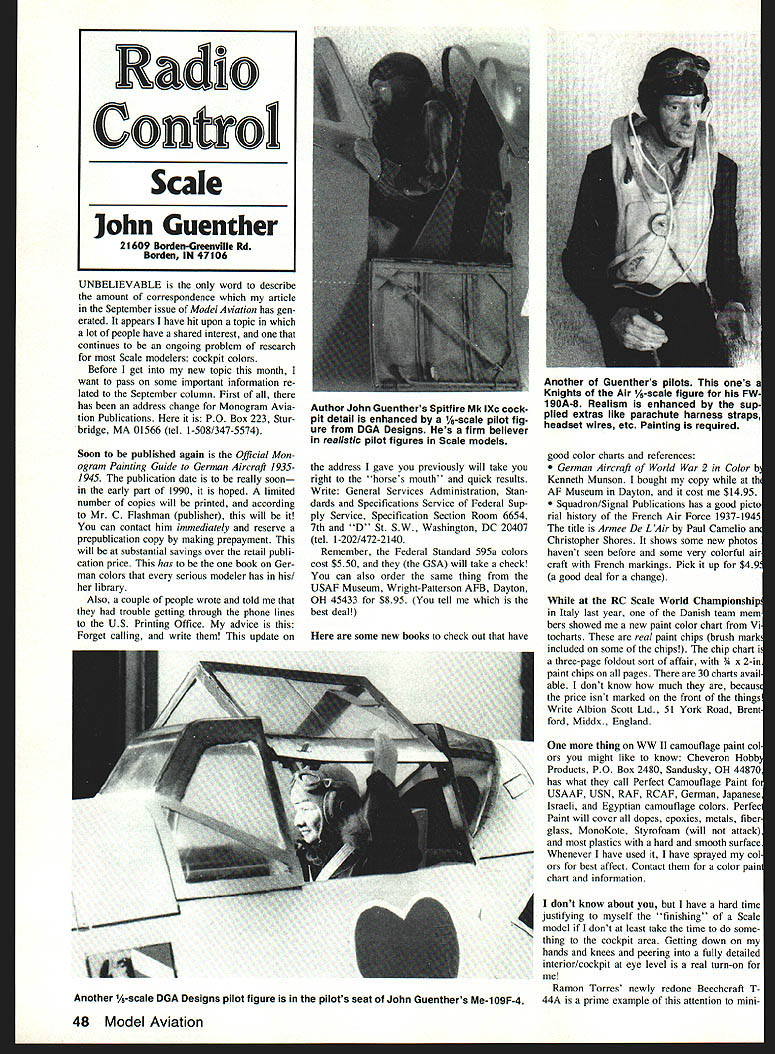
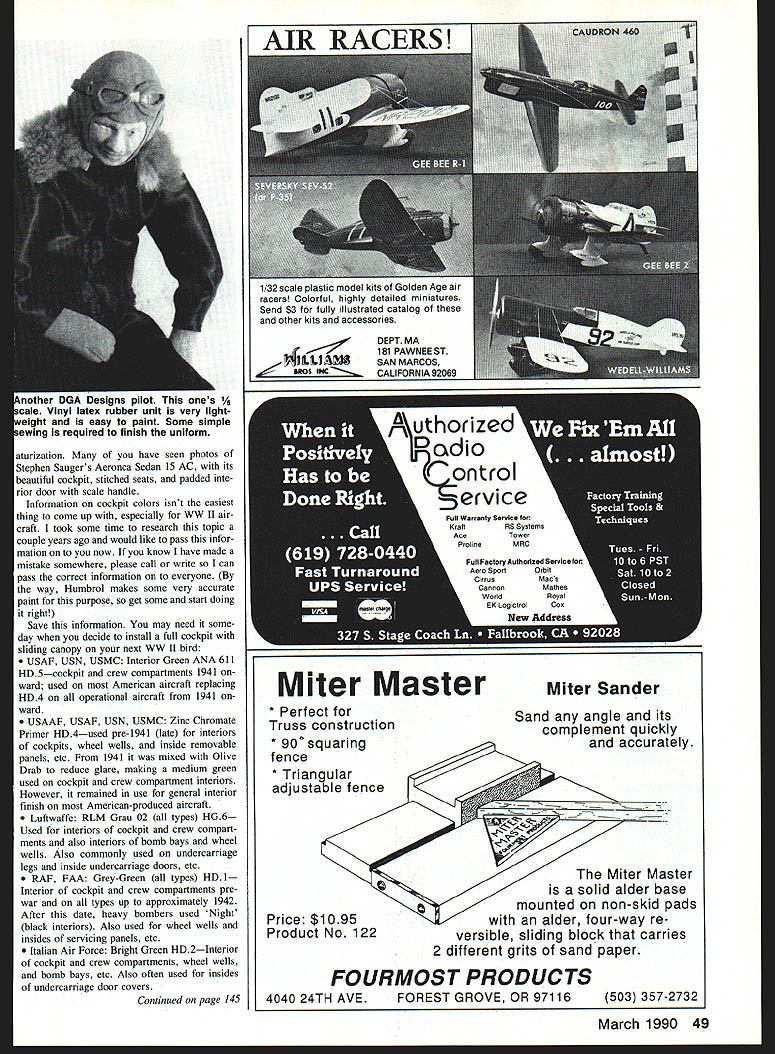
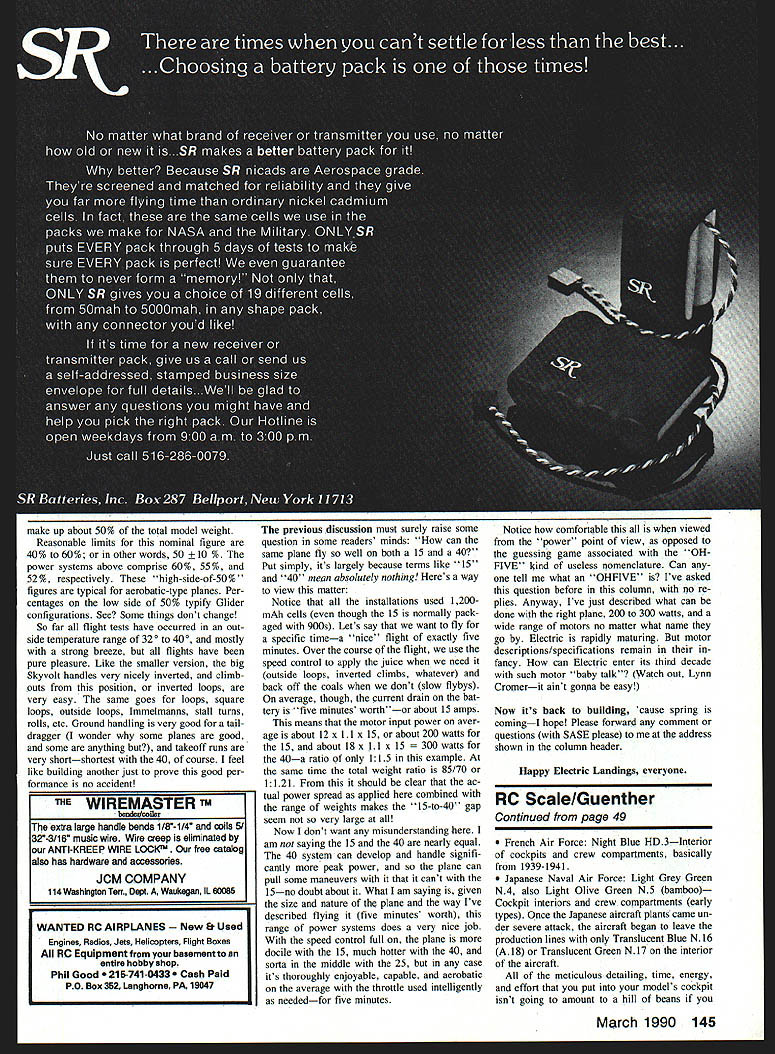
John Guenther's Spitfire Mk IXc cockpit detail is enhanced by a scale pilot figure from DGA Designs. I'm a firm believer in realistic pilot figures on scale models. Examples:
- A Knight's Air 1/4-scale figure used in an Fw 190A-8 — realism enhanced by extras such as parachute harness straps and headset wires. Some painting and finishing are required.
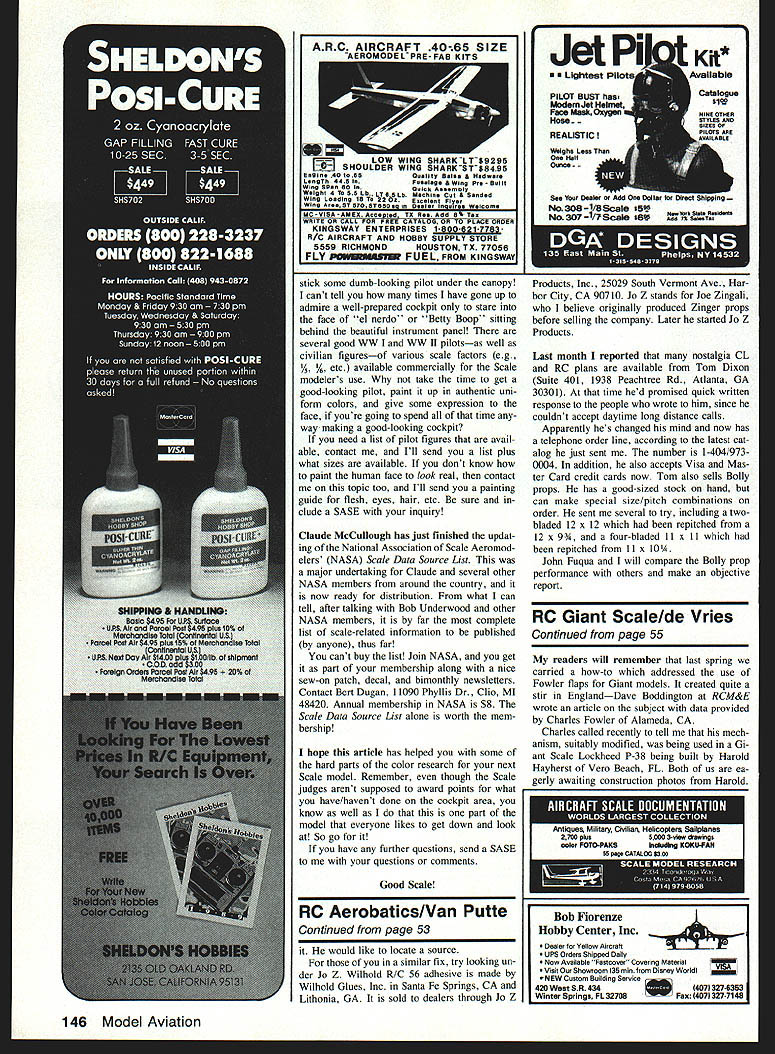
- DGA Designs' pilot figures are 1/5 vinyl-latex rubber units — very light and easy to paint. Simple finishing is required to achieve a realistic uniform.
NASA Scale Data Source List
Claude McCullough has finished updating the National Association of Scale Aeromodelers (NASA) Scale Data Source List. This major undertaking produced what appears to be the most complete list of scale-related information published so far.
You can't buy the list separately. Join NASA and you receive it as part of your membership, along with a 16-page half-tone decal and bi-monthly newsletters. Contact:
- Bert Dugan, 11090 Phyllis Dr., Clio, MI 48420.
- Annual membership in NASA is $8. The Scale Data Source List alone is worth the membership.
Closing
I hope this article has helped with some of the hard parts of color research for your next scale model. Remember, even though scale judges aren't supposed to award points for how much you've done in the cockpit area, this is one part of the model that everyone likes to look at — so go for it!
If you have any further questions, send a SASE to me with your questions or comments.
Good scale!
Transcribed from original scans by AI. Minor OCR errors may remain.

