
Radio Control: Scale
Author
Dennis Crooks P.O. Box 98, Big Rock, IL 60511
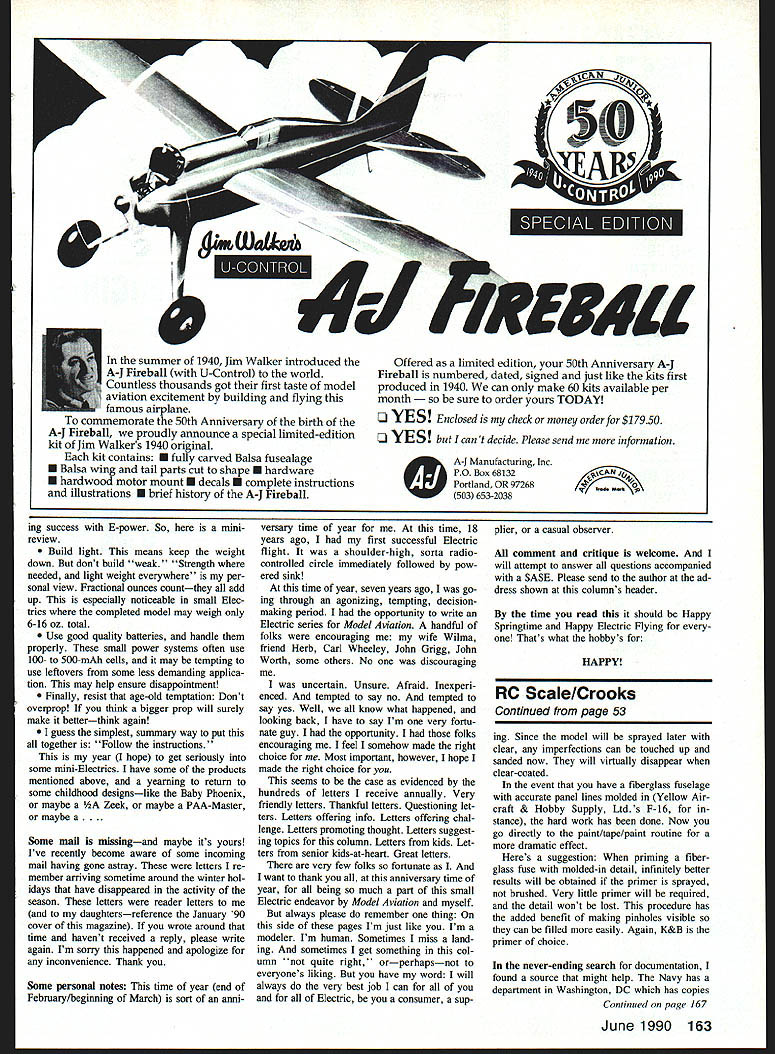
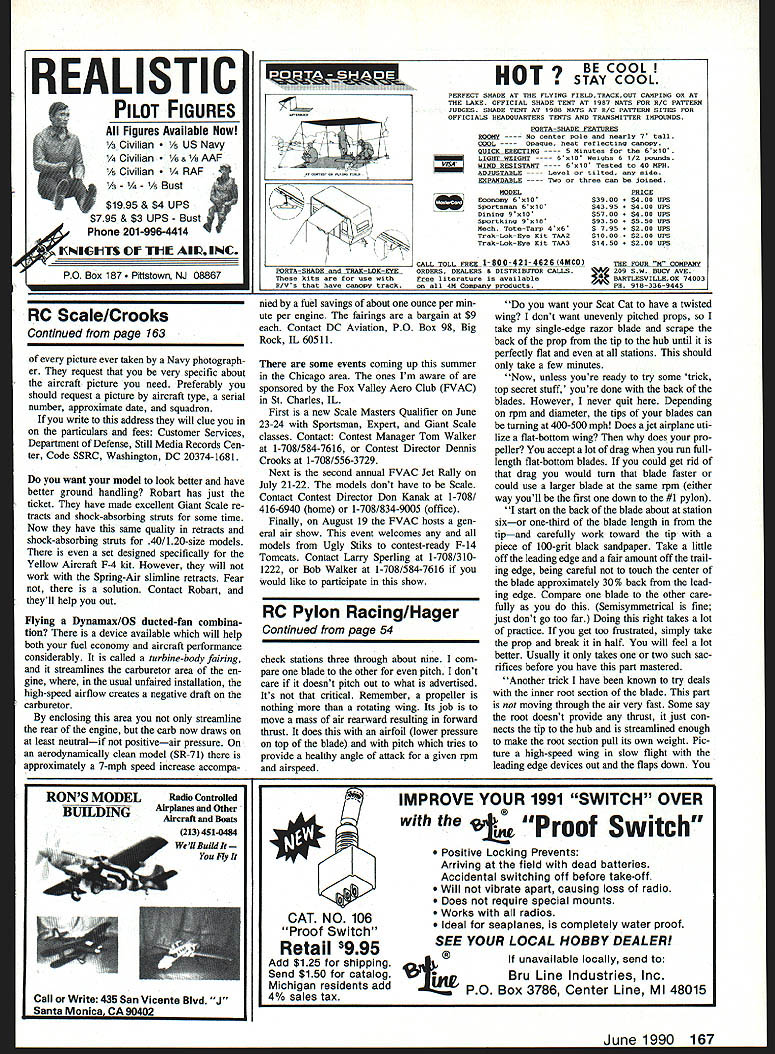
Surface detailing a scale model
Three-views and measuring accuracy
The first and most important requirement is an accurate set of three-views. To check their accuracy:
- Divide a known dimension on the three-view (wingspan) by the wingspan of your model to get a conversion factor.
- Use that factor to scale other dimensions from the three-view (aileron length, canopy length, elevator span, etc.) and compare them to the model.
Keep in mind the accuracy of your measurements depends on your measuring tool. I highly recommend a good dial caliper — the length of your index finger to the second knuckle won’t do.
If the three-views prove inaccurate, try to find a better set. Be aware that if your model itself is not accurate this search may be futile. Even good models and good drawings will rarely match perfectly in every dimension.
Preparing the model for transfer
- Place the model on a level surface (a pool table works well) and block it so it is perfectly level in all directions.
- Gather tools: accurate three-views, calculator, dial calipers, soft pencil, flexible straightedge, 400- and 600-grit sandpaper.
- Divide the length of the model into quarters and concentrate on locating panel lines within those boundaries to allow correction of inconsistencies.
- Don’t start at the nose and work to the tail — errors can accumulate and you may run out of model.
Transferring panel lines
- Draw all panel lines on the model with a soft pencil. If you make a mistake, 400-grit sandpaper works well as an eraser.
- Use a flexible straightedge when you encounter compound curves; progress in small areas.
- Once all panel lines are transferred, gather all markings to be used on the finished product and check how panels and markings coordinate. Make any necessary fudging before taping.
Methods for simulating panel lines
Simulating lap joints (overlapping panels)
- Use Scotch fine-line masking tape to mask the edge where you want the lap joint.
- Brush K&B primer over the tape edge. One application won’t be enough — wait about an hour and brush on another coat.
- After the primer has dried at least 24 hours, carefully sand the primer down to the tape and feather the other edge into the surrounding surface.
- Remove the tape. The result will appear as one piece of sheet metal overlapping another.
Simulating butt joints or stand-off replicas
There are two approaches:
- Simple, low-effort method:
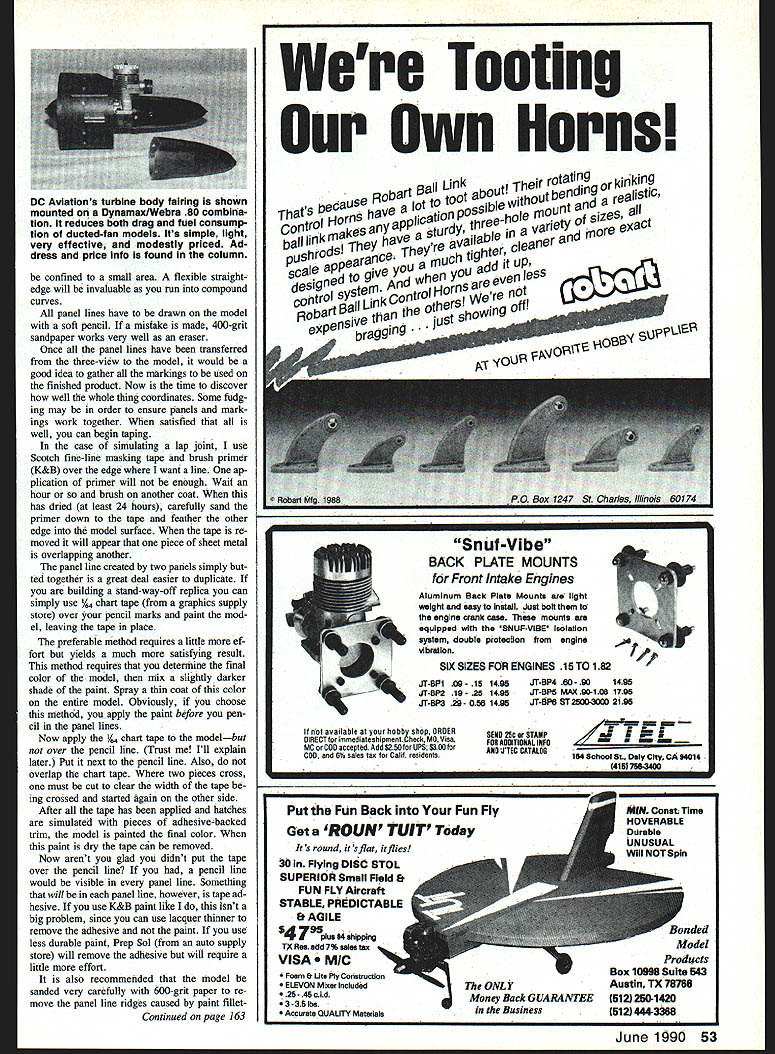
- Use 1/4" chart tape (from a graphics supply store) and apply it over your pencil marks.
- Paint the model leaving the chart tape in place. This creates a stand-off appearance.
- Preferred (more effort, more satisfying) method:
- Decide the final color and mix a slightly darker shade for a base.
- Spray a thin coat of the slightly darker color over the entire model.
- Pencil in panel lines (or plan their positions).
- Apply 1/4" chart tape next to — not over — the pencil line. (Do not put tape directly on the pencil line; otherwise the pencil mark will show in every panel.)
- Where pieces cross, overlap the chart tape but cut the clear width where they cross and restart on the other side.
- Add hatches and simulated pieces with adhesive-backed trim.
- Spray the final color and let it dry.
- Remove the tape.
Be prepared to remove tape adhesive:
- If you use K&B paint, lacquer thinner will remove adhesive residue.
- Paints with less durable binders (for example, Prep Sol from the auto supply store) will allow adhesive removal with less effort.
Sanding and finishing
- Sand carefully with 600-grit paper to remove panel-line ridges caused by paint fillets.
- Since the model will be sprayed later with clear, any remaining imperfections can be touched up and sanded now; they will virtually disappear when clear-coated.
Fiberglass fuselages with molded detail
If you have a fiberglass fuselage with accurate, molded-in panel lines (for example, Yellow Aircraft & Hobby Supply, Ltd.'s F-16), the hard work is already done. Go directly to the paint/tape/paint routine for a more dramatic effect.
Suggestion: when priming fiberglass with molded-in detail, spray the primer rather than brushing it. Very little primer is required and the detail won’t be lost. Spraying also makes pinholes visible for easier filling. K&B is the primer of choice.
Documentation
The Navy (Department of Defense Still Media Records Center) in Washington, DC, maintains copies of many Navy photographs. Be specific when requesting pictures: give aircraft type, serial number, approximate date, and squadron if possible. For particulars and fees, write:
Customer Services Department of Defense, Still Media Records Center, Code SSRC Washington, DC 20374-1681
Products and accessories
Robart retracts and struts
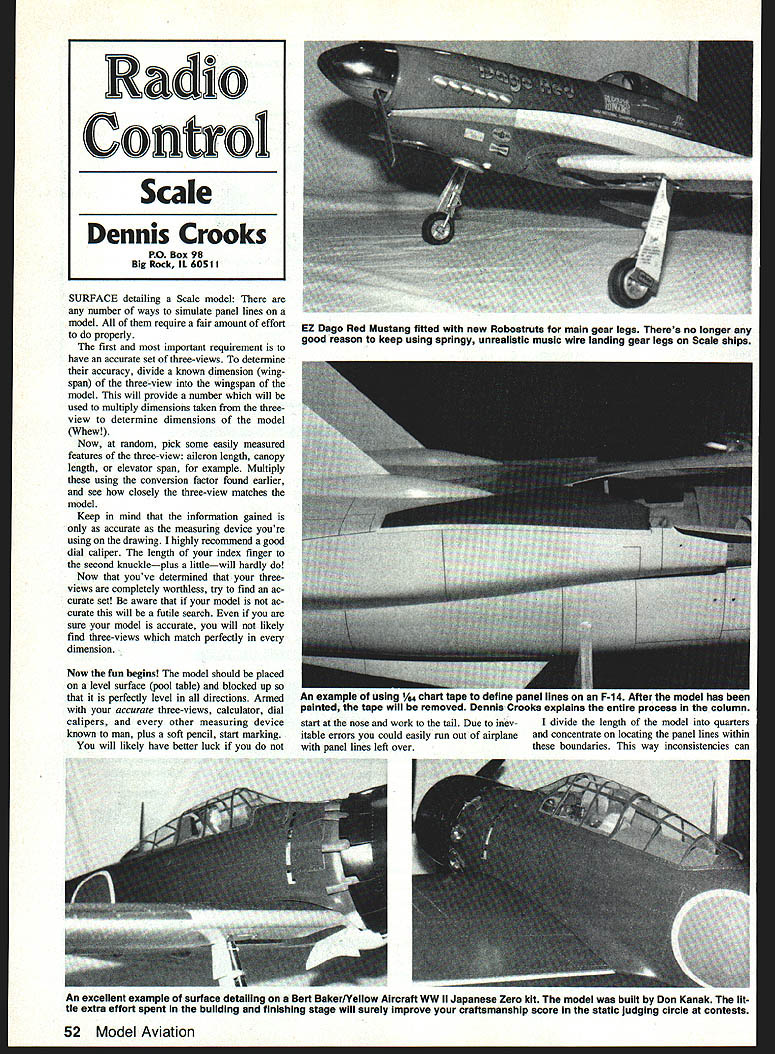
Robart makes Giant Scale retracts and shock-absorbing struts and now offers the same quality for 3/4, 1/2, and 1/20-size models. There is even a set designed specifically for the Yellow Aircraft F-4 kit. Note: these will not work with Spring-air slimline retracts. Contact Robart for assistance.
Turbine-body fairing for Dynamax/OS ducted-fan installations
A turbine-body fairing streamlines the carburetor area so the carburetor draws neutral or positive pressure rather than a negative draft. On an aerodynamically clean model (example: SR-71), expect roughly a 7-mph speed increase and a fuel savings of about one ounce per minute per engine. The fairings are $9 each. Contact:
DC Aviation P.O. Box 98, Big Rock, IL 60511
Upcoming events (Chicago area)
These events are sponsored by the Fox Valley Aero Club (FVAC) in St. Charles, IL:
- Scale Masters Qualifier — June 23–24
Classes: Sportsman, Expert, Giant Scale Contact: Contest Manager Tom Walker, 1-708-584-7616 or Contest Director Dennis Crooks, 1-708-556-3729
- FVAC Jet Rally (second annual) — July 21–22
Models don’t have to be scale. Contact: Contest Director Don Karnak, 1-708-416-6940 (home) or 1-708-834-9005 (office)
- General air show — August 19
Open to all models from Ugly Stiks to contest-ready F-14 Tomcats. Contact: Larry Sperling, 1-708-310-1222, or Bob Walker, 1-708-584-7616
Transcribed from original scans by AI. Minor OCR errors may remain.

