

Radio Control: Scale
By Dan Parsons
11809 Fulmer Dr. Albuquerque, NM 87111
SEVERAL times within the last year I have been a guest columnist for this column and have primarily covered how-to subjects. This time I'm going to concentrate on the heart and soul of RC Scale modeling—flying. I'll cover several interesting scale models I enjoyed seeing fly at various locations around the country last year.
Nosen P-51 and proper power
The big Nosen P-51 has been around since the early days of the big-plane movement, and the popularity of the 105-in. kit appears to be steadily increasing. My observation over the years is that these very large models are often underpowered—sometimes grossly so—which produces mediocre performance in rolling and vertical maneuvers and does the real warbird no justice.
Joe Pasztor of Lake Jackson, TX, demonstrated at the IMAA Festival '89 in Odessa what a properly powered Nosen P-51 can do. He had flown his beautiful 33-lb P-51 for two years with a Sachs‑Dolmar 3.7; it flew well but lacked vertical performance. He replaced the 3.7 with a Sachs‑Dolmar 5.8 from A&M Aircraft, and the problem was solved. The 5.8 drove Joe's P-51 through slow rolls, four- and eight-point rolls, big loops, Cuban eights, and other maneuvers in a way that emulates the full-scale fighter.
Observing full-scale performers such as Lefty Gardner and Gerald Martin—who fly full-scale fighters at private "Big Iron" fun-flys—has informed my sense of how WWII fighters should perform when flown aerobatically. Their routines represent the ultimate in WWII fighter aerobatics and helped shape my view of what scale RC models should attempt to emulate.
IMAA Festival '89 highlights
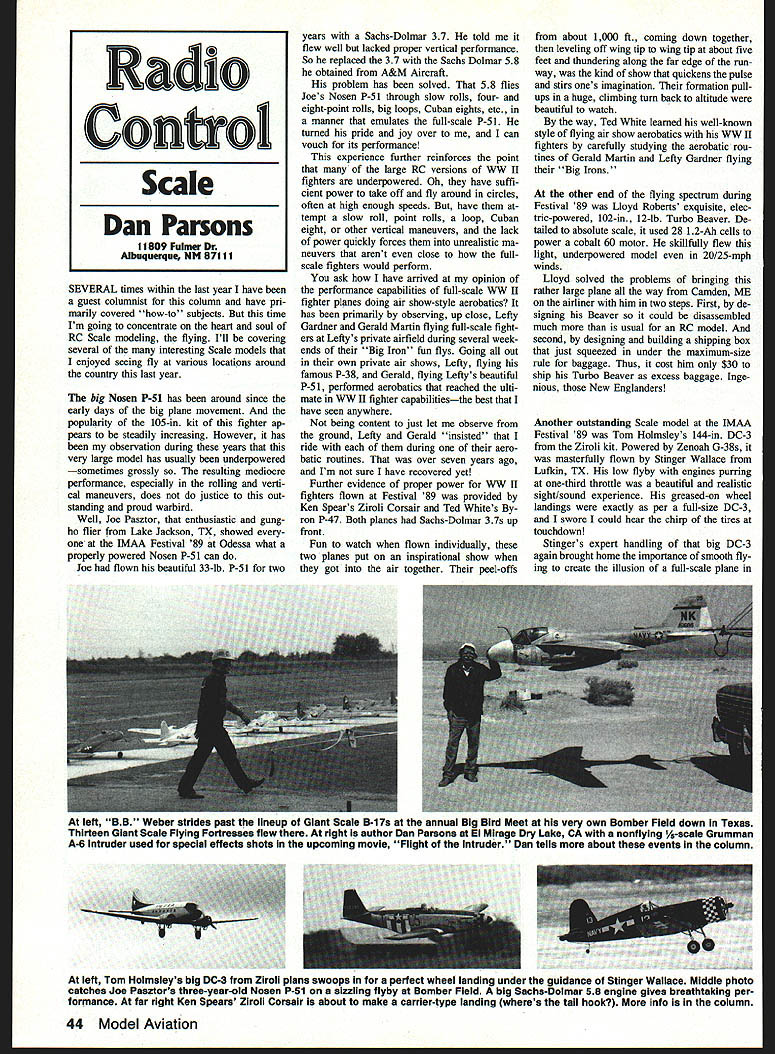
- Ken Spears' Ziroli Corsair (Sachs‑Dolmar 3.7) and Ted White's Byron P-47 (Sachs‑Dolmar 3.7) provided excellent examples of proper power on WWII fighters. Individually impressive, together they staged peel-offs from about 1,000 ft., descending and leveling off wingtip to wingtip within about five feet and roaring along the runway edge—very inspirational. Their formation pullups and large climbing turns were beautiful.
- Ted White learned his air-show style largely by studying Gerald Martin and Lefty Gardner.
- Lloyd Roberts flew an exquisite electric-powered 102-in., 12-lb Turbo Beaver. Detailed to scale, it used 28 1/2-Ah cells and a Cobalt 60 motor. Despite being relatively light and underpowered, Lloyd skillfully flew it even in 20–25 mph winds. To transport the large model from Camden, ME, Lloyd designed it for extensive disassembly and built a shipping box that just fit under the maximum baggage-size rule, allowing him to ship it as excess baggage for about $30.
- Tom Holmsley's 144-in. DC-3 (a Ziroli kit), powered by Zenoah G-38s and expertly flown by Stinger Wallace (Kiln, TX), delivered low flybys at one-third throttle with greased-on wheel landings that perfectly evoked the full-size DC-3.
Houston Big Bird fly-ins
The last two weekends of October '89 featured back-to-back Big Bird fly-ins in the Houston area. The HARKS field west of Houston hosted many giant-scale planes from its 700-ft. grass runway.
- Tom Street's 120-in. B-17 (Westcraft kit), painted after the Confederate Air Force's "Texas Raiders," was powered by four O.S. .61 four-stroke engines (mounted inverted). Tom has logged over 330 missions on his five-year-old model.
- During a formation escort for Tom's B-17, I lost an engine on my UH Hornet twin and then discovered the landing gear wouldn't come down. We landed on the undersides of the nacelles and slid straight for at least 400 ft. down the grass runway—no damage, not even broken props.
- Tom Street later landed his B-17 with one wheel stuck up and one stuck down; he held it level as long as possible, then the wingtip gently touched the runway and the plane turned 180° before stopping—again with no damage. Grass runways are forgiving.
- I had been looking forward to an aerial ballet by Tommy Jacobsmann and Harold Roberts in 1/5-scale Lasers (Ulney plans, Sachs‑Dolmar 3.7s, smoke generators), but an earlier head-on collision between their Lasers ripped off the right wing of one plane, and they were unable to continue their aerial ballet.
Water fliers in British Columbia
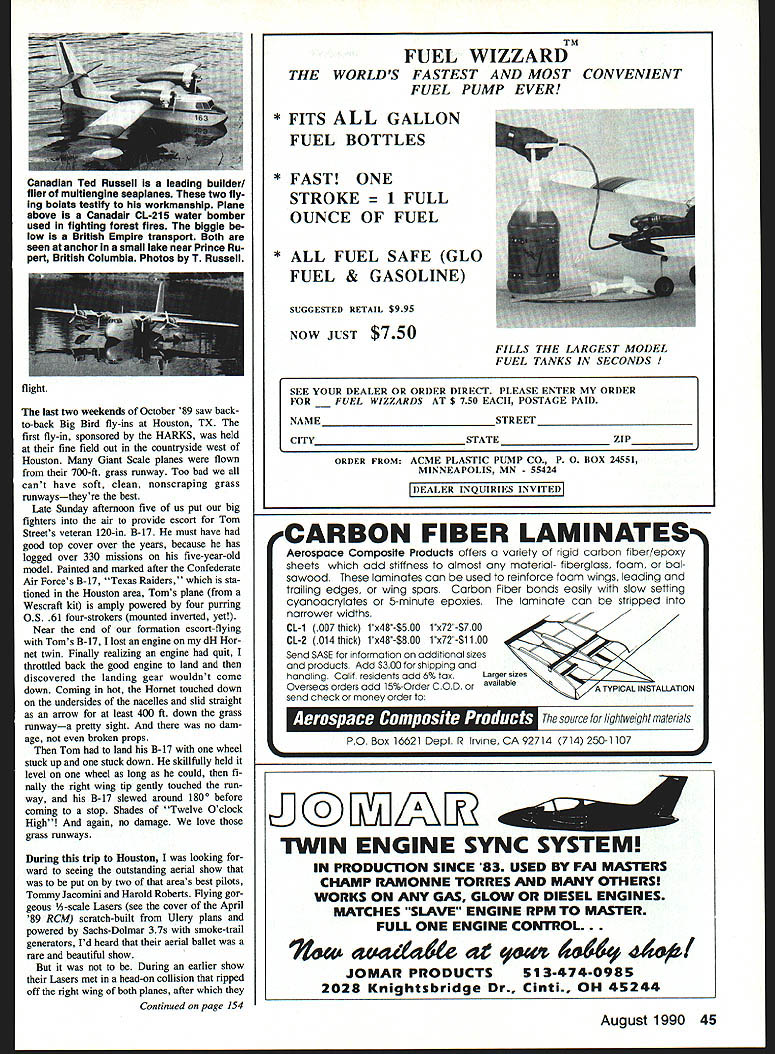
Starting with Labor Day weekend each year, western Canada's water fliers hold three big water-flys over two consecutive weekends. Ted Russell of Prince Rupert, B.C., a prolific designer and top water-flier, sent edited videotapes of these events.
Ted's current and recent models include:
- 96-in., 25-lb Canadair CL-215 water bomber, powered by two O.S. .61 four-strokes.
- 108-in., 26-lb Twin Otter on floats, powered by O.S. .61 two-strokes.
- 120-in., 43-lb Short S-23 British Empire flying boat, powered by Enya .80 four-strokes—quadruple four-stroke engines that make a magnificent sound in close low flybys.
- A half-completed 120-in. Canadair CL-215 project planned to be powered by two 1.20 four-strokes with onboard starters and water-delivery capability.
Canadians favor multiengine flying boats because differential throttle provides excellent steering during water taxiing and in windy conditions.
Scale Masters qualifier (Phoenix, AZ)
The Scale Masters qualifier held in Phoenix on January 20–21 featured very high-quality models and flying by veterans such as Shailesh Patel, Al Casey, Bob Frey, Chuck Collier, Tony Arand, and Gene Barton.
Kent Walther used a modified radar gun (a $20,000 unit adapted to measure small fast objects) to obtain accurate straight-and-level model speeds. Measured speeds (likely at full throttle) included:
- Byron Staggerwing Beech (O-50) — 100 mph
- 72-in. Mig 3 (O.S. .61 FSR) — 93 mph
- Curtiss Jenny — 85 mph
- Baker 80-in. P-47 (Webra Bully) — 103 mph
- Lewis 90-in. Douglas — 75 mph
- Skyraider (Webra Bully) — 75 mph
Landing speeds (measured at about five feet altitude) were typically 40–50 mph, except the Jenny at around 30 mph. Kent noted that when larger models approached the lower end (≈40 mph) they became visually near-stall and harder to control. He also observed that these measured speeds are more representative of aerodynamically proper "dynamic" scale speeds than the theoretical "geometric scale speeds" sometimes mentioned in earlier discussions—an important point for scale-flight judges.
RC scale models in movies — Flight of the Intruder
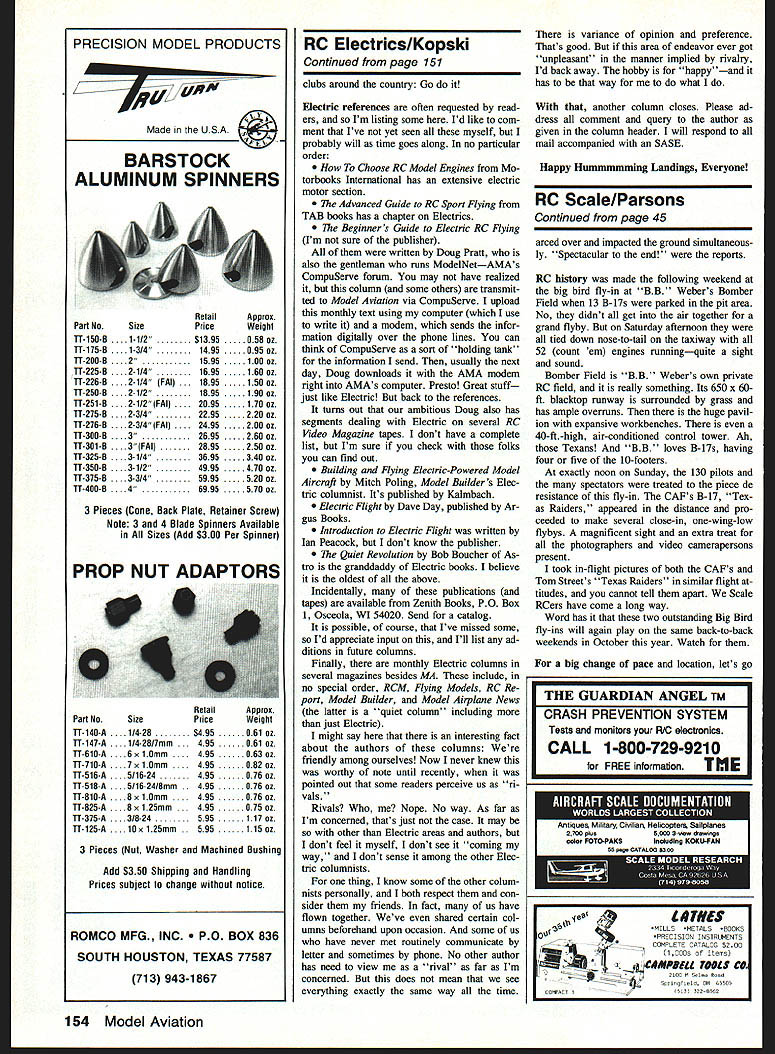
Recent model-magazine articles describe successful use of RC scale models in movies. The Paramount film Flight of the Intruder used several 1/5-scale (120-in.) flying and static models of the A-6 Intruder, built by the Eaglerly Co. and Special Effects Unlimited.
- The flying A-6 models weighed about 42 lb and were powered by Rossi .91 engines driving two-bladed props.
- Identical nonflying static models were mounted on controllable booms for varied camera angles.
- Both Eaglerly and Special Effects Unlimited used O.S. .62 engines and glass cloth to cover wing and tail surfaces on the 120-in. A-6s.
- Garland Hamilton (a top RC scale competitor) contributed realistic paint and markings, and performed much of the final flying of the models.
Flight of the Intruder is adapted from Stephen Coonts' best-selling novel; Coonts flew A-6 Intruders in Vietnam and the movie was slated for release this summer.
Correction — Joe Robinson contact
An air-hydraulic cylinder being developed by Joe Robinson of Hohman in Florida was mentioned in my January '90 "R/C Scale" column. I originally printed an incorrect area code. Joe Robinson's correct number is: 407/439-6965.
Closing
Scale modeling is as much about creating the illusion of full-scale flight as it is about craftsmanship. Proper power, smooth flying, clever transport solutions, and attention to scale behavior (including dynamic scale speed) all contribute to convincing and exciting scale flight.
Transcribed from original scans by AI. Minor OCR errors may remain.

