
Radio Control: Scale
Cliff Tacie 47774 Applewood Dr. Mt. Clemens, MI 48045
The Matrix
The Craftsmanship portion of static judging in RC Sport Scale has been a subject of controversy and discussion for quite some time. There has been question as to what constitutes "Craftsmanship" and how many points a judge should deduct on items for which he feels the contestant does not deserve the credit. In an effort to guide the judges in their thankless task, we have used the "Craftsmanship Declaration," a list, provided by the builder, of items he did not construct himself. This helped in providing the judges the needed information to make their decision on how many Craftsmanship points to award—but it was still up to the individual judge to award the points, and obviously no two judges are going to deduct the same number of points for a particular item... it just might depend on what kind of day he's been having!
Enter the new rule in RC and CL Sport Scale this year, paragraph 4.6, sometimes referred to as the Declaration "matrix." There has been much controversy about this rules change both locally and nationally, primarily centering around the fact that everyone wondered where it came from. Too often we don't pay enough attention to the rules proposals published in Model Aviation's "Competition Newsletter" section and are sometimes surprised by what we see passed on the Contest Board's Final Vote. In this case, the proposal was there, but because of space constraints, it was not explained in depth—rather it was listed by main topic. It sure slipped under my nose!
The concept of the craftsmanship matrix is not new. The first implementation I saw came at the 1989 Top Gun Invitational Tournament held in Coral Springs, FL. Using its own rule book based somewhat on the AMA Competition Regulations, Top Gun developed the craftsmanship matrix system to take the task of deciding how much to deduct for non-builder-constructed items completely out of the hands of the judges, and it worked very well.
The idea behind it is that the judges do not know what part of a model is not the work of the contestant at the time they judge it, because the Declaration is no longer included in the presentation. Under Craftsmanship, they are allowed to truly judge what they see for the quality that is there. Are the surfaces aligned? Did the modeler use sandpaper? Are there runs or orange peel in the paint? Are all the seams between surfaces even and properly shaped? Is this a quality piece of work?
Later, based on the separate Declaration Matrix form the modeler has provided, the scorekeeper/tabulator is the one who will deduct points from the static score awarded by the judges to arrive at a final and official static score.
Declaration matrix (AMA Competition Regulations)
Under the AMA Competition Regulations, points are deducted according to the following matrix of items the modeler claims were purchased or not made by himself:
- Scale spinner(s) - .15
- Scale prop(s) - .25
- Scale engine - .25
- Molded plastic or glass exterior details - .20
- Molded plastic or glass cowl - .25
- Molded plastic or glass fuselage - 1.00
- Molded plastic or glass wheel pants - .25
- Wheels - .15
- Scale ordnance - .25
- Decals (extensive) - .20
Using the matrix, let's see how much would be deducted for a typical balsa/plywood kit model. Figure the cowl and wheel pants are probably plastic or fiberglass provided by the kit (-.50). You probably will use commercially available wheels (-.15). Finally, if you utilized decal sheets from the kit rather than develop your own color scheme (-.20). Add up: -.85, which means a raw static score total of 925.0; the final Static Score would be 916.5. Bad, considering the average static judge would have docked a couple points under Craftsmanship using similar kit-provided items.
If you've got take-out-of-the-box-and-assemble fiberglass beauties, deductions are minimal:
- Molded plastic or glass exterior details - .20
- Molded plastic or glass cowl - .25
- Molded plastic or glass fuselage - 1.00
- Molded plastic or glass wheel pants - .25
- Wheels - .15
- Scale ordnance - .25
- Decals - .20
Total deductions - .230
Losing 23 points off the total static score is a very small price to pay for the convenience of using fiberglass components provided by the kit manufacturer. Considering cases where the craftsmanship, outline and final product may indeed be better than what could have been done personally using built-up construction, you're way ahead in the ball game.
I know what you're thinking. You're thinking this matrix system is going to put you at a disadvantage if you don't scratch-build your model. This couldn't be farther from the truth. In fact, at the 1990 Top Gun Invitational Tournament in Mesa, AZ, using a similar matrix system, the top finishers were all kit airplanes!
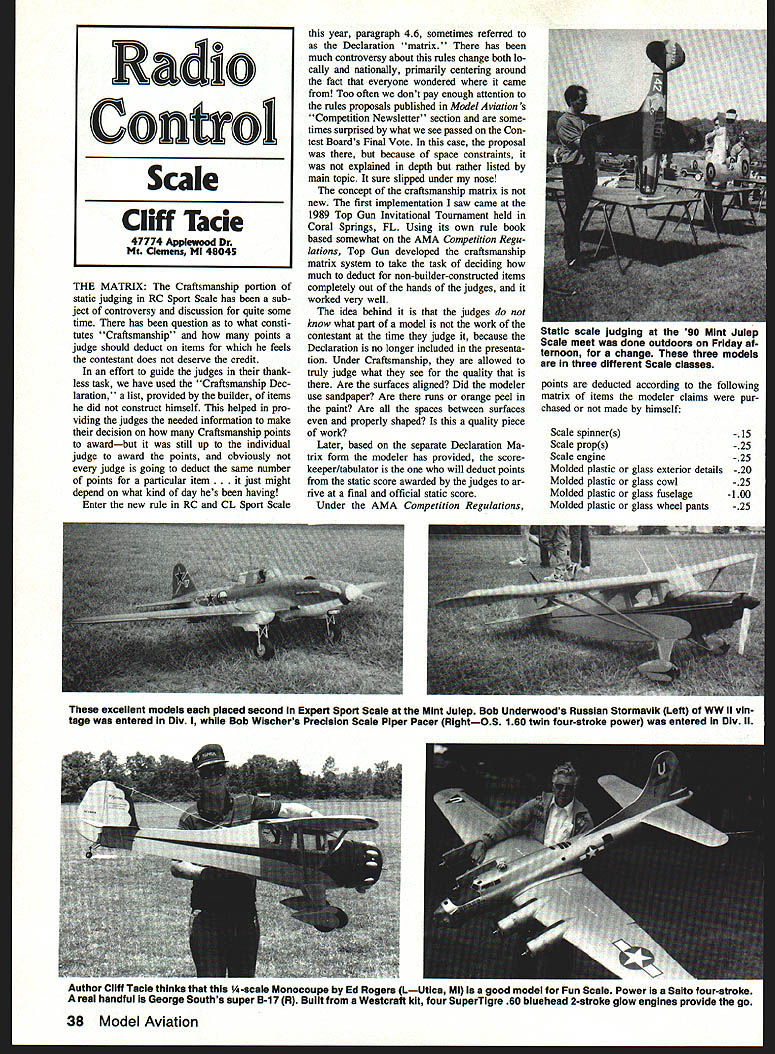
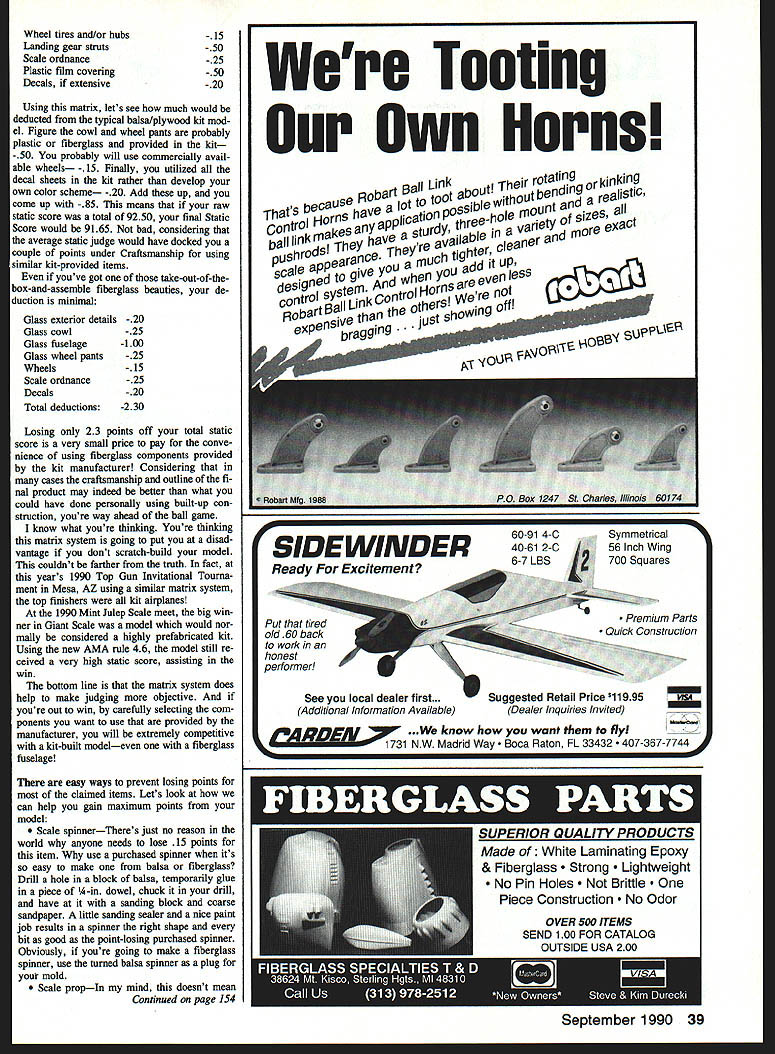
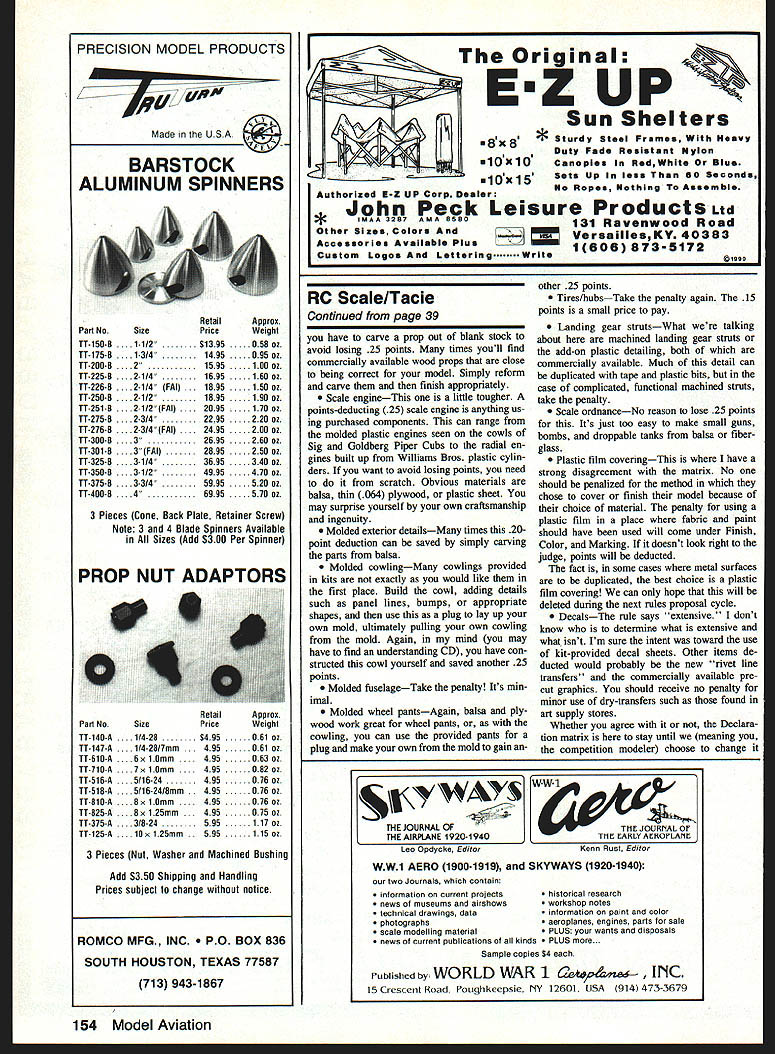
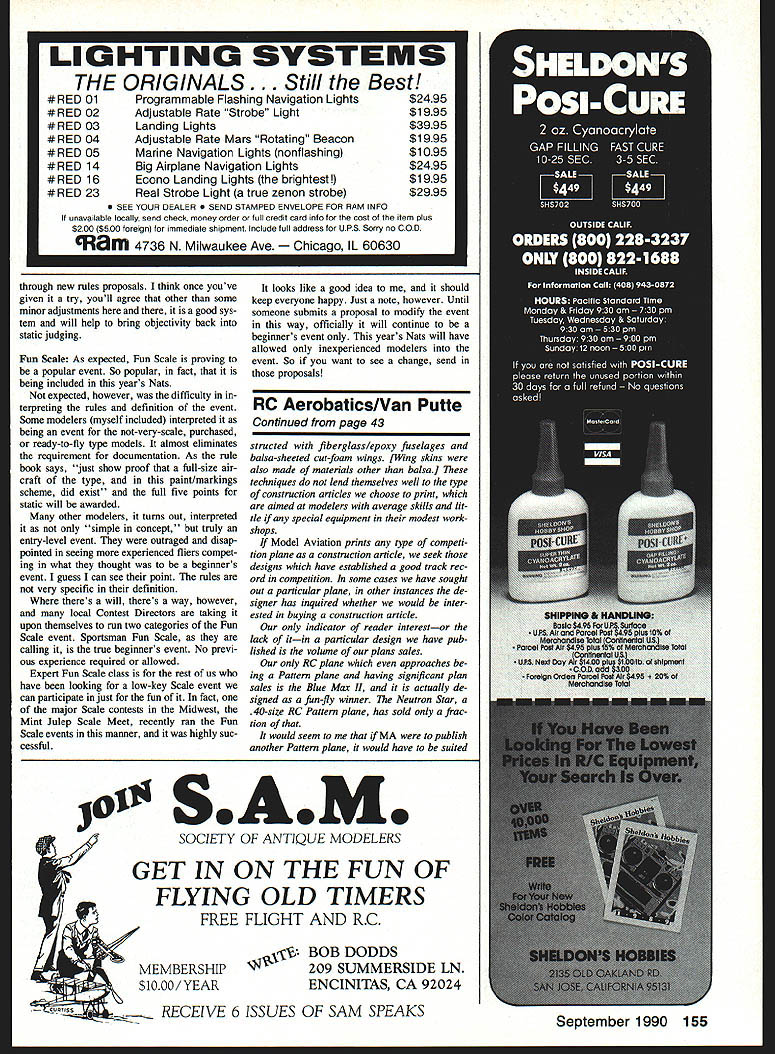
At the 1990 Mint Julep Scale meet, the big winner in Giant Scale was a model which would normally be considered a highly prefabricated kit. Using the new AMA rule 4.6, the model still received a very high static score, assisting in the win.
The bottom line is that the matrix system does help to make judging more objective. And if you're out to win, by carefully selecting the components you want to use that are provided by the manufacturer, you will be extremely competitive with a kit-built model—even one with a fiberglass fuselage!
How to avoid losing points
There are easy ways to prevent losing points for most of the claimed items. Let's look at how we can help you gain maximum points from your model:
- Scale spinner — There's just no reason in the world why anyone needs to lose .15 points for this item. Why use a purchased spinner when it's so easy to make one from balsa or fiberglass? Drill a hole in a block of balsa, temporarily glue on a piece of 1/4-in. dowel, chuck it in your drill and have at it with a sanding block and a coarse sandpaper. A little sanding sealer and a nice paint job results in a spinner that is the right shape and every bit as good as the point-losing purchased spinner. If you're going to make a fiberglass spinner, use the turned balsa spinner as a plug for your mold.
- Scale prop — You don't have to carve a prop out of blank stock to avoid losing .25 points. Many times you'll find commercially available wood props that are close to being correct for your model. Simply re-profile and carve them and then finish appropriately.
- Scale engine — This one is a little tougher. A points-deducting (.25) scale engine is the sum of the purchased components. This can range from the molded plastic engines seen on the cowls of Sig and Goldberg Piper Cubs to the radial engines built up from Williams Bros. plastic cylinders. If you want to avoid losing points, you need to do it from scratch. Obvious materials are balsa, thin (0.064) plywood, or plastic sheet. You may surprise yourself by your own craftsmanship and ingenuity.
- Molded exterior details — Many times this .20-point deduction can be saved by simply carving the parts from balsa.
- Molded cowling — Many cowlings provided in kits are not exactly as you would like them in the first place. Build the cowl, adding details such as panel lines, bumps, or appropriate shapes, and then use this as a plug to lay up your own cowl, ultimately pulling your own cowling from the mold. In my mind, you have constructed this cowl yourself and saved another .25 points.
- Molded fuselage — Take the penalty! It's minimal.
- Molded wheel pants — Balsa and plywood work great for wheel pants, or, with the cowling, you can use the provided parts for a plug and make your own from the mold to gain another .25 points.
Other items
- Tires/hubs — Take the penalty again. The .15 points is a small price to pay.
- Landing gear struts — What we're talking about here are machined landing gear struts or the add-on plastic detailing, both of which are commercially available. Much of this detail can be duplicated with tape and plastic bits, but in the case of complicated, functional machined struts, take the penalty.
- Scale ordnance — No reason to lose .25 points for this. It's just too easy to make small guns, bombs, and droppable tanks from balsa or fiberglass.
- Plastic film covering — This is where I have a strong disagreement with the matrix. No one should be penalized for the method in which they choose to cover or finish their model because of their choice of material. The penalty for using plastic film in a place where fabric and paint should have been used will become under finish, color, and marking. If it doesn't look right in a judged sense, points will be deducted.
- Decals — The rule says "extensive." I don't know how to determine what is extensive and what isn't. I'm sure the intent was toward the use of kit-provided decal sheets. Other items deducted would probably be the new "rivet line" transfers and the commercially available pictures. You should receive no penalty for minor use of dry-transfers such as those found in the decal supply stores.
Whether you agree with it or not, the Declaration matrix is here to stay until we (meaning you, the competition modeler) choose to change it through new rules proposals. I think once you've given it a try, you'll agree that other than some minor adjustments here and there, it is a good system and will help to bring objectivity back into static judging.
Fun Scale
As expected, Fun Scale is proving to be a popular event. So popular, in fact, that it is being included in this year's Nats.
Not expected, however, was the difficulty in interpreting the rules and definition of the event. Some modelers (myself included) interpreted it as being an event for not-very-scale, purchased, or ready-to-fly type models. It almost eliminates the requirement for documentation. As the rule book says, "just show proof that a full-size aircraft of the type, and in this paint/markings scheme, did exist" and the full five points for static will be awarded.
Many other modelers, it turns out, interpreted it as not only "simple in concept," but truly an entry-level event. They were outraged and disappointed in seeing more experienced fliers competing with what they thought was to be a beginner's event. I guess I can see their point. The rules are not very specific in their definition.
Where there's a will, there's a way, however, and many local Contest Directors are taking it upon themselves to run two categories of the Fun Scale event: Sportsman Fun Scale, which is the true beginner's event (no previous experience required or allowed), and Expert Fun Scale for the rest of us who have been looking for a low-key Scale event we can participate in just for the fun of it. One of the major Scale contests in the Midwest, the Mint Julep Scale Meet, recently ran the Fun Scale events in this manner, and it was highly successful.
It looks like a good idea to me, and it should keep everyone happy. Just a note, however: until someone submits a proposal to modify the event in this way, officially it will continue to be a beginner's event only. This year's Nats will have allowed only inexperienced modelers into the event. So if you want to see a change, send in those proposals!
Transcribed from original scans by AI. Minor OCR errors may remain.

