
Radio Control: Scale
Earl Aune 13165 N.W. Filbert St. Portland, OR 97229
Realism
One of the most challenging aspects of Scale modeling is to make a miniature model look as close to full-size as possible—not only on the ground, but in the air as well. It's a joy to watch a model fly as if it were full size.
Obtaining the right amount of flight realism is very difficult and takes years of refined practice and experimenting. Judges are now paying closer attention to this mandatory maneuver by watching the aircraft throughout the entire flight. I have been downgraded in the past for opening my canopy too fast as I taxied past the judges before the flight began! But that's what it's all about: make it look realistic in all aspects of the presentation, learn from the judges and make the next flight even better. We all win that way, and the spectators love it.
Whidbey Island
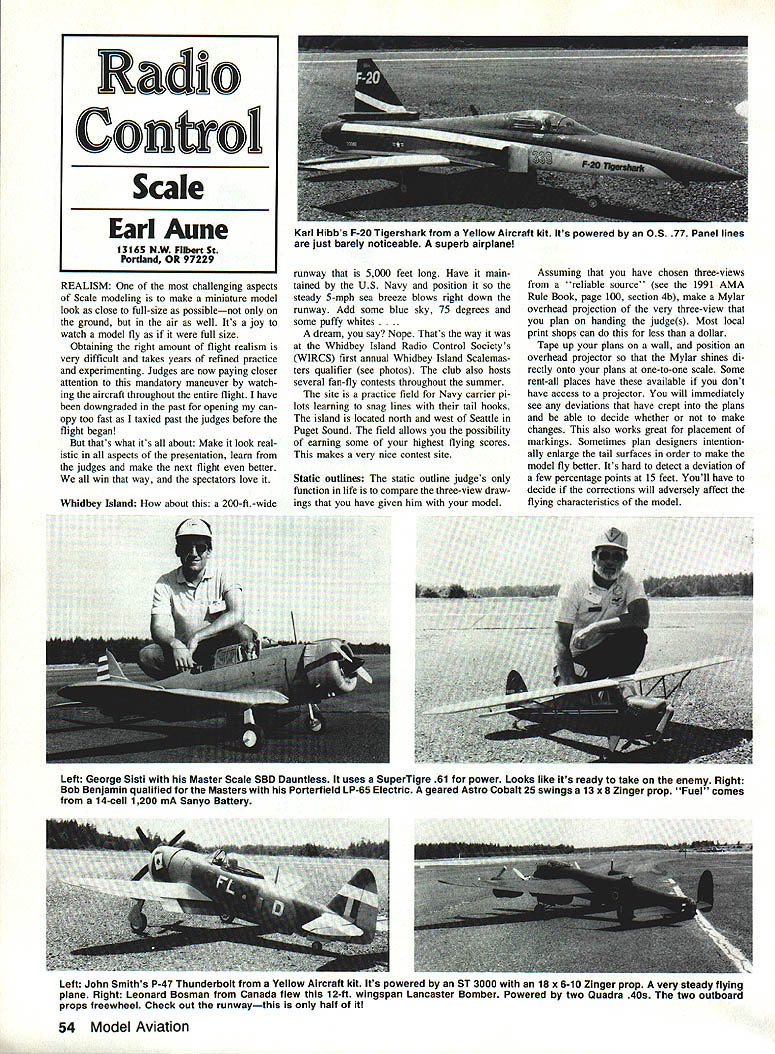
How about this: a 200-ft.-wide runway that is 5,000 feet long. Have it maintained by the U.S. Navy and position it so the steady 5-mph sea breeze blows right down the runway. Add some blue sky, 75 degrees and some puffy whites—a dream, you say? Nope. That's the way it was at the Whidbey Island Radio Control Society's (WIRCS) first annual Whidbey Island Scalemaster qualifier (see photos). The club also hosts several fan-fly contests throughout the summer; the site is a practice field for Navy carrier pilots learning to snag lines with their tail hooks. The island is located north and west of Seattle in Puget Sound. The field allows you the possibility of earning some of your highest flying scores. This makes a very nice contest site.
Static outlines
The static outline judge's only function in life is to compare the three-view drawings that you have given him with your model.
Assuming that you have chosen three-views from a "reliable source" (see the 1991 AMA Rule Book, page 100, section 4b), make a Mylar overhead projection of the exact three-view drawing that you plan to hand the judge(s). Most local print shops can do this for less than a dollar. Tape up your plans on a wall, and position the overhead projector so that the Mylar shines directly onto your plans at one-to-one scale. Some rental stores have one; if you don't have access to a projector you will immediately see deviations that have crept into the plans and be able to decide whether or not to make changes. This also works well for placement of markings.
Sometimes plan designers intentionally enlarge tail surfaces in order to make the model fly better. It's hard to detect a deviation of a few percentage points at 15 feet. You'll have to decide if the corrections will adversely affect the flying characteristics of the model.
Using this method will allow you to present a much closer match to the judges, which should result in better static scores for you.
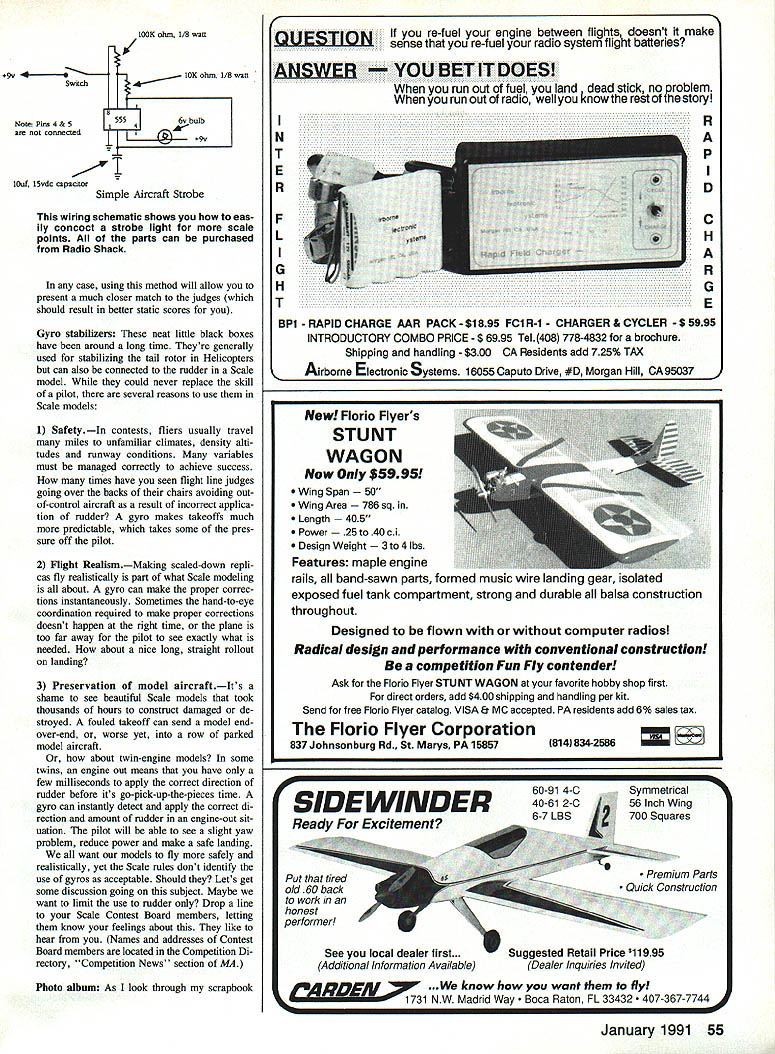
Strobe light
This wiring schematic shows you how to easily concoct a strobe light for more scale points. All of the parts can be purchased from Radio Shack.
Gyro stabilizers
These neat little black boxes have been around a long time. They're generally used for stabilizing the tail rotor in helicopters but can also be connected to the rudder in a Scale model. While they could never replace the scale skill of a pilot, there are several reasons to use them in Scale models:
- Safety.
In contests, fliers usually travel many miles to unfamiliar climates, density altitudes and runway conditions. Many variables must be managed correctly to achieve success. How many times have you seen flight line judges going over the backs of their chairs avoiding out-of-control aircraft as a result of incorrect application of rudder? A gyro makes takeoffs much more predictable, which takes some of the pressure off the pilot.
- Flight Realism.
Making scaled-down replicas fly realistically is part of what Scale modeling is all about. A gyro can make the proper corrections instantaneously. Sometimes the hand-to-eye coordination required to make proper corrections doesn't happen at the right time, or the plane is too far away for the pilot to see exactly what is needed. How about a nice long, straight rollout on landing?
- Preservation of model aircraft.
It's a shame to see beautiful Scale models that took thousands of hours to construct damaged or destroyed. A fouled takeoff can send a model end-over-end, or worse yet, into a row of parked model aircraft.
In some twin-engine models, an engine cut means that you have only a few milliseconds to apply the correct direction of rudder before it's go-pick-up-the-pieces time. A gyro can instantly detect and apply the correct direction and amount of rudder in an engine-out situation. The pilot will be able to see a slight yaw problem, reduce power and make a safe landing. We all want our models to fly more safely and realistically, yet the Scale rules don't identify the use of gyros as acceptable. Should they? Let's get some discussion going on this subject. Maybe we want to limit the use to rudder only? Drop a line to your Scale Contest Board members, letting them know your feelings about this. They like to hear from you. (Names and addresses of Contest Board members are located in the Competition Directory, 'Competition News' section of MA.)
Photo album
As I look through my scrapbook...
Transcribed from original scans by AI. Minor OCR errors may remain.

