
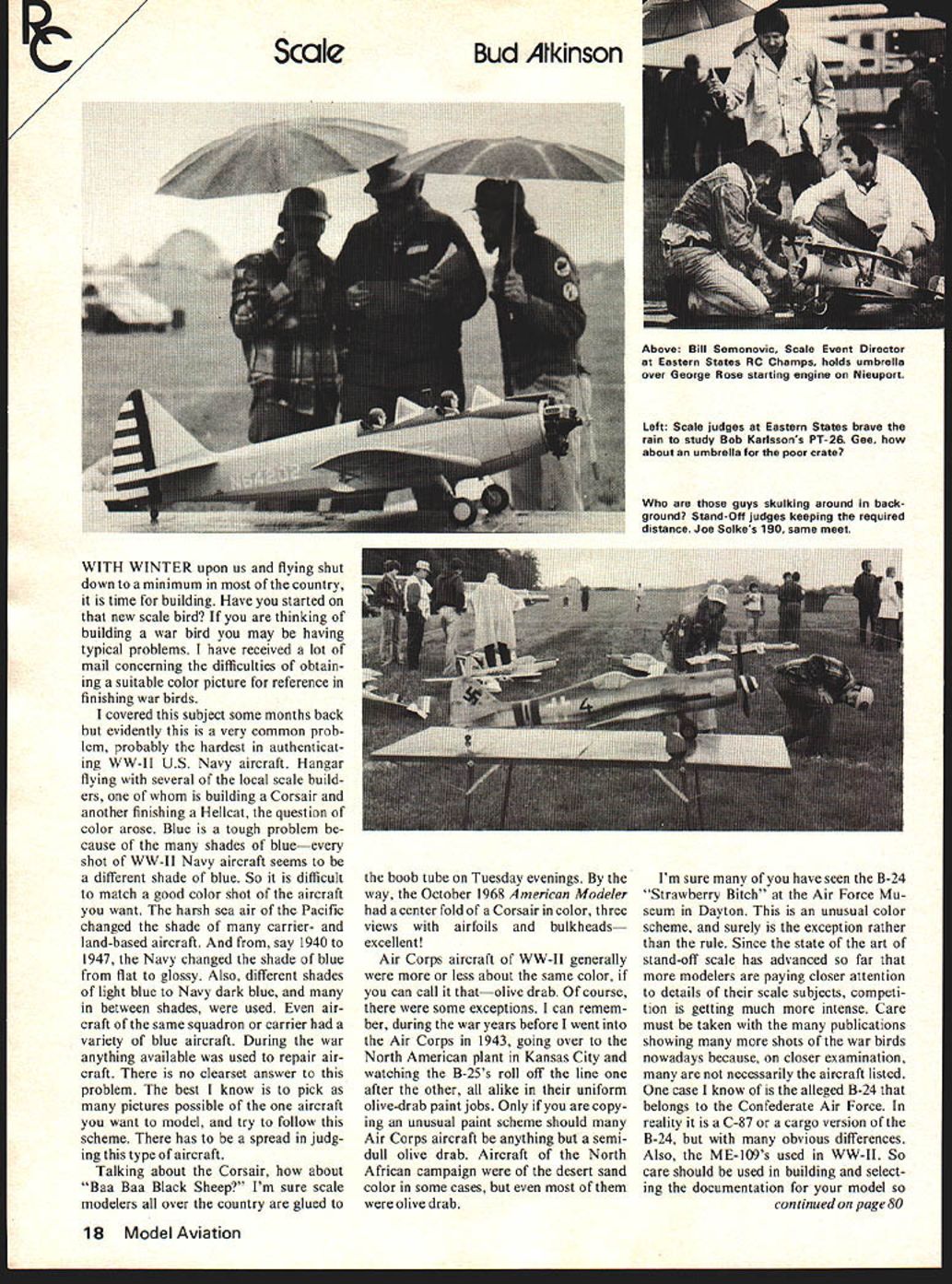
Radio Control: Scale
Bud Atkinson
WITH WINTER upon us and flying shut down to a minimum in most of the country, it is time for building. Have you started on that new scale bird? If you are thinking of building a war bird you may be having typical problems. I have received a lot of mail concerning the difficulties of obtaining a suitable color picture for reference in finishing war birds.
I covered this subject some months back but evidently this is a very common problem, probably the hardest in authenticating WW-II U.S. Navy aircraft. Hangar flying with several of the local scale builders, one of whom is building a Corsair and another finishing a Hellcat, the question of color arose. Blue is a tough problem because of the many shades of blue—every shot of WW-II Navy aircraft seems to be a different shade of blue. So it is difficult to match a good color shot of the aircraft you want. The harsh sea air of the Pacific changed the shade of many carrier- and land-based aircraft. And from, say, 1940 to 1947, the Navy changed the shade of blue from flat to glossy. Also, different shades of light blue to Navy dark blue, and many in between shades, were used. Even aircraft of the same squadron or carrier had a variety of blue aircraft. During the war anything available was used to repair aircraft. There is no clearcut answer to this problem. The best I know is to pick as many pictures possible of the one aircraft you want to model, and try to follow this scheme. There has to be a spread in judging this type of aircraft.
Talking about the Corsair, how about "Baa Baa Black Sheep"? I'm sure scale modelers all over the country are glued to the boob tube on Tuesday evenings. By the way, the October 1968 American Modeler had a center fold of a Corsair in color, three views with airfoils and bulkheads—excellent!
Air Corps aircraft of WW-II generally were more or less about the same color, if you can call it that—olive drab. Of course, there were some exceptions. I can remember, during the war years before I went into the Air Corps in 1943, going over to the North American plant in Kansas City and watching the B-25's roll off the line one after the other, all alike in their uniform olive-drab paint jobs. Only if you are copying an unusual paint scheme should many Air Corps aircraft be anything but a semi-dull olive drab. Aircraft of the North African campaign were of the desert sand color in some cases, but even most of them were olive drab.
I'm sure many of you have seen the B-24 "Strawberry Bitch" at the Air Force Museum in Dayton. This is an unusual color scheme, and surely is the exception rather than the rule. Since the state of the art of stand-off scale has advanced so far that more modelers are paying closer attention to details of their scale subjects, competition is getting much more intense. Care must be taken with the many publications showing many more shots of the war birds nowadays because, on closer examination, many are not necessarily the aircraft listed. One case I know of is the alleged B-24 that belongs to the Confederate Air Force. In reality it is a C-87 or cargo version of the B-24, but with many obvious differences. Also, the ME-109's used in WW-II. So care should be used in building and selecting the documentation for your model so that you don't represent it as one thing and show pictures of another. The quality of judging is advancing along with our building and flying of scale and stand-off scale as should be. So more time needs to be spent on obtaining your static material.
Of the reported 33,000 or so ME-109's constructed from 1936 to 1945, there were hundreds of modifications, some very obvious and many not, such as engine or armament changes that do not show up in a stand-off model. So we say again, select your 3-views and pictures with care. At most contests I attend the static scores are running very close; there are many fine stand-off models being turned out these days. How would you have liked to static judge 70 or so stand-off scale models, as was the case at the 1976 Nats?
On the subject of static judging I have been requested by many modelers to mention that when planning a scale contest, especially a two-day scale contest, contest planners should state if scale flying will be both days, and also when static judging will take place. I'm sure there is much confusion on this subject, especially if pattern is also flown. We have all experienced the problem: "When will my scale be judged?" It's especially hard for those who have to drive a long distance.
The big west-coast Western Front Morgan Hill contest has come and gone and by all indications I have seen and heard it was something else! This being the fifth year for this WW-I AMA and Stand-Off Scale contest, they incorporated some interesting events, such as WW-I maneuvers and WW-I combat. Sounds like a real fun scale contest. We need more contests in this theme. The specialization of WW-I and WW-II scale and stand-off is becoming more popular throughout the country.
Bud Atkinson, 734 North 6th Street Terrace, Blue Springs, MO 64015.
Transcribed from original scans by AI. Minor OCR errors may remain.

