
Radio Control: Scale
Jeff Troy
200 S. Spring Garden St. Ambler, PA 19002
I want to open with a sincere thank you to the Scale readers who have contacted me recently. Your response to the column has been a most pleasant surprise. More than one person warned me that I wouldn't get much help from the masses, but those folks were mistaken. Your telephone calls and letters have been coming in regularly since the first issue hit the stands, and the information you continue to share will make for much more interesting, well-rounded reading in the long run. So, again, thank you.
Jim Pepino of Scale Plans and Photo Service sent me a great non-commercial video on Top Gun III. In his note accompanying the tape, Jim acknowledged the plight of every contest scorekeeper: we get to look closely at all the tally sheets, but not long enough at the airplanes. Thanks to Jim's tape, I finally got to see more than a few scattered seconds of Top Gun III—even though I was right there with a front row seat throughout every minute of the entire contest. Thanks, Jim.
Dummy me! In an earlier article I talked about useful documentation sources and left out some very good ones, not the least of which is one of my personal favorites. Thankfully, Leo Opdyke, publisher of World War One Aero and Skyways magazines, reminded me of his fantastic publications.
If you are a WW-I enthusiast, you absolutely cannot live your life to the fullest without a subscription to World War One Aero. Likewise, if aviation's "golden age" lights your candle, you should be receiving Skyways. WW-I Aero is "The Journal of the Early Aeroplane" and Skyways is "The Journal of the Airplane 1920–1940."
These publications are the most thoroughly detailed magazine research sources I have ever seen, without exception. Although both are full-scale magazines, they feature multiple-page modeling columns, overstuffed with detail, to provide a modeler with plenty of inspiration in addition to all manner of proof of scale. Drawings, hard-to-find detailed photos, and accurate prototype information—not limited to color and markings, but including in-service performance and general aviation history—are included in each informative issue.
Both magazines are available by "membership," with a suggested donation starting at twenty-five dollars per year. I have subscribed to WW-I Aero for the past five or six years and consider the price a steal! Write to:
- World War One Aeroplanes, Inc., 15 Crescent Road, Poughkeepsie, New York 12601 for a current subscription card and more information.
I stirred up a bit of excitement among readers; however, I owe those interested modelers an apology for leaving them with a dead end. Back then I didn't think to include manufacturers' addresses with my articles. As of this issue, I promise to provide you with an address when I mention commercially available products. Sorry for not giving it to you earlier. For example:
- Jack Dorman: J.D. Scale Models, 317 Jonquil Avenue, Fort Walton Beach, Florida 32548.
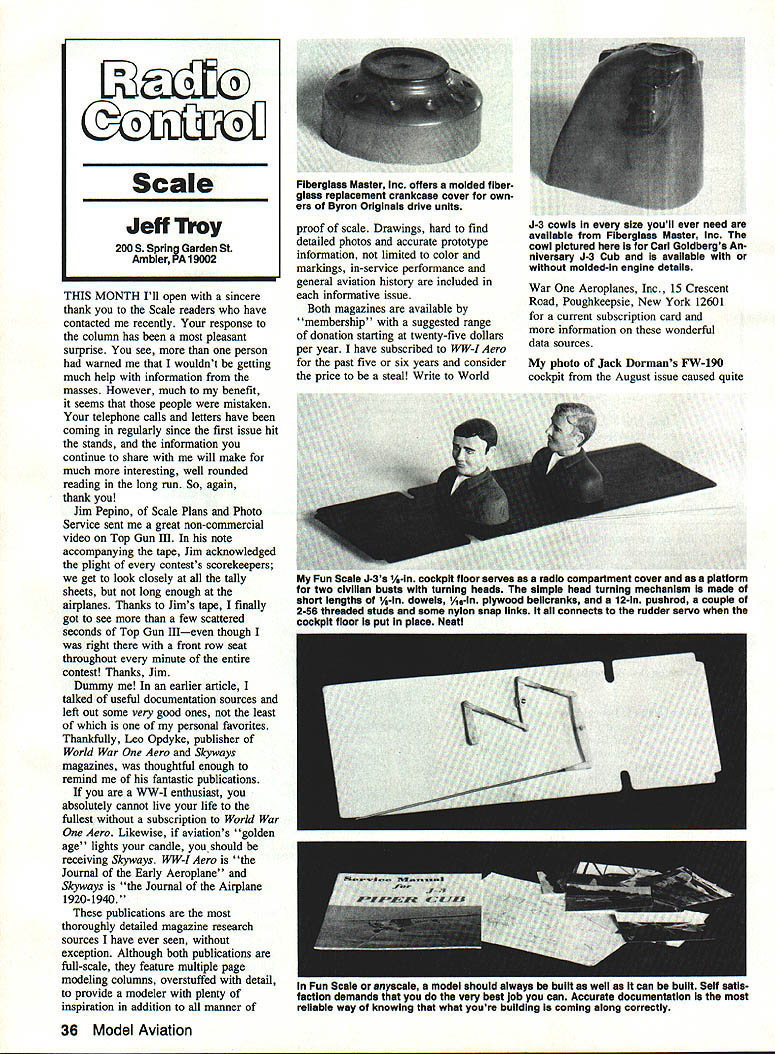
Myron Pickard of Fiberglass Master, Inc., showed me a neat part he's made available to owners of Byron Originals' Quadra and Sachs prop drives. It's a rugged fiberglass replacement for the plastic case cover that fits behind the prop hub on many Byron drive units. I don't imply anyone has had trouble with the standard part, but Myron's replacement looks very nice—especially if you like working with nicely molded fiberglass components.
Fiberglass Master, Inc. also has custom-molded cowls, wheel pants, and accessories available for a number of scale subjects. Write to:
- Fiberglass Master, Inc., P.O. Box 530, Goodview, Virginia 24095 and enclose a buck for their current catalog.
Sport, Precision, and Fun Scale
Model Aviation's RC Scale column is unique in that it deals with not just one but three separate scale realms: Sport Scale, Precision Scale, and Fun Scale. We have been reading about Sport and Precision Scale for years; the models are exquisite and the techniques required to produce such models are of the highest order. I will continue to collect and submit as much information on these magnificent models as I can lay my hands on—they are an inspiration to us all.
But what of Fun Scale? What of the newcomer to scale who has only limited abilities at present but would like to improve novice building and flying skills without going overboard in time and expense?
In hopes of encouraging even more participation in scale modeling, I will give special attention to Fun Scale each month—not to Fun Scale as a competitive event, but to Fun Scale models themselves. After all, just as full-scale aviators do not learn the basics of flight in combat-ready F-16s, RC modelers should not begin their scale modeling adventures with scratch-built DC-6s and P-38s. We have a fairly high number of competitors in the scale contest circle, but I often see many of the same faces at contests across the country. Perhaps some attention to good ol' grassroots kit building will inspire a few more Sunday fliers to eventually get that extra mile into Sport or Precision Scale. What harm can come from this column's providing a focal point to aspiring newcomers, in addition to praising the accomplishments of the master modelers we have been reading about over the years?
Where to start
To me, the choice is clear. Carl Goldberg Models' Anniversary J-3 Cub is probably the most popular entry-level scale kit to come along since the hobby of flying radio-controlled model airplanes began. The J-3 is one of the most recognized airplanes in the world, and Goldberg's kit does a great job of simplifying construction. Almost every club across the country has at least one member with a Cub in their hangar. There is something about the old easy-going character of a J-3 that draws RC modelers to it like a magnet.
During the next few issues I will build a Goldberg Cub under the camera, showing you additions you can make to your kit if you happen to be building one along with me. The intent is not to turn Goldberg's Cub into a Scale Masters–quality contest model, but to pass along a few basic construction and finishing techniques that can set your Goldberg kit apart from the rest. I'll be making some very subtle yet interesting changes in my Cub's outward appearance with the addition of some neat off-the-shelf hardware items from my local hobby store and a few of my own personal touches.
First things first: there's data. In Fun Scale competition, the picture from Goldberg's kit box lid would be sufficient documentation, but contest appearance isn't the goal here. The goal is to make the model satisfy us, not just a panel of relaxed Fun Scale judges. Sig Manufacturing Co., Inc. has two detailed sets of photos available for the J-3. Use documentation to guide slight changes in the aileron design of the model and to get better acquainted with the many small details of the J-3 without having to visit the local airport for photographs.
- Sig Manufacturing Co., Inc., 407 Front Street, Montezuma, Iowa 50171.
A Piper Cub Service Manual reprint should be available through either Scale Model Research or Scale Plans and Photo Service (addresses in the advertiser's listing in the back of the magazine). I'll use the documentation to guide slight aileron changes and to study small details.
My next step is to order a fiberglass cowl from Fiberglass Master, Inc. Since I intend to fly the living daylights out of my J-3, I prefer the strength of fiberglass over ABS where longevity is concerned (even though my friends will question why I worry about longevity on an airplane that I'll be flying—my track record is not that good).
As a final exercise before beginning construction, I've built a radio compartment cover that serves double duty as both a cockpit floor and a platform for two Williams Brothers civilian busts. The heads are made to turn in opposite directions when rudder command is applied. I purchased a number of other goodies to customize my model as well; I'll show you more of those in the next couple of issues. Meanwhile, why not see if you can do a radio cover with turning heads? The mechanism is easy to rig up and makes for a great conversation piece at the field.
For more information on the J-3 kit, write to:
- Carl Goldberg Models, 4734 West Chicago Avenue, Chicago, Illinois 60651.
Please send me your suggestions on Fun Scale kit projects that first-time scale modelers might enjoy building and flying. A success story the first time out is the name of the game; an early accomplishment is the best way I know to ensure ongoing enthusiasm in an aspiring scale modeler. If a person can fly a trainer, he can fly scale. All it takes is the right airplane and the right attitude.
Build straight and fly safely. See you next month.
Transcribed from original scans by AI. Minor OCR errors may remain.

