
Radio Control: Scale
Jeff Troy 200 S. Spring Garden St. Ambler, PA 19002
Byron Originals' Expo '91
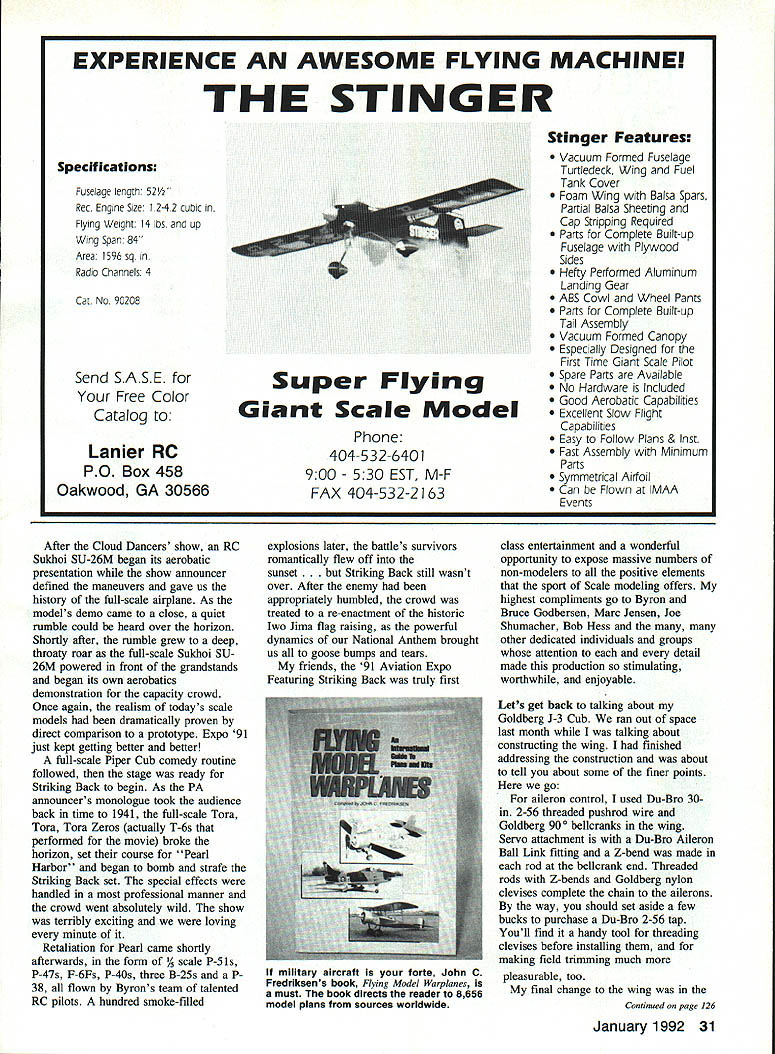
This past August 7–11 I had the pleasure of attending Byron Originals' Expo '91 in Ida Grove, Iowa, and I must admit that I have never before been so impressed by a model aviation event. Did I say model aviation event? Well, for the most part, I guess it is, but let me tell you that the mix of full-scale and model aircraft performances at Byron Godbersen's Aviation Expo '91 was so finely choreographed that you might not have known which you were really watching if the sound of the engines hadn't given the game away.
Like many of us, I had been hearing about "Striking Back" for quite some time. I had seen Ken Wells's R/C Video Magazine tape of the show many times (as a matter of fact, I used it to entertain scout troops when I conducted youth group tours at AMA's National Center for Aeromodeling in Reston, Virginia), but I had never seen Byron's show in person. I had always thought that Byron's blow-em-up would have to be a pretty fun thing to watch, but probably not anything for me to get overly excited about.
Brother, was I ever mistaken! Watching the live performance of Striking Back was visually and emotionally overpowering, and yet it played only a single part in a dramatically creative, multi-faceted, full-scale and scale model air show.
Expo '91 began with a full-scale parachute jump performed by almost 50 skydivers. Their performance really got the audience going, because the show's announcer promised that each jumper would land nearest to the loudest group of spectators. You can well imagine the roar! As the last skydiver touched the ground, four colorful Pitts Specials came into view. These agile, full-scale biplanes belonged to the Holiday Inn Aerobatic team, whose show was a picture-perfect demonstration of what world-class team flying should look like.
The highly acclaimed Cloud Dancers Show Team were up next and showed the many thousands of spectators in attendance what today's model aircraft are capable of doing. During their performance, the Cloud Dancers staged a parachute drop of their own, but the Dancers' drop used RC model jumpers and an RC airplane. The resemblance to the earlier full-scale demonstration was uncanny, and watching the audience throughout Byron's event really gave me an accurate indication of just how far model aircraft technology has come. The crowd was eating it up!
After the Cloud Dancers' show, an RC Sukhoi SU-26M began its aerobatic presentation while the show announcer defined the maneuvers and gave us the history of the full-scale airplane. As the model's demo came to a close, a quiet rumble could be heard over the horizon. Shortly after, the rumble grew to a deep, throaty roar as the full-scale Sukhoi SU-26M powered in front of the grandstands and began its own aerobatics demonstration for the capacity crowd. Once again, the realism of today's scale models had been dramatically proven by direct comparison to a prototype. Expo '91 just kept getting better and better!
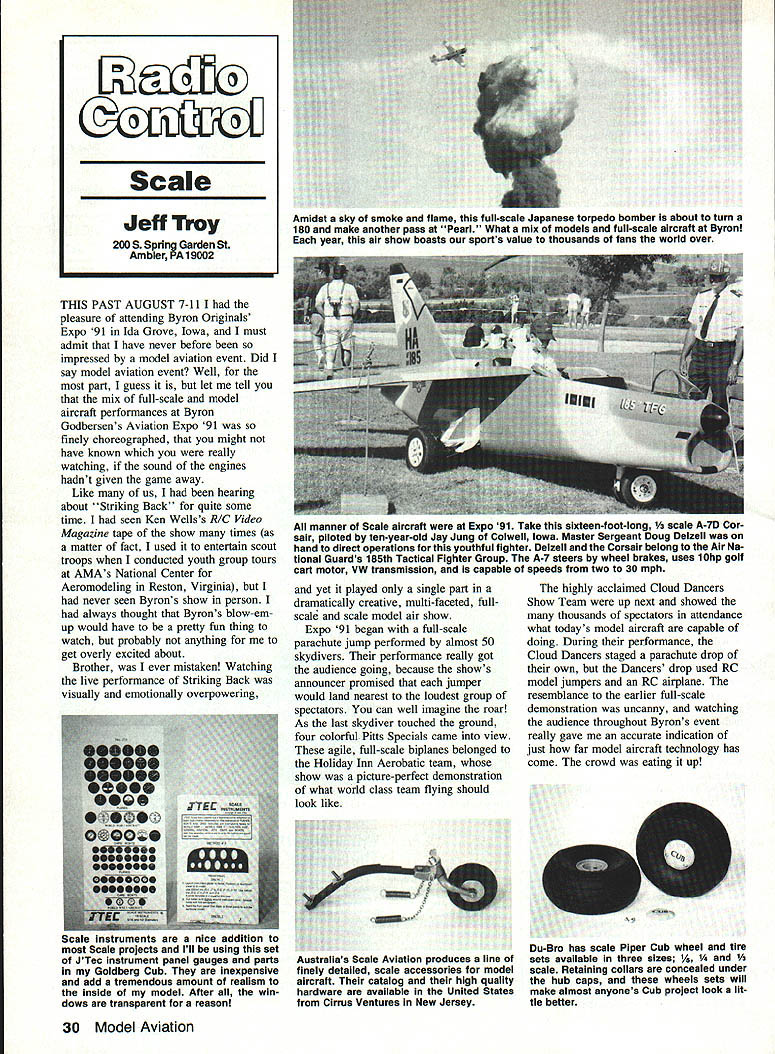
A full-scale Piper Cub comedy routine followed, then the stage was ready for Striking Back to begin. As the PA announcer's monologue took the audience back in time to 1941, the full-scale Tora, Tora, Tora Zeros (actually T-6s that performed for the movie) broke the horizon, set their course for "Pearl Harbor" and began to bomb and strafe the Striking Back set. The special effects were handled in a most professional manner and the crowd went absolutely wild. The show was terribly exciting and we were loving every minute of it.
Retaliation for Pearl came shortly afterward, in the form of 1/3-scale P-51s, P-47s, F6Fs, P-40s, three B-25s and a P-38, all flown by Byron's team of talented RC pilots. A hundred smoke-filled explosions later, the battle's survivors romantically flew off into the sunset... but Striking Back still wasn't over. After the enemy had been appropriately humbled, the crowd was treated to a re-enactment of the historic Iwo Jima flag raising, as the powerful dynamics of our National Anthem brought us all to goose bumps and tears.
My friends, the '91 Aviation Expo Featuring Striking Back was truly first-class entertainment and a wonderful opportunity to expose massive numbers of non-modelers to all the positive elements that the sport of scale modeling offers. My highest compliments go to Byron and Bruce Godbersen, Marc Jensen, Joe Schumacher, Bob Hess and the many, many other dedicated individuals and groups whose attention to each and every detail made this production so stimulating, worthwhile, and enjoyable.
Goldberg J-3 Cub — continued construction
Let's get back to talking about my Goldberg J-3 Cub. We ran out of space last month while I was talking about constructing the wing. I had finished addressing the construction and was about to tell you about some of the finer points. Here we go:
- Aileron control: I used Du-Bro 30-in. 2-56 helicopter pushrod wire and Goldberg 90° bellcranks in the wing. Servo attachment is with a Du-Bro Aileron Ball Link fitting and a Z-bend was made in each rod at the bellcrank anchor. Threaded rods with Z-bends and Goldberg nylon clevises complete the chain to the ailerons. By the way, you should set aside a few bucks to purchase a Du-Bro 2-56 tap. You'll find it a handy tool for threading holes before installing them, and for making field trimming much more pleasurable, too.
- Wing tips: Before installing the Lite-Ply wing tips, I used one to trace four tip doublers onto a piece of 1/16-in. balsa. After the tips were installed as per the plan, I glued these doublers in place, top and bottom, over the tips between the forward and rear sheeting. After sanding them to contour, I found that they gave the tips of my Cub's wing a much more finished look (a Cub's tips are tubing) and it only took ten minutes of my time.
Tail group
Since the tail feathers on the full-scale J-3 are of tube construction, I further decided to round all the appropriate edges of my model's stab, elevators, rudder, and fin. It kinda hurt to round the top of the vertical fin and the underside of the rudder overbalance, but tubing is round, isn't it?
As much as I enjoy using Goldberg's beveled Flex-Point Hinges on sport models, I opted for Robart's steel pin hinge points on this project for their more scale-like appearance. I drilled 1/8-in. holes as instructed by Robart, then used a 1/16-in.-square X-Acto file to allow the hinge points to seat deeper with less surface gap. Goldberg's kit method of hinging will undoubtedly produce a better seal between surfaces than the method I chose, but surface seal was not my goal. The illusion of a full-scale Cub was the intent.
After sanding everything to shape, I cut a recess in the rudder's lower leading edge to accept the CM Associates' dual rudder horn (taken from the CBA scale tail wheel gear package).
Fuselage
Few changes were made here. The kit fuse looks real good. I placed a 1/8-inch dowel along the center of the rear sides to give the covering a more authentic look, then I cut a new slot for the elevator pushrod above the existing slot on the right fuselage side; I would be using both of the existing slots for Sonic-Tronics' Pull-Pull Cable rudder linkage. Incidentally, don't make bends in the elevator pushrod as described in the plan. Just make the 1/4-inch bend at the end of the music wire to secure it to the balsa rod. The completed pushrod will work better and resist any tendency to flex under load if the music wire is kept straight.
I installed one 4-40 blind nut and a short section of dowel at the rear of the fuselage to accept the bolt and the wood screw I will use to fasten the CBA scale tail wheel assembly in place during final assembly. This was done before installing the Lite-Ply stabilizer saddle plate into the fuselage.
Instead of the 6-32 steel bolts and blind nuts provided, I chose to use 1/4-20 nylon bolts for wing attachment. I installed Du-Bro's 1/4-20 threaded studs into the fuselage blocks after drilling them out to accept the larger pieces; then I opened the wing bolt holes to 1/4 inch.
The head-turning pilot platform/radio cover discussed last month was trimmed to fit comfortably into the fuselage. Two scraps of 3/8-inch Lite-Ply were cut to sandwich the forward tongue of the platform, and a third was used to support a maple bolt-down block at the rear of the cabin. Removal of the cockpit platform for radio maintenance takes but a moment with this method.
My final fuselage construction modification concerns the fin fairing blocks and mounting the stab and rudder. Cubs have a unique fabric fillet at the base of their fin—and it has been overlooked in Goldberg's fine kit. In order to capture the rear fuselage/fin covering correctly, you only need to sand the sides of the blocks to match the fuselage sides; you don't have to sand the tops of the fin fairing blocks as the covering will never touch them.
With the exception of cap strips and aileron linkages, these modifications can be made at almost any point during the Goldberg Cub's construction—in many cases it's not even too much trouble after it has been completed and flown.
The step I'm doing now is covering the model with Coverite's new, pre-painted 21st Century Fabric. I'm also in the process of fabricating the wing's struts and jury struts, painting the cabin interior, and constructing the details of the landing gear shock cords.
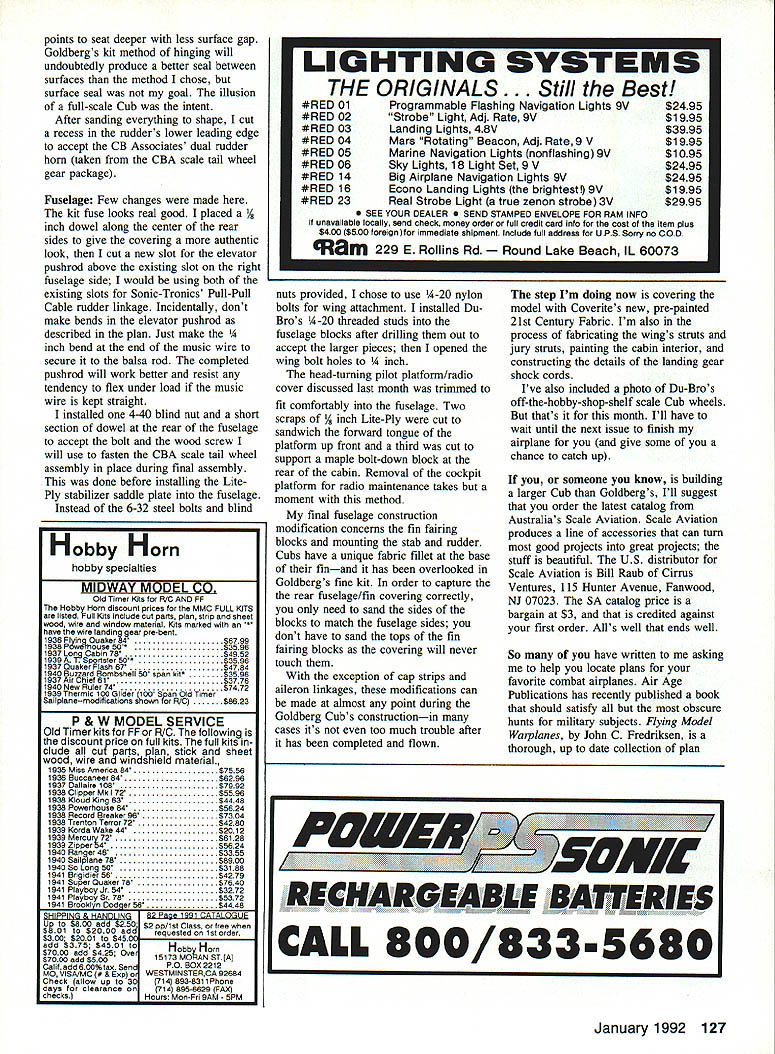
I've also included a photo of Du-Bro's off-the-hobby-shop-shelf scale Cub wheels. But that's it for this month. I'll have to wait until the next issue to finish my airplane for you (and give some of you a chance to catch up).
Larger Cubs and accessories
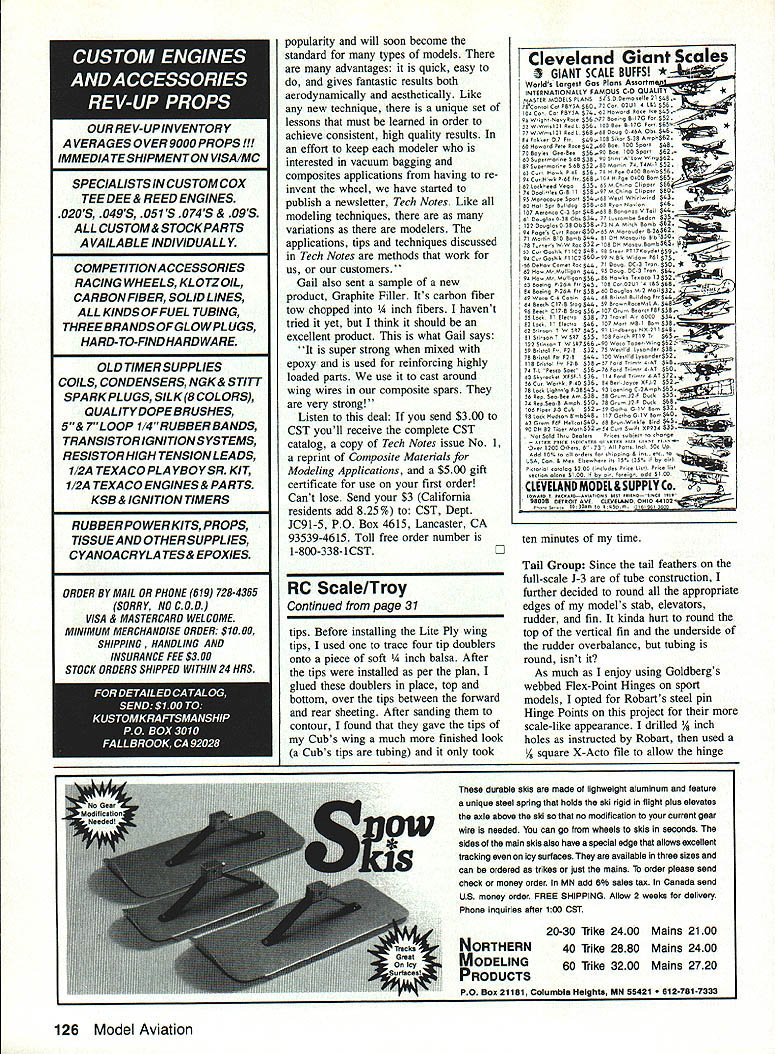
If you, or someone you know, is building a larger Cub than Goldberg's, I'll suggest that you order the latest catalog from Australia's Scale Aviation. Scale Aviation produces a line of accessories that can turn most good projects into great projects; the finish is beautiful. The U.S. distributor for Scale Aviation is Bill Raub of Cirrus Ventures, 115 Hunter Avenue, Fanwood, NJ 07023. The SA catalog price is a bargain at $3, and that is credited against your first order.
So many of you have written to me asking me to help you locate plans for your favorite combat airplanes. Air Age Publications has recently published a book that should satisfy all but the most obscure hunts for military subjects. Flying Model Warplanes, by John C. Fredricks, is a thorough, up-to-date collection of plans and source information. It is well organized and highly recommended by this writer. Every country that ever launched an airplane in any theater of operation is represented here. If it flew, and it meant to do injury to an enemy, it's undoubtedly on one of the 304 pages in John Fredricks's book and you'll most likely be directed to its model plan. For more information, write to Air Age Publications, 251 Danbury St., Wilton, CT 06897.
Every time I think I've put the subject of Air Design's big SE-5a to bed, more mail comes in to wake it up again. I recently received a letter from one of Air Design's founders, Bill DeVarna, 228 Edgerton Drive, Waterville, OH 43366. Bill informed me that, "Air Design still lives," and that he is now its sole proprietor. At last year's Toledo show, Bill showed me a set of large-scale custom retracts he was producing. I never realized that his company name was Air Design, or I might have talked British Scouts with him for hours.
Though the SE-5a is no longer in his stable, Air Design has a number of products and accessories that might interest you. Send Bill a stamped, self-addressed envelope for a current listing. In his letter Bill promised to try tracking down the 1/3-scale SE-5a plan, in case one of you would care to model it.
As luck would have it, I received a telephone call from Mike Cooke, the owner of Avco Model Supplies, 205 Gulf Bank, Houston, TX 77037. Mike still has the plans for the Air Design SE-5a and can arrange for copies for you. He sent a set to me, and the memories of building that airplane poured out of the plans as if they were an old Berkeley box!
Mike is one of the purchasers of the original Air Design company, and he kindly informed me that Avco is still in operation. The company no longer manufactures the SE-5a kit, but scale accessories for that and several other models are available. ABS plastic WW-I style wheel covers and both Lewis and Vickers machine gun kits are on hand in 1/3 scale and will complement Balsa USA's Sopwith Pup perfectly.
Avco also has nicely done, affordable cockpit kits in several scales for many popular airplane kits, including Sig, Platt, Yellow Aircraft, Ziroli, Nosen, and Balsa USA subjects. Next month, when more space is available, I'll give you an in-depth look at the cockpit Mike produces for Sig's J-3 Cub. His cockpit kits are light, easy to assemble, amply detailed, and you can buy one without taking out a second mortgage on your country estate!
John Gauger, at D&D Manufacturing, 1111 Industrial Parkway, Brick, NJ 08724, has Top Flite Models' SE-5a plan sets available. Anyone interested can get one for ten dollars, including UPS shipping. John is offering to trade a set of his Top Flite plans with the first person who will have them enlarged to 1/4 scale and provide him with a copy of the blown-up plans. Sounds like a good deal to me, but you'd better hurry if you want to be first!
Restored scale planes for a large number of Top Flite, Berkeley, Mooney, and other companies' discontinued kits are still available from David W. Jones, 2703 Lincolnwood Drive, Evanston, IL 60201. David has been restoring plans with his friend, Al Onken, for a number of years, and they have built up quite a sizable collection of first-class subjects. Where necessary, in addition to the complete contents of the original plans, David's and Al's restorations include drawings of extra parts and patterns that did not appear on the original kits' plans. In many cases, this feature is the sole difference between being able to get and then being able to use a particular set of drawings!
David Roach and Al Onken are employed in the pattern and design departments of Revell/Monogram and, needless to say, have accumulated a wealth of experience in scale aeromodelling. If you have a rare scale plan that you'd like to make available to future plan-seekers, why not let them know about it? It's likely that someone may really need it one day. Write to David for a list of what they have on hand. Don't forget to enclose a stamped, self-addressed envelope.
Scale competition — a few candid thoughts
I'm going to open a sizable can of worms right now. I'm going to tell you why scale modeling is the easiest to compete in of all our RC modeling disciplines. Before I open it all the way, please understand that the worms I am releasing are supposed to be fun worms and nothing more.
I really don't want to exchange an endless amount of pointless correspondence about the sanctity of Scale modeling and Scale competition, since I believe in that as much as anyone else does. All I ask is that you read this as it is intended… tongue in cheek, but not without its fair share of truth.
In my time as a Scale competitor, I have attended more than one contest wherein the philosophy of "Give everyone a ninety in static, and fly it out in the air" was clearly evident. I have to tell you that I find the presence of this attitude in Scale competition absurd, since the AMA official rule book provides all the information necessary for any reasonably intelligent contest director to properly run the static portion of his event.
On the other hand, I have also seen models with high static scores wind up in a winner's circle even though their flights were far short of prototypical performances. "These are Scale models, not Pattern planes" is also an absurd statement to make, since the rule book clearly defines the parameters for judging the flight portion of competition, too.
If performance in the air is your idea of how a model should solely prove its value, then Pattern, Pylon or Soaring competition will provide you with the challenge you need. Scale is not for you. On the other hand, if you feel that craftsmanship and fidelity to scale are a model's only necessary virtues, then you really don't need to fly in Scale competition—you need a mail show.
The bottom line is that if you are to be a part of a Scale event, whether as a competitor, as an official, or as its director, you must understand that it is the AMA rule book, not your opinion or your vanity, that is intended to guide the manner in which models' static scores and pilots' flight scores are judged. Static criteria and flight criteria must both be met by each entrant and judged with due respect by each official concerned. Only then can these scores be combined to decide which contestant did the best job of creating the illusion of his full-scale prototype… both on the ground and in the air!
Competitors, as well as officials, must understand the rules of competition. They must know how they are to be judged if they expect to compete effectively. Rules are written so that everyone involved can learn how the game is played and then play it fairly. If it were otherwise, the biggest, meanest man on the field would always win the contest. In model aviation competition, our rules are written by AMA members who take much time and energy to draft proposals and submit them to AMA Headquarters. They're not written by AMA Headquarters staff or the Executive Council.
Once a rule has been submitted, voted on and passed by the AMA contest board, it becomes the law of the land (and air) and should be followed. Whether or not an official or a competitor agrees with it is no longer an issue…the rule is in force! Those who do not like the rule should not complain and give officials or contestants grief; they should draft a rules change proposal in time for the next rules cycle. There is a democratic mechanism to change any of our competition event rules (except the AMA Official Safety Code) and it is available to each of us.
Now that I've given you sufficient reason to read (or reread) the Scale rules, how do you like this? Scale is a cakewalk! How many events are there in which each contestant can tell the judges what maneuvers he will fly, how he will fly them, and in what order?
Did you know that a contestant in Scale can actually ask the officials to judge maneuvers unique to his aircraft in a non-standard manner? This is provided, of course, that the appropriate documentation has been presented to the contest director and approved before the flight. That's freedom you won't find anywhere else!
While the demands of other RC events dictate the general style of model that must be flown in order to be competitive, no such boundaries exist in Scale. You can fly any model you like and still be competitive. In Scale, we participate in an atmosphere in which a 1912 Blackburn Monoplane can be equal to a P-38 Lightning, and wherein either can be equal to a fully equipped F-14 Tomcat. Try that action in Pylon! Would you ever see a Sopwith Camel running neck and neck with a Cosmic Wind? Could you picture a 1903 Wright Flyer in a Pattern contest… or an SG-38 in thermal duration Soaring competition?
As to static scores, there's really no excuse for any score less than 100%. How could there be? You pick the airplane you want to model, and you provide the documentation by which it is judged. If you like, you can even write a guide to instruct the static judges how to use your documentation. You get to choose any particular airplane you like (in the color scheme you like best) and all you have to do is copy it. You don't have to invent a thing, only imitate what is visible.
What's more, you don't even have to bring your model to a contest until it has been crafted to your own satisfaction. If the rudder shape is wrong, why not make another one before you decide to enter the airplane in competition? If the second rudder is wrong, you can make a third. In fact, you can make as many as you like; that's what it will take to get the one you want the judges to see. The only one who will know the truth is you!
The only reason for a model to score less than perfect is that the builder thought his effort was good enough and that the judges would never notice the flaws. This kind of modeler will be in for a rude awakening if he ever manages to get as far as the judges at Top Gun, the Mint Julep, or the U.S. Scale Masters. "Good enough" may be okay for other events but could never be acceptable in an arena like Scale's, where competitors write a good portion of their own tests.
Scale is grass-roots simple because each of us involved in it gets to build and fly what we like… and a labor of love is always easier than work. As Scale modelers, surely, we all love to build airplanes. If a model took one hundred hours to complete, it will have provided you with one hundred hours of pleasure. In truth, shouldn't a two-thousand-hour model be twenty times more enjoyable?
Eyes, my friends. Scale competition is easy, because the difficult part of Scale modeling isn't the contest; it's the attitude—making the commitment to build and fly a Scale model, then following through with that commitment until the job is completed.
Build straight and fly safely. See you next month.
Contacts and sources (addresses mentioned)
- Cirrus Ventures (Scale Aviation U.S. distributor): Bill Raub, 115 Hunter Avenue, Fanwood, NJ 07023.
- Air Age Publications: 251 Danbury St., Wilton, CT 06897.
- Bill DeVarna (Air Design): 228 Edgerton Drive, Waterville, OH 43366.
- Avco Model Supplies: Mike Cooke, 205 Gulf Bank, Houston, TX 77037.
- D&D Manufacturing: John Gauger, 1111 Industrial Parkway, Brick, NJ 08724.
- David W. Jones (plans/restorations): 2703 Lincolnwood Drive, Evanston, IL 60201.
Transcribed from original scans by AI. Minor OCR errors may remain.

