
Radio Control: Scale
Jeff Troy
200 S. Spring Garden St. Ambler, PA 19002
In 1991, I attended Byron Godberson's Aviation Expo for the first time. By now, many of you will have heard that the Expo has been offered for sale and will not be held in Ida Grove, Iowa again. Perhaps another party will take on this event, perhaps not; but as of this writing, there will be no Expo '92. Byron's Expo was a real thrill for me and will be sorely missed in my schedule of aeromodeling's newsworthy events.
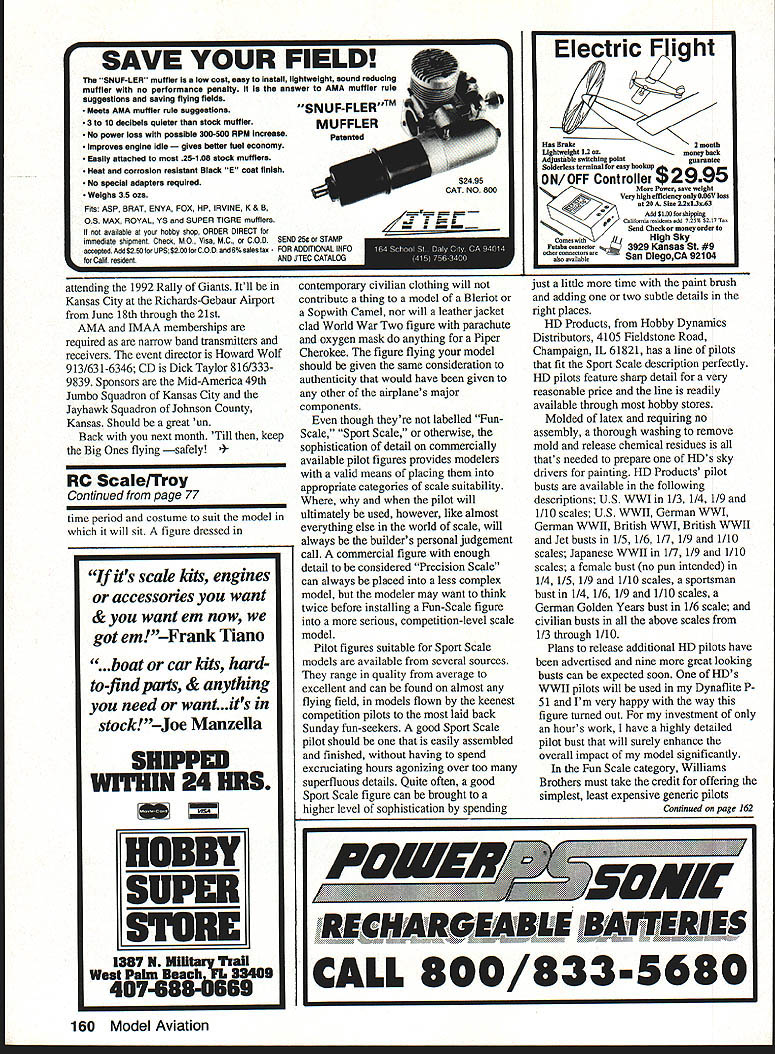
This seems an appropriate place for me to reiterate my thanks to Byron Godberson, Bruce Godberson, Joe Schumacher and Marc Jensen for their gracious hospitality, and for the many seemingly impossible advancements in model aviation made possible because of their unique energies.
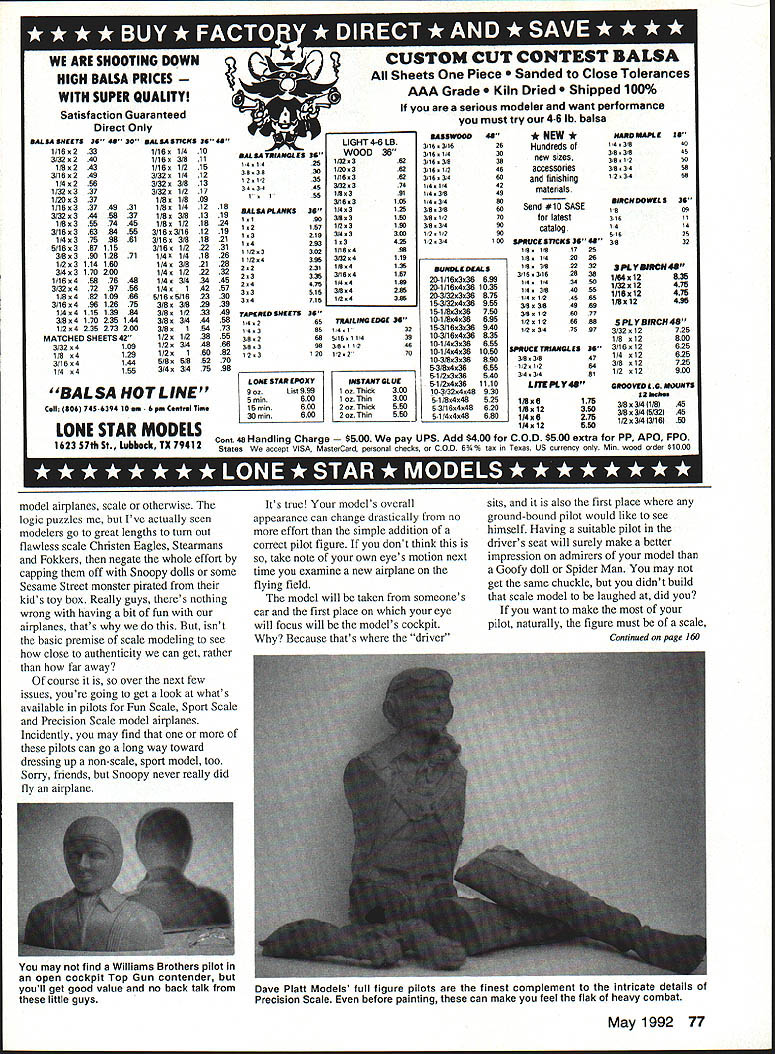
While attending Byron Originals' Expo '91, I photographed a beautiful Piper Super Cruiser belonging to Al Hill of Lincoln, Nebraska. The model was built from a Champion kit (now DSC, Davey Systems Corporation, 675 Tower Lane, West Chester, PA 19380). Al's Super Cruiser is covered with original FabriKote and painted with Diana Cream and Tennessee Red Sig dope. Power is an O.S. .91 Surpass four-stroke and the plane flies beautifully. It's always good to see those "down to earth" model airplanes. I wish I could photograph all of them.
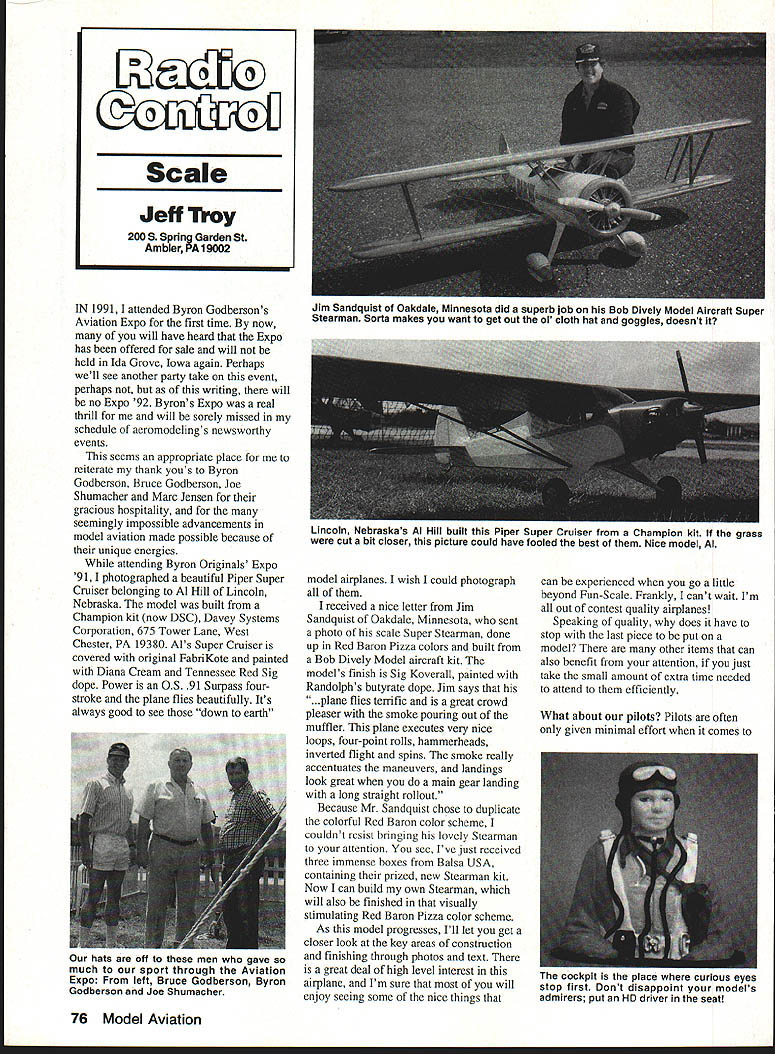
I received a nice letter from Jim Sandquist of Oakdale, Minnesota, who sent a photo of his scale Super Stearman, done up in Red Baron Pizza colors and built from a Bob Dively Model Aircraft kit. The model's finish is Sig Koverall, painted with Randolph's butyrate dope. Jim says that his "plane flies terrific and is a great crowd pleaser with the smoke pouring out of the muffler. This plane executes very nice loops, four-point rolls, hammerheads, inverted flight and spins. The smoke really accentuates the maneuvers, and landings look great when you do a main gear landing with a long straight rollout."
Because Mr. Sandquist chose to duplicate the colorful Red Baron color scheme, I couldn't resist bringing his lovely Stearman to your attention. You see, I've just received three immense boxes from Balsa USA, containing their prized new Stearman kit. Now I can build my own Stearman, which will also be finished in that visually stimulating Red Baron Pizza color scheme. As this model progresses, I'll let you get a closer look at the key areas of construction and finishing through photos and text. There is a great deal of high-level interest in this airplane, and I'm sure that most of you will enjoy seeing some of the nice things that can be experienced when you go a little beyond Fun-Scale. Frankly, I can't wait. I'm all out of contest-quality airplanes.
Speaking of quality, why does it have to stop with the last piece to be put on a model? There are many other items that can also benefit from your attention, if you just take the small amount of extra time needed to attend to them efficiently.
Pilot Figures: Why They Matter
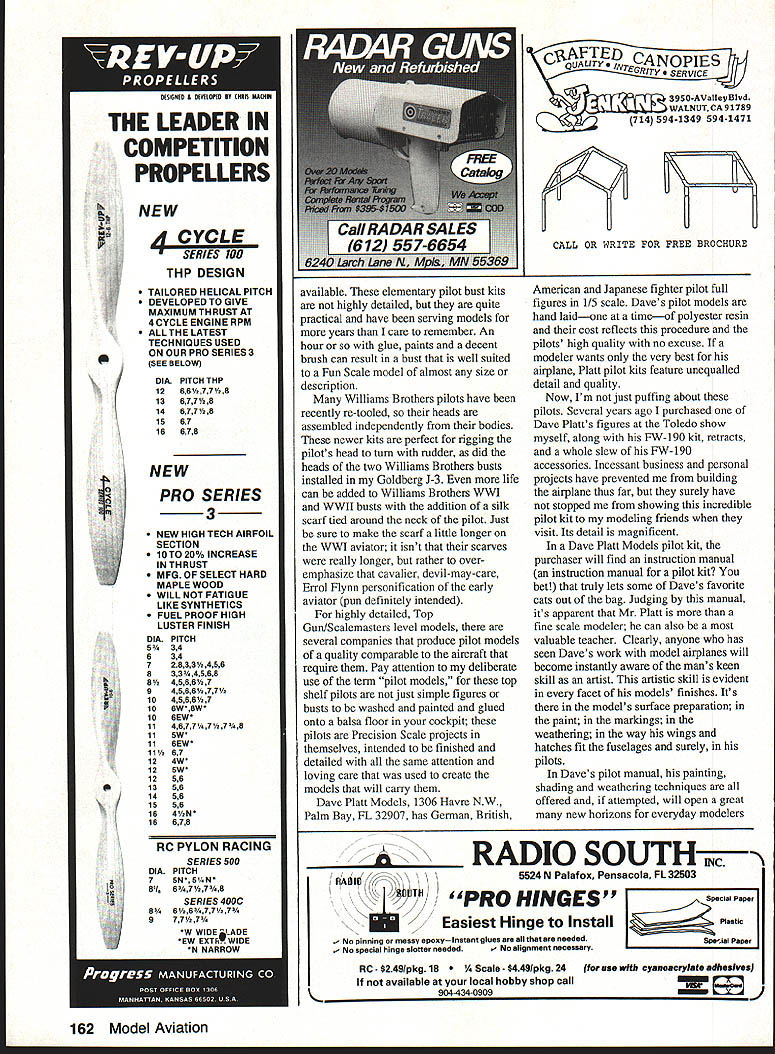
What about our pilots? Pilots are often only given minimal effort when it comes to model airplanes, scale or otherwise. The logic puzzles me, but I've actually seen modelers go to great lengths to turn out flawless scale Christen Eagles, Stearmans and Fokkers, then negate the whole effort by capping them off with Snoopy dolls or some Sesame Street monster pirated from their kid's toy box. Really, guys, there's nothing wrong with having a bit of fun with our airplanes—that's why we do this. But isn't the basic premise of scale modeling to see how close to authenticity we can get, rather than how far away?
Of course it is, so over the next few issues, you're going to get a look at what's available in pilots for Fun Scale, Sport Scale and Precision Scale model airplanes. Incidentally, you may find that one or more of these pilots can go a long way toward dressing up a non-scale, sport model, too. Sorry, friends, but Snoopy never really did fly an airplane.
It's true! Your model's overall appearance can change drastically from no more effort than the simple addition of a correct pilot figure. If you don't think this is so, take note of your own eye's motion next time you examine a new airplane on the flying field.
The model will be taken from someone's car and the first place on which your eye will focus will be the model's "cockpit." Why? Because that's where the "driver" sits, and it is also the first place where any ground-bound pilot would like to see himself. Having a suitable pilot in the driver's seat will surely make a better impression on admirers of your model than a Goofy doll or Spider-Man. You may not get the same chuckle, but you didn't build that scale model to be laughed at, did you? If you want to make the most of your pilot, naturally, the figure must be of a scale, time period and costume to suit the model in which it will sit. A figure dressed in contemporary civilian clothing will not contribute a thing to a model of a Bleriot or a Sopwith Camel, nor will a leather-jacket-clad World War Two figure with parachute and oxygen mask do anything for a Piper Cherokee. The figure flying your model should be given the same consideration to authenticity that would have been given to any other of the airplane's major components.
Even though they're not labeled "Fun-Scale," "Sport Scale," or otherwise, the sophistication of detail on commercially available pilot figures provides modelers with a wide means of placing them into appropriate categories of scale suitability. Where, why and when the pilot will ultimately be used, however, like almost everything else in the world of scale, will always be the builder's personal judgment call. A commercial figure with enough detail to be considered "Precision Scale" can always be placed into a less complex model, but the modeler may want to think twice before installing a Fun-Scale figure into a more serious, competition-level scale model.
Sport Scale Pilots
Pilot figures suitable for Sport Scale models are available from several sources. They range in quality from average to excellent and can be found on almost any flying field, in models flown by the keenest competition pilots to the most laid-back Sunday fun-seekers. A good Sport Scale pilot should be one that is easily assembled and finished, without having to spend excruciating hours agonizing over too many superfluous details. Quite often, a good Sport Scale figure can be brought to a higher level of sophistication by spending just a little more time with the paint brush and adding one or two subtle details in the right places.
HD Products, from Hobby Dynamics Distributors, 4105 Filestone Road, Champaign, IL 61821, has a line of pilots that fit the Sport Scale description perfectly. HD pilots feature sharp detail for a very reasonable price and the line is readily available through most hobby stores.
Molded of latex and requiring no assembly, a thorough washing to remove mold and release chemical residues is all that's needed to prepare one of HD's sky drivers for painting. HD Products' pilot busts are available in the following descriptions:
- U.S. WWII: 1/3, 1/4, 1/9 and 1/10 scales
- U.S. WWI, German WWI, British WWI, and jet busts: 1/5, 1/6, 1/7, 1/9 and 1/10 scales
- Japanese WWII: 1/7, 1/9 and 1/10 scales
- Female bust: 1/4, 1/5, 1/9 and 1/10 scales
- Sportsman bust: 1/4, 1/5, 1/9 and 1/10 scales
- German Golden Years bust: 1/6 scale
- Civilian busts: 1/3 through 1/10 scales
Plans to release additional HD pilots have been advertised and more prototypes of racing busts can be expected soon. One of HD's WWII pilots will be used in my DynaFlite P-51 and I'm very happy with the way this figure turned out. For my investment of only an hour's work, I have a highly detailed pilot bust that will surely enhance the overall impact of my model significantly.
Fun Scale Pilots
In the Fun Scale category, Williams Brothers must take the credit for offering the simplest, least expensive generic pilots available. These elementary pilot bust kits are not highly detailed, but they are quite practical and have been serving modelers for more years than I care to remember. An hour or so with glue, paints and a decent brush can result in a bust that is well suited to a Fun Scale model of almost any size or description.
Many Williams Brothers pilots have been recently re-tooled, so their heads are assembled independently from their bodies. These newer kits are perfect for rigging the pilot's head to turn with rudder, as did the heads of the two Williams Brothers busts installed in my Goldberg J-3. Even more life can be added to Williams Brothers WWI and WWII busts with the addition of a silk scarf tied around the neck of the pilot. Just be sure to make the scarf a little longer on the WWII aviator; it isn't that their scarves were really longer, but rather to over-emphasize that cavalier, devil-may-care Errol Flynn personification of the early aviator (pun definitely intended).
Precision Scale Pilots
For highly detailed, Top Gun/ScaleMaster-level models, there are several companies that produce pilot models of a quality comparable to the aircraft that require them. Pay attention to my deliberate use of the term "pilot models," for these top-shelf pilots are not just simple figures or busts to be washed and painted and glued onto a balsa floor in your cockpit; these pilots are Precision Scale projects in themselves, intended to be finished and detailed with all the same attention and loving care that was used to create the models that will carry them.
Dave Platt Models, 1306 Havre N.W., Palm Bay, FL 32907, has German, British, American and Japanese fighter pilot full figures in 1/5 scale. Dave's pilot models are hand laid—one at a time—of polyester resin and their cost reflects this procedure and the pilots' high quality with no excuse. If a modeler wants only the very best for his airplane, Platt pilot kits feature unequalled detail and quality.
Now, I'm not just puffing about these pilots. Several years ago I purchased one of Dave Platt's figures at the Toledo show myself, along with his FW-190 kit, retractions, and a whole slew of his FW-190 accessories. Incessant business and personal problems have prevented me from building the airplane thus far, but they surely have not stopped me from showing this incredible pilot kit to my modeling friends when they visit. Its detail is magnificent.
In a Dave Platt Models pilot kit, the purchaser will find an instruction manual (an instruction manual for a pilot kit? You bet!) that truly lists some of Dave's favorite hints about building, painting and rigging—it's apparent that Mr. Platt is more than a fine scale modeler; he is an artist and a valuable teacher. Clearly, anyone who has seen Dave's work with model airplanes will become instantly aware of the man's keen skill as an artist. This artistic skill is evident in every facet of his models' finishes. It's also in the modeler's surface preparation; in the paint; in the markings; in the weathering; in the way his wings and hatches and fuselages—and surely, in his pilots.
In Dave's pilot manual, his painting, shading and weathering techniques are offered and, if attempted, will open a great many new horizons for everyday modelers who want to accomplish something new and exciting with each new project they undertake.
Next issue, I'll show you more commercially available pilot kits for Sport, Fun and Precision Scale models. I've only just touched on what's available, so stay with me. There's so-o-o-o much more to see.
The DynaFlite P-51 is totally framed and is presently being covered. With a little luck, this column's next installment should bring photos of the final changes in the model's construction. 'Til then, build straight and fly safely!
Transcribed from original scans by AI. Minor OCR errors may remain.

