
Radio Control: Scale
Jeff Troy
200 S. Spring Garden St. Amber, PA 19002
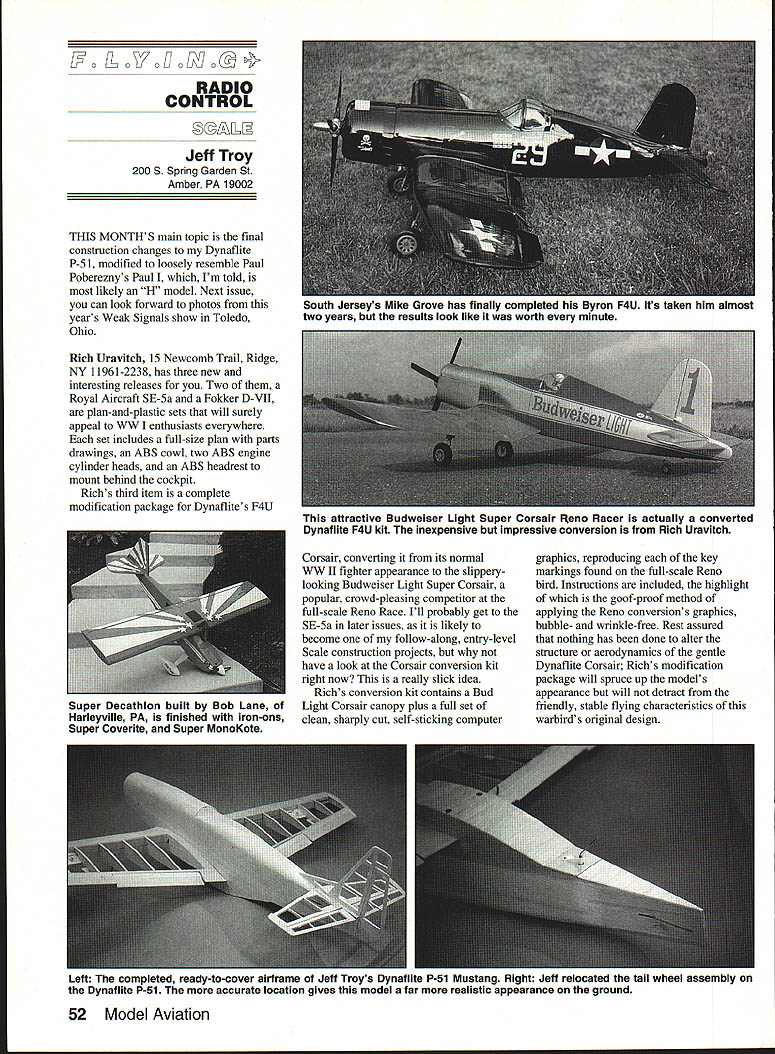
THIS MONTH'S main topic is the final construction changes to my Dynaflite P-51, modified to loosely resemble Paul Poberezny's "Paul I" (most likely an "H" model). Next issue, look for photos from this year's Weak Signals show in Toledo, Ohio.
New releases from Rich Uravitch
Rich Uravitch 15 Newcomb Trail Ridge, NY 11961-2238
Rich has three new releases:
- Royal Aircraft SE-5a (plan-and-plastic set)
- Fokker D-VII (plan-and-plastic set)
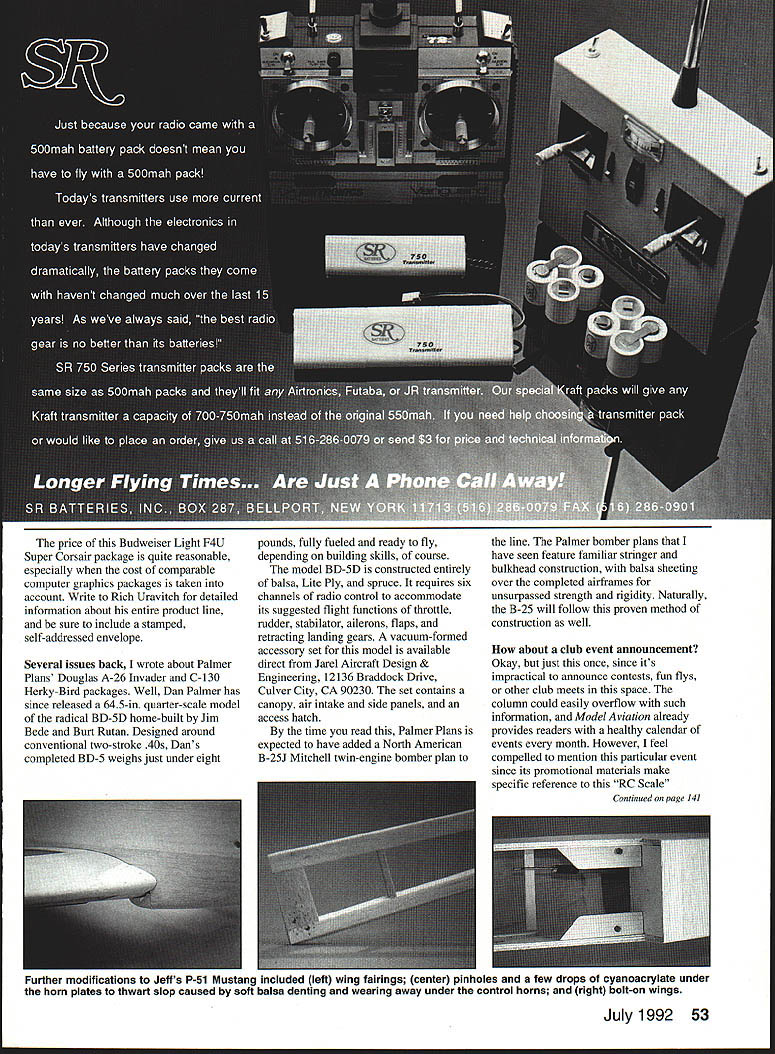
- A complete modification package for Dynaflite's F4U Corsair converting it to the Budweiser Light Super Corsair (Reno racer scheme)
Each of the SE-5a and Fokker D-VII sets includes:
- A full-size plan with parts drawings
- An ABS cowl
- Two ABS engine cylinder heads
- An ABS headrest for behind the cockpit
The Corsair conversion kit contains:
- A Bud Light Corsair canopy
- A full set of clean, sharply cut, self-sticking computer graphics reproducing the key Reno markings
- Instructions, including a goof-proof method for applying the graphics bubble- and wrinkle-free
Nothing in the conversion alters the Dynaflite Corsair's structure or aerodynamics; it improves appearance without affecting the model's stable flying characteristics. The price is reasonable compared with comparable graphics packages. For detailed information, write Rich Uravitch and include a stamped, self-addressed envelope.
Palmer Plans updates
Dan Palmer has released a quarter-scale BD-5D (64.5 in.) of the radical BD-5 home-built (Jim Bede/Burt Rutan design). Highlights:
- Designed for conventional two-stroke .40 engines
- Completed weight: just under eight pounds fully fueled (depending on building skills)
- Construction: balsa, Lite Ply, and spruce
- Required radio: six channels for throttle, rudder, stabilator, ailerons, flaps, and retracting landing gear
Vacuum-formed accessory set (canopy, air intake, side panels, access hatch) is available from Jarel Aircraft Design & Engineering, 12136 Braddock Drive, Culver City, CA 90230.
Palmer Plans is also expected to add a North American B-25J Mitchell twin-engine bomber to the line. Palmer bomber plans use familiar stringer-and-bulkhead construction with balsa sheeting over the completed airframe for strength and rigidity; the B-25 will follow this method.
Club event announcement
Keystone Radio Control (KRC), host of America's premier annual Electric Fly, will hold its first Cub Food and Fun Fly on Saturday, August 15, 1992. Details:
- Open flying all day, emphasis on the Piper Cub (all types welcome)
- Food served from noon until it runs out; free to KRC members and registered nonmembers
- AMA licenses required for all fliers, as are 1991 transmitters and receivers
- One award: Pilots' Choice for Best Scale Cub Flown
Event announcements reference the Cub articles from October and December 1991 and January 1992. If you’ll be in the Northeast in August, consult the Model Aviation calendar, write for additional information, and plan to attend.
Tip of the month
From Stan Novak, Crab Rag (newsletter of the Chesapeake Bay Radio Control Club): "If you eat bacon, the plastic liner supplied makes an excellent template, marker, or epoxy mixing pad. Don't forget to wash the grease off first!" Thanks, Stan.
Reader projects and product notes
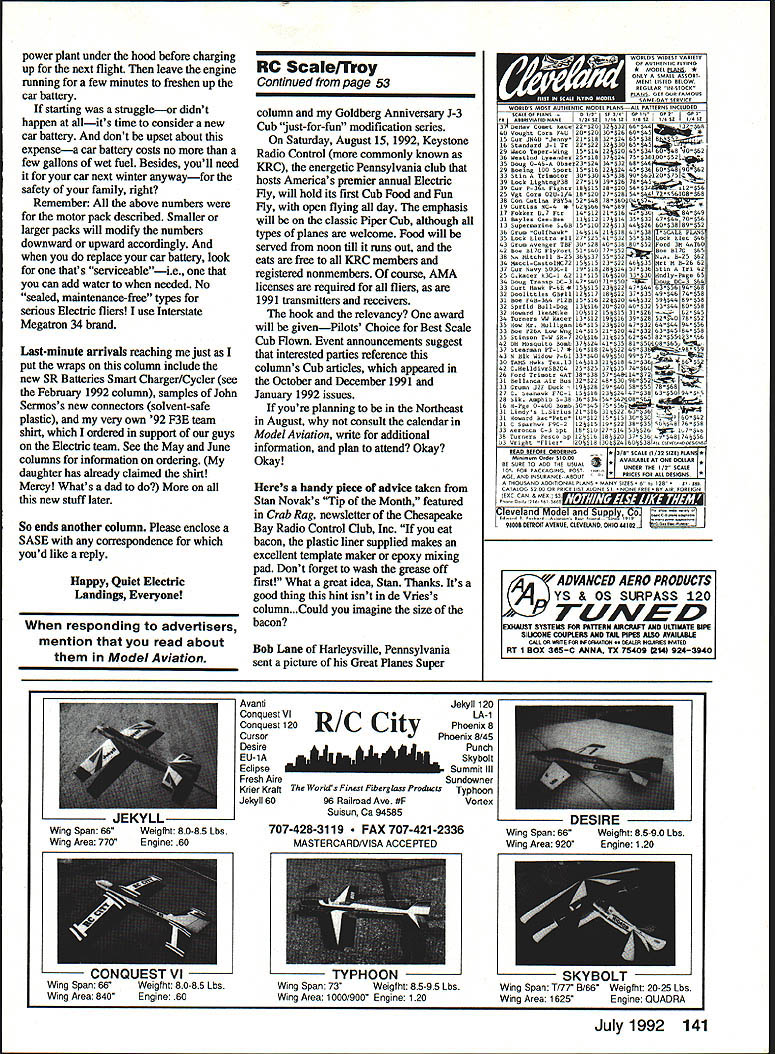
Bob Lane — Great Planes Super Decathlon
- Built a Decathlon that’s competitive in appropriate events but not an all-consuming project
- Hinges:
- Model Products Corporation De-Hinges on elevators and rudder (available from Model Products Corporation, P.O. Box 314, Pompton Plains, NJ 07444). De-Hinges allow easy removal of control surfaces when angled to 90°.
- Ailerons hinged with 1/8-in. piano wire
- Spintronics Easy-Hinges (7865 Mill Road, Elkins Park, PA 19117) — simple to install: cut slit, insert hinge, touch with a few drops of thin CyA
- Finishing:
- Computer-cut graphics from Custom R/C Graphics (4138 Boston Road, Bronx, NY 10475)
- Covered airframe with Super Coverite (natural woven cloth with heat-activated adhesive — Coverite, 420 Babylon Road, Horsham, PA 19044)
- Outer covering with Super MonoKote (Top Flite, Great Planes Model Distributors, P.O. Box 9021, Champaign, IL 61826-9021)
- Because the cloth is porous, plastic film can be ironed over it; the weave shows through and no priming, sealing, or painting was required
Mike Grove
- Sent a photo of a Byron Originals F4U Corsair using Robart retracts and a Sachs engine in Byron's Byro-Drive unit. Hoping Mike has flown it successfully by now. Best to Kathy, Linda, Michelle, and Becky.
Gilbert Delagnes
- From Healdsburg, California; flew P-51H models with the 57th Fighter Group in 1947
- Believes Poberezny's P-51 "Paul" is an H model, and his comparison supports the Dynaflite alteration being an H model. If corrections are necessary, reader letters will let us know.
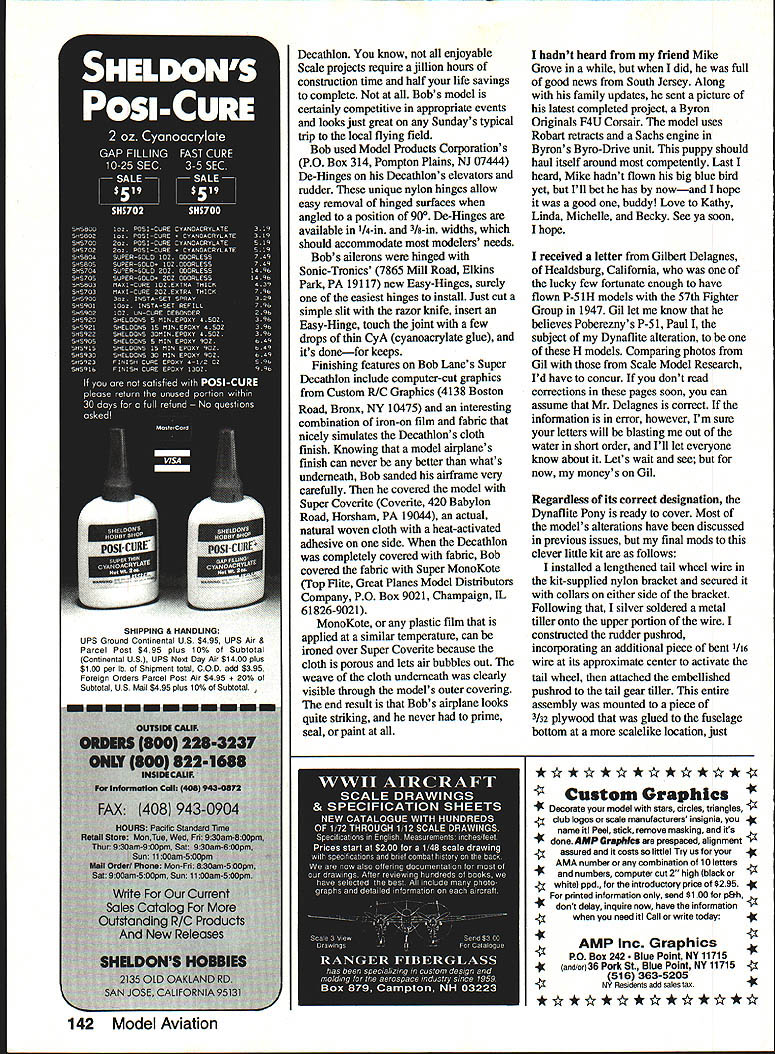
Dynaflite P-51 final modifications
Regardless of the exact designation, the Dynaflite Mustang (Paul) is ready for covering. Final modifications include:
Tail wheel and tank:
- Installed a lengthened tail wheel wire in the kit-supplied nylon bracket and secured it with collars on either side
- Covered the tank with two coats of epoxy and incorporated a bent 1/16-in. wire to activate the tail wheel
- Attached the wheel to the fuselage bottom at a more scale location, just behind the rear of the Mustang's belly scoop for a proper stance and authentic appearance
Bolt-on wing installation (recommended even for entry-level kits):
- Fill dowel holes.
- Install two hard maple blocks inside the fuselage.
- Add a pair of 1/4-in. dowels to the wing; the dowels run from the ply dihedral brace to a point 7/8 in. beyond the leading edge.
- Drill holes for the dowels in the appropriate fuselage bulkhead and mount the wing.
- Drill two 3/16-in. holes through the wing into the maple blocks.
- Remove the wing, enlarge the wing holes to 1/4 in., and tap the maple blocks for 1/4-20 nylon bolts.
- Apply Zap cyanoacrylate to the threads, allow to cure, and tap again — this ensures extremely hard, long-lasting threads.
Leading-edge wing root fairings:
- Used K&B microballoons and polyester resin
- Method:
- Mount the wing and form molds from two pieces of thin cardboard folded to shape and taped to the leading edges.
- Mix one ounce of K&B polyester resin with 12 drops of catalyst.
- Add microballoons until a thick paste forms.
- Fill the pockets formed by the cardboard molds with the paste.
- When resin dried, remove the cardboard, pull/scrape/sand, and finish with Goldberg's Model Magic where needed.
- Result: authentic-looking wing root leading edges; the process was quick (about an hour).
Preventing control-horn slop:
- To avoid softening balsa and slop under control horns:
- Poke several pinholes around the horn mounting area on both sides of the wood.
- Saturate the pinholes with Zap cyanoacrylate.
- Re-sand when dry.
- This strengthens the area and prevents slop caused by softened or worn balsa.
The Mustang's covering details will follow soon. Paul I is very visual — a colorful, powerful, dynamic scheme that’s unmistakably Mustang.
Closing
That's it for now. I'm leaving for the Weak Signals show in two days and expect to show some great-looking models in next month's column. 'Til then, build straight, and fly safely. I'll talk with you again.
Transcribed from original scans by AI. Minor OCR errors may remain.

