
Radio Control: Scale
Bud Atkinson
NOW WITH THE elections and the football season over, we can devote more time to that new scale job. And this is the time of year we all start thinking about the many trade shows.
In the last several years the kit and accessory manufacturers definitely have leaned toward Stand-off Scale. It is amazing how many different types of aircraft are possible to build and fly compared to just five years ago, when the J-3 Cub or Fairchild PT-19 was the backbone of scale types to build. I can hardly wait to see some of the new subjects the kit manufacturers will come up with this year.
Rather slow in coming are some of the great aircraft of the golden age of aviation—the years before WW II, 1929 to 1939. The thirties were the heydays of racing. Some interesting subjects were being turned out in those days and many make good Stand-Off Scale subjects. Many of the early aircraft companies were small, turning out many new designs in hope of landing a military contract because, in the 30's, depression years, it was mostly the services that were buying airplanes. The 30's also were the years that many oil companies sponsored flying advertising. They all were in on the act—Shell, Texaco and so on, and they had money to buy the best available. Many new aircraft companies cropped up in barns, garages and sheds to bid on the market for the one to three special aircraft.
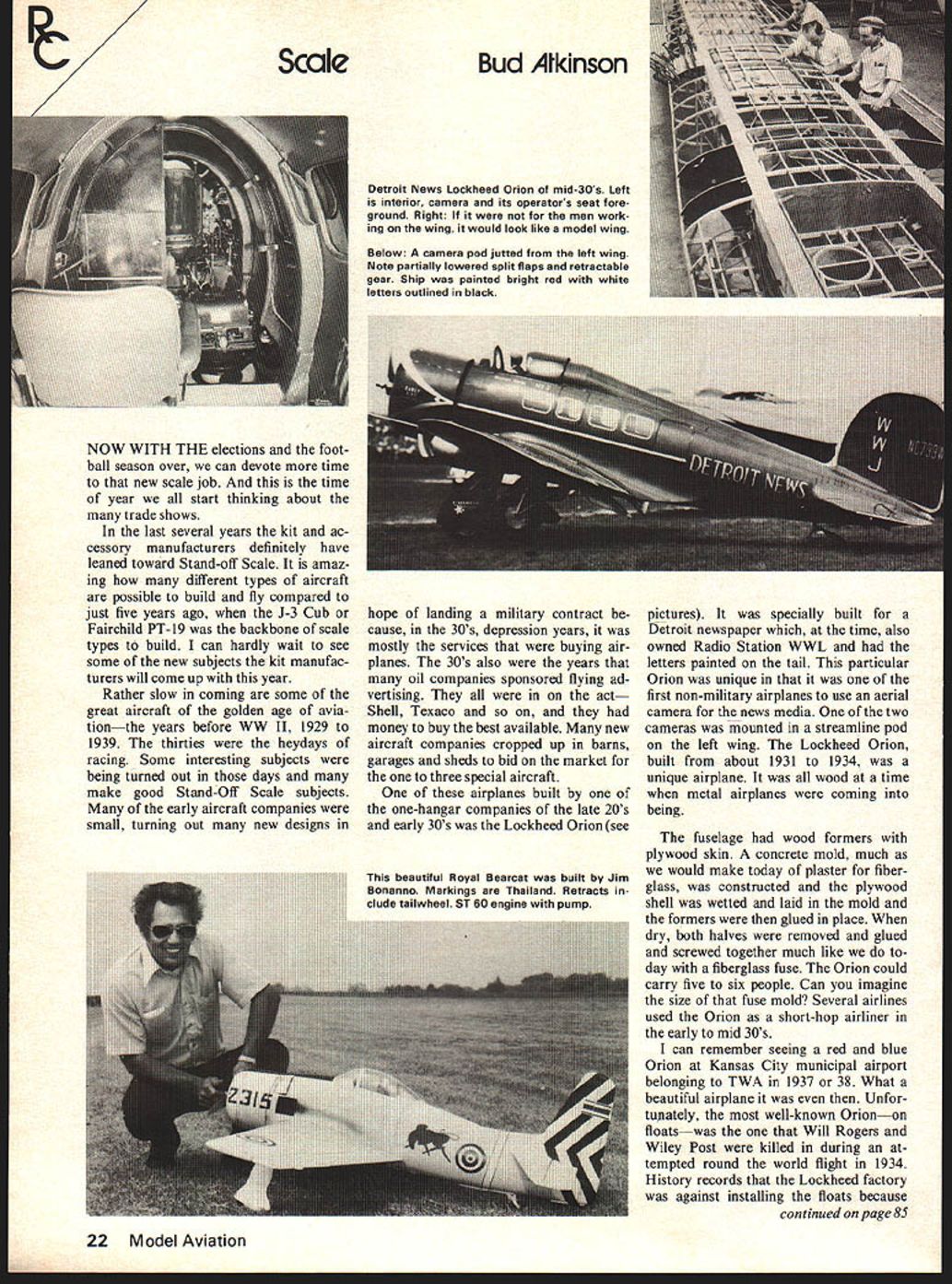
One of these airplanes built by one of the one-hangar companies of the late 20's and early 30's was the Lockheed Orion (see pictures). It was specially built for a Detroit newspaper which, at the time, also owned Radio Station WWJ, and had the letters painted on the tail. This particular Orion was unique in that it was one of the first non-military airplanes to use an aerial camera for the news media. One of the two cameras was mounted in a streamline pod on the left wing. The Lockheed Orion, built from about 1931 to 1934, was a unique airplane. It was all wood at a time when metal airplanes were coming into being.
The fuselage had wood formers with plywood skin. A concrete mold, much as we would make today of plaster for fiberglass, was constructed and the plywood shell was wetted and laid in the mold and the formers were then glued in place. When dry, both halves were removed and glued and screwed together much like we do today with a fiberglass fuse. The Orion could carry five to six people. Can you imagine the size of that fuse mold? Several airlines used the Orion as a short-hop airliner in the early to mid 30's.
I can remember seeing a red and blue Orion at Kansas City municipal airport belonging to TWA in 1937 or 38. What a beautiful airplane it was even then. Unfortunately, the most well-known Orion—on floats—was the one that Will Rogers and Wiley Post were killed in during an attempted round the world flight in 1934. History records that the Lockheed factory was against installing the floats because
Radio Control: Scale
they made the plane nose-heavy. During a takeoff in Alaskan waters the plane nosed over and both occupants were drowned. So we see that, be it full-size or model, a plane improperly balanced can be a disaster.
As far as is known there are no all-wood Lockheed Orions left. There is an all-metal Orion that was built for Shell Oil Company that Jim Doolittle used to break several records in the 30's. It has been restored and is presently in a museum. As far as is known it's the only Orion that was metal-skinned. An all-wood Orion was reported to have been sold to the Spanish government at the time of their Civil War and no doubt was destroyed in the war since there has been no trace of it since.
At least one wood Orion saw service in the U.S. It belonged to the Air Corps and was painted olive drab with Col. Paul Metz's name below the cockpit. It ended its life on the scrap heap as have many fine birds of the golden years of aviation. The point of all this is to emphasize the fact that, I think, that much of the fun of scale building and flying is in the seeking of information and knowledge of the great and not so great flying machines of the past as well as the present. It may be that you will find unusual facts on a particular airplane and the people who built and flew them. Many facts help you in building and flying your model.
Bud Atkinson, 734 North 6th Street, Terrace, Blue Springs, MO 64015.
Transcribed from original scans by AI. Minor OCR errors may remain.

