
Radio Control: Scale
By Jeff Troy
200 S. Spring Garden St. Amber, PA 19002
Every now and then, it really is fun to gloat! Can you imagine a profession that demands attendance at events like model hobby trade shows, flying competitions, fun flys, and visits to major hobby shops and various manufacturers of hobby products? Tough life, but since someone has to sweat this hard, I thought it might as well be me.
In keeping with my assumed, obviously hard-at-work identity, the month of May brought my wife, Lisa, my 20-month-old daughter, Devin, and me to the lovely state of Florida for two of RC modeling's more entertaining events. The first of these was the debut of the Orlando International Modeler Show.
Modeling trade shows are always good fun, and it isn't difficult to understand why. The industry's latest and greatest offerings are usually on display and available for hands-on inspection; many of the country's finest craftsmasters treat showgoers to first glimpses of their newest creations at the static display competitions; and of course there are often fabulous savings in show swap shops, exhibiting hobby shops, and from manufacturers.
On May 1–3, the Radio Control modeling community was treated to the premiere of a fine show, the Orlando IMS. The three-day International Modeler Show took place at Orlando's spacious Orange County Convention/Civic Center, a facility that features wide aisles, an enormous show floor, spotless rest rooms, good food, and enough parking to accommodate every modeler on the face of the planet. While I busied myself with the business of RC modeling, my wife and daughter happily entertained themselves poolside, helped along by some of the nicest Florida weather I've ever seen.
My meanderings about our social activities could go on for a very long time, so I'll shut myself down before I lose you. After all, it's the Scale modeling information that gets tuned here each month, and on this particular Florida trip there was quality Scale activity by the truckload.
Orlando International Modeler Show — highlights
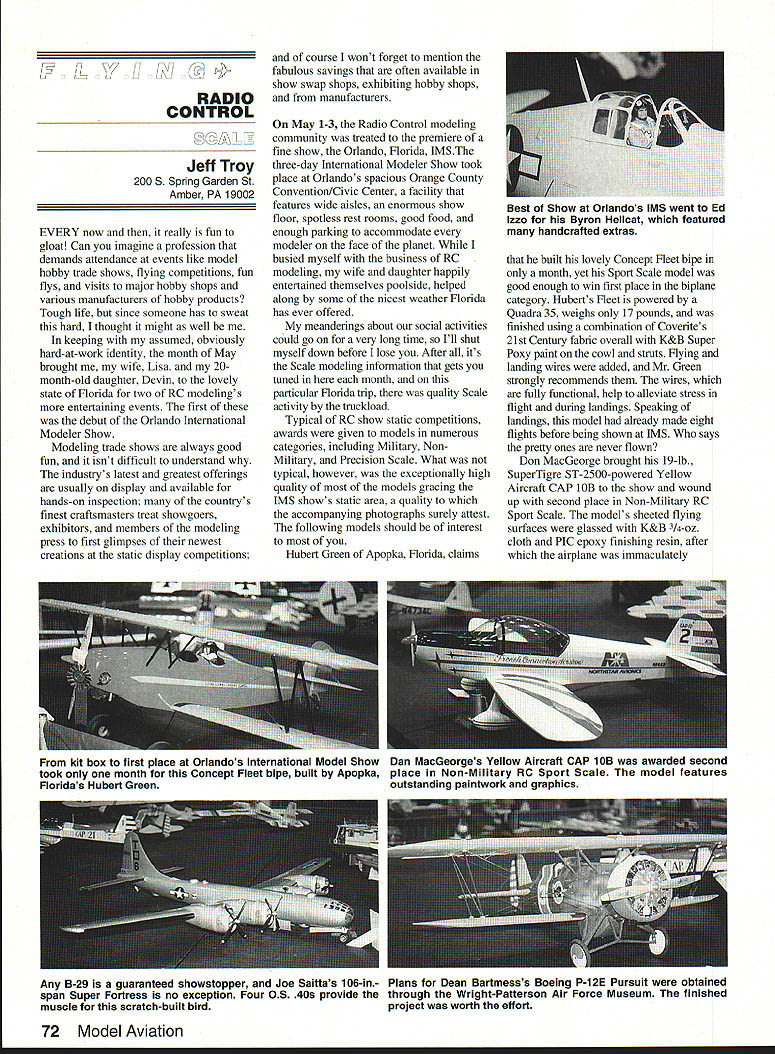
Typical of RC show static competitions, awards were given to models in numerous categories, including Military, Non-Military, and Precision Scale. What was not typical, however, was the exceptionally high quality of most of the models in the IMS static area — a quality to which the accompanying photographs surely attest. The following models should be of interest to most readers.
- Hubert Green — Concept Fleet biplane (Sport Scale)
- Built in about a month; won first place in the biplane category.
- Powered by a Quadra 35; weighs about 17 pounds.
- Covered with Coverite 21st Century fabric overall; cowl and struts painted with K&B Super Poxy.
- Flying and landing wires added; Mr. Green strongly recommends fully functional wires to alleviate stress in flight and during landing.
- Had already made eight flights before being shown at IMS. He says pretty ones are never flown.
- Don MacGeorge — Yellow Aircraft CAP 10B (Non-Military RC Sport Scale, 2nd place)
- Weighs 19 pounds; powered by a SuperTigre ST-2500.
- Sheeted flying surfaces glassed with K&B 3/4-oz. cloth and PIC epoxy finishing resin.
- Finished in acrylic lacquer and urethane clear.
- Eight servos; J-Tec muffler; Great Planes Switch 'n Glow onboard glow ignition.
- Color graphics package available from Yellow Aircraft.
- Pat Rogers — R/C Taylorcraft
- Covered with light-grade Ceconite, treated with nitrate dope.
- Painted with white and red K&B Super Poxy; KHP Flex-Mask used for color separations.
- Weighs 27 pounds; guided by a JR Century Seven radio system; powered by an O.S. Gemini 1.2 twin.
- Joe Saitta — B-29 Super Fortress (scratch-built)
- Features retractable gear, bomb bay doors with functional bomb drop, and four O.S. .40 engines.
- Sprawling 106-inch wingspan; weighs about 17 pounds.
- Finish in acrylic lacquer; surface detail modest but effective.
- Dean Bartmess — Boeing P-12E Pursuit (scratch-built)
- Duplicated from extensive plans and documents from Wright-Patterson AFB Museum, the National Air and Space Museum, and Aero Publications.
- Powered by a Quadra 5.2; guided by a Futaba radio system; weighs 31 pounds.
- Finished with Chevron Hobby Products' Perfect Paint applied over Super Coverite.
- Ed Izzo — Byron F6F Grumman Hellcat (Best of Show)
- Gloss-yellow warbird guided by a JR Galaxy radio.
- Finish achieved by meticulously applying K&B Super Poxy over gray lacquer auto primer on fiberglass fuselage and Super Coverite-covered surfaces.
- Robart rotating retract gear; 4.2 Sachs in a Byron Power-Pac unit provides power.
- Custom molds for operating drop tanks; Vortac bomb release mechanisms used.
- Glenn Torrance / Bob Hanft — Fokker Dr.I triplane (kitted by Glenn Torrance Models)
- Glenn Torrance is kitting a superb Fokker Dr.I; Bob Hanft built and flew one at Top Gun last year (U.S. FAI Scale Team member).
- The kit is highly recommended for World War I enthusiasts.
- For information: Glenn Torrance Models, 2981 Vail Valley Court, Snellville, GA 30278.
Masking techniques and materials
Since I mentioned KHP Flex-Mask earlier, here's a sensible approach to masking:
- KHP makes vinyl masks in 1/8-in. and 1/4-in. widths.
- For color separation lines, I usually use 1/8-in. Flex-Mask or simple drafting tape from an art supply store.
- Regular department/hardware store masking tape has too aggressive an adhesive for model work and its serrated edges lead to ratty paint lines.
- My technique: mask up to the color line with Flex-Mask for curves and use Flex-Mask or drafting tape on straight edges.
- I only use regular masking tape to secure cut-to-fit pieces of plastic trash bags (for open areas) to the Flex-Mask or drafting-tape color separation masks. At no time will regular masking tape touch the surface of my model.
- Why plastic trash bags instead of paper masks? Paper absorbs liquid — paints are liquid. Simple as that.
If paper masks work for you, continue using them with my best wishes, but I have no interest in them myself.
Instructional video recommendation
If, like me, you build a pretty fair airplane but feel your flying could improve, consider Carl Goldberg Models' "Wring It Out!" (Vol. 1 and 2). The videos are Gulf Stream productions and feature the flying skills of Dave Patrick, Canadian National Pattern Champion. The point is not to turn Scale pilots into Pattern pilots, but to learn sound flying techniques and judgment from an expert. The lessons should help you think more clearly about flying and attain your goals.
Larry Hill's Taube
Many readers will remember Larry Hill's Christen Husky modification on a Goldberg J-3 Cub. Larry is back with a project too cute to pass up: a Balsa USA Taube with several authentic touches.
- Features: scalloped trailing edges, king and queen posts, flying and landing wires, a dummy Mercedes engine, and a near-authentic Taube undercarriage.
- Covered with Supershrink Coverite and finished in two shades of Min-Wax stain.
- Rib lines and crosses inked with marker pens, then oversprayed with Chevron Hobby Products Dead Flat Clear Perfect Paint.
- Pilot figures modified from Williams Brothers Sportsman busts, using large O-rings to achieve a cork-and-leather look.
- Powered by a Saito .65 — runs reliably, even inverted.
Closing / Next month
Next month I'll have a lifetime's worth of fantastic airplanes to drool over, including Bob Pickney's fabulous Beech D-18, winner of Team Scale at the recent 1992 Top Gun Scale Invitational — the second stop on my Florida trip.
Until then, build straight, and fly safely. I'll talk with you again.
Transcribed from original scans by AI. Minor OCR errors may remain.

