
Radio Control: Scale
Jeff Troy 200 S. Spring Garden St. Ambler, PA 19002
Top Gun Invitational — West Palm Beach
When the column ended last month, I had finished telling you about my trip to Florida for the Orlando International Modeler Show. Unfortunately, I didn't have the luxury of enough space to show you the kind of fun I had on the second half of my trip—eight days in West Palm Beach as the official scorekeeper for the 1992 Top Gun Invitational Scale contest. Now I do!
After packing up our booth at the IMS in Orlando, my wife, my daughter, and I headed for West Palm Beach and three days of fun, sun, and total relaxation before my working part of our holiday would begin. West Palm Beach and its kind people, along with the Palm Beach Polo Club, the hosts of the Top Gun event, were absolutely wonderful. Let me assure you that no better setting could have been chosen for the contest. Top Gun was definitely first class from beginning to end.
Scorekeeping and helpers
As Top Gun's scorekeeper, the first step of my job each year is to find two or three willing volunteers to help handle the endless flow of numbers that cross the scoring table. Well, I didn't have to look very far before the six hardest-working calculator drivers on the face of the planet found me first!
When I arrived for static scoring on Thursday morning, Top Gun's opening day, my right-hand person, Rosella Curry, riding on an energy level that would not quit for the entire weekend, was already waiting at the scorekeeping table to introduce herself. As Rose and I were discussing the mechanical details of the contest's scoring system, three of my old club buddies from the Atlantic County (New Jersey) Sky Blazers happened by the table to see if they could lend a hand. Could they? You bet!
Helpers who volunteered:
- Rosella Curry
- Chris Curry (Rosella's son)
- Chic Coombs
- Dave Coombs
- Bob Chapman
- Robin Riley
This report could not be complete without my acknowledgment of their tireless efforts on Top Gun's behalf.
Static judging
The first two full days of the meet, Thursday and Friday, were devoted to static judging only, with three skillful judges taking their time to carefully examine each and every square inch of each and every model. Out of a total of 49 of the finest model aircraft the competition world has to offer and a median score that eventually set itself in the high eighties, only five scores made it into the nineties. As one might expect in a contest situation where only the best of the best are invited to attend, the judging was tough. It was fair, it was accurate—but it was positively tough.
When the last of the 49 had been judged for Fidelity to Scale, based on the meticulous documentation provided to the judges by each modeler, Charles Nelson of Massachusetts and his Waco VKS-7F biplane had utterly humbled the field with a superb static score of 96.02, which at Top Gun is roughly the equivalent of scoring an 11 at the Olympic Games. Other entrants to score in the nineties were:
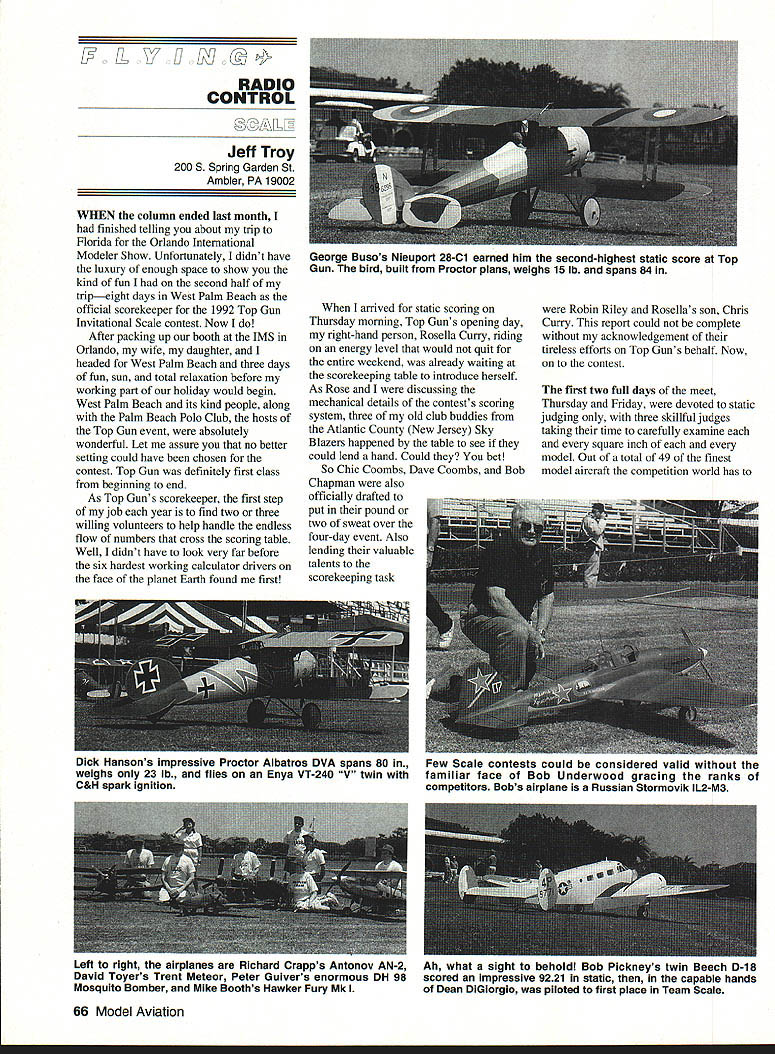
- George Buso — Nieuport 28-Cl, 93.55
- Mel Whitley — Hawker Sea Fury (1991 Top Gun winner), 92.27
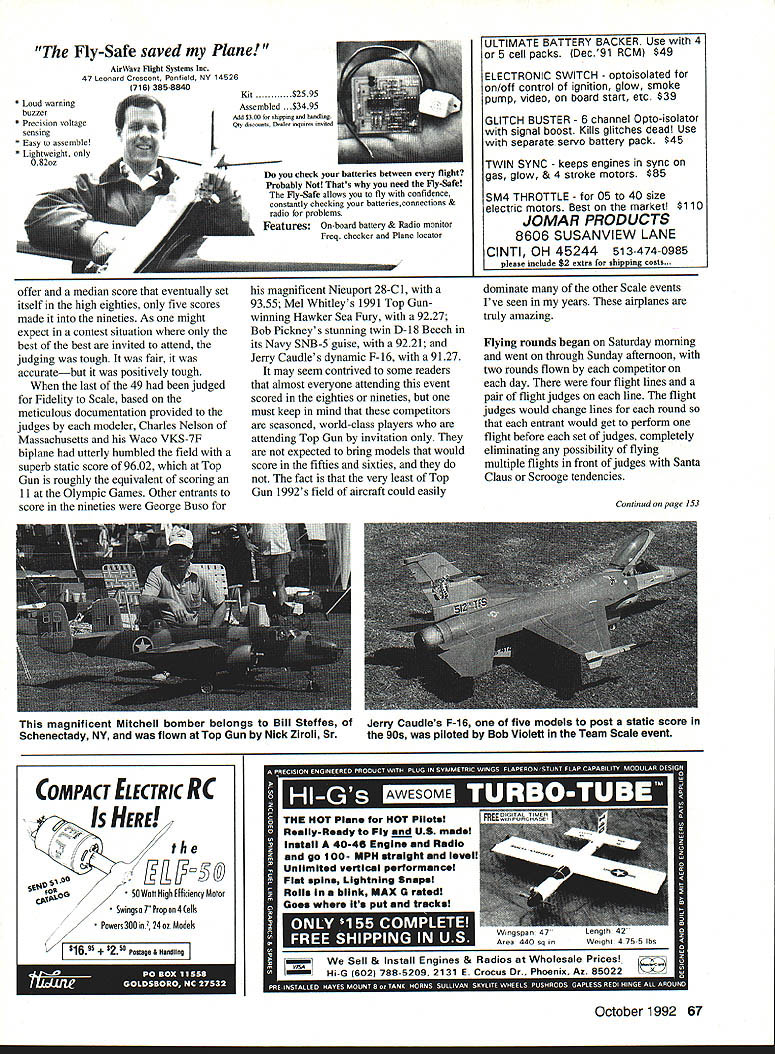
- Bob Pickney — twin D-18 Beech (Navy SNB-5), 92.21
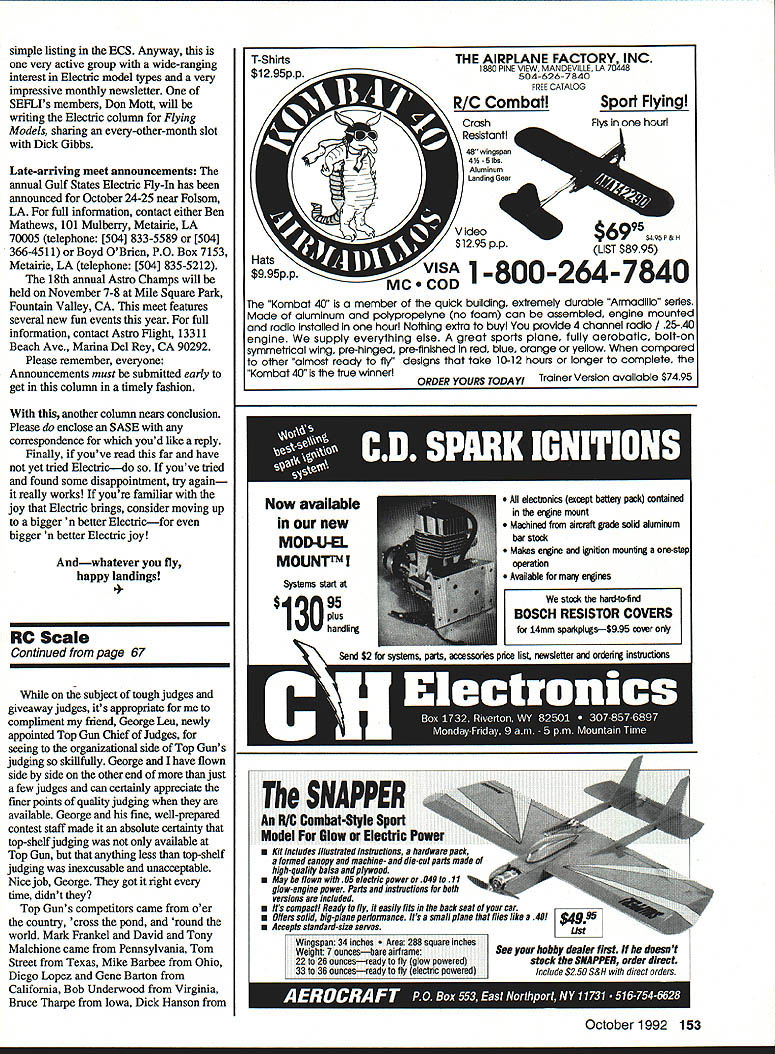
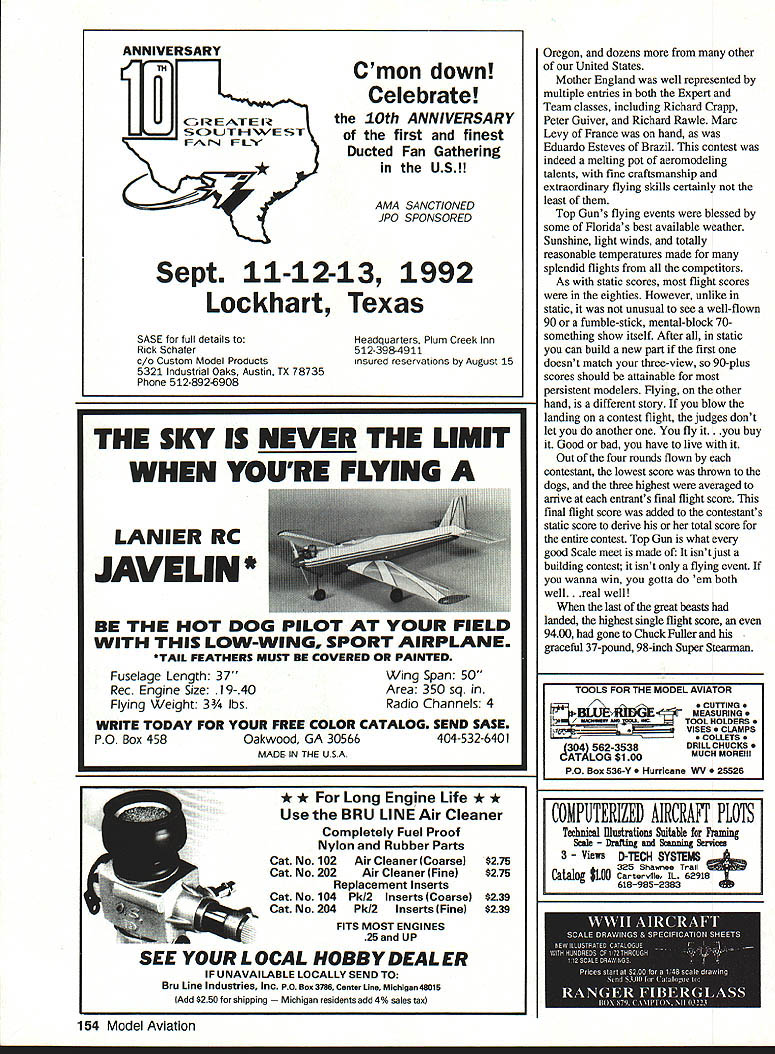
- Jerry Caudle — F-16, 91.27
It may seem contrived to some readers that almost everyone attending this event scored in the eighties or nineties, but one must keep in mind that these competitors are seasoned, world-class players who are attending Top Gun by invitation only. They are not expected to bring models that would score in the fifties and sixties, and they do not. The fact is that the very least of Top Gun 1992's field of aircraft could easily dominate many of the other Scale events I've seen in my years. These airplanes are truly amazing.
Flying rounds and judging
Flying rounds began on Saturday morning and went on through Sunday afternoon, with two rounds flown by each competitor on each day. There were four flight lines and a pair of flight judges on each line. The flight judges would change places for each round so that each entrant would get to perform a flight before a set of judges, completely eliminating any possibility of flying multiple flights in front of judges with Santa Claus or Scrooge tendencies.
While on the subject of tough judges and giveaway judges, it's appropriate for me to compliment my friend, George Lee, newly appointed Top Gun Chief of Judges, for seeing to the organizational side of Top Gun's judging so skillfully. George and I have flown side by side on the other end of more than just a few judges and can certainly appreciate the finer points of judging when they are available. George and his fine, well-prepared contest staff made it an absolute certainty that top-shelf judging was not only available at Top Gun, but that anything less than top-shelf judging was inexcusable and unacceptable. Nice job, George. They got it right every time.
Top Gun's competitors came from across the country and around the world, including:
- Mark Frankel, David Malichone, Tony Malichone — Pennsylvania
- Tom Street — Texas
- Mike Barbee — Ohio
- Diego Lopez, Gene Barton — California
- Bob Underwood — Virginia
- Bruce Thorpe — Iowa
- Dick Hanson — California
- Numerous others from across the United States
International entrants included:
- Richard Crapp, Peter Guiver, Richard Rawle — England
- Marc Levy — France
- Eduardo Esteves — Brazil
Top Gun's flying events were blessed by some of Florida's best available weather. Sunshine, light winds, and totally reasonable temperatures made for many splendid flights from all the competitors.
As with static scores, most flight scores were in the eighties. However, unlike in static, it was not unusual to see a well-flown 90 or a fumble-stick, mental-block 70-something show itself. After all, in static you can build a new part if the first one doesn't match your three-view, so 90-plus scores should be attainable for most persistent modelers. Flying, on the other hand, is a different story. If you blow the landing on a contest flight, the judges don't let you do another one. You fly it ... you buy it. Good or bad, you have to live with it.
Out of the four rounds flown by each contestant, the lowest score was discarded, and the three highest were averaged to arrive at each entrant's final flight score. This final flight score was added to the contestant's static score to derive his or her total score for the entire contest. Top Gun is what every good Scale meet is made of: it isn't just a building contest; it isn't only a flying event. If you wanna win, you gotta do 'em both well... real well!
When the last of the great beasts had landed, the highest single flight score, an even 94.00, had gone to Chuck Fuller and his graceful 37-pound, 98-inch Super Stearman. It wasn't enough, however—nor was anyone else's flight score enough—to displace the enormous lead that Charlie Nelson had gained on the pack with his 96.02 static score. When the flying was done, Charlie had won the event handsomely, finishing the four-day Top Gun Invitational with a total score of 186.52.
Results
Top finishers:
- Charles (Charlie) Nelson — Waco VKS-7F biplane — Total 186.52
- Mel Whitley — Hawker Sea Fury — Total 184.06
- Diego Lopez — Douglas Skyraider (90-inch) — Total 181.80
- Terry Nitsch — Violett F-86 Sabre — Total 180.62
- Jeff Foley — Dave Platt Models A6M3 Zero (completed in six weeks) — Total 180.15
Sixth through tenth places:
- Corvin Miller — Globe Swift
- George Buso — Nieuport 28-Cl
- Kent Nogy — F-86 Sabre
- David Hayes — Rockwell Thrush crop duster
- Bill Harris — F-86 Mk IV Sabre
Half-time entertainment
For pure enjoyment value, the half-time entertainment at Top Gun was the equal of the competition. Several notable modelers and manufacturers performed demonstrations that thrilled the thousands of spectators filling the Palm Beach Polo Club's multilevel grandstands.
Performers included:
- Bubba Spivey (Lanier RC) — aerobatic giant-size Stingers (single and formation)
- Mike Maus — an unbelievable aerobatic demonstration with a fixed-wing fun-fly model
- The Cloud Dancers Air Show Team — multiple routines, including an RC-assisted parachute drop
Two of aeromodelling's unique personalities handled the event's public address system: Dave Platt (Florida; England's loss) and Sam Wright (California). They described the details of every airplane and every flight to an appreciative public. Their knowledge of aviation facts and fantasies was astounding, with each pointing out little-known items concerning each airplane that had taken to the blue. The crowd was thoroughly entertained throughout the contest.
Sponsors
Top Gun is sponsored by a horde of major industry players who, through donations of cash, merchandise, or both, see to it that the event continues to grow in stature each year. Some of the many sponsors for 1992 were:
- Pacer Technology
- Model Airplane News
- Ace R/C
- Airtronics Incorporated
- Bob Violet Models
- Dave Platt Models
- Frank Tiano Enterprises
- Futaba
- Gene Barton Machine
- Hobby Dynamics
- House of Balsa
- Lanier R/C
- McDaniel R/C
- R/C Report
- Robert Manufacturing
- Sig Manufacturing
- Yellow Aircraft
Closing
For my close this month, I'll simply pass one more thank-you to Frank Tiano, Top Gun's designer and enthusiastic promoter, for taking his style of model aviation out of the back forty and into full view of an appreciative public, for still another fine Scale contest, and for one helluva good party!
So until next month, my friends, build straight and fly safely. I'll talk with you again.
—Jeff Troy 200 S. Spring Garden St., Ambler, PA 19002
Transcribed from original scans by AI. Minor OCR errors may remain.

