

Radio Control: Scale
Jeff Troy, 200 S. Spring Garden St., Ambler, PA 19002
No doubt about it: it's airplane-building time. In most parts of the country, snow, slush, ice, and tire chains are the order of the day, and no kind of weather could offer a better opportunity to open that new scale kit, lay out its plan sheets, pencil in your slick additions, and take the first few steps toward stunning the judges next season.
I'm not much of a psychic, but I know that many of you will create exceptionally wonderful airplanes during this long, cold winter. I know because I've been receiving an unusually high number of model photographs these past few months. It's a real pleasure to see the caliber of craftsmanship so many of you are capable of attaining. The last 20 or 30 models I've been privileged to view were so far above standard that it may be time for some of us to raise our personal standards a notch or two just to keep up!
Since it would be a shame to keep those pictures to myself, I'll share as many of them as I can this month.
Featured Models
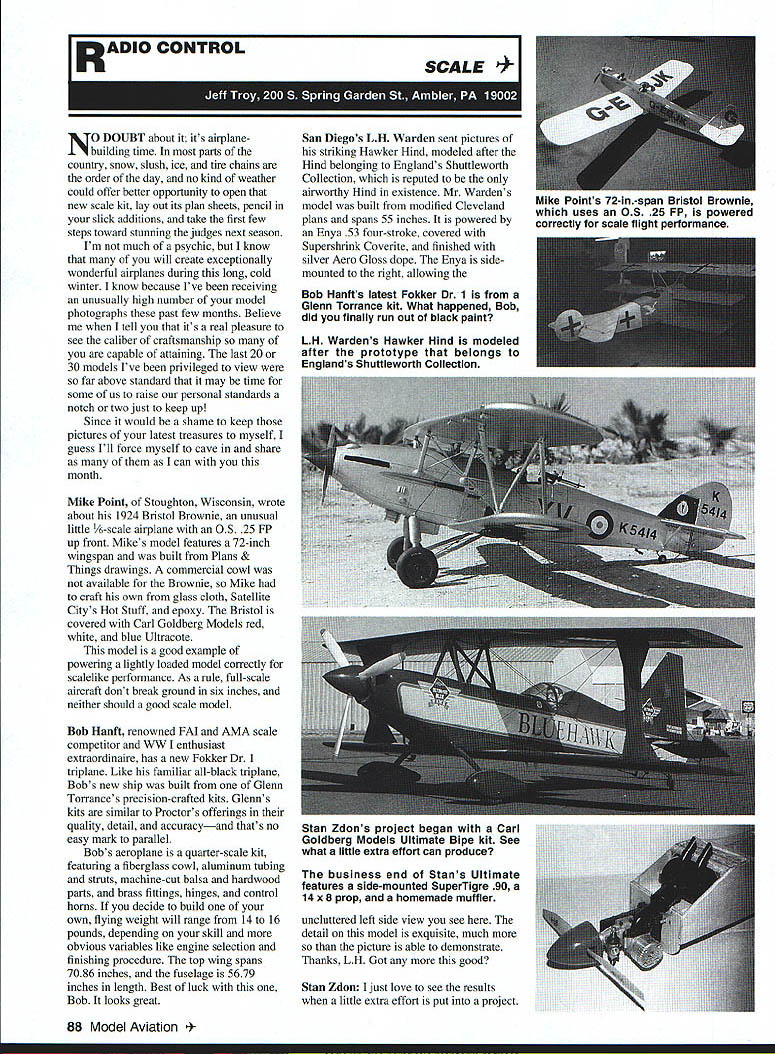
Mike Point — 1924 Bristol Brownie
- Modeler: Mike Point, Stoughton, WI
- Scale/details: 1/6-scale, 72-inch wingspan, Plans & Things drawings
- Power: O.S. .25 FP
- Construction/finish: No commercial cowl was available, so Mike crafted his own from glass cloth, Satellite City's Hot Stuff, and epoxy. Covered with Carl Goldberg Models red, white, and blue Ultracote.
- Note: A good example of powering a lightly loaded model correctly for scale-like performance. Full-scale aircraft don't break ground in six inches, and neither should a good scale model.
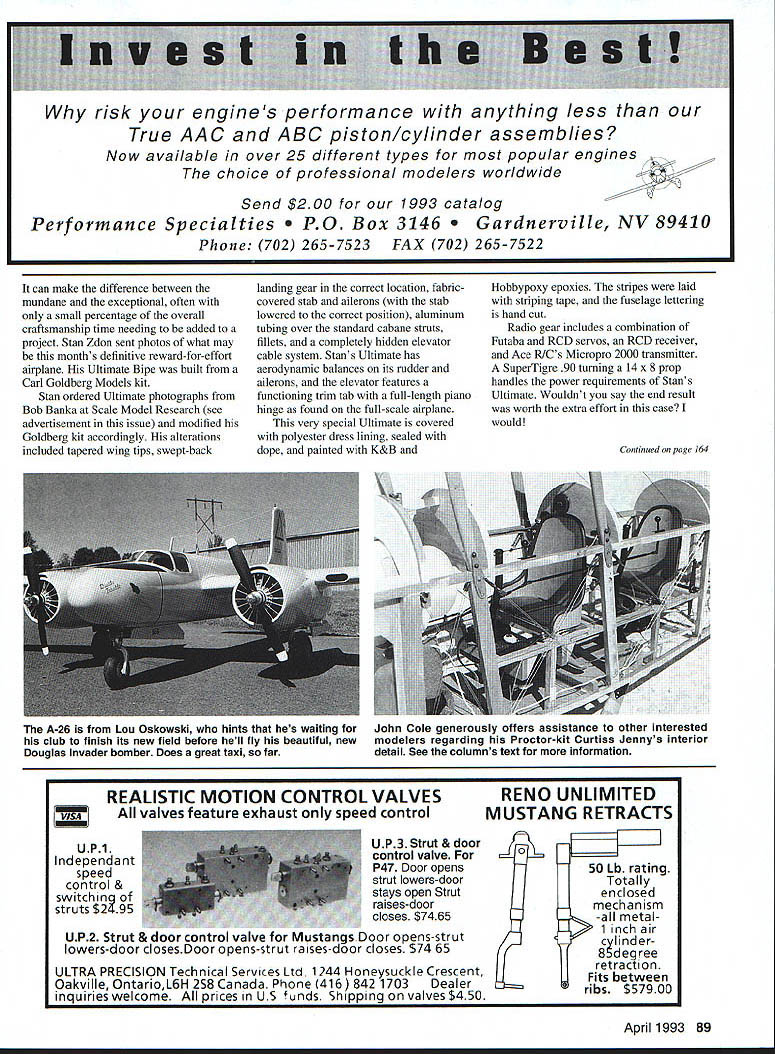
Bob Hanft — Fokker Dr. 1 Triplane
- Modeler: Bob Hanft (renowned FAI and AMA scale competitor)
- Kit: Glenn Torrance precision-crafted kit
- Scale/details: Quarter-scale; top wing span 70.86 in; fuselage length 56.79 in
- Construction/finish: Fiberglass cowl, aluminum tubing and struts, machine-cut balsa and hardwood parts, brass fittings, hinges, and control horns
- Flying weight: 14 to 16 lb (depends on engine selection, finishing, and building technique)
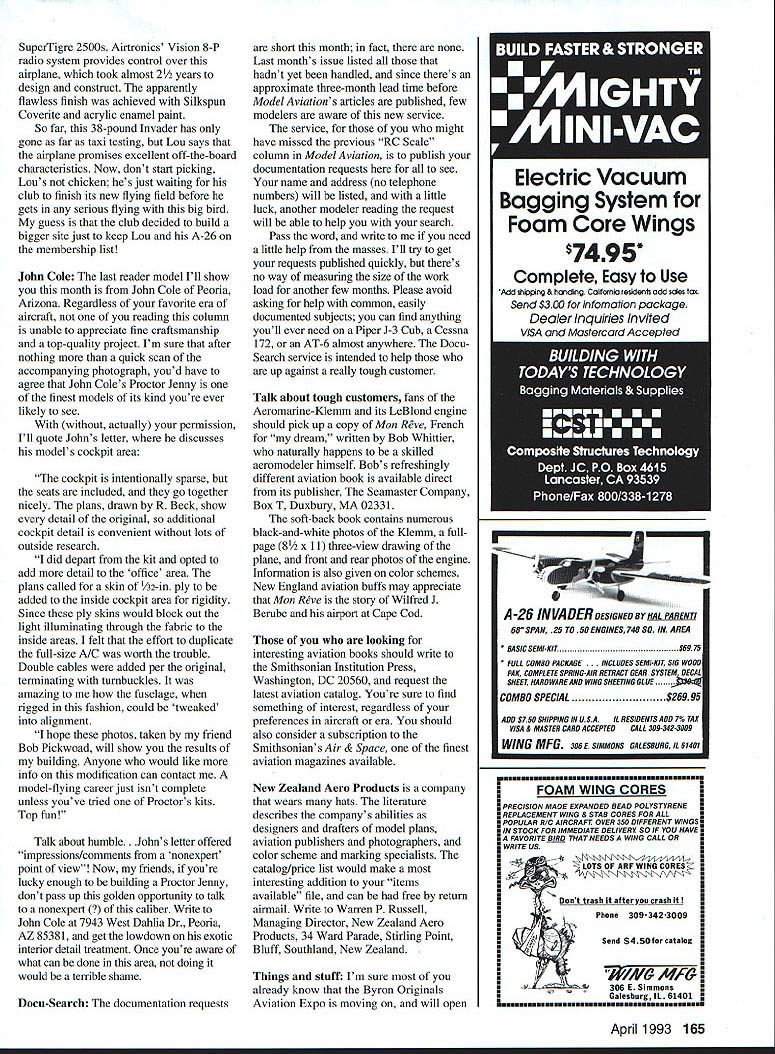
L.H. Warden — Hawker Hind
- Modeler: L.H. Warden, San Diego
- Prototype: Modeled after the Hind in England's Shuttleworth Collection (reputedly the only airworthy Hind)
- Kit/plans: Modified Cleveland plans
- Scale/details: 55-inch span
- Power/finish: Enya .53 four-stroke (side-mounted to the right), covered with Supershrink Coverite, finished with silver Aero Gloss dope
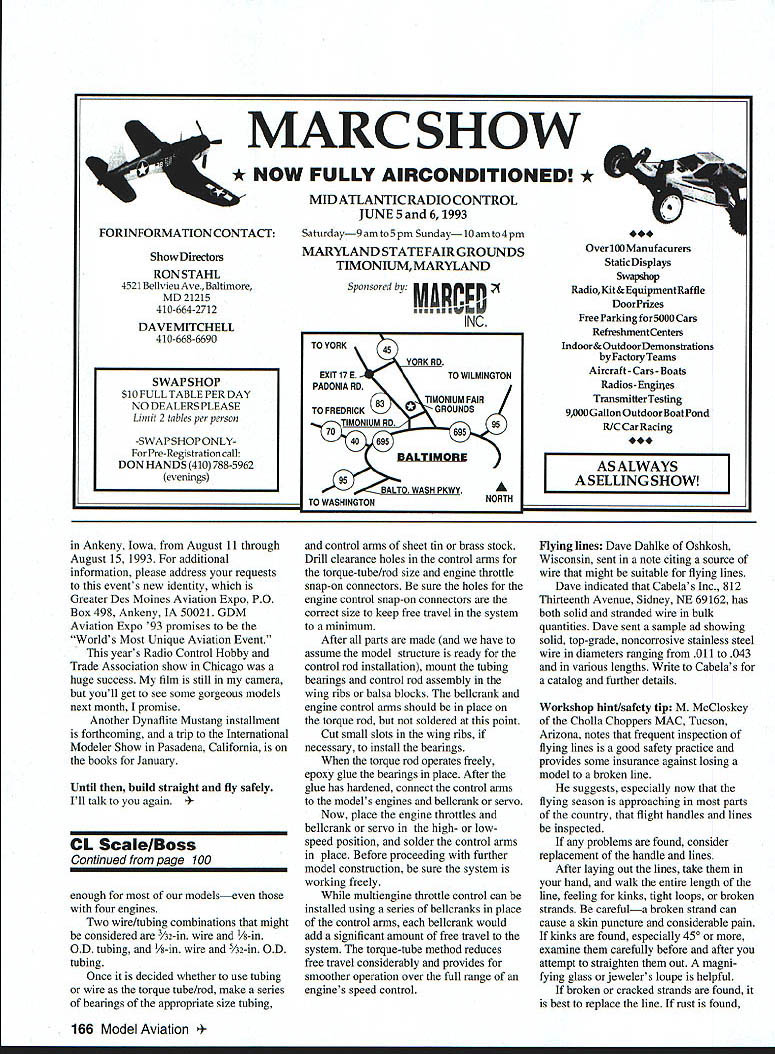
Stan Zdon — Carl Goldberg Ultimate Bipe (modified)
Stan's Ultimate may be this season's definitive "reward-for-effort" airplane. Built from a Carl Goldberg Models Ultimate Bipe kit ordered from Bob Banka at Scale Model Research, Stan made extensive, scale-accurate modifications.
Modifications and features:
- Tapered wingtips
- Swept-back landing gear, positioned correctly
- Fabric-covered ailerons and stabilizer; stabilizer lowered to the correct position
- Aluminum tubing over the standard cabane struts
- Fillets that completely hide the elevator cable system (routed as on the full-scale airplane)
- Aerodynamic balances on the rudder, ailerons, and elevator
- Functioning trim tab on the elevator with a full-length piano hinge, as on the full-scale airplane
- Covering: polyester dress lining sealed with dope
- Paint/finish: sealed with dope and painted with K&B and Hobbypoxy epoxies; stripes applied with striping tape; fuselage lettering hand-cut
Radio and power:
- Servos: combination of Futaba and RCD servos
- Receiver: RCD
- Transmitter: Ace R/C Micropro 2000
- Engine: SuperTigre .90 turning a 14 x 8 prop
Wouldn't you say the end result was worth the extra effort? I would.
Lou — A-26 Invader
- Power: SuperTigre 2500s
- Radio: Airtronics Vision 8-P radio system
- Construction/finish: Took almost 2½ years to design and construct; finish achieved with Silkspun Coverite and acrylic enamel paint
- Weight/status: Approximately 38 lb; so far has completed taxi tests only. Lou is waiting for his club to finish a new flying field before serious flying.
John Cole — Proctor Jenny
- Modeler: John Cole, Peoria, AZ
- Kit: Proctor Jenny (plans drawn by R. Beck)
- Notes from John (quoted):
"The cockpit is intentionally sparse, but the seats are included, and they go together nicely. The plans show every detail of the original, so additional cockpit detail is convenient without lots of outside research. I did depart from the kit and opted to add more detail to the 'office' area. The plans called for a skin of 1/32-in. ply to be added to the inside cockpit area for rigidity. Since these ply skins would block out the light illuminating through the fabric to the inside areas, I felt that the effort to duplicate the full-size aircraft was worth the trouble. Double cables were added per the original, terminating with turnbuckles. It was amazing to me how the fuselage, when rigged in this fashion, could be 'tweaked' into alignment. I hope these photos, taken by my friend Bob Pickwood, will show you the results of my building. Anyone who would like more info on this modification can contact me. A model-flying career just isn't complete unless you've tried one of Proctor's kits. Top fun!"
- Contact: John Cole, 7943 West Dahlia Dr., Peoria, AZ 85381
Speed Controls — Practical Preferences
I prefer speed controls that meet the following safety and handling criteria:
- Avoid controls that allow sustained motor operation when the receiver is on but the transmitter is off (safety hazard).
- Prefer slightly slowed response: a control that does not instantaneously respond to stick motion but has a subtle lag, similar to servo travel. This reduces the model’s reaction to momentary glitches.
- Good linear rejection: some speed controls react to small receiver-battery-voltage changes when servos move. Poor rejection can cause motor-speed fluctuation, especially at low throttle settings.
When choosing a new speed control, check what others are using at your field and apply the above guidelines along with price and availability to make the best choice for you.
Tidbits and Electric-Flight Notes
- Radio/meeting: For electric-oriented fliers who are also amateur radio operators, there's activity on 7243 kHz Friday mornings at 1000 ET. Join AA4L (Bob), W2NDY (John), and W4AZD (Jim) to discuss Electric subjects. AA4L (Bob Johnson) is the fellow who told us how to help reduce motor glitching with toroids in motor leads (see August '91 R/C Report).
- Electric scale growth: Electric Scale is growing not just in numbers but in the quality of models and the size of power systems. KRC '92 demonstrated this trend.
- KRC '92 Best Scale: Steven Stratt of New York won Best Scale with a stunning Sopwith Swallow. Steven can supply a documentation package titled "Fabulous Planes and Plans" by Aerodrome for $10 plus $2.90 first-class postage. Contact: Aerodrome, P.O. Box 1425, FDR Station, New York, NY 10150. Tell Steven that Bob sent you!
- Antivibration and mufflers: I've noticed an increase in antivibration products and muffler how-tos—often for good reason. Noise has cost fields and driven people away from model flying. If you fly Electric, you enjoy the advantages of low noise and low vibration.
Docu-Search and References
The Docu-Search service publishes documentation requests for modelers. If you need help finding rare documentation, submit a request with your name and address (no telephone numbers). Please avoid requests for common subjects (e.g., Piper J-3 Cub, Cessna 172, AT-6), which are easily documented elsewhere. The service is intended for truly difficult searches.
Recommended publications and sources:
- Mon Rêve (by Bob Whitter) — contains photos and a three-view drawing of the Aeromarine-Klemm and photos of the LeBlond engine. Available from The Seamaster Company, Box T, Duxbury, MA 02331.
- Smithsonian Institution Press — request their latest aviation catalog for books of interest; consider subscribing to Air & Space magazine.
- New Zealand Aero Products — designers/drafters of model plans, aviation publishers/photographers, and marking specialists. Free catalog/price list: Warren J. Russell, Managing Director, New Zealand Aero Products, 34 Ward Parade, Stirling Point, Bluff, Southland, New Zealand.
Closing Notes
Several small items of topical interest have accumulated, but that's enough for now. Thank you for your continuing support and the nice comments on what I'm trying to do each month — it makes this effort all the more worthwhile and fun.
Please be sure to enclose an SASE with any correspondence for which you'd like a reply.
Until then, build straight and fly safely.
Happy, Quiet Landings, Everyone.
I'll talk to you again.
Transcribed from original scans by AI. Minor OCR errors may remain.

