
Radio Control: Scale
Jeff Troy, 200 S. Spring Garden St., Ambler, PA 19002
IMS SHOW
In a few days I'll have the pleasure of leaving home for a lovely weekend at Bill and Anita Northrop's International Modeler Show (IMS) in Pasadena, California. It's a sure bet that a California trade-show trip will result in a large number of scale photos for the column.
There are probably more modelers from that area than from most other parts of the country, so it's only logical that a large number of scale models can be expected at this show. Besides, I like California modelers; those West Coast folks have always treated this East Coaster very nicely. You'll see all the IMS action in a future issue.
As usual, there are a few new and useful items on hand to share with you this month, so have a look.
Aero Scale Products (Switzerland)
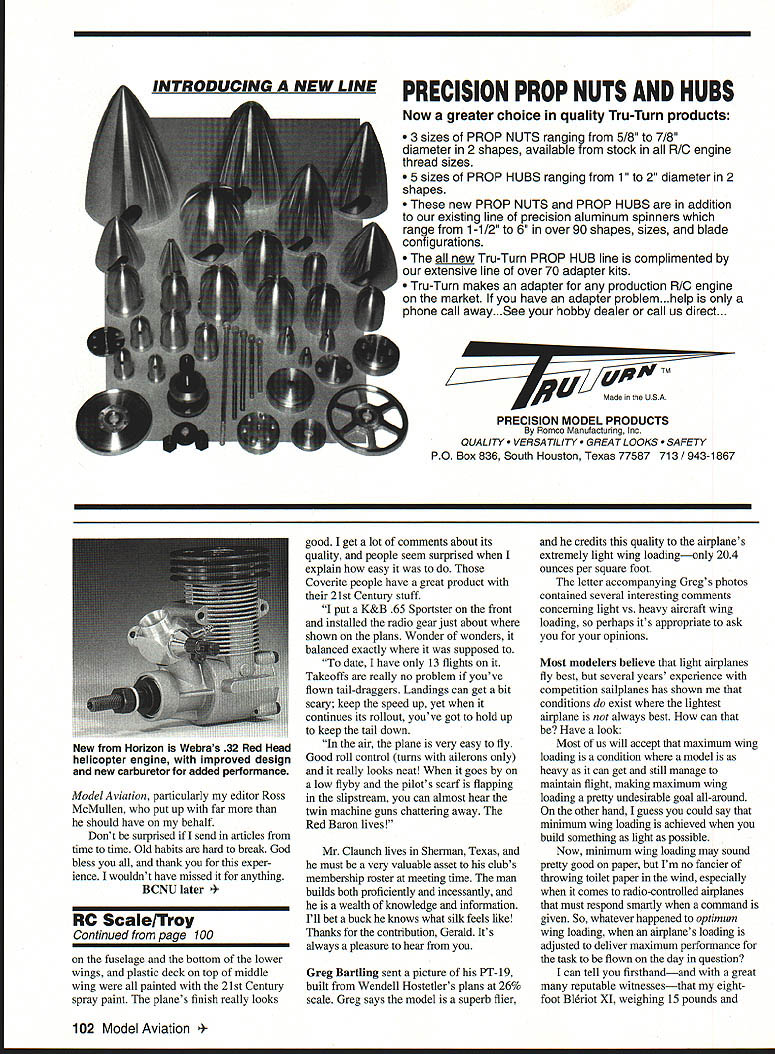
The first is from the lovely country of Switzerland and a company called Aero Scale Products. The company manufactures and distributes custom-length sets of working streamlined flying wires for scale or sport models, and I'm sure they have a set or two that's right for you. Aero Scale says their flying wire sets are true scale reproductions and are adaptable to 1/4-scale models of sport or training aircraft or fighters of approximately one-fifth scale.
Aero Scale's wires are formed from rolled chrome steel, with 2 mm threads. They are stainless and highly stress resistant. The clevises supplied with these sets use a 2 mm pin and feature cotter pins in addition to locknuts. The length of the wire, ranging from 250 to 830 mm, can be specified by the purchaser.
Once the wires are mounted on an airplane, adjustment is a simple matter of rotating the streamlined wire between the two wire terminals (clevises), then tightening the locknuts to assure that the adjustment holds.
Please write to Hans U. Gautschi at Aero Scale Products, Dankensbergstr. 8, 5712 Beinwil am See, Switzerland, for pricing and more specific ordering information. Mr. Gautschi would also like to hear from dealers and kit manufacturers who may be interested in his sophisticated product line.
J&R Fiberglass
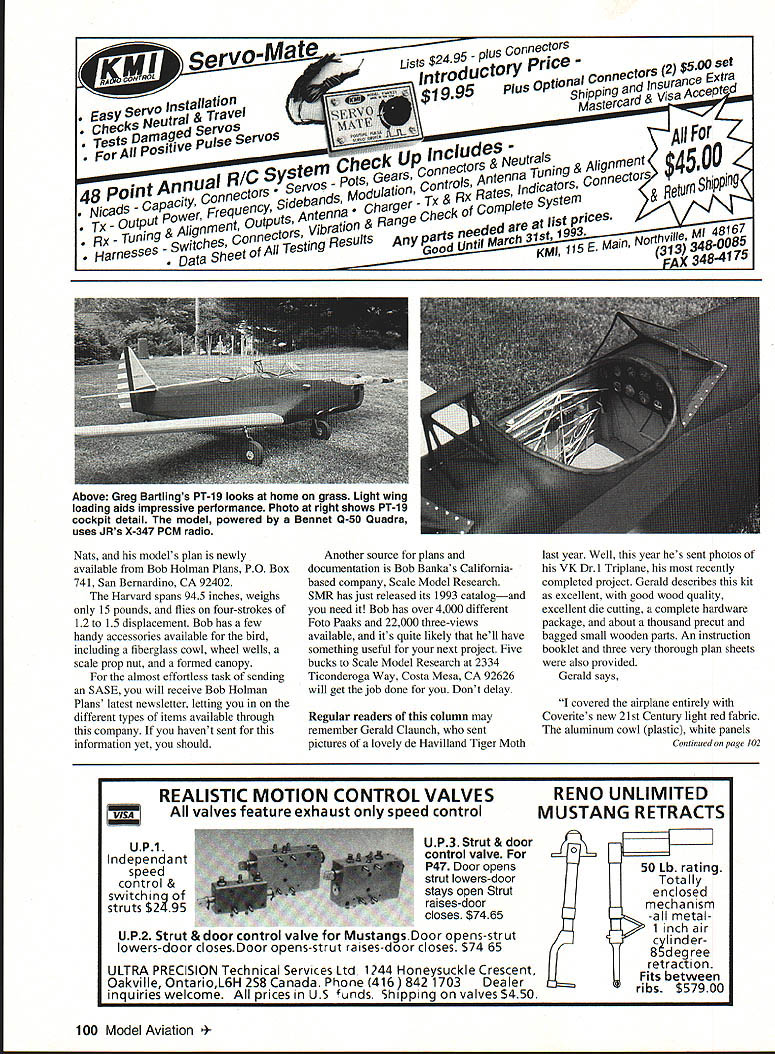
Jeff Davis, of J&R Fiberglass, fabricates lightweight, high-quality fiberglass parts in sizes from Giant Scale fuselages down to the smallest sets of wheel pants. J&R is not the least expensive maker of fiberglass accessories, but it certainly is one of the better ones.
A little over a year ago this column ran a photo of J&R Fiberglass's replacement cowl for Goldberg's Cub, but since that photo the company has added a number of popular kit replacement pieces to its inventory. In addition to J&R's Cub cowl, carefully formed cowls and wheel pants are now available for Carl Goldberg Models' Ultimate Bipe and Extra 300 airplanes, as well as Great Planes Model Manufacturing's Super Decathlon 40 and P-51 kits.
An SASE will get you a price list and basic information. Write to Jeff Davis, J&R Fiberglass, 22 Trotter Circle, Kissimmee, FL 34743.
Bob Holman — Harvard/T-6 Texan
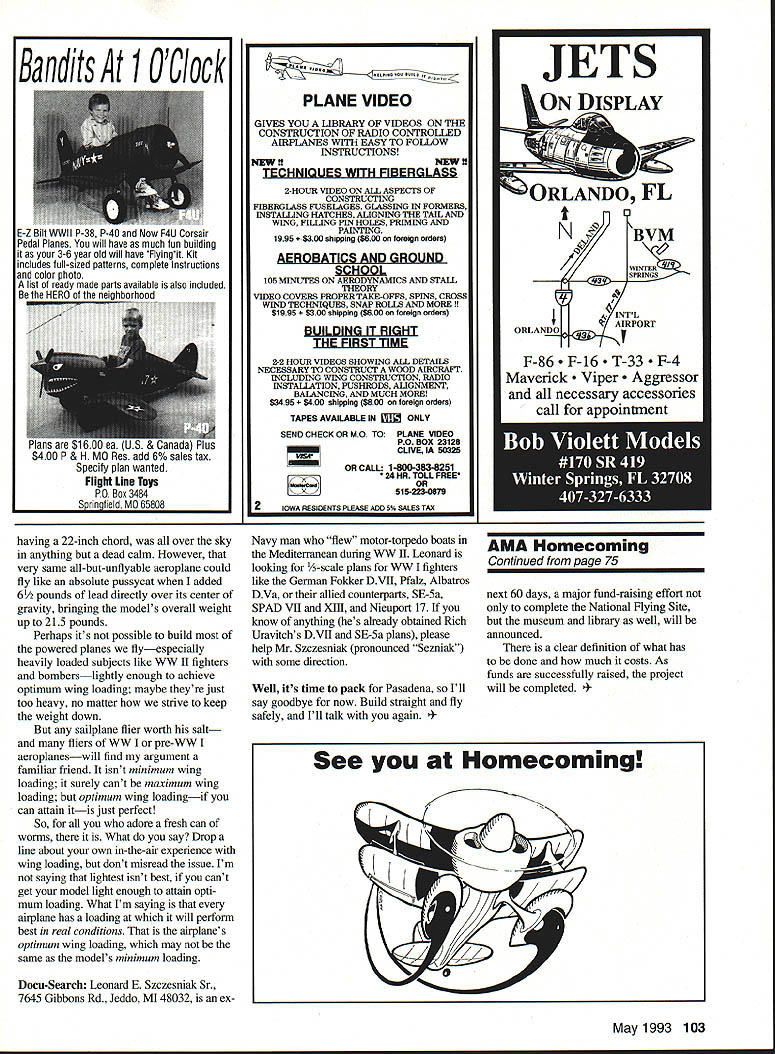
Bob Holman sent a picture of Brian Taylor's latest model, a Harvard/T-6 Texan. Brian's airplane took third at the British Nationals. His model's plan is newly available from Bob Holman Plans, P.O. Box 741, San Bernardino, CA 92402.
The Harvard spans 94.5 inches, weighs only 15 pounds, and flies on four-strokes of 1.2 to 1.5 displacement. Bob has a few handy accessories available for the bird, including a fiberglass cowl, wheel wells, a scale prop nut, and a formed canopy.
For the almost effortless task of sending an SASE, you will receive Bob Holman Plans' latest newsletter, letting you in on the different types of items available through this company. If you haven't sent for his information yet, you should.
Scale Model Research
Another source for plans and documentation is Bob Banca's California-based company, Scale Model Research. SMR has just released its 1993 catalog — and you need it! Bob has over 4,000 different Foto Paks and 22,000 three-views available, and it's quite likely that he'll have something useful for your next project. Five bucks to Scale Model Research at 2334 Ticonderoga Way, Costa Mesa, CA 92626 will get the job done for you. Don't delay.
Gerald Claunch — VK Dr.1 Triplane
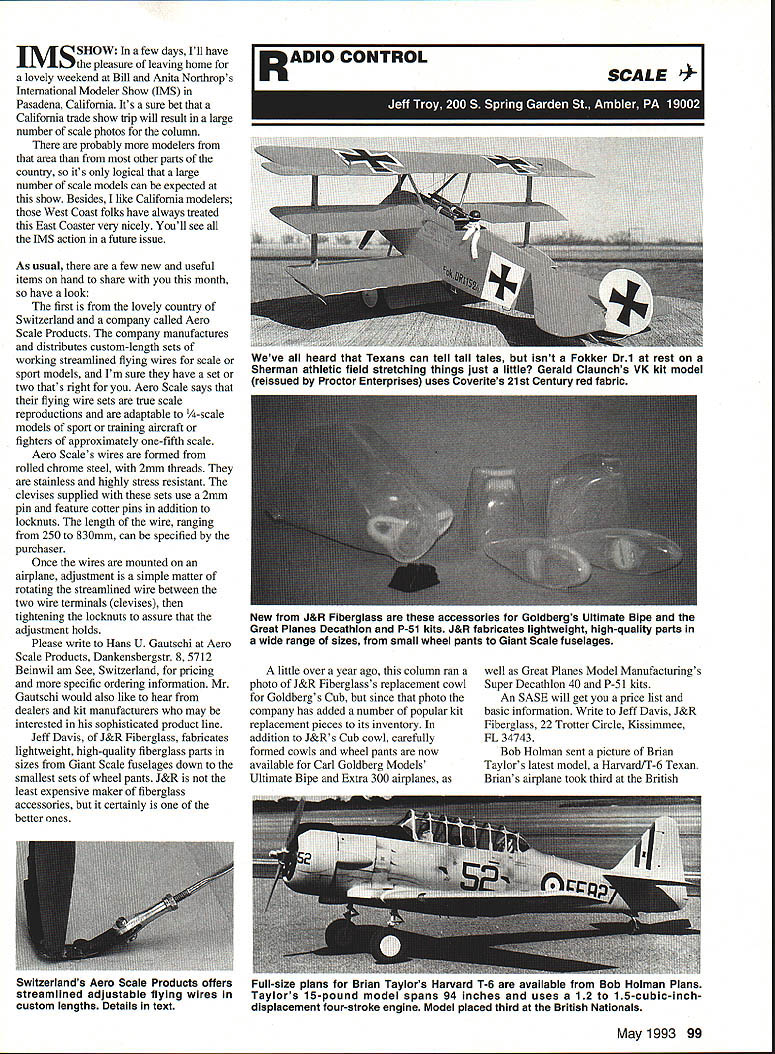
Regular readers of this column may remember Gerald Claunch, who sent pictures of a lovely de Havilland Tiger Moth last year. Well, this year he's sent photos of his VK Dr.1 Triplane, his most recently completed project. Gerald describes this kit as excellent, with good wood quality, excellent die cutting, a complete hardware package, and about a thousand precut and bagged small wooden parts. An instruction booklet and three very thorough plan sheets were also provided.
Gerald says, "I covered the airplane entirely with Coverite's new 21st Century light red fabric. The aluminum cowl (actually plastic) and white panels look good. I get a lot of comments about its quality, and people seem surprised when I explain how easy it was to do. Those Coverite people have a great product with their 21st Century stuff."
"I put a K&B .65 Sportster on the front and installed the radius guard just about where shown on the plans. Wonder of wonders, it balanced exactly where it was supposed to.
"To date, I have only 13 flights on it. Takeoffs are really no problem if you've flown tail-draggers. Landings can get a bit scary; keep the speed up, yet when it continues its rollout, you've got to hold up to keep the tail down.
"In the air, the plane is very easy to fly. Good roll control (turns with ailerons only) and it really looks neat! When it goes by on a low flyby and the pilot's scarf is flapping in the slipstream, you can almost hear the twin machine guns chattering away. The Red Baron lives!"
Mr. Claunch lives in Sherman, Texas. He builds both proficiently and incessantly, and he is a wealth of knowledge and information. Thanks for the contribution, Gerald. It's always a pleasure to hear from you.
Greg Bartling — PT-19 and Wing Loading Discussion
Greg Bartling sent a picture of his PT-19, built from Wendell Hostetler's plans at 26% scale. Greg says the model is a superb flier, and he credits this quality to the airplane's extremely light wing loading—only 20.4 ounces per square foot.
The letter accompanying Greg's photos contained several interesting comments concerning light vs. heavy aircraft wing loading, so perhaps it's appropriate to ask for your opinions.
Most modelers believe that light airplanes fly best, but several years' experience with competition sailplanes has shown me that conditions do exist where the lightest airplane is not always best. How can that be? Have a look:
Most of us will accept that maximum wing loading is a condition where a model is as heavy as it can get and still manage to maintain flight, making maximum wing loading a pretty undesirable goal all around. On the other hand, you could say that minimum wing loading is achieved when you build something as light as possible.
Now, minimum wing loading may sound pretty good on paper, but I'm no fancier of throwing toilet paper in the wind, especially when it comes to radio-controlled airplanes that must respond smartly when a command is given. So, whatever happened to optimum wing loading, where an airplane's loading is adjusted to deliver maximum performance for the task to be flown on the day in question?
I can tell you firsthand—and with a great many reputable witnesses—that my eight-foot Bleriot XI, weighing 15 pounds and having a 22-inch chord, was all over the sky in anything but a dead calm. However, that very same all-but-unflyable aeroplane could fly like an absolute pussycat when I added 6½ pounds of lead directly over its center of gravity, bringing the model's overall weight up to 21.5 pounds.
Perhaps it's not possible to build most of the powered planes we fly—especially heavily loaded subjects like WWII fighters and bombers—lightly enough to achieve optimum wing loading; maybe they're just too heavy, no matter how we strive to keep the weight down.
But any sailplane flier worth his salt—and many fliers of WWI or pre-WWI aeroplanes—will find my argument a familiar friend. It isn't minimum wing loading; it surely can't be maximum wing loading; but optimum wing loading—if you can attain it—is just perfect!
So, for all you who adore a fresh can of worms, there it is. What do you say? Drop a line about your own in-the-air experience with wing loading, but don't misread the issue. I'm not saying that lightest isn't best, if you can't get your model light enough to attain optimum loading. What I'm saying is that every airplane has a loading at which it will perform best in real conditions. That is the airplane's optimum wing loading, which may not be the same as the model's minimum loading.
Docu-Search
Leonard E. Szczesniak Sr., 7645 Gibbons Rd., Jeddo, MI 48032, is an ex-Navy man who "flew" motor-torpedo boats in the Mediterranean during WWII. Leonard is looking for 1/5-scale plans for WWI fighters like the German Fokker D.VII, Pfalz, Albatros D.Va, or their allied counterparts, SE-5a, SPAD VII and XIII, and Nieuport 17. If you know of anything (he's already obtained Rich Uravitch's D.VII and SE-5a plans), please help Mr. Szczesniak (pronounced "Sezniak") with some direction.
Well, it's time to pack for Pasadena, so I'll say goodbye for now. Build straight and fly safely, and I'll talk with you again.
Transcribed from original scans by AI. Minor OCR errors may remain.

