
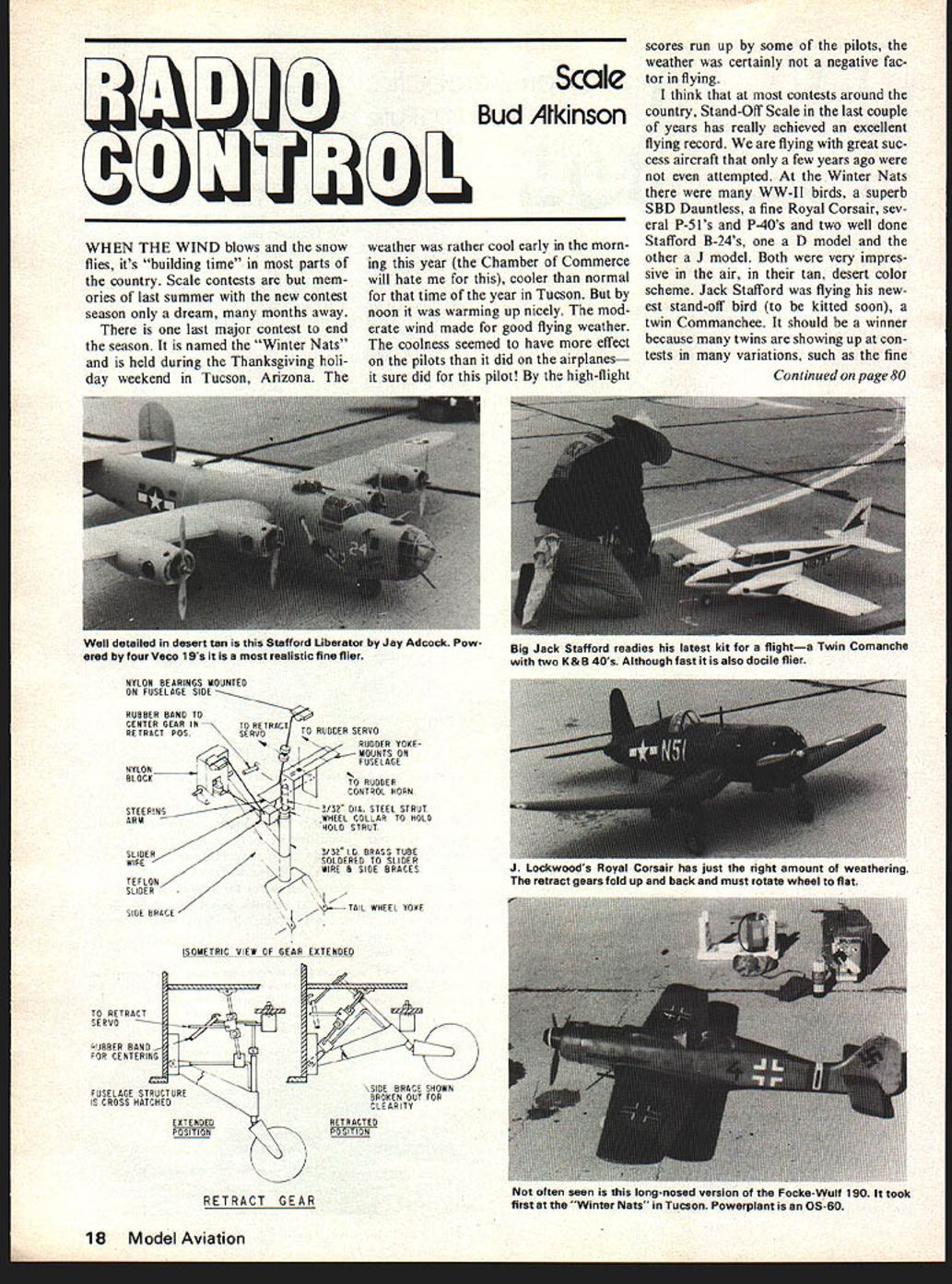
Radio Control: Scale
Bud Atkinson
WHEN THE WIND blows and the snow flies, it's "building time" in most parts of the country. Scale contests are but memories of last summer with the new contest season only a dream, many months away.
There is one last major contest to end the season. It is named the "Winter Nats" and is held during the Thanksgiving holiday weekend in Tucson, Arizona. The weather was rather cool early in the morning this year (the Chamber of Commerce will hate me for this), cooler than normal for that time of the year in Tucson. But by noon it was warming up nicely. The moderate wind made for good flying weather. The coolness seemed to have more effect on the pilots than it did on the airplanes — it sure did for this pilot! By the high-flight scores run up by some of the pilots, the weather was certainly not a negative factor in flying.
I think that at most contests around the country, Stand-Off Scale in the last couple of years has really achieved an excellent flying record. We are flying with great success aircraft that only a few years ago were not even attempted. At the Winter Nats there were many WW-II birds, a superb SBD Dauntless, a fine Royal Corsair, several P-51's and P-40's and two well done Stafford B-24's, one a D model and the other a J model. Both were very impressive in the air, in their tan, desert color scheme. Jack Stafford was flying his newest stand-off bird (to be kitted soon), a twin Commanchee. It should be a winner because many twins are showing up at contests in many variations, such as the fine
Black Widow at the Dayton Nats.
This year at the Winter Nats 20 stand-off scale birds showed up and were flown in with pattern on about five flight lines. Many scale fliers were not too happy with this. There were several mid-airs, including your reporter. Fortunately, I was able to get it down in one piece, with half a pattern ship rudder embedded in the wing tip. Thank goodness for retracts! Can you imagine the head-on impact of an 11-lb. scale doing 75 and a 7-lb. pattern doing 100 mph? Of course, with only two days flying time at a contest this size, it's hard to set things up any other way.
The facilities at the Winter Nats are fantastic. It takes place on an old WW-II base with miles of good runways. At one end many large aircraft are stored by various airlines. The strip is also used by the forest service. Would you believe they have a WW-II B-17 equipped for forest fire fighting, as well as many other more modern aircraft for this purpose? There is an excellent cafeteria on the base as well as a coffee and sandwich shop right on the flight line, and on the end of the field on which the contest was held, I have attended many contests from coast to coast including many AMA Nats, but the Tucson Winter Nats has to have the finest facilities for an RC contest and is a CD's dream. Speaking of CD's, Bill Hempel and Chuck Taylor, and all the people of the Tucson R/C Club, are to be commended on the fine job they do each year.
One of the side benefits of the Winter Nats at Tucson is a fine Air Museum; a lot of the aircraft are WW-II vintage—many need restoring. One of the exceptions is a B-24J which this reporter called home for over 600 hours of flying time back in '44-'45. The old "Libby" looks as if it could take off right now. But most of the aircraft are in dire need of restoration. The outdoor museum was started within the last two or three years.
They have many unusual aircraft, such as several large amphibians. There are several B-26's, or A-26 as they were called in WW II, B-25's, a P-63, many cargo craft including a C-46 and C-47. There are B-29's and, of course, several early jets, and some interesting little-known helicopters. It's gratifying that, after 30 years since WW II, there is a mood (and I suppose money) throughout the country to restore and preserve as many as possible aircraft of that era.
In the years following 1946 many fine historical aircraft ended on the scrap pile and were lost forever. This is especially true of Japanese aircraft of WWII, one of the most famous or, from our standpoint, infamous, airplanes of the war was the Zero. It was produced in great numbers from 1935 to 1945. In this country there are no airworthy Zeros left and very few static ones. WW-II's Spitfires, P-51's and ME-109's are all flying, well-kept machines but, because of short-sightedness, there are no true Zeros—only makeshift AT-6-type Zeros. It's truly a shame!
For you who want to get a chance at full retract points, you should retract the tail wheel (if it did on the full-size bird). My old scale friend from Lincoln, Nebraska, Don Neill, has worked out a very successful retracting tail-wheel unit which he has used many times. The latest was in his superb F6F Hellcat he flew at the 1976 AMA Scale Nats. I have seen this unit firsthand and it really works. The drawings speak for themselves.
Bud Atkinson, 734 North 6th Street Terrace, Blue Springs, MO 64015.
Transcribed from original scans by AI. Minor OCR errors may remain.

