
RADIO CONTROL: SCALE
Jeff Troy, 200 S. Spring St., Ambler, PA 19002
THERE'S NO SHORTAGE OF NEWS. The Dynaflite Mustang is finished, and I've attended both the WRAM show (White Plains, NY) and the Weak Signals show (Toledo, OH). Add a few new manufacturers' products and Docu-Search items to the goodie list — I hope you'll find some entertainment in this column.
Dynaflite Mustang
Markings
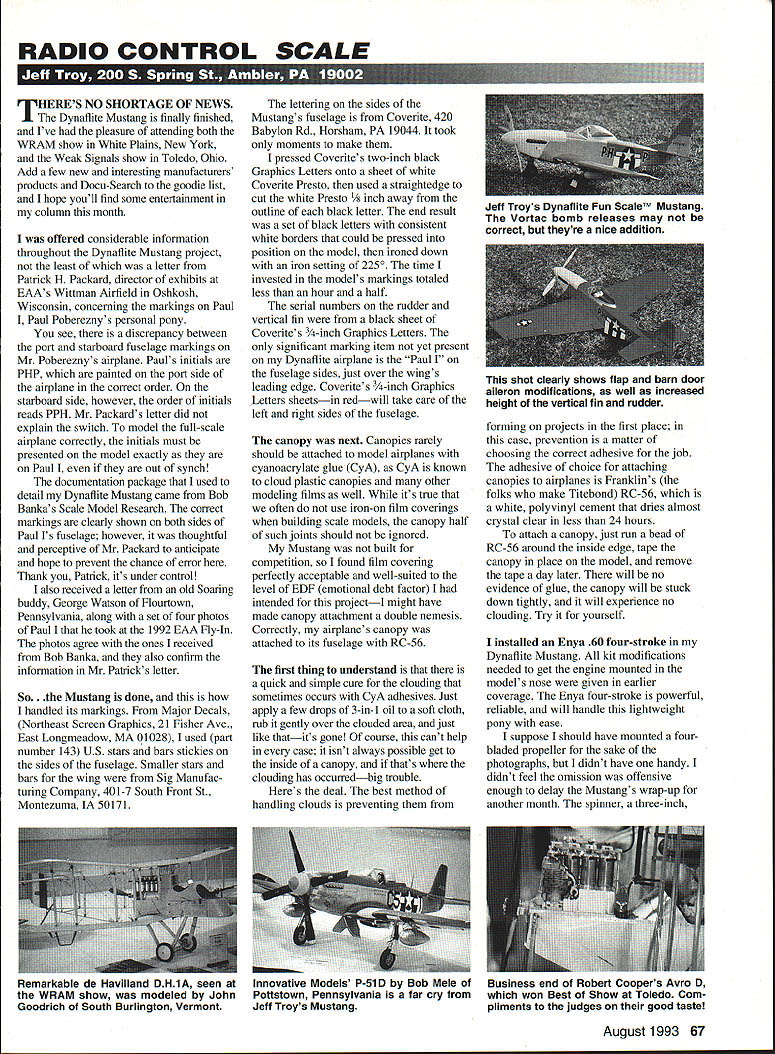
I received considerable input during the Dynaflite Mustang project, including a letter from Patrick H. Packard, director of exhibits at EAA's Wittman Field (Oshkosh, WI), about the fuselage markings on Paul Poberezny's personal Mustang. There is a discrepancy between the port and starboard sides: Paul's initials (PHP) appear on the port side in the correct order, but read PPH on the starboard side. To model the full-scale airplane correctly, the model must reproduce the markings exactly as they appear on Paul’s airplane — even if they're out of sync.
Documentation for the build came from Bob Banka's Scale Model Research and was corroborated by photos I received from Bob Banka and by a set of four photos sent by George Watson of Flourtown, PA (taken at the 1992 EAA Fly-In).
Decals and lettering used:
- Major decals (U.S. stars and bars stick-ons): Northeast Screen Graphics (Major Decals), part no. 143 — 21 Fisher Ave., East Longmeadow, MA 01028.
- Smaller stars and bars for the wings: Sig Manufacturing Company — 401 S. Front St., Montezuma, IA 50171.
- Lettering: Coverite — 420 Babylon Rd., Horsham, PA 19044.
Lettering technique:
- Press Coverite's 2-inch black Graphic Letters onto a sheet of white Coverite Presto.
- Use a straightedge to cut the white Presto about 1/8 inch away from the outline of each black letter.
- Result: black letters with consistent white borders. Press into position and iron down at about 225°.
Total time invested in the model's markings was less than an hour and a half.
Serial numbers on the rudder/vertical fin were cut from a black sheet of Coverite's 3/4‑inch Graphic Letters. The only significant marking still to be added is "Paul" on each fuselage side over the wing's leading edge; Coverite's 3/4‑inch Graphics Letters in red will be used for that.
Canopy
Canopies should rarely be attached with cyanoacrylate (CyA) because CyA can cloud plastic canopies and other modeling films. A quick cure for minor CyA clouding is to apply a few drops of 3‑in‑1 oil to a soft cloth and rub gently over the clouded area — that often removes the clouding. However, if the clouding is on the inside and you can't reach it, you're in trouble.
The best approach is prevention: use the correct adhesive. For canopies I recommend Franklin's (Titebond) RC‑56, a white polyvinyl cement that dries nearly crystal clear in less than 24 hours. To attach a canopy:
- Run a bead of RC‑56 around the inside edge.
- Tape the canopy in place on the model.
- Remove the tape after 24 hours.
Result: no visible glue, a tight bond, and no clouding.
For my Mustang (not built for strict competition), I found film covering acceptable and used RC‑56 to attach the canopy securely.
Powerplant and hardware
- Engine: Enya .60 four-stroke installed in the nose (kit modifications for mounting were covered earlier).
- Spinner: three-inch yellow plastic Du-Bro Products item.
I considered a four‑bladed prop for photos but didn't have one handy and didn't delay wrapping up the project.
Next build-along?
I'm undecided on the next build-along project; a World War I subject is likely as interest in WWI models is rising. Candidates in my stash include:
- Proctor Nieuport 11 (with Technopower five‑cylinder radial)
- Glenn Torrance Fokker Dr.I triplane kits
- Blériot XI‑2
- Dave Platt Focke‑Wulf 190‑A with available accessories (Platt retracts, Jack Dorman cockpit and machine gun kits)
- Balsa USA 1/3‑scale Stearman with Steven Durecki fiberglass replacement parts for ABS accessories
I'll report back once I settle on one of the 400‑plus kits tucked around my home.
Shows
WRAM (White Plains, NY)
The WRAM show had excellent scale entries.
- John Goodrich (South Burlington, VT) brought a de Havilland D.H.1A:
- Scale: 2 in = 1 ft
- Span: 82 inches
- Weight: 6½ pounds
- All flying surfaces cable-actuated, with 80 functional turnbuckles
- Shock-absorbing landing gear, O.S. .60 engine, Futaba FPT5NL PCM system
- Covering: Sig Koverall and Sig butyrate dope
- Bob Mele (Pottstown, PA) brought a P‑51D Mustang:
- Built from an Innovative Models kit
- Gene Barton retracts
- O.S. 1.08 engine with 15 x 8 prop
- Features operating cowl doors, a sliding canopy, and sequencing inner gear doors
Weak Signals (Toledo, OH)
The Weak Signals annual show was another major event.
- Best-of-Show / First Place Precision Scale: Robert Cooper (Savannah, GA) — his Avro D. A superb handcrafted biplane; workmanship in machine work, woodwork, and covering was first class. I photographed the detailed nose (suitable full‑view shots were not usable for publication), and the model will be a strong competitor on the circuit.
- Midwest (soon-to-be-released): Success Series North American AT‑6 Texan prototype
- Span: approx. 85 inches
- Recommended power: .120 four-stroke or .90 two-stroke
- Construction: conventional balsa, spruce, Lite Ply, and ply (wing may feature foam tip-panel cores)
- Designed to appeal to sport builders wanting a larger WWII model without committing to a full-blown scale project
- Proctor Enterprises (shown by Mark Heinicke): prototype Fokker Eindecker — everything you'd expect from Proctor. Mark wouldn't commit to a release date, but the kit drew a lot of interest. Proctor also imports Seidel radial engines from Germany; the nine‑cylinder example looked fantastic in the Fokker nose.
- Bob Shattleroe Custom Gear:
- Makes welded landing gear (for Cubs and many other models) with excellent workmanship and a finish reminiscent of gun bluing
- Vinyl shock covers and boots available
- Over 90 gear sets listed; prices are very reasonable
- For a complete listing, send a stamped, self‑addressed envelope to:
Bob Shattleroe Custom Gear, 31985 John Hauk St., Garden City, MI 48135
DOCU-SEARCH
The hardcover Color Profiles of World War I Combat Planes includes an artist's rendition of a Blériot II‑2, serial BL‑242. If any reader can supply a photograph or verification of that particular Blériot aeroplane, please send information or photocopies to my mailing address:
Jeff Troy, 200 S. Spring St., Ambler, PA 19002
Transcribed from original scans by AI. Minor OCR errors may remain.

