
Radio Control: Scale
Jeff Troy 200 S. Spring Street, Ambler, PA 19002
Build-along project selection
After a great deal of consideration, damnation, and procrastination, I've finally settled on the next just-for-the-fun-of-it, build-along Scale project for this column. The Piper J-3 Cub and the North American P-51 Mustang have already been covered, and I've received many requests for a World War I aeroplane. Since WW I is my favorite aviation era, the choice was easy—now to pick which subject.
A quick inventory of my more serious kit pile turned up:
- Proctor's 1/4-scale Nieuport 28 C-1 and the smaller Nieuport 11 Bébé
- Glenn Torrance's 1/4-scale Fokker Dr. I triplane
- A Flair 1/6-scale Taube
- A DB Models (England) 1912 Blackburn Monoplane
- Dave Platt-designed Top Flite 1/6-scale SE-5a
- Three original VK little-fighter kits: Sopwith Camel, Fokker triplane, and Nieuport 17
Most of those are fairly complicated kits and would make for a dedicated project beyond what many builders would enjoy following. I wanted something not trivial, but not overwhelmingly complex. In the end I chose one of Rich Uravitch's Fokker D.VII Plans and Plastic kits, as kitted by Chuck Gill's new company, The Aeroplane Works.
Why the Fokker D.VII
Anthony Fokker's nimble D.VII is widely regarded as the superior single-seat fighting machine of WW I. It entered service in the summer of 1918 and benefitted from late-war advances in aeronautical technology. Even Manfred von Richthofen had a hand in its development after flying and evaluating a prototype.
The D.VII had good speed, tremendous agility, and—unlike many fighters of the day—could be dived full throttle without shedding its wings, which was no small feat in 1918. Many modelers also favor it because it has a clearly visible nose moment (engine mass ahead of the leading edge), rather than the typical “mill on the leading edge” seen on many early aeroplanes.
The Uravitch 1/5-scale Fokker D.VII (as kitted by The Aeroplane Works) is the build-along selection.
What the build-along will cover
The purpose of building a model together in this column is not only to pass along construction and finishing tips but to take you through the entire development of the finished bird—from selection to first flight—so you can see the decisions and techniques involved. Contributions and input from readers will also be invited during the project.
By the time the project is complete you will have seen and learned:
- Reasons for selecting a particular model and engine
- How to handle documentation and research for accurate scale detail
- How to alter plans to match documentation
- Construction techniques and finishing methods for scale appearance
- Radio installation and system selection
- Replicating special details
- Preparation and execution of the first flight
- Selection of flight maneuvers for fun and competition
If you've never built a Scale model, don't be intimidated by very elaborate examples. Try a project like this and you'll see you can build a good Scale airplane with sensible choices and modest stretching of your skills.
Recent reader projects and highlights
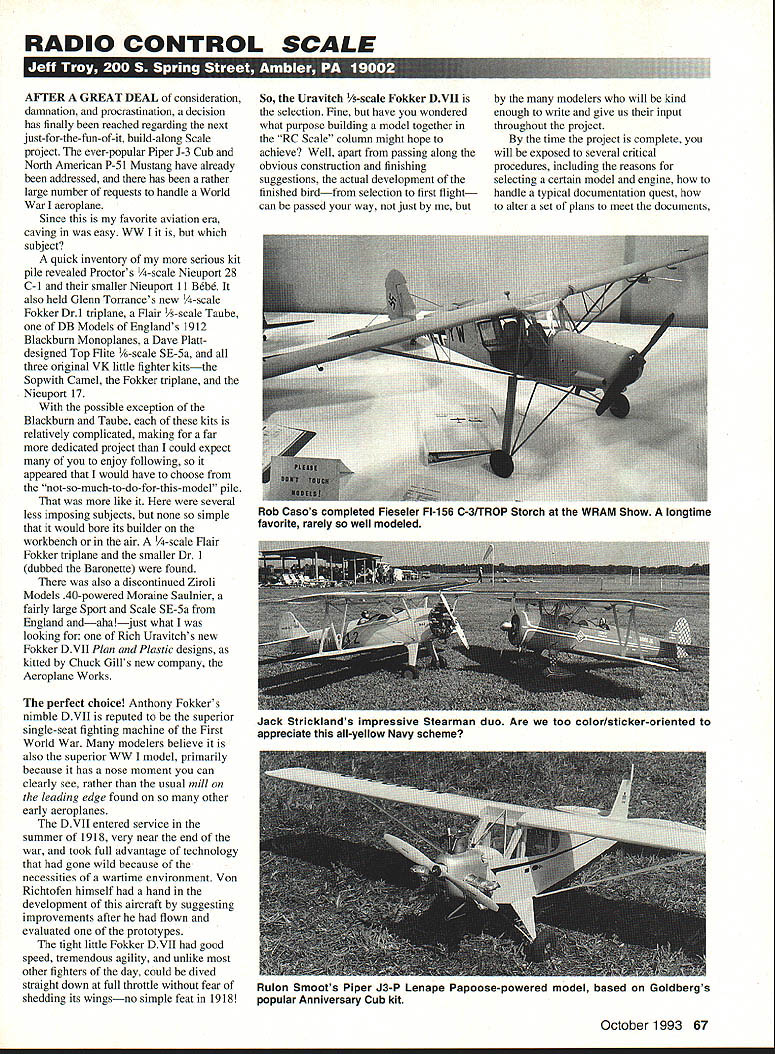
Rob Caso — Fieseler Storch (Fi-156)
- Recently featured in Model Aviation in final assembly photos; now completed.
- Entered in RC Scale and displayed at the WRAM show in New York last winter.
- Features numerous operating appointments: flaps, latching cabin door, bomb release, landing light, trim tabs, and accurate telescoping landing gear.
- Radio: Futaba 7 UAF with eight servos; power: inverted O.S. .91 two-stroke; batteries: SRL 400 mAh.
- Span: 93 inches; flying weight: about 14 pounds.
- Based on a much-modified Svensen kit, covered with Supershrink Coverite and finished with Hobbypoxy paints custom-mixed to match paint chips. Approximately 800 hours of craftsmanship went into the model.
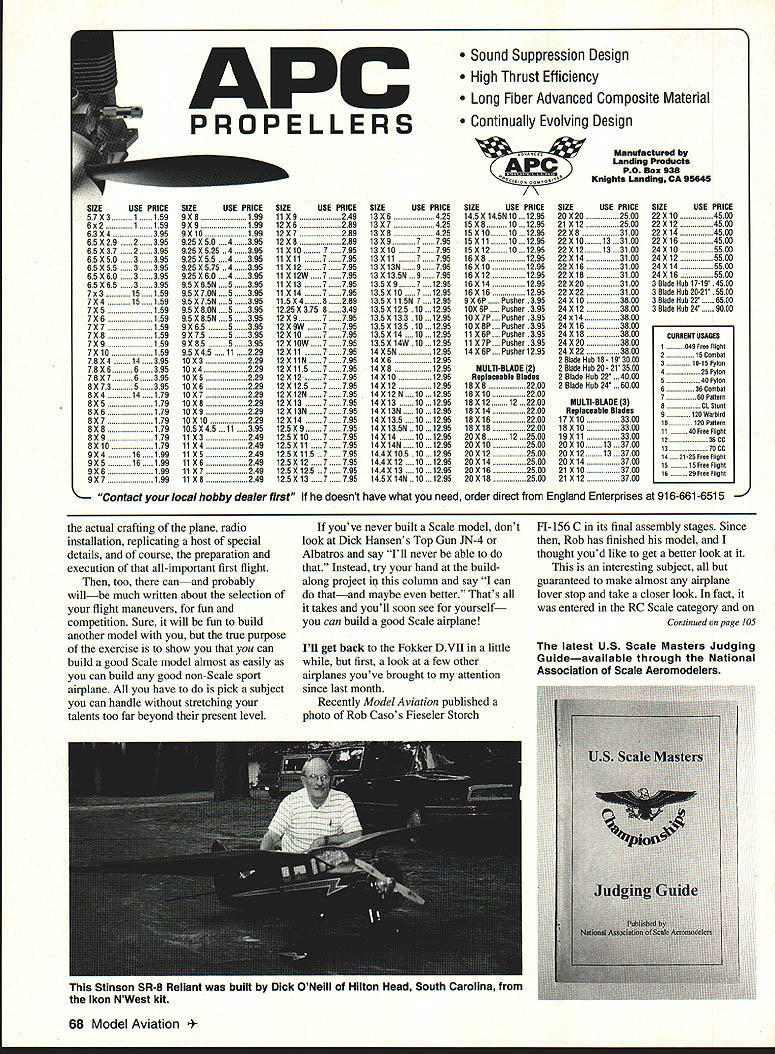
Jack Strickland — Stearmans
- Completed two Stearmans: a 25% totally scratch project and a Balsa USA 1/3-scale version (Jack notes the Balsa USA version is actually about 30% of the original).
- The 25% model is yellow Navy scheme; the big Balsa USA model is finished in Bob Blankenship's full-scale flying scheme.
- Weights: big Stearman ~29 lb; original ~26 lb.
- Both use Airtronics radios and 5.8-cubic-inch gas engines.
- Plans for the 25% Stearman are available directly from Jack Strickland (1118 Pawnee Trail, Carrollton, TX 75007). Send a stamped, self-addressed envelope for price and info.
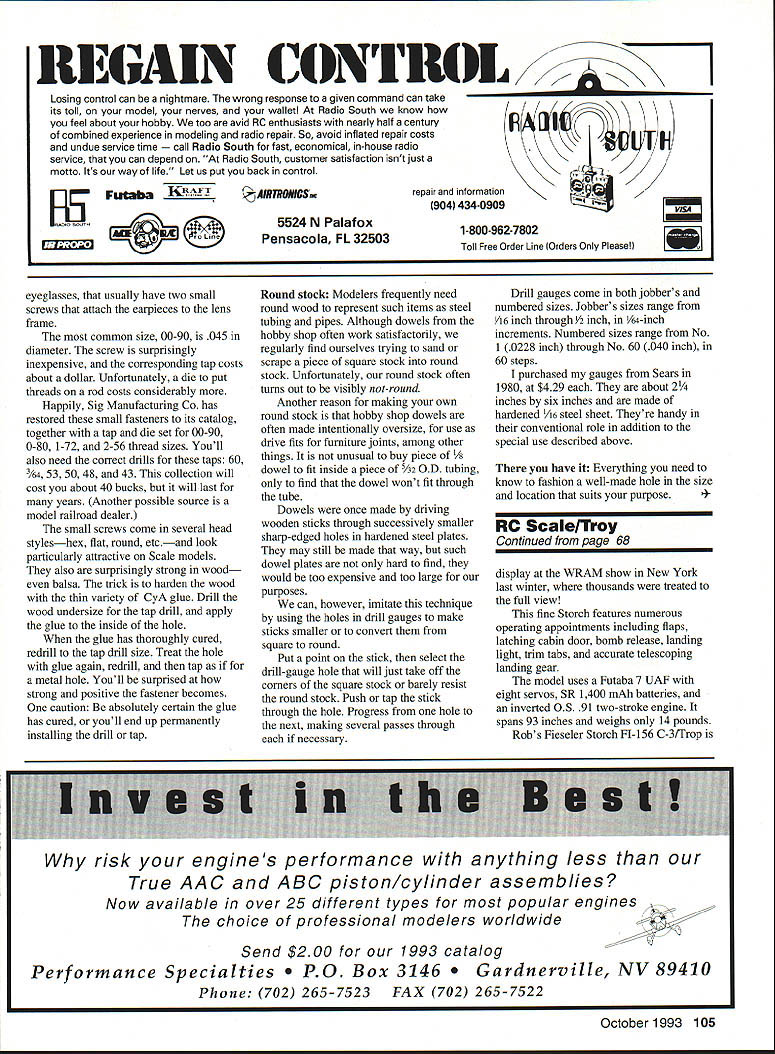
Rulon Smoot — Goldberg Anniversary Cub (J3-P emulation)
- Modified Goldberg Anniversary Cub to emulate the little-known J3-P Cub fitted with a Lenape Papoose three-cylinder radial engine (only a few originals known to exist).
- Model uses a Saito .80 four-stroke mounted upright; two additional cylinders are non-functional dummies.
- Span: 78 inches; weight: 7.75 pounds.
- Rulon has been modeling since 1927 and in radio control since 1983. His letter included a reproduction of a Lenape Papoose-powered Cub ad from Popular Aviation, August 1938.
About The Aeroplane Works Fokker D.VII kit and plans
The Aeroplane Works (2134 Gilbride Rd., Martinsville, NJ 08836) is producing kits of Nick Ziroli's and Rich Uravitch's popular designs. Chuck Gill's kits are well made and supported by a hands-on modeler.
Details for the Uravitch Fokker D.VII kit:
- Scale: 1/4-scale (Chuck Gill also offers other scales)
- Span (this kit): 75 inches
- Estimated finished weight: ~16 pounds (varies with detail level and craftsmanship)
- Kit contents: quality wood parts, prebent landing gear legs and cabane struts, ABS plastic louvered side panels for the fuselage, and a nicely molded ABS cowl
- The Aeroplane Works' kits do not include the Plans and Plastic set; those are available from Rich Uravitch (15 Newcomb Trail, Ridge, NY 11961-2238)
- The Plans and Plastic set includes two large construction sheets with printed instructions, a third sheet with full-size parts templates, and several pages of photocopied photos/captions
- Each kit is personally signed and numbered by Chuck Gill
Tips: small screws, taps/dies, and making round stock
Small screws and fasteners
- Eyeglass screws (often 00-90 size) are handy on scale models for detail and small assemblies. 00-90 is about .045 inch diameter.
- A tap and die set for small sizes (00-90, 0-80, 1-72, 2-56) plus corresponding taps and dies and small drills is extremely useful. A modest set will cost on the order of a few dozen dollars and will last for years. Model railroad dealers and hobby suppliers can be good sources.
- Common tap drill sizes for these threads are:
- 00-90 → #60 drill
- 0-80 → #36 drill
- 1-72 → #54 drill
- 2-56 → #43 drill
- When using small screws in wood (including balsa), harden the hole with thin CA (cyanoacrylate) glue:
- Drill the hole undersize for the tap drill.
- Apply thin CA to the inside of the hole and allow it to cure thoroughly.
- Redrill to the proper tap-drill size, apply CA again, redrill if needed, then tap as if into metal.
- Caution: be absolutely certain the CA has cured before redrilling or tapping, or you risk binding the drill or tap permanently.
Making round stock from square stock
- Hobby-shop dowels sometimes are oversize or not exactly round. You can make good round stock from square or oversize stock using a drill-gauge plate.
- Method:
- Put a point on the stick.
- Select a drill-gauge hole that will just remove the corners of the square stock or barely resist the round stock.
- Push or tap the stick through the hole. Progress through successively smaller holes, making several passes through each as necessary.
- Drill gauges come in jobber sizes (1/16" to 1/2" in 1/64" increments) and numbered sizes (No. 1 to No. 60). Hardened-steel drill gauges are compact and useful both for sizing and as a handy shop reference.
Resources and next steps
- Look through your aviation books and magazines (including Lee Opdyke's WW I Aeroplanes) for color schemes and markings that might inspire your Fokker D.VII. Photo-Paks and plan/photo services are available from Scale Model Research and Scale Plans and Photo Service.
- Next month: the planning stage—documentation, scheme selection, and how we’ll adapt plans to match period photos and references.
Until then, build straight and fly safely. I'll talk with you again.
Transcribed from original scans by AI. Minor OCR errors may remain.

