
Radio Control: Scale
Jeff Troy, 200 S. Spring Street, Ambler, PA 19002
I can't begin to tell you how happy I was when Bob Underwood became the Academy of Model Aeronautics' Executive Director. I have long felt that Bob has everything it takes to handle the job with style. After all, he's not just a straight shooter; Bob is also a highly competent Scale modeler and competitor, and a good friend.
I must avoid paying Bob too many flowery compliments, since they may be construed as brown-nosing, rather than the snide ribbing he normally expects from me, but I would like to say that I think the AMA is in the very best of hands. I'm sure that those of you who have shared a flightline or a conversation with Bob will emphatically agree.
Docu-Search
This addition to the column has turned out to be a lot of fun. It's interesting to see the multitude of aircraft types you're after, and the best part is observing the way you constantly help each other. Here are the latest pleas for help:
- Robert S. Pease — 21714 Sunset Drive, Astor, FL 32102 — is quite interested in building a Parker Pal, but he is having difficulty locating a usable three-view. According to Robert's letter, the Parker Pal was built by the Willard Aircraft Corporation in Cleveland, Ohio around 1928–31. At the age of two, Robert got his first taste of aviation by taking a ride in his dad's Parker. It seems only natural for him to make the model. Can you help him?
- Anthony HooSong — 18945 Muirland, Detroit, MI 48221 — is looking for photos and any available information about the P-51D and P-51K models of the 332nd Fighter Group, sometimes called the Tuskegee Airmen. According to Mr. HooSong, the 332nd included the 99th, 301st and 302nd squadrons, were under Lieutenant Colonel Benjamin O. Davis, and were based in North Africa.
- Larry Hermansen — 1241 Prairie Drive, Algonquin, IL 60102 — is in desperate need of plans for a B-29 Superfortress. He would be happy with anything available for .45 to .60 engines, and can even modify a good set of control-line plans if an RC version proves too difficult to dig up.
- Frank M. Boros — 500 W. Conference Drive, Boca Raton, FL 33486 — has an unusual dilemma. He wants to build a Scale paraplane based on the Parascender or Buckeye, but he is not having any luck with his research. His letters have gone unanswered and his project is stalled. Frank would like a three-view or any available documentation and photos; even a couple of good snapshots might do the trick.
Reader Projects and Photos
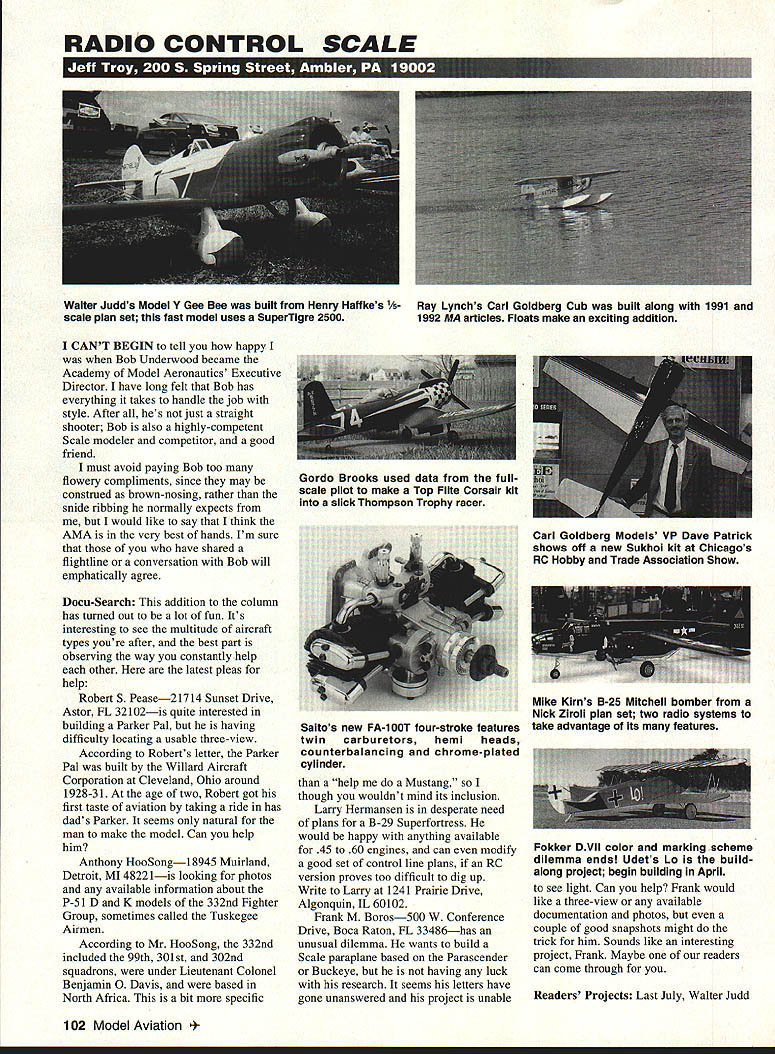
Last July Walter Judd of Honeoye, New York snapped a shot of his new Gee Bee at the STARS Rally in Olean, New York. It's a 1/2-scale Model Y from a set of Henry Haffke's plans, and turned out to be Walt's first "scratched-from-plans" project. The Gee Bee was beefed up considerably to handle the Super Tigre 2500 that Walt chose, and it swings an 18-inch-diameter prop.
Williams Bros. dummy engine cylinders were used around a home-brewed balsa crankcase, and 21st Century fabric and paint handled the finishing chores. In order to achieve a reasonable center of gravity (CG), Mr. Judd had expected to add quite a bit of weight to the model's rear, but it turned out the model balanced perfectly without it.
At the time Walter's letter was written there were three flights on the Gee Bee. It's stable, fast (as you can imagine!), but still flies very slowly at low throttle settings. The model lands fast and does much better on the mains than when attempts are made at three-point landings. Judging from the photo, Walter Judd has done a very nice job on this model.
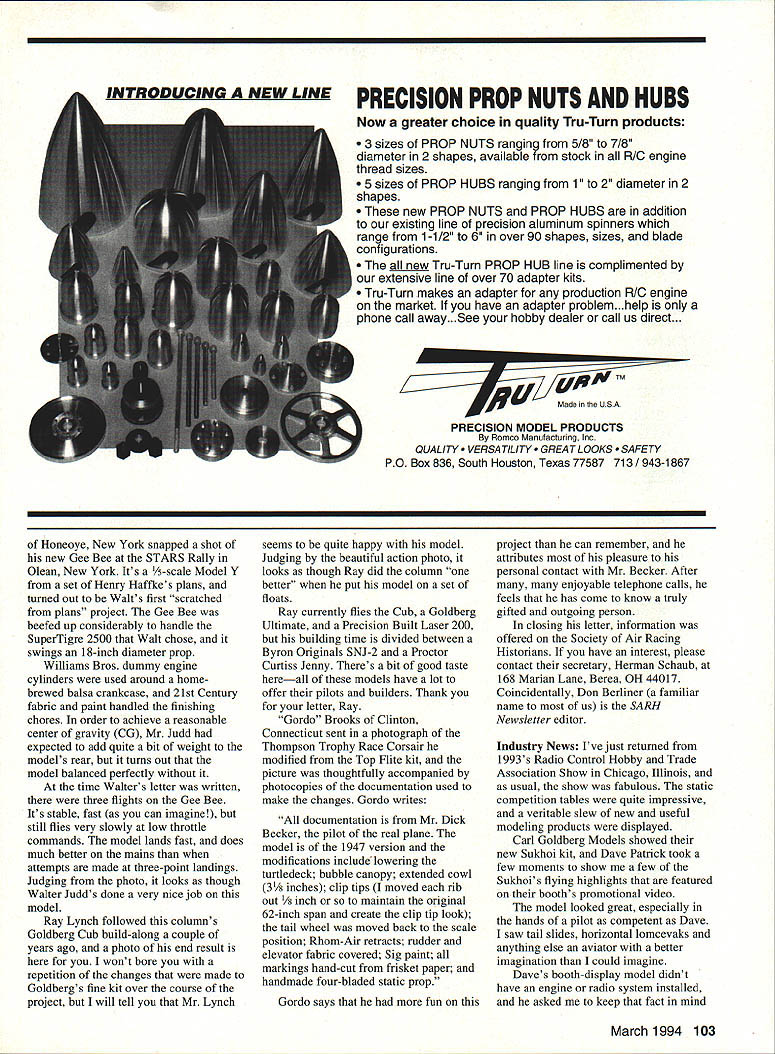
Ray Lynch followed this column's Goldberg Cub build-along a couple of years ago, and a photo of his end result is here for you. I won't bore you with a repetition of the changes that were made to Goldberg's fine kit over the course of the project, but Mr. Lynch seems quite happy with his model. Judging by the beautiful action photo, it looks as though Ray did the column "one better" when he put his model on a set of floats.
Ray currently flies the Cub, a Goldberg Ultimate, and a Precision Built Laser 200, but his building time is divided between a Byron Originals SNJ-2 and a Proctor Curtiss Jenny. There's a bit of good taste here—all of these models have a lot to offer their pilots and builders. Thank you for your letter, Ray.
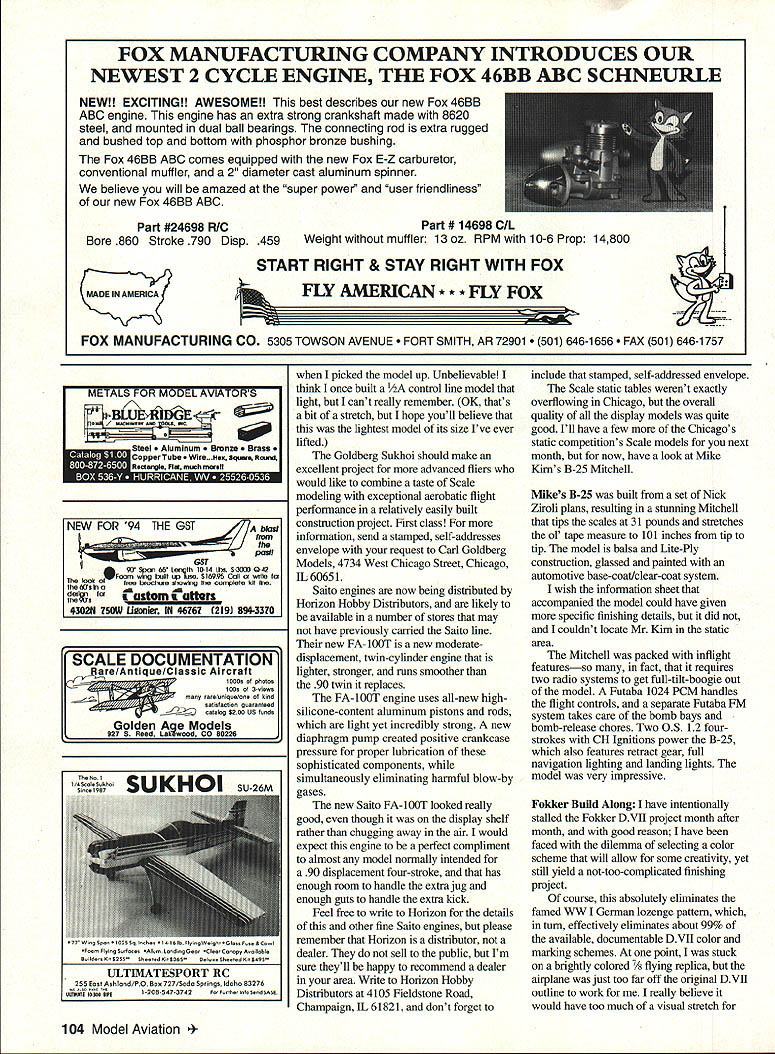
"Gordo" Brooks of Clinton, Connecticut sent in a photograph of the Thompson Trophy Race Corsair he modified from the Top Flite kit, and he thoughtfully included photocopies of the documentation used to make the changes. Gordo writes:
"All documentation is from Mr. Dick Becker, the pilot of the real plane. The model is of the 1947 version and the modifications included lowering the turtledeck; bubble canopy; extended cowl (3-1/8 inches); clip tips (I moved each rib out 1/8 inch or so to maintain the original 62-inch span and create the clip tip look); the tail wheel was moved back to the scale position; Rhom-Air retracts; rudder and elevator fabric covered; Sig paint; all markings hand-cut from frisket paper; and a handmade four-bladed static prop."
Gordo says that he had more fun on this project than he can remember, and he attributes much of his pleasure to his personal contact with Mr. Becker. After many enjoyable telephone calls, he feels that he has come to know a truly gifted and outgoing person.
In closing his letter, information was offered on the Society of Air Racing Historians. If you have an interest, contact their secretary Herman Schaub at 168 Marian Lane, Berea, OH 44017. Coincidentally, Don Berlinger (a familiar name to most of us) is the SARH Newsletter editor.
Industry News
I just returned from 1993's Radio Control Hobby and Trade Association Show in Chicago, Illinois, and as usual, the show was fabulous. The static competition tables were quite impressive, and a veritable slew of new and useful modeling products were displayed.
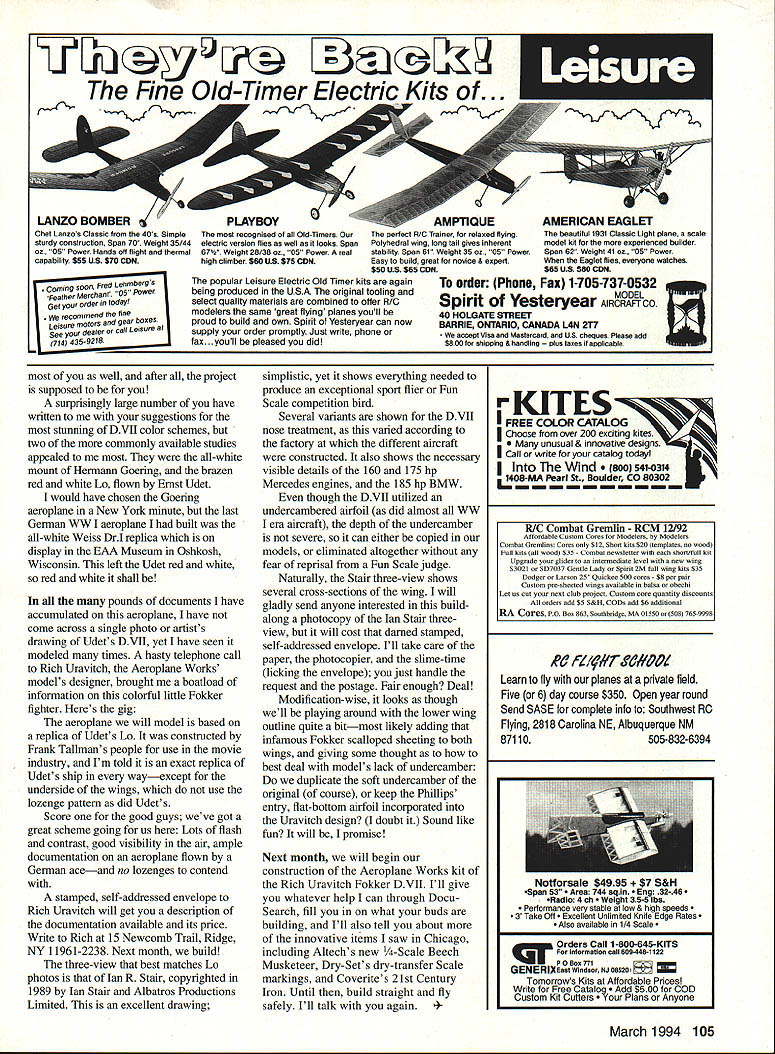
- Carl Goldberg Models showed their new Sukhoi kit, and Dave Patrick spent a few mornings demonstrating some of the Sukhoi's flying highlights that are featured on the booth's promotional video. The model looked great, especially in the hands of a pilot as competent as Dave. I saw tail slides, horizontal low-twists and anything else an aviator with a better imagination than I could imagine.
Dave's booth-display model didn't have an engine or radio system installed, and he asked me to keep that fact in mind. When I picked the model up—unbelievable! I think I once built a 1/2A control-line model that light, but I can't really remember. The Goldberg Sukhoi should make an excellent project for more advanced fliers who would like to combine a taste of Scale modeling with exceptional aerobatic flight performance in a relatively easily built construction project. First class! For more information, send a stamped, self-addressed envelope to Carl Goldberg Models, 4734 West Chicago Street, Chicago, IL 60651.
- Saito engines are now being distributed by Horizon Hobby Distributors, and are likely to be available in a number of stores that may not have previously carried the Saito line. Their new FA-100T is a moderate-displacement, twin-cylinder engine that is lighter, stronger, and runs smoother than the .90 twin it replaces.
The FA-100T uses all-new high-silicone-content aluminum pistons and rods, which are light yet incredibly strong. A new diaphragm pump creates positive crankcase pressure for proper lubrication of those components, while simultaneously eliminating harmful blow-by gases.
The new Saito FA-100T looked really good, even though it was on the display shelf rather than chugging away in the air. I would expect this engine to be a perfect complement to almost any model normally intended for .90-displacement four-stroke, provided the model has enough room to handle the extra jug and enough guts to handle the extra kick.
Feel free to write to Horizon for details of this and other Saito engines, but remember that Horizon is a distributor, not a manufacturer. They do not sell to the public, but I'm sure they'll be happy to recommend a dealer in your area. Write to Horizon Hobby Distributors at 4105 Fieldstone Road, Champaign, IL 61821, and include a stamped, self-addressed envelope.
The Scale static tables weren't exactly overflowing in Chicago, but the overall quality of the display models was quite good. I'll have a few more of the Chicago static competition entries in Scale models for you next month, but for now, have a look at Mike Kim's B-25 Mitchell.
Mike's B-25 was built from a set of Nick Ziroli plans, resulting in a stunning Mitchell that tips the scales at 31 pounds and stretches the tape measure to 101 inches from tip to tip. The model is balsa and Lite-Ply construction, glassed and painted with an automotive base-coat/clear-coat system. I wish the information sheet that accompanied the model could have given more specific finishing details, but it did not, and I couldn't locate Mr. Kim in the static area.
The Mitchell was packed with in-flight features—some that require two radio systems to get full in-flight use of the model. A Futaba 10Z4 PCM handles the flight controls, and a separate Futaba FM system takes care of the bomb bays and bomb-release actuators. Two O.S. 1.20 four-strokes with O.S. ignition power the B-25, which also features retract gear, full instrument navigation lighting and landing lights. The model was very impressive.
Fokker Build-Along
I have intentionally stalled the Fokker D.VII project month after month, and with good reason: I have been faced with the dilemma of selecting a color scheme that will allow some creativity, yet still yield a not-too-complicated finishing project.
Of course, this essentially eliminates the famed WWI German lozenge pattern, which in turn eliminates about 99% of the available, documentable D.VII color and marking schemes. At one point I was stuck on a brightly colored 7/8 flying replica, but the airplane was just too far off the original D.VII outline to work for me. I really believe it would have too much of a visual stretch for most of you as well, and after all, the project is supposed to be for you!
A surprisingly large number of you have written with suggestions for the most stunning D.VII color schemes, but two of the more commonly available studies appealed to me most: the all-white mount of Hermann Goering, and the brazen red-and-white "Lo," flown by Ernst Udet.
I would have chosen the Goering aeroplane in a New York minute, but the last German WWI aeroplane I built was the all-white Weiss D.R.I replica which is on display in the EAA Museum in Oshkosh, Wisconsin. This left the Udet D.VII—red and white it shall be!
In all the many pounds of documents I have accumulated on this aeroplane, I have not come across a single photo or artist's drawing of Udet's D.VII, yet I have seen it modeled many times. A hasty telephone call to Rich Uravitch, Aeroplane Works' designer, brought me a boatload of information on this colorful little Fokker fighter. Here's the scoop:
The aeroplane the model is based on is a replica of Udet's D.VII. It was constructed by Frank Tallman as a replica for use in the movie industry, and I'm told it is an exact replica of Udet's ship in every way—except for the underside of the wings, which do not use the lozenge pattern as did Udet's.
Score one for the good guys; we've got a great scheme going for our build. Lots of flash and contrast, good visibility in the air, ample documentation on the aeroplane flown by a German ace—and no lozenges to contend with.
A stamped, self-addressed envelope to Rich Uravitch will get you a description of the documentation available and its price. Write to Rich at 15 Newcomb Trail, Ridge, NY 11961-2238. Next month, we build!
The Three-View and Modifications
The three-view that best matches "Lo" photos is that of Ian R. Stair, copyrighted in 1989 by Ian Stair and Albatros Productions Limited. This is an excellent drawing: simplistic, yet showing everything needed to produce an exceptional sport flier or Fun Scale competition bird.
Several variants are shown for the D.VII nose treatment, as this varied according to the factory at which the different aircraft were constructed. It also shows the necessary visible details of the 160 and 175 hp Mercedes engines, and the 185 hp BMW.
Even though the D.VII utilized an undercambered airfoil (as did almost all WWI aircraft), the depth of the undercamber is not severe, so it can either be copied in our models or eliminated altogether without fear of reprisal from a Fun Scale judge.
Naturally, the Stair three-view shows several cross-sections of the wing. I will gladly send anyone interested in this build-along a photocopy of the Ian Stair three-view, but it will cost that darned stamped, self-addressed envelope. I'll take care of the paper, the photocopier, and the slime-time (licking the envelope); you handle the request and the postage. Fair enough? Deal!
Modification-wise, it looks as though we'll be playing around with the lower wing a bit—most likely adding that infamous Fokker scalloped sheeting to both wings, and giving some thought as to how best to deal with the model's lack of undercamber. Do we duplicate the soft undercamber of the original (of course), or keep the Phillips' entry flat-bottom airfoil incorporated into the Uravitch design? (I doubt it.) Sound like fun? It will be, I promise!
Next month we will begin construction of the Aeroplane Works kit of the Rich Uravitch Fokker D.VII. I'll give you whatever help I can through Docu-Search. I'll run you through what you need for building, and I'll also tell you about more of the innovative items I saw in Chicago, including Altech's new 1/4-scale Beech Musketeer, Dry-Set's dry-transfer Scale markings, and Correcote's 21st Century Iron.
Until then, build straight and fly safely. I'll talk with you again.
Transcribed from original scans by AI. Minor OCR errors may remain.

