
Radio Control: Scale
Bud Atkinson
THERE SEEMS to be something about a war bird that stirs the imagination. This is true regardless of what insignia it carries, be it 1918 or 1961. The war birds were built for a specified purpose—to oppose their adversary and hopefully out-fly, out-bomb and out-guess the opponent.
Rhinebeck, the Confederate Air Force, and the many other air shows around the world demonstrate this love for and curiosity about the fighting air machine. The point I am aiming at is first-hand inspection of the detail, color and markings of these past birds. You WWII buffs have missed the great opportunity of a lifetime if you haven't seen the Confederate Air Force fly and be able to inspect and even touch these wonderful birds. I'm sure any inspired scale modeler has seen a WW I or WWII airplane and marched home to build his favorite warbird. I'm sure this is the case with many of the manufacturers of Scale and Stand-off Scale, because we have such a fine selection of these subjects.
One of the problems of both WW I and WWII aircraft is the semi-flat camouflage paint jobs. Much has been written on the subject of finishes but still camouflaging is a problem! Several years ago, when presented with this problem, I did research on the subject and came up with a product I called Cam-o-sheen. When added to lacquer, enamel, dope, nitrate or butyrate in different amounts it will give you a flat to dull finish without damaging the fuel-proof quality of the material. It may even be added to clear dope to protect by flatting your detailing and decals.
Just recently my K.C.R.C. scale friend, Fred Hulen, has used it in K & B epoxy to paint his Nam T-28—yes, the T-28 was used in Vietnam. Many were camouflaged. His results were great. So it will work in K & B epoxy. I'm not sure about any other epoxy paint. The degree of flat naturally depends on the amount of Cam-o-sheen, so experiment before applying it to your model.
There are two sources for Cam-o-sheen (Ace Radio Control of Higginsville, Mo. and KRD Products, at Ken's R/C—10915 W. 59th Terr., Shawnee, Kan. 66203). I can guarantee you will obtain a scale-like camouflage finish. Don't overdo the amount of flat. Most full-scale camouflage paint jobs were not dead flat, but rather semi-gloss. I think too many fine scale models are over flat and not realistic. They have to be badly weathered to become dead flat. If you get a chance to visit the Air Force Museum in Dayton take a good look at the many fine examples of war birds they have on display. I have yet to find anything else that will give you the desired sheen you want, so try Cam-o-sheen on your next camouflage paint job and let me know how you like it.
I don't intend to do a complete review of scale kits in this column, but will give a run down on new Scale or Stand-off Scale kits and its affiliated products. One such kit is Sig's new Stand-off biplane, the "Steen Skybolt." It's fully acrobatic and the kit shows both scale dual ailerons as well as the non-scale strip aileron for those who would like just a sport plane. I believe the Skybolt is one of the best proportioned biplanes to date. A good Stand-off copy of the full-size Skybolt, which was designed by an RC modeler, shows its appearance to the RC modeler as well as a full-size man-carrying plane. In opening the kit I found the parts well marked and, above all, they fit exceptionally well. It has nice decals, and later there will be a choice of several paint jobs and decals to choose from. The kit seems to be very complete. I'm sure the Stand-off scale biplane bug will appreciate this fine kit of the Steen Skybolt.
There was a very good array of Stand-off Scale kits at the Toledo show. Too many to mention, but they should be showing up in the publications soon. With the already fine line of scale birds on the market, you scale flyers should have no trouble in finding something new to build.
While talking about realism, I have heard many Scale and Stand-off Scale buffs making mention of how well a particular scale model looked, except there was no pilot. It really is sad to see a fine Scale bird taxiing along with no pilot, gunner, or what have you, because after all we are trying to simulate in miniature a particular P-51, P-40, ME 109 or whatever. While static judging, I think a pilot or gunner or even a passenger should come under the category of "general appearance" and points should be reduced if, at least, an attempt is not made to simulate a pilot. I'm sure if the cockpit were just painted over and not completed the judges would down-grade the model, and so should an absent pilot.
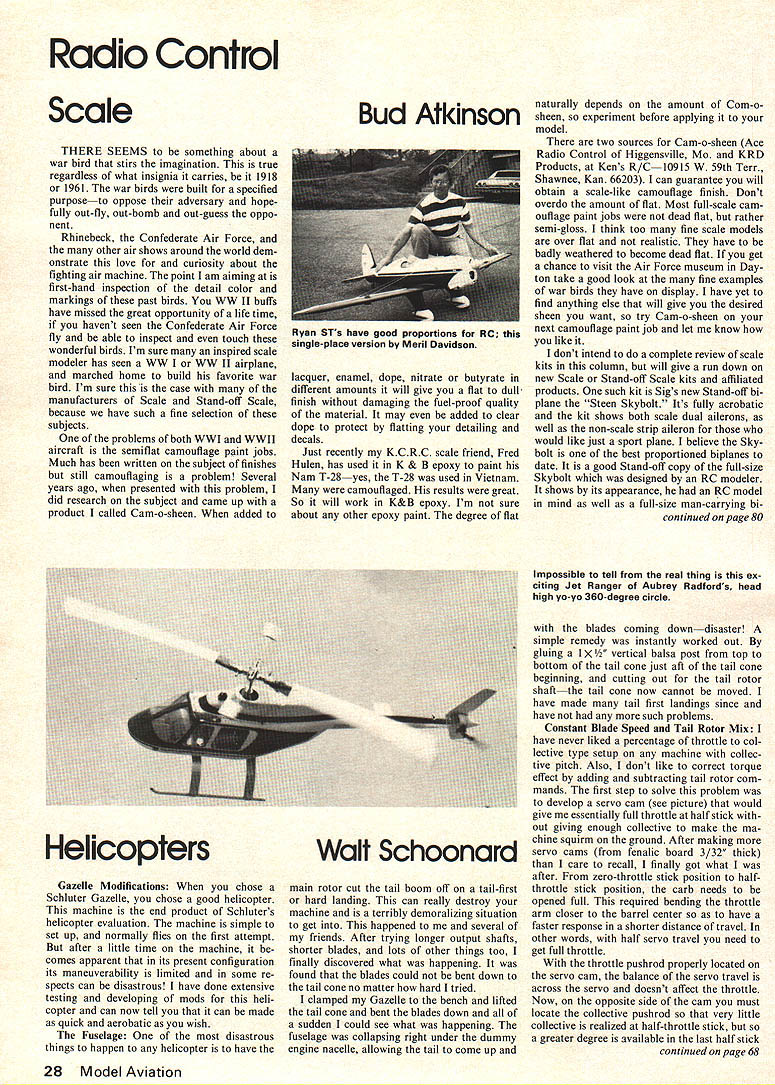
One picture this month is rather a common sight around the scale contest circuit, a Sig STA Ryan, but the big difference is this Ryan, by Merril Davidson, of Shawnee, Kan. Merril is a superb scale builder and spent almost two years building his Ryan. I have seen a lot of STA Ryans, but I do believe Merril's is about the most honest one I have ever seen. A picture could not do justice to this fine model. It is complete to every detail.
The cockpit you have to see to believe; every bolt and rivet is in place, every knob and switch is very realistic, and it has an immaculate paint job. Merril is an old hand at building scale and has constructed many fine scale RC models. One fine job was a 1/6th-scale T-6 trainer which he built for a friend. They got back a long way to the single-channel days. Merril redid the kit into a beautiful Stand-off Scale model. When the day comes when Merril can fly them as well as he builds, look out, scale contestants.
O.K. let's see some more of you guys out there send in pictures and info of your scale planes. (My address is 734 N. 6th St. Terrace, Blue Springs, Mo. 64015.)
Transcribed from original scans by AI. Minor OCR errors may remain.

