
RADIO CONTROL: SCALE
Jeff Troy 200 S. Spring Street, Ambler, PA 19002
I hate clichés, but remember this was written in early February when there was about ten inches of snow on my Pennsylvania driveway and tons of collapsed highway in Southern California. It's good to be home.
After packing our gear at the close of the International Modelers Show in Pasadena, we grabbed the shuttle for LAX, ate a little institutional food there, and boarded our aircraft—just a scant four-and-a-half hours before the earthquake hit!
When I finally arrived at Philadelphia International early the following morning, I lucked out again by beating a severe ice storm by another four-and-a-half hours. Sometimes life is good. The bear eats me up on a regular basis, but every now and then I get it right.
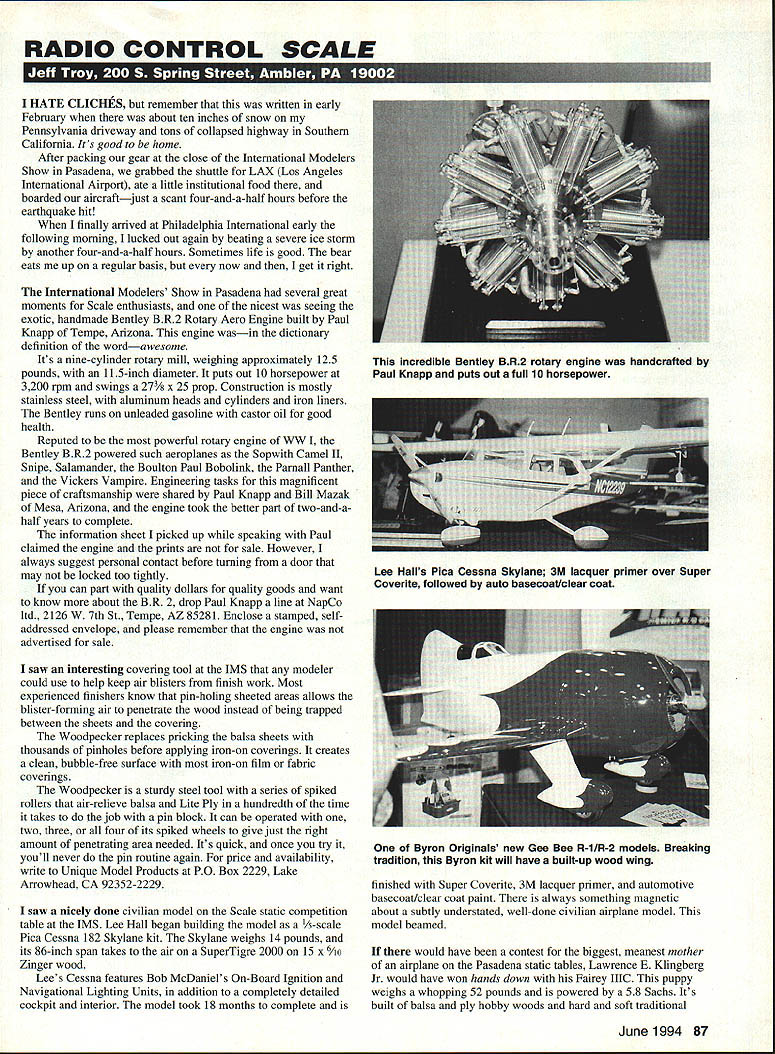
The International Modelers' Show in Pasadena had several great moments for Scale enthusiasts. One of the nicest was seeing the exotic, handmade Bentley B.R.2 rotary aero engine built by Paul Knapp of Tempe, Arizona. This engine was—in the dictionary definition of the word—awesome.
Bentley B.R.2 Rotary Aero Engine
It's a nine-cylinder rotary mill, weighing approximately 12.5 pounds, with an 11.5-inch diameter. It puts out 10 horsepower at 3,200 rpm and swings a 27-1/2 x 25 prop. Construction is mostly stainless steel, with aluminum heads and cylinders and iron liners. The Bentley runs on unleaded gasoline with castor oil for good health.
Reputed to be the most powerful rotary engine of WWI, the Bentley B.R.2 powered such aeroplanes as:
- Sopwith Camel II
- Sopwith Snipe
- Sopwith Salamander
- Boulton Paul Bobolink
- Parnall Panther
- Vickers Vampire
Engineering tasks for this magnificent piece of craftsmanship were shared by Paul Knapp and Bill Mazak of Mesa, Arizona, and the engine took the better part of two-and-a-half years to complete.
The information sheet I picked up while speaking with Paul claimed the engine and the prints are not for sale. However, I always suggest personal contact before turning from a door that may not be locked too tightly.
If you can part with quality dollars for quality goods and want to know more about the B.R.2, drop Paul Knapp a line at NapCo Ltd., 2126 W. 7th St., Tempe, AZ 85281. Enclose a stamped, self-addressed envelope, and please remember that the engine was not advertised for sale.
Covering Tool: The Woodpecker
I saw an interesting covering tool at the IMS that any modeler could use to help keep air blisters from finish work. Most experienced finishers know that pin-holing sheeted areas allows the blister-forming air to penetrate the wood instead of being trapped between the sheets and the covering.
The Woodpecker replaces pricking the balsa sheets with thousands of pinholes before applying iron-on coverings. It creates a clean, bubble-free surface with most iron-on film or fabric coverings.
The Woodpecker is a sturdy steel tool with a series of spiked rollers that air-relieve balsa and Lite Ply in a hundredth of the time it takes to do the job with a pin block. It can be operated with one, two, three, or all four of its spiked wheels to give just the right amount of penetrating area needed. It's quick, and once you try it, you'll never do the pin routine again. For price and availability, write to Unique Model Products at P.O. Box 2229, Lake Arrowhead, CA 92352-2229.
Notable Models at IMS
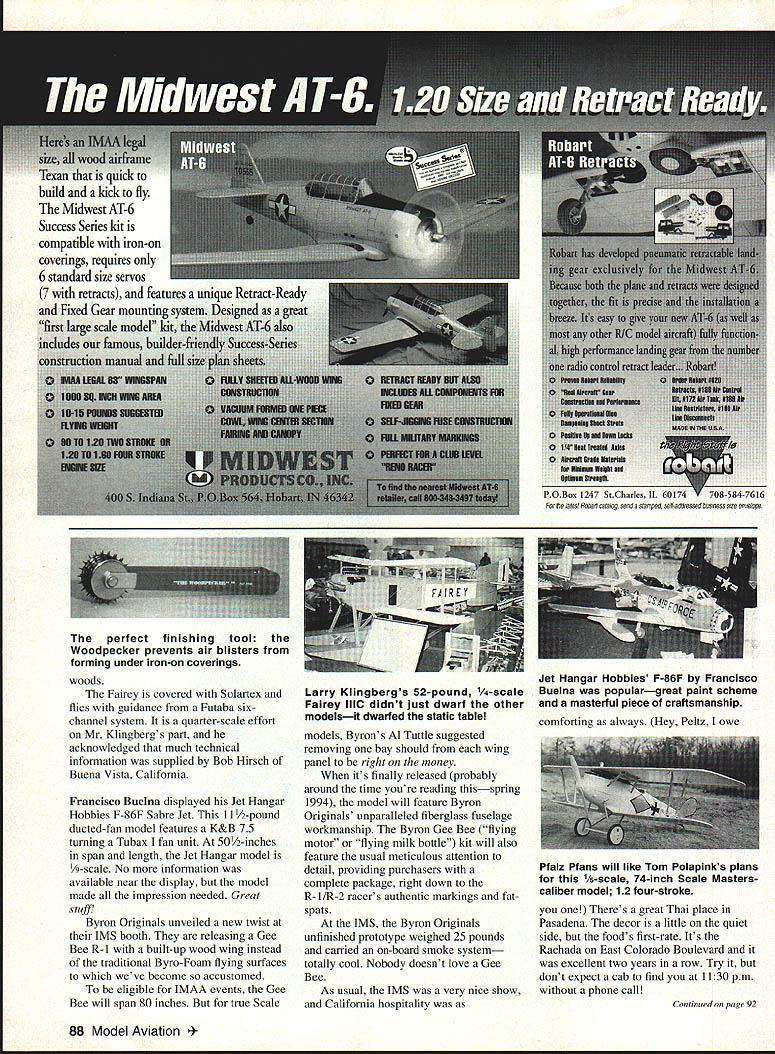
Lee Hall displayed a nicely done civilian model on the Scale static competition table at the IMS. Lee began with a 1/5-scale Pica Cessna 182 Skylane kit. The Skylane weighs 14 pounds, and its 86-inch span takes to the air on a SuperTigre 2000 with a 15 x 6 Zinger wood prop.
Lee's Cessna features Bob McDaniel's on-board ignition and navigational lighting units, in addition to a completely detailed cockpit and interior. The model took 18 months to complete and finished with Super Coverite, 3M lacquer primer, and automotive basecoat/clear coat paint. There is always something magnetic about a subtly understated, well-done civilian airplane model. The model beamed.
If there had been a contest for the biggest, meanest mother of an airplane on the Pasadena static tables, Lawrence E. Klingberg Jr. would have won hands down with his Fairey IIIC. This puppy weighs a whopping 52 pounds and is powered by a .58 Sachs. It's built of balsa and ply hobby woods and hard and soft traditional woods.
The Fairey is covered with Solartex and flies with guidance from a Futaba six-channel system. It is a quarter-scale effort, and Mr. Klingberg acknowledged that much technical information was supplied by Bob Hirsch of Buena Vista, California.
Francisco Buelna displayed his Jet Hangar Hobbies F-86F Sabre Jet. This 11-1/2-pound ducted-fan model features a K&B .75 turning a Tubax fan unit. At 50-1/2 inches in span and length, the Jet Hangar model is 1/9-scale. No more information was available near the display, but the model made all the impression needed. Great stuff!
Byron Originals Gee Bee
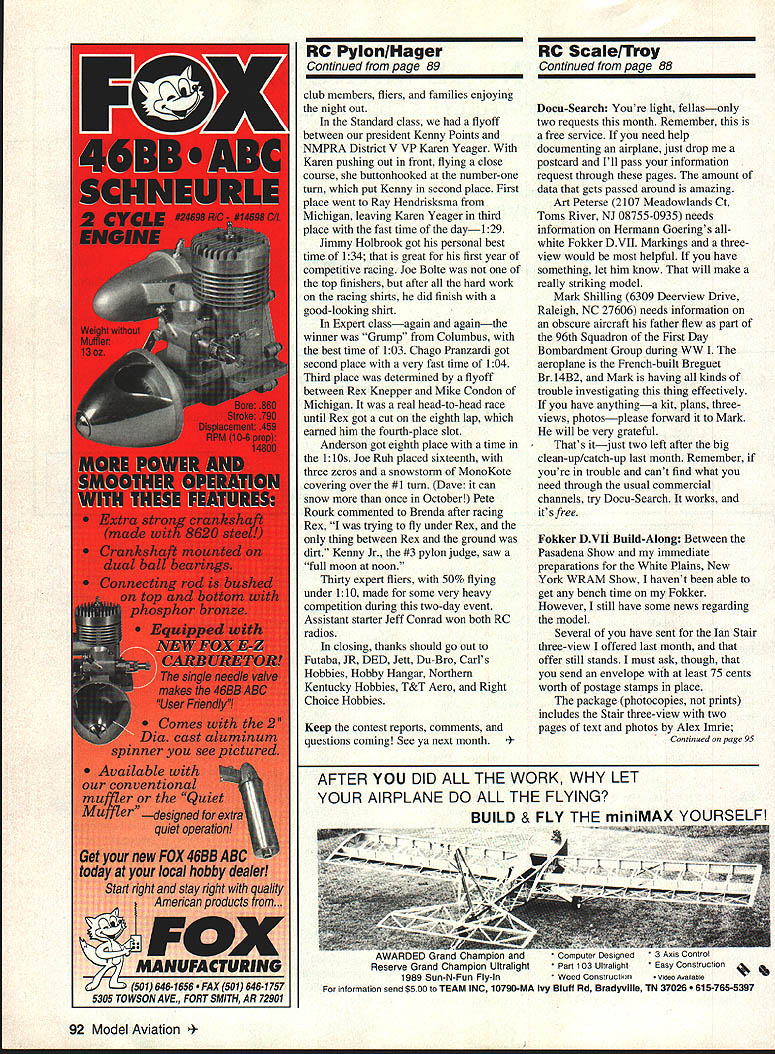
Byron Originals unveiled a new twist at their IMS booth. They are releasing a Gee Bee R-1/R-2 with a built-up wood wing instead of the traditional Byron-foam flying surfaces. To be eligible for IMAA events, the Gee Bee will span 80 inches. For true scale models, Byron's Al Tuttle suggested removing one bay from each wing panel to be right on the money.
When it's finally released (probably around the time you're reading this—spring 1994), the model will feature Byron Originals' unparalleled fiberglass fuselage workmanship. The Byron Gee Bee ("flying milk bottle") kit will also feature the usual meticulous attention to detail, providing purchasers with a complete package, right down to the R-1/R-2 racer's authentic markings and fasteners.
At the IMS, the Byron Originals finished prototype weighed 25 pounds and carried an on-board smoke system—totally cool. Nobody doesn't love a Gee Bee.
IMS Recap and Pasadena Dining
As usual, the IMS was a very nice show, and California hospitality was as comforting as always. (Hey, Peltz, I owe you one!) There's a great Thai place in Pasadena. The décor is a little on the quiet side, but the food's first-rate. It's The Racha on East Colorado Boulevard and it was excellent two years in a row. Try it, but don't expect a cab to find you at 11:30 p.m. without a phone call!
---
RC SCALE / TROY
Docu-Search
Docu-Search: You're light, fellas—only two requests this month. Remember, this is a free service. If you need help documenting an airplane, just drop me a postcard and I'll pass your information request through these pages. The amount of data that gets passed around is amazing.
Requests this month:
- Art Petersen
- Address: 2107 Meadowlands Ct., Toms River, NJ 08755-0935
- Needs information on Hermann Goering's all-white Fokker D.VII. Markings and a three-view would be most helpful.
- Mark Shilling
- Address: 6309 Deerview Drive, Raleigh, NC 27606
- Needs information on an obscure aircraft his father flew as part of the 96th Squadron of the First Day Bombardment Group during WWI. The aeroplane is the French-built Breguet Br.14B2. He needs any kit, plans, three-views, or photos.
That's it—just two left after the big cleanup/catch-up last month. Remember, if you're in trouble and can't find what you need through the usual commercial channels, try Docu-Search. It works, and it's free.
Fokker D.VII Build-Along
Between the Pasadena show and my immediate preparations for the White Plains, New York WRAM Show, I haven't been able to get any bench time on my Fokker. However, I still have some news regarding the model.
Several of you have sent for the Ian Stair three-view I offered last month, and that offer still stands. I must ask, though, that you send an envelope with at least 75 cents worth of postage stamps enclosed.
The package (photocopies, not prints) includes:
- The Stair three-view with two pages of text and photos by Alex Imrie
- Three photocopies of actual photographs of Frank Tallman's Lo movie replica, as taken by Idaho's Vince O'Brian
- Photocopies of two pages of text and artist's renderings of Lo, supplied by Ann Peplino of Scale Plans and Photo Service
- Photocopies of two aerial shots of the Lo movie replica, provided by Rich Uravitch from Air Classics magazine
- A product price list from Chuck Gill's The Aeroplane Works
If you're building along with me (or if you just would like a nice package of D.VII items to clutter your living space), it's well worth the six bits. I'll take care of the copies and the walk to the post office. You lick the stamps and send me the envelope. Deal? Done.
Incidentally, I have a great "ain't modelers good guys?" story concerning this documentation package.
While lounging around the house one evening, I received a call from an Idaho gentleman named Vince O'Brian. He seemed to be a most pleasant individual, and he informed me that he had had some contact with Frank Tallman's operation a long time ago during a trip to the Tall/Manta Museum. He wanted to know if I would like to see some photographs of the actual movie version of Lo.
Did I ever leap or what? Could the timing have been any better? I had just committed to Lo as the subject of our build-along, and here comes photos of the original (in this case, the replica is the original), right down the pike.
Vince sent a package containing three 8 x 10-inch shots of this charismatic aeroplane, an SE-5a in US AAC markings, what appears to be a Nieuport 24, a Nieuport 28 C., a Pfalz, a P-40E, and even an old Cessna L-19 Bird Dog. I won't keep these priceless photographs very long, so don't delay.
If you want copies, send that request and a stamped (75c) envelope. I will make 150 copies of this literature, then I will return the photos to Mr. O'Brian. When the buck and a half are done, you'll be on your own.
Next month, I'll get the fuselage framed, discuss mounting the tail feathers, and talk about the D.VII's undercarriage and wing saddle adjustments. This will be fun and very easy, so be here to see it through that far. There is quite a bit of activity regarding this project, and this is good—I hope you're enjoying it as much as I am. Believe me, every one of your warm letters and comments are genuinely appreciated.
Pfalz D.III Plans
I received an excellent set of plans for Tom Polapink's Pfalz D.III/D.IIIA. The mailing tube included three detailed construction sheets with parts patterns; a comprehensive, well-written construction manual; several photographs of Tom's completed model; and a personal note from Tom.
The plans are sold through Tom's operation, Great War Plans. For prices and more information, send a stamped, self-addressed envelope to 42 Eastwood Blvd., Centereach, NY 11720. You'll be glad you did. The model and the plan set are very nice and quite competently designed and drawn.
The model looks great, weighs 14 pounds, spans 74 inches, and uses a .12 four-stroke for power. Tom promises to offer vacuum-formed wheel covers and spinner, an aluminum spinner, scale five-inch-diameter tires, and possibly a vacuum-formed dummy Mercedes engine and wing-mounted radiator.
I found the construction to be relatively simple and straightforward for an aeroplane of such complexity as the Pfalz. I love the laminated wingtips and tail feather outlines, and Tom's Pfalz didn't disappoint me.
This shouldn't give you any particular trouble if you have a couple of construction projects under your belt. But you will find a test or two of skill along the road to completion. It's good to be challenged now and then; it keeps the blood flowing and those creative cells operational.
That's it, my friends. Until next time, build straight and fly safely. I'll talk with you again.
Transcribed from original scans by AI. Minor OCR errors may remain.

