
RADIO CONTROL SCALE
Stan Alexander 3709 Valley Ridge Dr., Nashville TN 37211 E-mail: onawing@mindspring.com
Spring projects and events
Spring is approaching in most areas of the country, and it's time to start finishing that winter building project—or, in some cases, last year's building project.
Scale events are starting across the country. There are contests and fly‑ins. Some events require qualification before you attend; others you can just show up at and enjoy. Try a contest or fly‑in, let everyone know you are a beginner, and you'll likely receive all the help you need to get started in scale modeling.
The AMA National Championships is one event in which anyone can show up and compete in Radio Control (RC) or Control Line (CL) Scale, or any of the other classes. Competitors tend to help each other, and everyone has a good time.
This year's Scale Nationals is starting a new program: expert modelers will be teamed with sportsman modelers to help the less‑experienced learn the basics of RC Scale competition. This will be a voluntary program, and hopes are high that a new generation of scale modelers will fly from these sessions and events.
This year's Scale National Championships will take place July 6–8 (not a week later, as previously reported).
Other ideas to help grow the number of scale modelers will be presented at the annual Toledo show (Weak Signals RC Exposition) in April. The National Association of Scale Aeromodelers (NASA) will host the first NASA Road Show. Expert modelers will host mini‑seminars to help modelers improve their skills and give an extra shot of enthusiasm for unfinished projects. Webmaster Ed Clayman will manage the first NASA Road Show at Toledo.
US Scale Masters qualifiers will be held across the country this year. This series of competitions determines which expert modelers will compete in the Championships, held each fall (this year the Championships will take place somewhere in the western half of the U.S.). The qualifiers are one of the handiest avenues for scale modelers to enter national‑level competition.
Building and detailing tips
As you complete the airframe and start adding details, it's a good time to stop and recheck photos and three‑views. Of all the three‑views I've compared, the Paul Matt version seems to be the most accurate. Another useful source is a reprint of the PT‑19 pilot's manual, which includes original specifications, load limits, speeds, and many other details. These reprints are available from Zenith and Historic Aviation book catalogs.
Before you cover a fabric‑covered aircraft, consider details and ways to add realism. Look at your photos for the usual handholds near the rear fuselage—these can be made from bent music wire. Other items to consider adding include:
- Fuel gauges
- Landing‑gear strut covers
- Access doors
- Flap hinge covers
- Airspeed indicator
- Inspection‑plate covers (often round and located on the fuselage and flying surfaces)
Plan your coverings and paint choices well in advance. If you wait until the last minute, manufacturers may be on backorder. At some point many of us wish we had stocked up on K&B epoxy paint. If you find yourself short, check what others have been using recently.
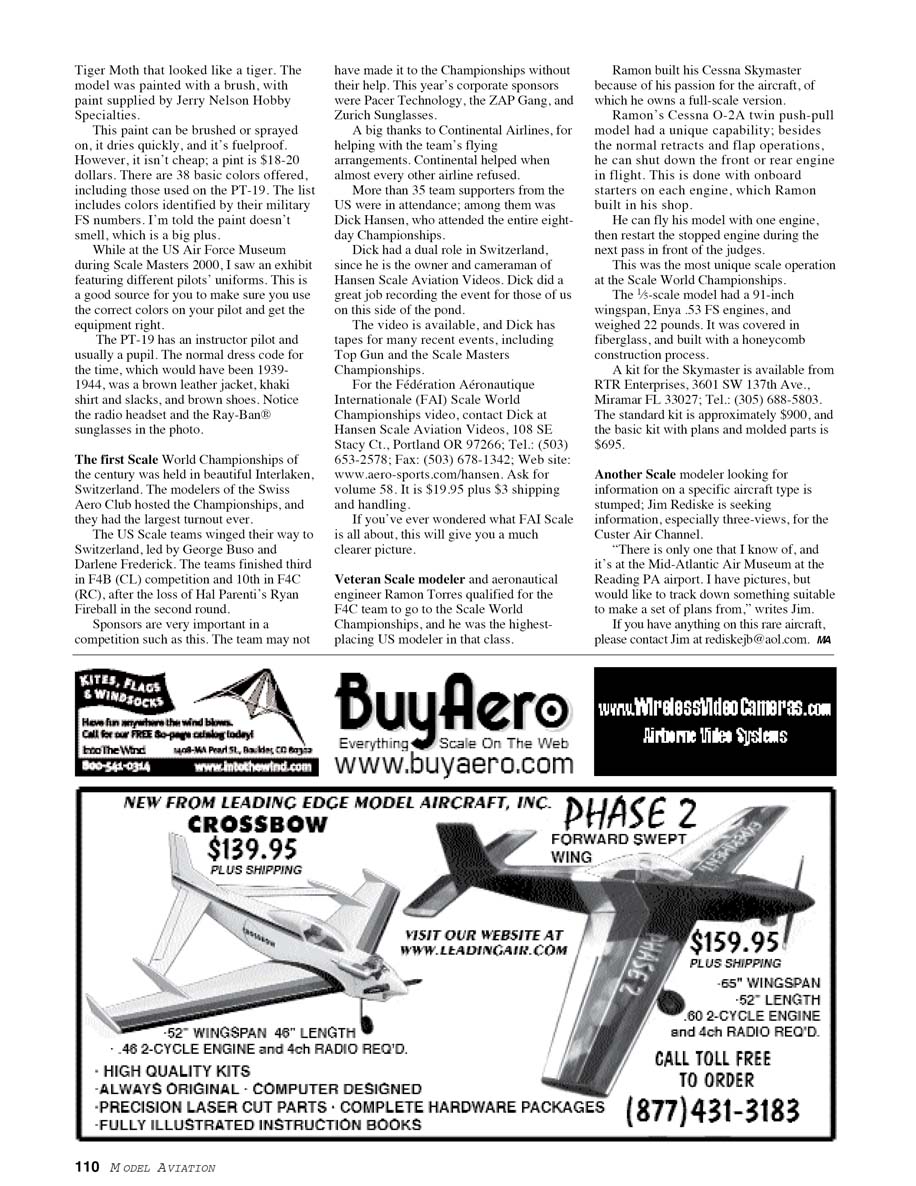
One model that interested me at the 2000 Scale Masters Championships was a 153‑inch‑span Dornier Super‑WAL built from Sea‑Clusion Aeronautics.
PT‑19 Update
As you build any scale model, check your documentation often to ensure you are recreating an accurate miniature—in this case, a 1/5‑scale PT‑19.
I also saw a Tiger Moth painted in a tiger scheme. The model was painted with a brush using paint supplied by Jerry Nelson Hobby Specialties. This paint can be brushed or sprayed, dries quickly, and is fuelproof. A pint runs about $18–20. There are 38 basic colors offered, including those used on the PT‑19, and many are identified by their military FS numbers. The paint is reported to be low‑odor.
While at the U.S. Air Force Museum during Scale Masters 2000, I saw an exhibit of different pilots' uniforms—an excellent source for correct pilot colors and equipment. The PT‑19 typically carried an instructor pilot and a pupil. Normal dress for the time (1939–1944) was a brown leather jacket, khaki shirt and slacks, and brown shoes. Note the radio headset and Ray‑Ban sunglasses seen in period photos.
Scale World Championships — Interlaken, Switzerland
The first Scale World Championships of the century was held in beautiful Interlaken, Switzerland. The Swiss Aero Club hosted the Championships, which had the largest turnout ever.
The U.S. scale teams were led by George Buso and Darlene Frederick. The teams finished third in F4B (CL) competition and 10th in F4C (RC) after the loss of Hal Parent's Ryan Fireball in the second round.
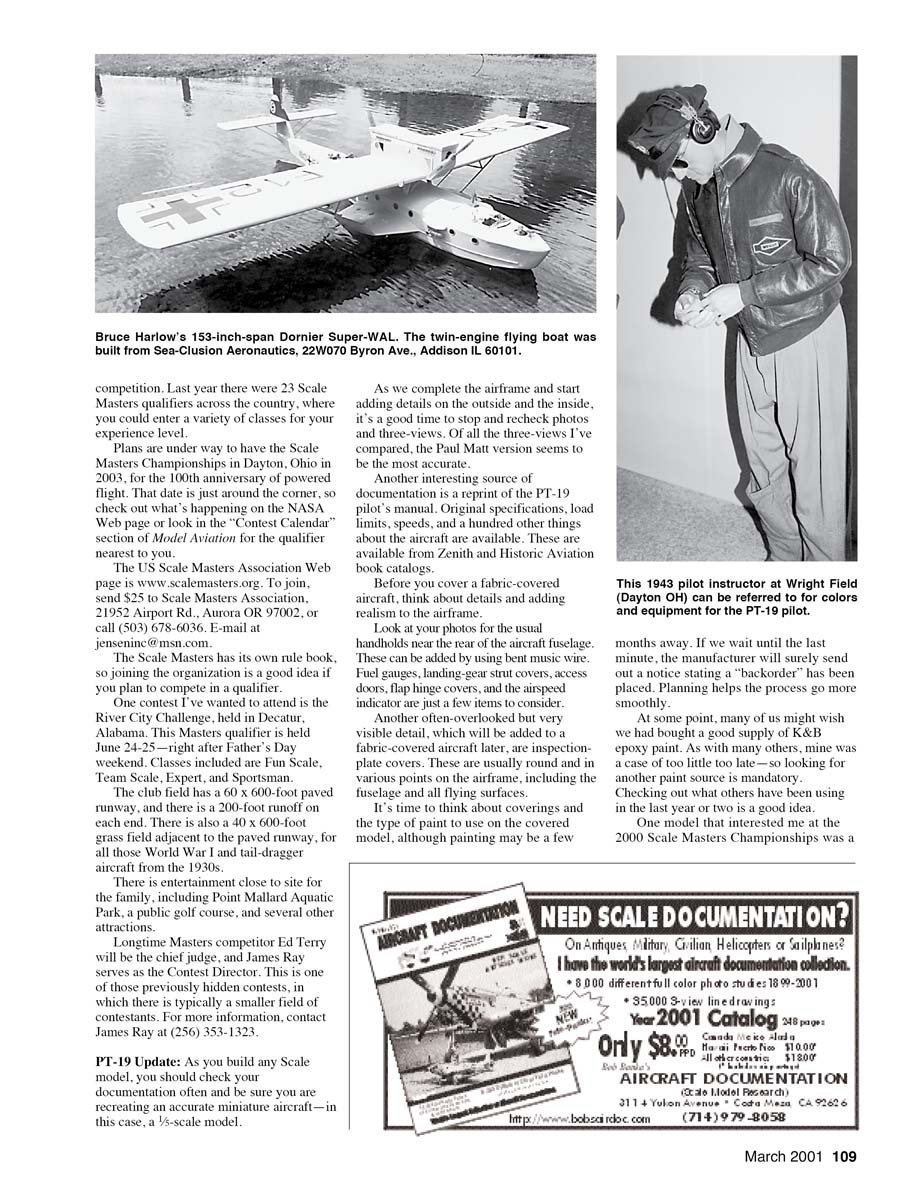
Sponsors are very important; the team may not have reached the Championships without their help. Corporate sponsors included Pacer Technology, the ZAP Gang, and Zurich Sunglasses. A big thanks to Continental Airlines for helping with the team's travel arrangements when other airlines refused.
More than 35 U.S. team supporters attended; among them was Dick Hansen, owner and cameraman of Hansen Scale Aviation Videos. Dick recorded the eight‑day Championships and did a great job documenting the event for those of us back home.
For the FAI Scale World Championships video, contact: Hansen Scale Aviation Videos 108 SE Stacy Ct., Portland OR 97266 Tel.: (503) 653‑2578 Fax: (503) 678‑1342 Web: www.aero‑sports.com/hansen Ask for volume 58. Price: $19.95 plus $3 shipping and handling.
If you've ever wondered what FAI Scale is all about, this video will provide a clear picture.
Ramon Torres — Cessna Skymaster model
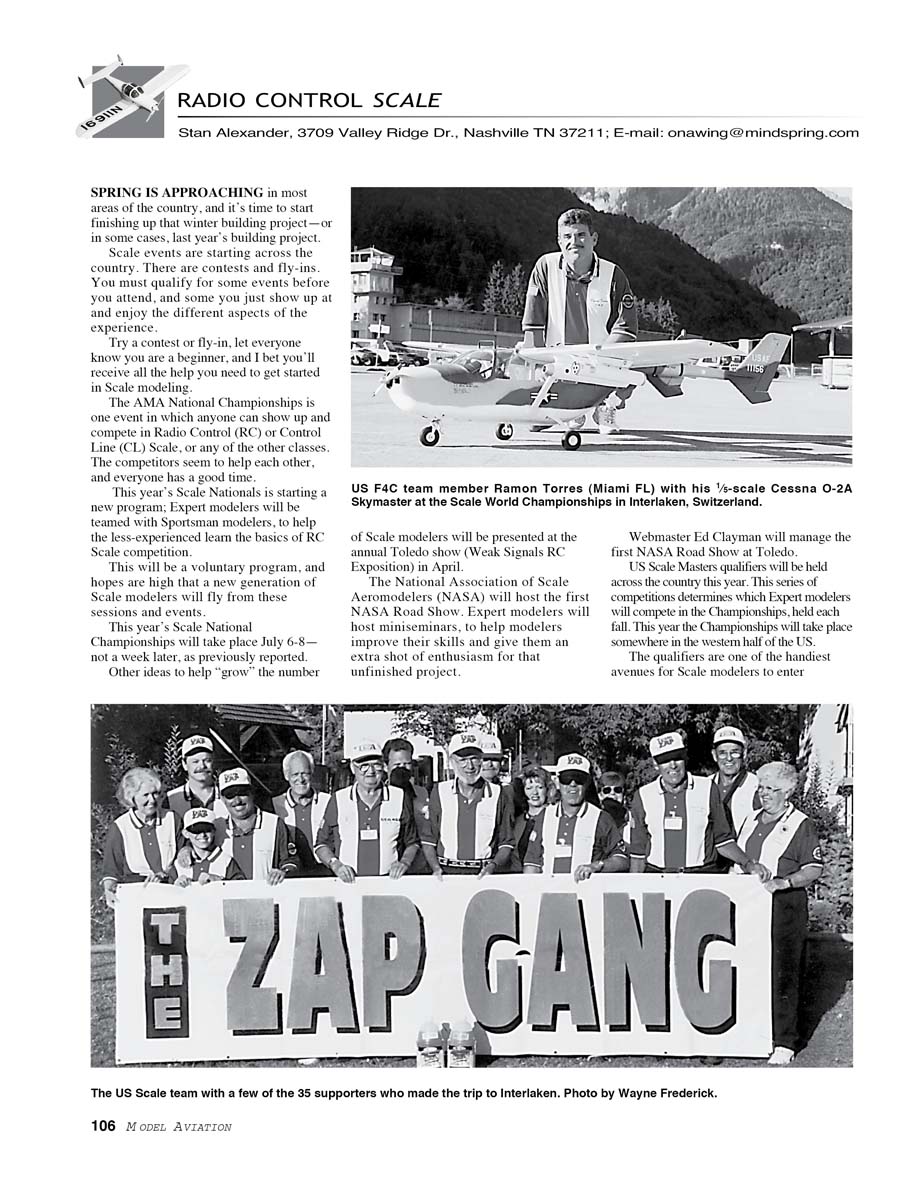
Veteran scale modeler and aeronautical engineer Ramon Torres qualified for the F4C team and was the highest‑placing U.S. modeler in that class. Ramon built his Cessna Skymaster out of passion for the aircraft—he owns a full‑scale version.
Ramon's Cessna O‑2A twin push‑pull model had a unique capability: besides normal retracts and flaps, he can shut down one engine in flight and restart it during the next pass in front of the judges using onboard starters he built. This was the most unique scale operation at the Championships.
Model details:
- Scale: 1/5
- Wingspan: 91 inches
- Engines: Enya .53 FS
- Weight: 22 pounds
- Construction: fiberglass covering and honeycomb construction process
A kit for the Skymaster is available from RTR Enterprises: RTR Enterprises 3601 SW 137th Ave., Miramar FL 33027 Tel.: (305) 688‑5803 Prices: standard kit approximately $900; basic kit with plans and molded parts $695.
Requests and classifieds
Another modeler seeking information is Jim Rediske, who is looking for three‑views and other documentation for the Custer Air Car. "There is only one that I know of, and it's at the Mid‑Atlantic Air Museum at the Reading, PA airport. I have pictures, but would like to track down something suitable to make a set of plans from," writes Jim.
If you have anything on this rare aircraft, please contact Jim at rediskejb@aol.com.
MA
Transcribed from original scans by AI. Minor OCR errors may remain.

