
RADIO CONTROL SCALE - 2001/05
Stan Alexander, 3709 Valley Ridge Dr., Nashville TN 37211; E-mail: onawing@mindspring.com
SOME INSPIRATION for this column came from the last trip to the local grocery store. My wife said we were going for a gallon of milk and a loaf of bread. You figure we'll spend five bucks at the most, right? After going through the checkout and having the pie crusts crushed, we spent a total of $61.93.
I think some of us are that way when we go to the hobby shop for that spare propeller or gallon of fuel; we spend more than we had planned. The hobby manufacturers know that flashy box covers and shiny photos of the finished models sell kits and Almost Ready to Flys (ARFs).
My job is in the retail grocery business. We know those candy bars are at the checkout counter for a reason. At roughly three feet off the floor, they are in reach of most kids; if the kids pick the candy up, mom will buy it.
The same logic holds true for us modelers. If the hobby shop has shiny new engines (on sale, of course), glue, and magazines out at the checkout counter, chances are we'll buy them.
Many modelers are what our wives or husbands commonly call "pack rats"—I'm one. This point was brought home last weekend during a conversation with Jim Rediske.
Jim is rebuilding his shop and is using some pieces he found locally. A hollow-core door with one side slightly damaged makes a good workbench. Flip it over and use 2 x 4s or 2 x 2s for a frame. Stores such as Lowe's or Home Depot let these doors go very cheap. You could add a sheet of Masonite® to the top or use the door itself, as I do.
We tend to keep parts and pieces of old models, field boxes we no longer use, and other stuff we "just know we can use" in the future. I've got a drawer and a couple of boxes for material labeled "future use"—sounds better than junk.
My wife almost dreads it when I say, "I've brought something really neat home from work" or "let's go for a ride this afternoon." These statements mean there is the likelihood of coming home with more junk.
A display piece on wheels makes a great roll-around stand for airframes in the shop. Another one might make a tool caddy. If you're lucky, you might find a discarded stand with shelves that you could use as a magazine organizer, which sounds much better than "magazine storage" or "dust collector."
Although I don't have a dust collector around the power tools, I do try to keep the dirt picked up. Around here I make it a point to dust the shop after I complete a new model or once a year—whichever comes first. That sounds like a warranty, doesn't it?
In the past I've written about flight routines. The accompanying table lists examples of schedules that could be used in Sport Scale competition. This chart was originally drawn up by master modeler Cliff Tacie. Cliff ran the AMA Scale Nationals for several years. At the pilots' meeting he handed these lists out to modelers who were participating in the Nationals for the first time. It really helped them out, and its continued use proves its worth.
At the local flying field you may see modelers not using the rudder. Flight judges see this at every contest. Modelers who fly using only their thumbs instead of both thumbs and fingers seem especially prone to this. Using the rudder on takeoff is almost mandatory on most Scale models. The use of the rudder isn't as important with many trainers—especially those with a tricycle landing gear configuration. Many of us get into the bad habit of using only the ailerons for turns. However, with Scale models the use of coordinated ailerons and rudder is necessary for the proper "turn and bank," as well as takeoffs and landings. This is especially true with lightly loaded civil aircraft, such as a J-3 Cub or a biplane type with a skid.
Why use thumbs and fingers?
It's very simple, as Dave Brown explained it to me: "Have you ever tried to write using a pencil just using your thumb? Go ahead and try it. Doesn't work so well. Okay, now take that same pencil and use your thumb and finger. You have much more control over the pencil because you are doubling your surface area on the pencil."
The sticks on your transmitter are the same as the pencil. If you don't believe me, try it with a sport model or an "engine hack"—a model you use to test equipment.
Start by attempting simple maneuvers, and work your way up to landing. After a few tries you will be surprised by the improvement in your total flights, and especially in those hard-to-do maneuvers.
It will take several flights with an open mind and determination to accomplish this progress. This concept has improved my flying skills better than anything else I've tried.
You will need a neck strap or a transmitter tray. The tray will also free you from worrying about where the transmitter is or where it might go if you take both hands off of it.
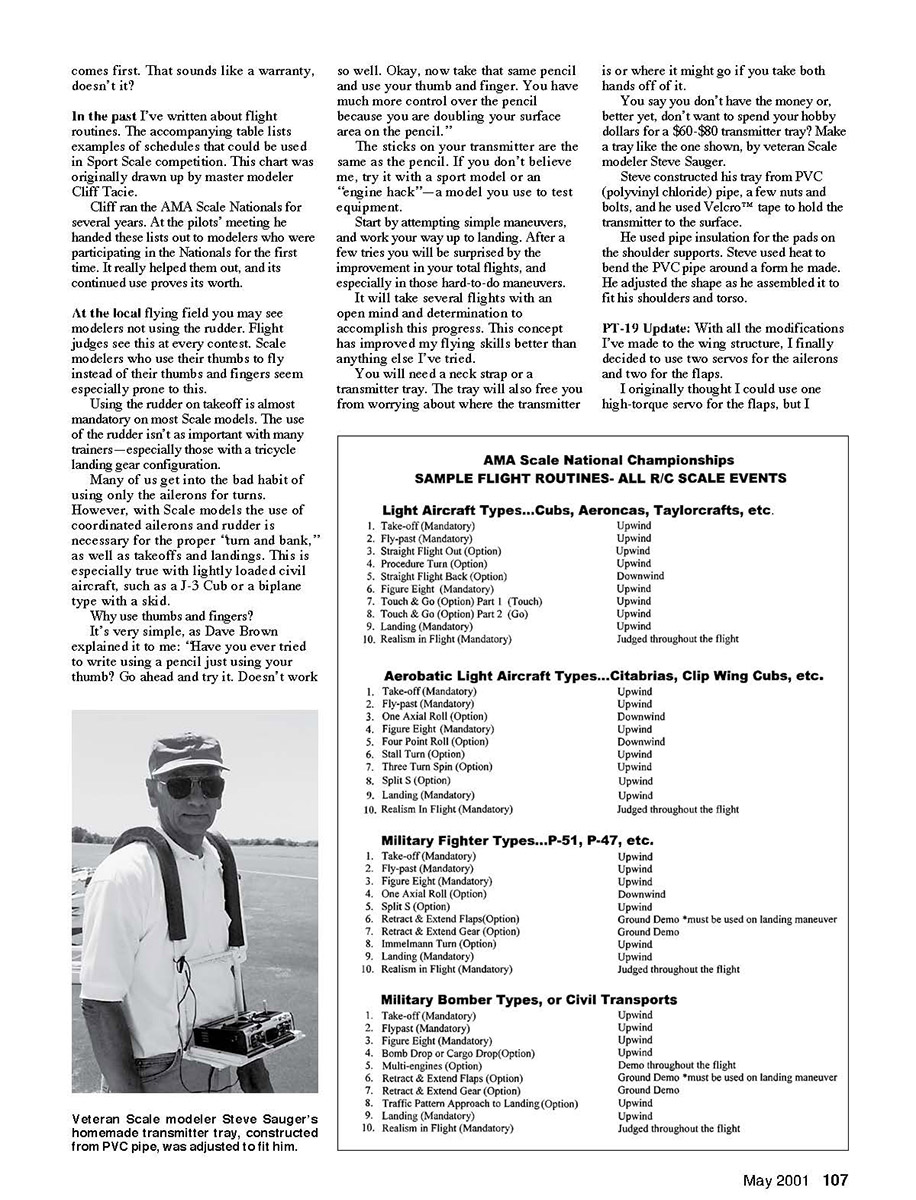
You say you don't have the money or, better yet, don't want to spend your hobby dollars for a $60–$80 transmitter tray? Make a tray like the one shown, by veteran Scale modeler Steve Sauger.
Steve constructed his tray from PVC (polyvinyl chloride) pipe, a few nuts and bolts, and he used Velcro tape to hold the transmitter to the surface.
He used pipe insulation for the pads on the shoulder supports. Steve used heat to bend the PVC pipe around a form he made. He adjusted the shape as he assembled it to fit his shoulders and torso.
PT-19 Update
With all the modifications I've made to the wing structure, I finally decided to use two servos for the ailerons and two for the flaps.
I originally thought I could use one high-torque servo for the flaps, but I found the flap loads were too great and the single servo would bind. I changed my mind when I was measuring the total surface area of the flaps.
When you install any servos connected to any control surface, try to eliminate angles that would cause binding or twisting between the servo and the control surface; this binding can cause flutter. With the trailing edge of the PT-19's wing tapering slightly toward the wingtip, repositioning the servos versus the plans might be in order to eliminate any chance of twisting.
The same goes for the tail surfaces on this or on any model; try to construct a straight line between the servo and the control surface.
Looking for a pilot that meets the criteria of being light, scale-like, and inexpensive perplexes many of us when we're building a Scale model.
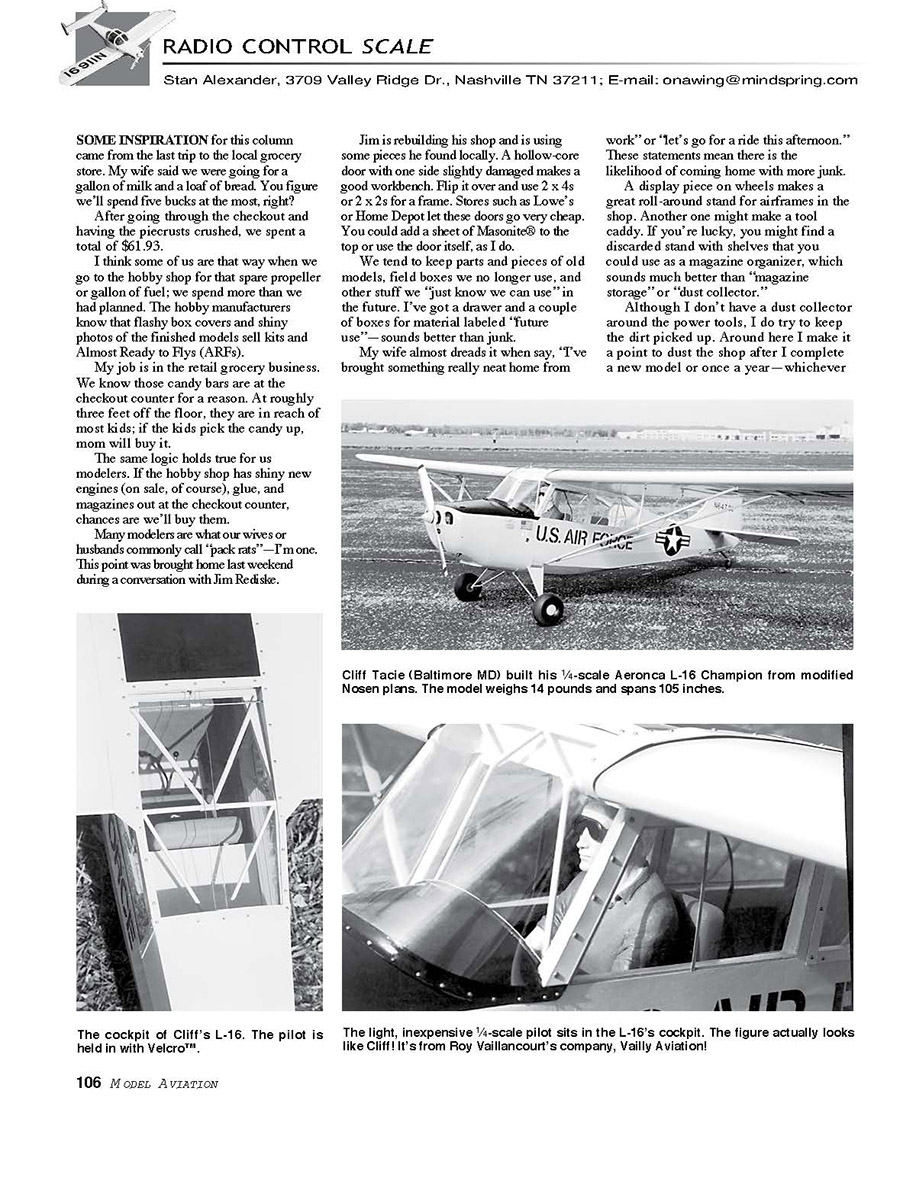
The pilot figure shown in Cliff Tacie’s Aeronca L-16 Champion is from Roy Vaillancourt. The 1/4-scale pilot, who looks surprisingly like his owner, is held in place with Velcro and is removable, to allow access to the receiver and servos.
Cliff built this model from a set of highly modified Nosen plans for the 1/4-scale Champ kit. This makes a large, stable, slow-flying aircraft that is just plain fun to fly.
Cliff’s skill of bringing out details can be obtained from these photos. His L-16 is powered by an O.S. 1.60 twin and spans 105 inches. The big yellow model weighs in at 14 1/2 pounds and is controlled by an Airtronics radio system.
Many of the details are added with pride in the construction of the model, even though they will never be judged in competition.
Scale modeling has a large cottage industry, as do many other modeling disciplines. Plans sources, parts, bits, and pieces that help build Scale models are available through these small businesses.
Vaillancourt Aviation is one of those companies with plans, parts, wheels, pilots, and accessories for Scale modelers. Roy Vaillancourt has assembled several plans that Scale modelers have drawn for him.
Although most aircraft are fighters, such as the 92-inch-span Hawker Hurricane, the 96-inch-span Hawker Tempest Mk V, the 92-inch-span P-47, and the 90-inch-span Focke Wulf Fw 190A-5, Roy has others, such as the 102-inch-span Stinson L-5 Sentinel and the 108-inch-span Cessna L-19 Bird Dog.
Kits from this line are available from the major kit-cutters, and are listed in Roy’s catalog.
The Bird Dog and the L-5 can be built on a smaller budget than many of the fighters that require larger engines and heavy-duty servos.
For more information about this assortment of Scale stuff, contact Vaillancourt Aviation, 10 Oakdale Ave., Farmingville NY 11738-2828; Tel: (631) 732-4715, or check out the Web site at VaillancourtAviation.com.
Till next time, fair skies and tail winds. MA
AMA Scale National Championships
SAMPLE FLIGHT ROUTINES - ALL R/C SCALE EVENTS
Light Aircraft Types... Cubs, Aeroncas, Taylorcrafts, etc.
- Take-off (Mandatory) ................................ Upwind
- Fly-past (Mandatory) ................................ Upwind
- Straight Flight Out (Option) ........................ Upwind
- Procedure Turn (Option) .............................. Upwind
- Straight Flight Back (Option) ....................... Downwind
- Figure Eight (Mandatory) ............................ Upwind
- Touch & Go (Option) Part 1 (Touch) ................. Upwind
- Touch & Go (Option) Part 2 (Go) .................... Upwind
- Landing (Mandatory) ................................ Upwind
- Realism in Flight (Mandatory) ..................... Judged throughout the flight
Aerobatic Light Aircraft Types... Citabrias, Clip Wing Cubs, etc.
Military Fighter Types... P-51, P-47, etc.
Military Bomber Types, or Civil Transports
Transcribed from original scans by AI. Minor OCR errors may remain.

