
RADIO CONTROL SCALE
Stan Alexander 3709 Valley Ridge Dr., Nashville, TN 37211 E-mail: onawing@mindspring.com
Color is one of the most controversial aspects of static judging in Scale competition and Scale modeling. I can't tell you how many times I've been to a field and someone in the "peanut gallery" has stated, "There never was a Corsair that color." Most of the time he or she is looking at a Hellcat or SBD Dauntless and not even an F4U Corsair!
I've seen aircraft that are shiny and the paint is perfect while other models of this particular airplane are weather-beaten and look used. Which is accurate? They could both be correct and they could both be incorrect. With sufficient research and a little spending on reference books, you can sometimes find enough photos of a World War II aircraft to model it.
Generally, finding photos of both sides of the fuselage or additional photos of one airframe is almost impossible. This is why our Sport Scale competition documentation standards from the AMA Scale Contest Board are written as they are. FAI competition is another story when it comes to documentation; that's why it is called Museum Scale. Many of the models you see in that competition are built from full-scale airplanes that are now in museums.
There is little chance of an airplane from the 1930s or earlier having photo documentation in color unless it's in a museum or has been restored. If the aircraft is restored—whether military or civilian—it is usually shiny, with a semigloss or gloss painted finish. A flat camouflage paint scheme attracts moisture, and this accelerates the deterioration of the paint pigment as well as the surface under it.
Finding accurate paint-chip sources is necessary for paint and color documentation, and there are several sources. I've known some serious modelers to go as far as contacting the Smithsonian, the US Air Force, or other resources, including owners and aircraft manufacturers. Full-scale manufacturers generally have little interest in what we do as modelers (although there are exceptions), so we need accepted sources of color documentation for our models. The rest of this column details color-documentation sources.
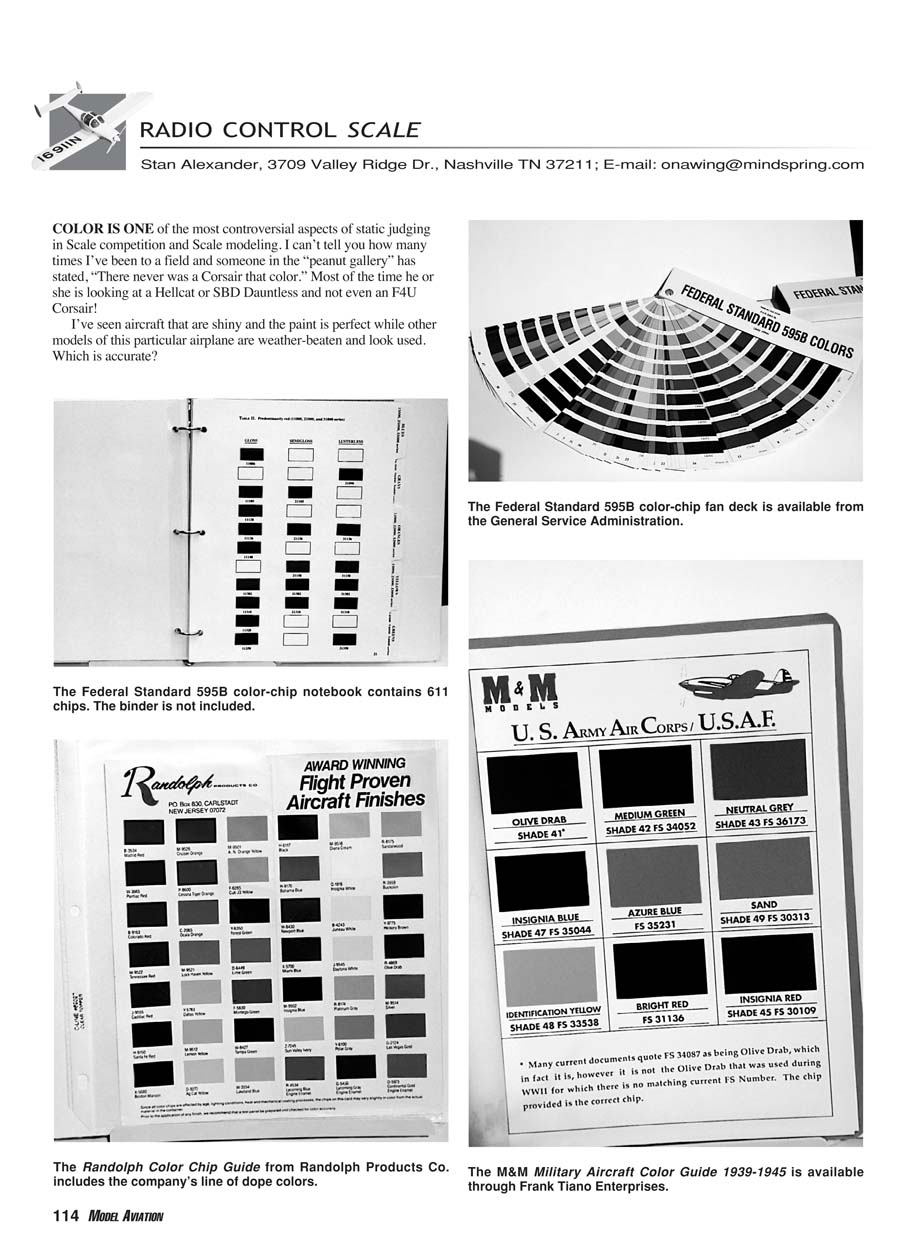
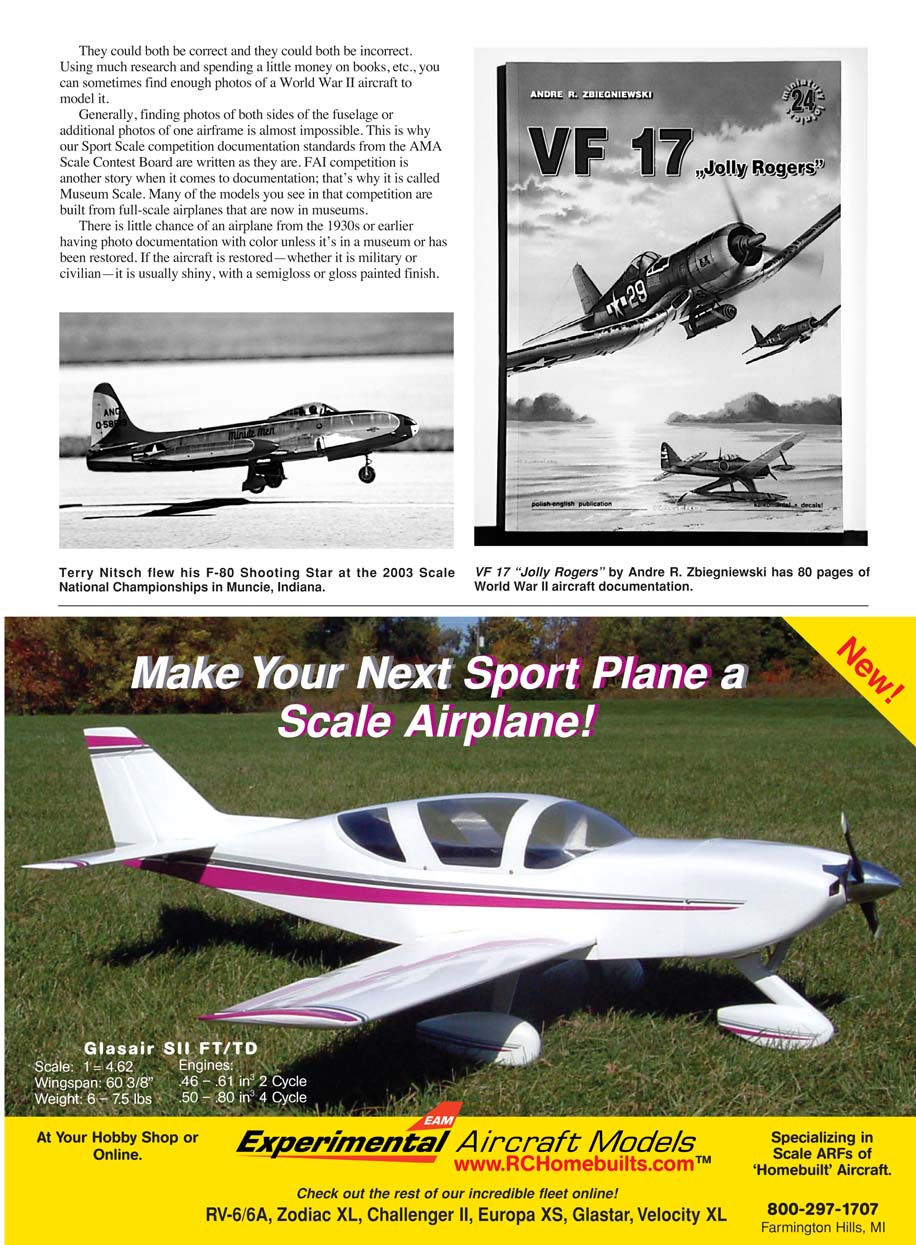
One of the best sources of paint chips for documentation is the United States government. They are available in several formats from the General Services Administration (GSA). The most popular set is the fan deck, which includes 611 1/2 x 2-inch paint chips. Another popular set is the 595B color book with 611 1/2 x 1-inch paint chips. These sets are listed under Federal Standards 595B Colors, effective May 1, 2002. If you have the government color-chip sets and know the color you need, you can order a larger individual chip for your documentation; these are $5 each, postage included.
Information about these paint-chip sets and cross-reference material for different nationalities is on the International Plastic Modelers' Society Web page at www.ipmsusa.org. All countries' air forces have, or once had, standard paint schemes for their different aircraft and the varying theaters of operation. The paint chips and the cross-reference sources are among the best ways to find the information you need for color documentation.
The colors in Federal Standard 595B Colors Used in Government Procurement are divided into the following groups:
- Browns: 10000, 20000, 30000 series
- Reds: 11000, 21000, 31000 series
- Oranges: 12000, 22000, 32000 series
- Yellows: 13000, 23000, 33000 series
- Greens: 14000, 24000, 34000 series
- Blues: 15000, 25000, 35000 series
- Grays: 16000, 26000, 36000 series
- Miscellaneous: blacks, whites, and metallics
- Fluorescent: 18000, 28000, 38000 series
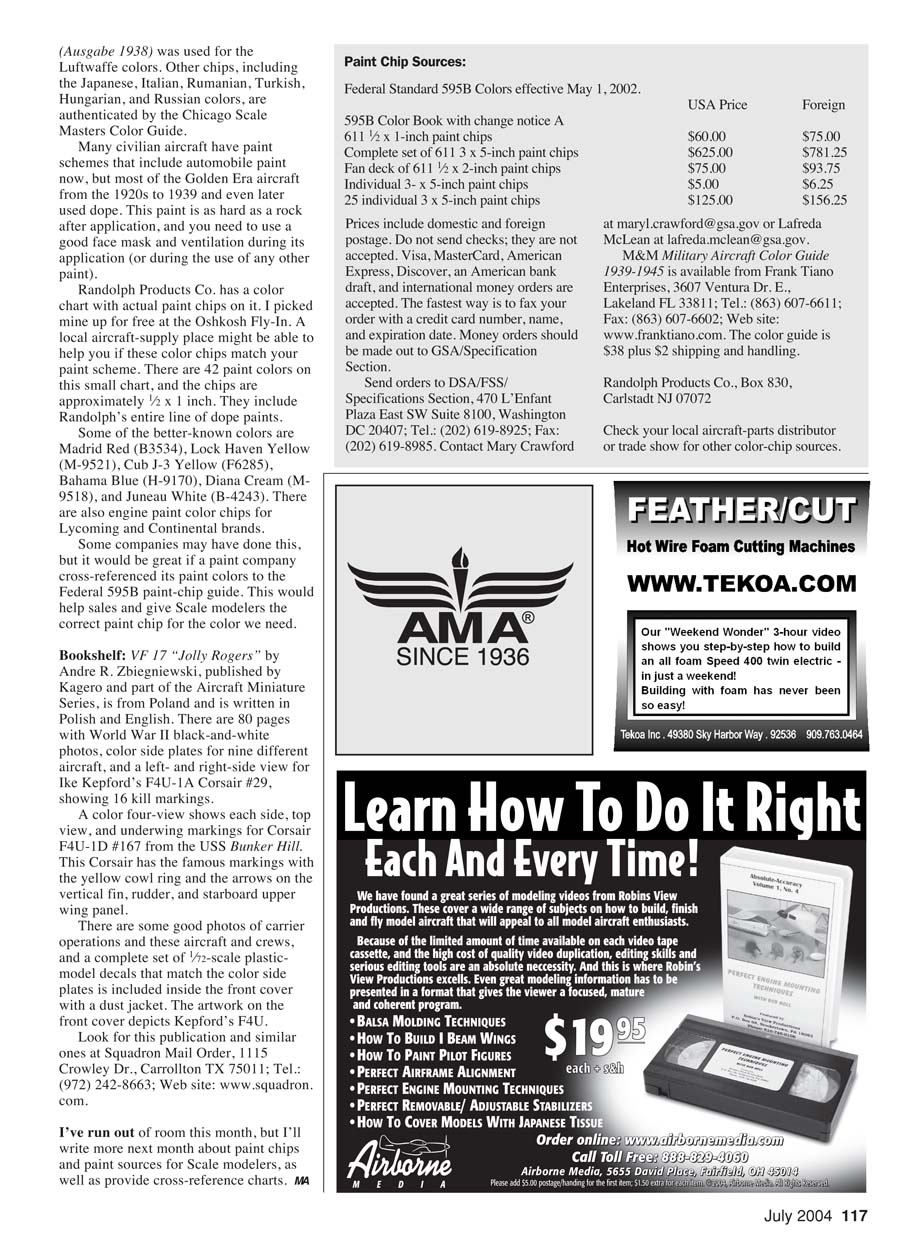
Another great resource for paint chips is the M&M Models Military Aircraft Color Guide 1939–1945. The book includes paint chips for US Navy/Marines, US Army, Imperial Japanese Army and Navy Air Forces, British Royal Air Force, German Luftwaffe, Italian Air Force, and the armed services of Russia, Turkey, Romania, and Hungary.
This paint-chip set is designed especially for Scale modelers and is endorsed by Dave Platt, chairman of the AMA Scale Contest Board. Specific to military aircraft, the 71 paint chips give the basic color schemes for these air forces during World War II.
Olive Drab, shade 41 under US Army Air Corps and US Air Force, is noted with the following update: "Many current documents quote FS34087 as being Olive Drab, which in fact it is; however, it is not Olive Drab that was used in World War II, for which there is no matching current FS number. The chip provided is the correct chip."
Three-views or side views for the different air forces' aircraft are provided in the guide, giving "standard" color schemes. These can vary with different theaters of operation, but the basic color chips and schemes can complete your color documentation.
Sources used for this booklet include Federal Standards 595B for US colors and the British Standards Institute publication B.S. 381C for British colors. The RLM color chart Farbtontafel zur Behandlungs- und Anwendungsvorschrift für Flugzeuglacke (Ausgabe 1938) was used for the Luftwaffe colors. Other chips, including the Japanese, Italian, Romanian, Turkish, Hungarian, and Russian colors, are authenticated by the Chicago Scale Masters Color Guide.
Many civilian aircraft paint schemes now include automobile paint, but most Golden Era aircraft from the 1920s through 1939 (and even later) used dope. Dope paint is extremely hard after application; use a good face mask and ventilation when applying it (or when using any other paint).
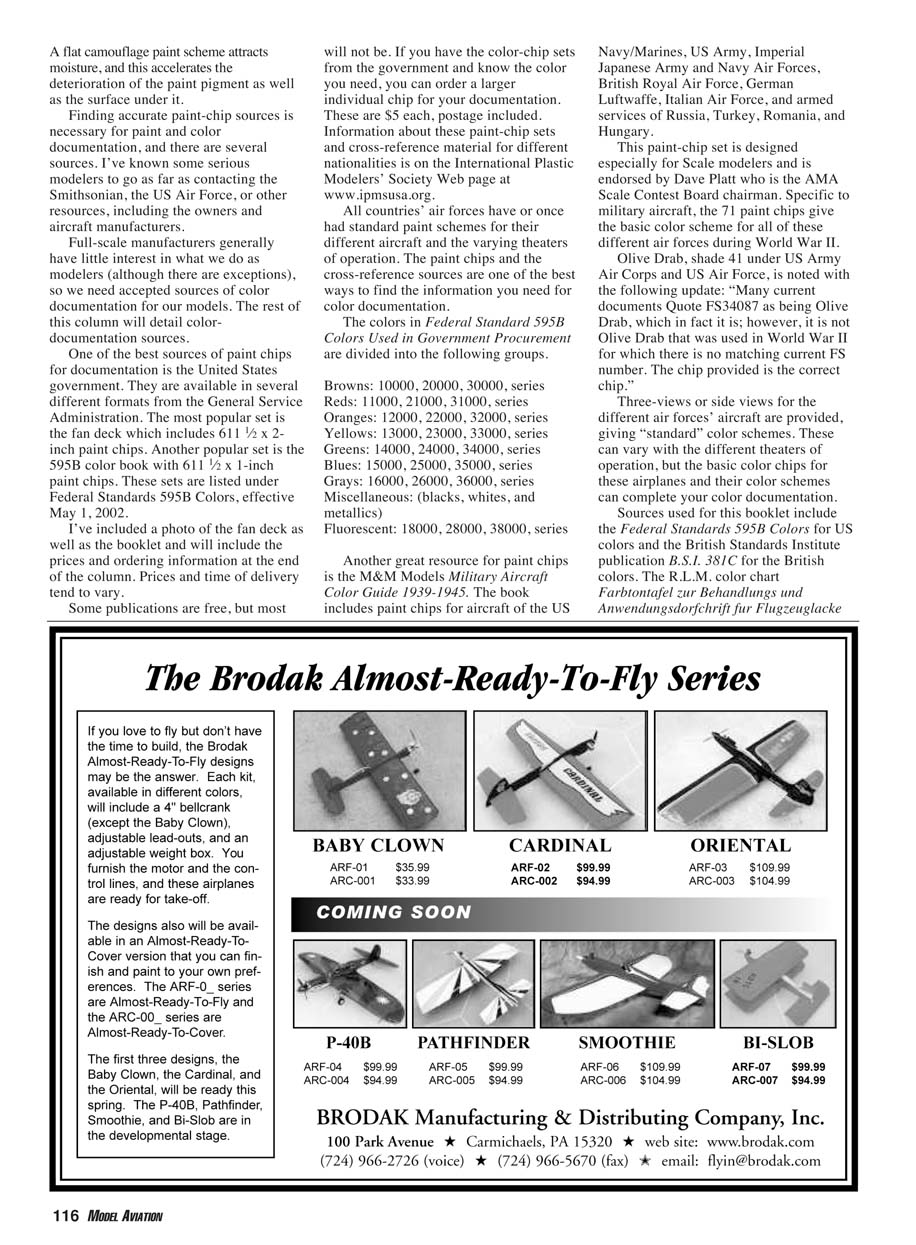
Randolph Products Co. has a color chart with actual paint chips. I picked mine up free at the Oshkosh Fly-In. A local aircraft-supply place might be able to help you if these color chips match your paint scheme. There are 42 paint colors on this small chart, with chips approximately 1/2 x 1 inch. They include Randolph’s entire line of dope paints.
Some of the better-known colors on the Randolph chart are Madrid Red (B3534), Lock Haven Yellow (M-9521), Cub J-3 Yellow (F6285), Bahama Blue (H-9170), Diana Cream (M-9518), and Juneau White (B-4243). There are also engine paint color chips for Lycoming and Continental brands.
It would be helpful if a paint company cross-referenced its paint colors to the Federal 595B paint-chip guide. This would aid sales and give Scale modelers the correct paint chip for the colors we need.
Bookshelf
VF 17 "Jolly Rogers" by Andre R. Zbiegniewski (Kagero), part of the Aircraft Miniature Series, is published in Polish and English. The 80-page book contains World War II black-and-white photos, color side plates for nine different aircraft, and left- and right-side views for Ike Kepford's F4U-1A Corsair #29, showing 16 kill markings.
A color four-view shows each side, the top view, and underwing markings for Corsair F4U-1D #167 from USS Bunker Hill. This Corsair has famous markings with a yellow cowl ring and arrows on the vertical fin, rudder, and starboard upper wing panel. The book includes good photos of carrier operations and crews, and a complete set of 1/72-scale plastic-model decals that match the color side plates is included inside the front cover with a dust jacket. The front-cover artwork depicts Kepford's F4U.
Look for this publication and similar ones at Squadron Mail Order, 1115 Crowley Dr., Carrollton, TX 75011; Tel.: (972) 242-8663; Web: www.squadron.com.
I've run out of room this month, but I'll write more next month about paint chips and paint sources for Scale modelers, as well as price cross-reference charts.
MA
Paint Chip Sources
Federal Standard 595B Colors effective May 1, 2002.
- 595B Color Book with change notice A — 611 1/2 x 1-inch paint chips
USA Price: $60.00 / Foreign: $75.00
- Complete set of 611 3 x 5-inch paint chips
USA Price: $625.00 / Foreign: $781.25
- Fan deck of 611 1/2 x 2-inch paint chips
USA Price: $75.00 / Foreign: $93.75
- Individual 3 x 5-inch paint chips
USA Price: $5.00 / Foreign: $6.25
- 25 individual 3 x 5-inch paint chips
USA Price: $125.00 / Foreign: $156.25
Prices include domestic and foreign postage. Do not send checks; they are not accepted. Visa, MasterCard, American Express, Discover, an American bank draft, and international money orders are accepted. The fastest way is to fax your order with a credit card number, name, and expiration date. Money orders should be made out to GSA/Specification Section.
Send orders to: DSA/FASS/Specifications Section 470 L'Enfant Plaza East SW, Suite 8100 Washington, DC 20407 Tel.: (202) 619-8925 Fax: (202) 619-8985 Contact Mary Crawford: maryl.crawford@gsa.gov Contact Lafreda McLean: lafreda.mclean@gsa.gov
M&M Military Aircraft Color Guide 1939–1945 is available from Frank Tiano Enterprises, 3607 Ventura Dr. E., Lakeland, FL 33811; Tel.: (863) 607-6611; Fax: (863) 607-6602; Web: www.franktiano.com. The color guide is $38 plus $2 shipping and handling.
Randolph Products Co., Box 830, Carlstadt, NJ 07072.
Check your local aircraft-parts distributor or trade shows for other color-chip sources.
Transcribed from original scans by AI. Minor OCR errors may remain.

