

RADIO CONTROL SCALE
Jeff Troy, 200 S. Spring Street, Ambler, PA 19002
I've resolved to handle this summer differently from the past few summers by trying to make as many trips to the flying field as possible. Diversions of all descriptions (which have been so easy to accept lately) have managed to lessen my flying to an unhealthy low level. I hope that all of you who share the same opinion will manage to increase your own dosages of aeromodeling this season, as well. After all, we need this, don't we?
An apology: Sorry. That's it—short and sweet. Here's the explanation behind it: If you've written to me for information, but have not received an answer, please be patient. I will get to everyone eventually.
The "scalemail" is extensive and quite often requires detailed, lengthy answers. "How do I glass my airplane?" takes about three seconds to write, but it takes at least an hour for me to document the method understandably on paper. There are a great many of you and only one of me (and a very busy one at that).
If you've sent a self-addressed, stamped envelope (SASE), I will eventually answer you personally if I have the right answer. If I do not have the answer you require, I will at least attempt to forward your letter to someone who does. If no SASE accompanies your letter, I cannot justify a reply at all.
As things stand right now, you could expect a wait of several months, although some responses, depending on the nature of the contact, may come almost immediately.
Docu-Search acknowledgements are a different story. My schedule allows for every one of them to be written into my monthly column and submitted for publication the same month they are received. What's more, I will let you know right away in which issue it will appear if you send an SASE with your Docu-Search request. I'm sorry if this delays projects, but there just isn't time to respond to everyone quickly.
What's up in the current-events department? Toledo! This year's show was bigger than ever. From its overwhelming attendance to the quality of the models on the static tables and the products in the exhibits, this show is still RC flying's heaviest hitter. Static awards are given in twenty categories, including Best of Show, Directors Award for Achievement and the newest category: Designer Scale Plane.
Before going into the highlights of the static tables, bear with me as I encourage participants to consider making a little more information available to the public when their model is displayed.
Which engine was chosen—which radio system? What was the finishing procedure? Many modelers who see a good finish would like to try their hand at duplicating it. How long did the model take to construct? Did you design it? Was it built from someone else's plans, from a kit, or truly scratched—where did you draw the plans yourself? Seriously, people want to know.
If no fact sheet is available near the model, I can't offer readers enough information to justify submitting a photograph of it for publication. ("...and who comes from Pittsburgh?" isn't of much interest to anyone but John.)
Apart from my own selfish interests, other reasons for you to boost your information levels include: giving judges a better idea of what went into making the model; helping knowledgeable admirers appreciate the combination of materials and devices that set your particular model apart from the rest; and (depending on disposition) to dramatically impress, thoroughly intimidate, or possibly bore to death nonmodelers as each gets his or her good long look at your latest undertaking.
Share a little more with us. Nothing more elaborate than a typed or printed sheet of paper next to the model is needed to do the trick nicely. Think about it: after all that work, aren't there at least one or two interesting things you could tell us about what went into your model?
Toledo's Scale Models
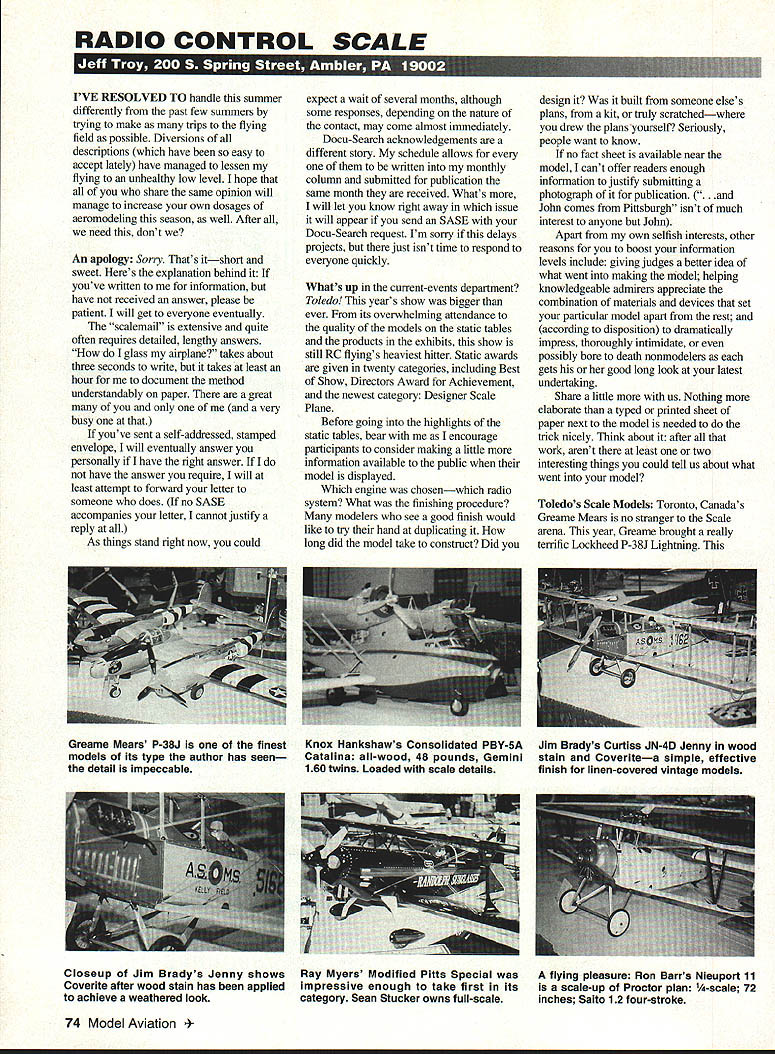
Toronto, Canada's Graeme Mears is no stranger to the scale arena. This year Graeme brought a really terrific Lockheed P-38J Lightning. This "Fork-Tailed Devil" was built from the Yellow Aircraft kit at a scale of 6.25:1 (or 1.92 inches to the foot). No other particulars were available, but I couldn't resist the picture; it was one of the best RC P-38s I've seen.
Third place in Designer Scale Plane went to Knox Hankshaw's complicated Consolidated PBY-5A Catalina. This immense amphibian features fourteen operating scale functions, including brakes, navigation lighting, retractable landing gear, retractable tip floats, operating bomb bay doors, and much more.
The model is all wood and is covered with Solartex. Two O.S. Gemini 1.60 twin four-strokes are used to power the 48-pound behemoth. Knox Hankshaw is from Brampton, Ontario, Canada.
A year or two before becoming our regular RC Scale contributor, I had the pleasure of guest-writing a column for Model Aviation. I suggested an easily applied, weathered finish for cloth-covered vintage aeroplanes that is all but guaranteed to dazzle judges and onlookers alike.
Alamogordo, New Mexico resident Jim Brady brought a beautiful Curtiss JN-4D Jenny to Toledo. He was kind enough to let me know that he used this finishing method on his model which has already competed quite successfully in European contests.
Jim used Proctor plans to fabricate his Jenny, but scratched every single piece on this aeroplane except its wheels and turnbuckles. When finishing time came, he covered the Jenny with Super Coverite and used a blend of various wood stains to achieve its slightly weather-beaten appearance. A little olive drab on the sheet metal, a few coats of clear to preserve the whole thing, and the job was done.
Unlike paint, wood stains allow a tinted or weathered finish to be applied to wood and fabric without having to sacrifice the wood's grain or the fabric's partial transparency. When vintage builders combine flying and landing wires with buff-colored fabric and stained wood, the shiny Pattern types often end up in the back seats.
Bloomdale, Ohio's Ray Myers earned a Toledo first place with his Sean Stucker's Modified Pitts Special. The 82-inch model was scratched and took approximately five years to complete. Ray covered his Pitts with Super Coverite and used Black Baron Paint and 3-M vinyl trim to get the color scheme together. The model features a B&B smoke system, with red smoke canisters on the lower wingtips and white smoke on its 4.2 Sachs engine. Airtronics handles the radio guidance.
Ron Barr of Burlington, Ontario, Canada enlarged a 3/4-scale Proctor Nieuport 11 plan to produce a 72-inch, 13-pound, 8-ounce model with a wing loading of 21 ounces per square foot. The model's weight keeps it within the limits of FAI F4C Scale competition, and its Saito 1.2 handles its power needs quite capably. This fine Nieuport is covered with Sig Koverall applied with nitrate dope, and according to full-scale practice, it was painted with butyrate dope.
The model's front end was most interesting. Its cowl is of aluminum, bent round, then slitted and MIG welded, ground to perfection, and polished. Even more impressive is Ron's handmade dummy engine that features more than 960 individual pieces — it took 620 metal disks just to construct the cylinder fins. This is a truly outstanding quarter-scale model.
Dave Platt of Palm Bay, Florida entered the Toledo competition for the first time in a number of years, and as one would expect, his Designer Scale Plane entry was not of the most common subject.
Best described as insectoid, Dave's Grumman OV-1D Mohawk easily takes the distinction of being the most unusual aircraft model I've seen in quite a while. Built to the scale of 1.75 inches to the foot, the 84-inch model tips the scale at just under the FAI limit; it is 14 pounds, 14 ounces.
The Mohawk is constructed entirely of balsa and is finished with fiberglass cloth, resin, and K&B Superoxy paints. It sports 1,100 square inches of wing area and features, what else but, Dave Platt Competition Retracts. Those of you who know Dave will appreciate this quote: "This has been the most complicated project in my life by a factor of at least three to one, which is probably why we've never seen one before."
There were many other fabulous models on display, but it was not possible for me to get to all of them. Accept my apology for missing my chance to bring you photos of Hall Parent's first-place Ryan Fireball. This is a really terrific model of a seemingly basic, yet very complicated subject: a twin-engine airplane that uses a tractor prop up front and a ducted-fan system in the rear.
Hall is pretty tough in competition; he's so quiet, friendly and unassuming that you never quite know he's there until he's bitten you in the rear end once again!
Manufacturers' News
How would you like to get your hands on the best set of competition-certified WWII-era color chips you're likely to find in this lifetime? Mike Marecki of M&M Models has made his new Military Aircraft Color Guide easily obtainable for any hobby shop or individual modeler through the distribution services of Frank Tiano Enterprises, 15300 Estancia Lane, West Palm Beach, FL 33414.
The guide covers popular military fighter aircraft from the U.S., Japan, England, Germany, Italy, Russia, Turkey, Romania, and Hungary, and features color chips for each that are "verified as being of acceptable accuracy for the purposes of AMA competition." If military aircraft from 1939 to 1945 is your thing, get it in gear and send a self-addressed, stamped envelope to Frank Tiano Enterprises for price and additional information. This is way too cool to miss!
Are you a tool nut? I am absolutely convinced that I am the person Tim Allen goofs on when he performs his stand-up routine on the Sears tools freak. I own a ridge reamer, but after I bought it, I had to ask several people what it was before finding someone who actually knew. Now I have a ridge reamer; I don't need one, but I still love owning it! So I'll ask again: are you a tool nut?
Genuine tool nuts will find their purchasing impulses difficult to control when they see the Tork-It, a U.S.-made torque screwdriver designed to let you put the right amount of force on your engine's head bolts when teardown, reconditioning, and assembly time comes around.
Tork-It features a quarter-inch square drive with a quarter-inch hex bit holder. You can choose from three torque ranges: 2–36 in./lbs. in 0.5 increments; 15–150 in./lbs.; and a 100 in./oz. model is also available.
Why a torque screwdriver for tightening something as simple as head bolts? Simple. Heat expands all things, and the high heat of a model engine is certainly no exception. As the head and cylinder expand, the force on the head bolts increases, and if the head bolts were over-torqued, the head and cylinder could distort. Thus the preventive measure, in this case, is proper torque values—which is always the best cure, since the only cure for warped engine components is replacement.
Contact your engine manufacturer to determine the proper torque values for your engine's hardware, then contact John W. Snider with a self-addressed, stamped envelope for more information on the Tork-It. Write to Tork-It, 1250 Kelvington Way SW, Lilburn, GA 30247-2059. You can't find this one at Sears (believe me, I know!), so go ahead, Tim Allen... eat your heart out!
Riteco Supply, Inc. has hoop pine, a most useful, lightweight, and flexible plywood for such unique bending applications as forming model cowl rings, or similar tasks where wrapping technique is required. Several sheet sizes and thicknesses are available, but the one I recommend for our uses measures 6 x 3 feet x 1.5 mm. This is also the most economical purchase, as their alternative sheets measure 8 x 4 feet.
Hoop pine isn't something you'll use for every project, but when the right task rears its ugly little head, hoop pine is the best way to handle it. I had received several press releases on this material, but I didn't really get the full picture until I saw its usefulness demonstrated to me in the flesh at a recent trade show. Believe me, this specialty wood deserves a better look, so dig for more information on your own with a SASE to Riteco, 12999 F.M. 529, Houston, TX 77041.
As always, the Toledo show was packed with entertaining and informative exhibits. A total of 375 display booths were available, and not a single booth was vacant. There is no adequate way to describe your need to attend this annual event. If you do RC airplanes, you have to do Toledo. Make a plan to attend '95.
Docu-Search
It looks as though Docu-Search is up to speed again. Several of you have written for assistance since last month, and I hope your listings bring you the success you need to get your projects underway.
- David W. Atherton
121 Windy Hill Road, Cowpens, SC 29330 Searching for plans for a North American F-82. He has a small three-view from Bob Banks' Scale Model Research but wants a plan in the 80-inch category (or any plan that can be enlarged).
- Louis Marchese
23-26 125th St., College Point, NY 11356 Looking for a kit or set of plans for the Howard DGA-15. He reports dead ends from several plan services and would appreciate any leads or three-views.
- George S. Gilbert
1704-D J St., Grand Forks AFB, ND 58204 Has copies of the February and March 1951 Model Airplane News articles on the de Havilland D.H.5 but needs the original drawings from those articles. Also seeks information about No. 32 Squadron (1917) under Captain Arthur Coningham—especially aircraft numbers and markings.
- Jim Bullard
P.O. Box 234, Christmas Valley, OR 97641 Wants plans for the Spad A.2 (quarter-scale) and the Wright Flyer (somewhat larger). Needs help finding plan sets or documentation.
- Clyde "Rusty" Fickes
7465 Spitfire, Corpus Christi, TX 78412 Needs complete documentation on the Messerschmitt Me 262.
- Don Briggs
Box 238, Curtis, NE 69025 Looking for plans for the C-124 Globemaster for an RC model project.
- John Raymond
Aircraft Research Ltd., 68 Gordon Parkway #2, Syracuse, NY 13219 Needs drawings for several uncommon aircraft: Driggs-Johnson D.J.-1 Bumblebee; Albert Teich?; Driggs Dart; Prest Baby Pursuit; Benes-Mraz Bibi; and the Verville Sky Coach.
- Edward T. Kimble
8465 Windfall Way, Colorado Springs, CO 80908 Noticed a photo of Bill Lagan and his control-line model RAF F.E.2B and would like Bill Lagan's plan or source documentation to build one.
- Randy A. Glenn
811 212th Ave. NE, Redmond, WA 98053 Wants documentation on the de Havilland D.H.98 Mosquito NF II—specifically photos and color/markings documentation for the all-black night-fighter version.
Keep the requests coming, my friends, but don't forget to contact the commercial documentation services listed in the advertisers' section of this month's Model Aviation. These people are seasoned professionals who know what you need, and are almost always able to provide it.
Thank you for your letters, your interest in RC Scale aeromodelling, and for once again sticking your nose in the prose! Until the next one, build straight and fly safely. I'll talk with you again.
Transcribed from original scans by AI. Minor OCR errors may remain.

