
RADIO CONTROL SCALE
Jeff Troy, 200 S. Spring Street, Ambler, PA 19002
SINCE THIS ISSUE'S DEADLINE was a week ahead of the Radio Control Hobby Trade Association show in Chicago (RCHTA), the coverage will be in the next issue. On the brighter side, there is no shortage of good-time items to show you right now.
Manufacturers' News
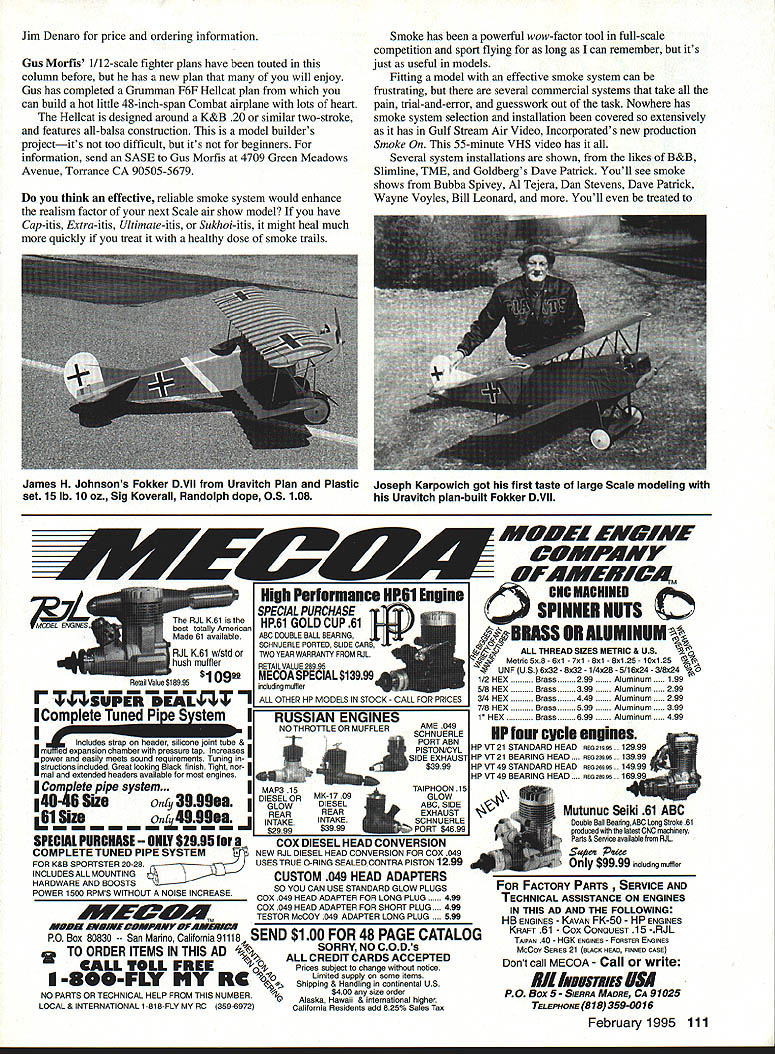
Have you found a solution for the problem of mounting clear plastic windows on the side of a Scale model? Do you really think that edging the window with 1/4-inch striping tape hides the mess? Do you iron clear MonoKote over the window area? This works pretty well on Goldberg Cubs and the like, but it could hardly be called the definitive Scale procedure. Jim Denaro of JDM Products (543 Bedford Street, Concord, MA 01742) seems to have come up with a winner.
The JDM Route-A-Bit is a miniature rabbet routing attachment that fits a Dremel Moto-Tool (or similar rotary motor tool), allowing you to cut inlays for scale window panes in a matter of a few moments per opening. Features include:
- Three possible inlay widths: 1/16", 3/32", and 1/8".
- Ability to rout inside or outside edges.
- Quick setup—change bits as you would any motor tool.
The most direct way to get the tool is to send an SASE to Jim Denaro for price and ordering information.
Gus Morfis' 1/12-scale fighter plans have been touted in this column before, and he has a new plan many of you will enjoy. Gus has completed a Grumman F6F Hellcat plan from which you can build a 48"-span combat airplane designed around a K&B .20 or similar two-stroke. It features all-balsa construction. This is a model-builder's project—not too difficult, but not for beginners. For information, send an SASE to Gus Morfis, 4709 Green Meadows Avenue, Torrance, CA 90505-5679.
Do you think an effective, reliable smoke system would enhance the realism factor of your next Scale air-show model? Smoke has been a powerful wow factor in full-scale competition and sport flying for as long as I can remember, and it's just as useful in models.
Fitting a model with an effective smoke system can be frustrating, but several commercial systems take the pain, trial-and-error, and guesswork out of the task. Nowhere has smoke system selection and installation been covered so extensively as in Gulf Stream Air Video, Inc.'s new production Smoke On. This 55-minute VHS video covers several system installations (B&B, Slimline, TME, Goldberg's Dave Patrick), and shows smoke displays from Bubba Spivey, Al Tejera, Dan Stevens, Dave Patrick, Wayne Voyles, Bill Leonard, and others. You'll see smoke oils, colored smoke, and the effects of temperature and humidity on a typical smoke system's output.
Being somewhat locked into my vintage "thing," I don't get to tinker with options like retractable landing gear and smoke systems as often as I'd like, but this video was an inspiration. Check a hobby retailer or write to Gulf Stream Air Video, Inc., P.O. Box 482, Hagan, GA 30429.
Docu-Search
We have a couple of readers looking for information, kits, or contacts:
- David B. Kirschstein (21 Carey Drive, Chappaqua, NY 10514) would like to build a Cessna 170, Cessna 180, or a Piper Pawnee. He prefers kits in the 60–70" span, .45–.60 two-stroke range. David is not an avid Scale modeler but would like to have a go at one of these subjects. If you have a kit or know where to find one, please contact David.
- Frank Newman (4209 Baron, Deer Park, TX 77536) would like to build a B-36. Frank is not a practicing Scale modeler and is seeking advice from experienced modelers about the problems and rewards of such a massive model. If you can offer constructive direction or experience, please contact Frank.
Modelers' Projects
Dr. Alan Chenman built a lovely Stinson SR-8 from the Ikon N'Wst kit. This massive Stinson spans 108" and is powered by an Enya VT-240 V-twin four-stroke.
Two items further enhance the model's front end:
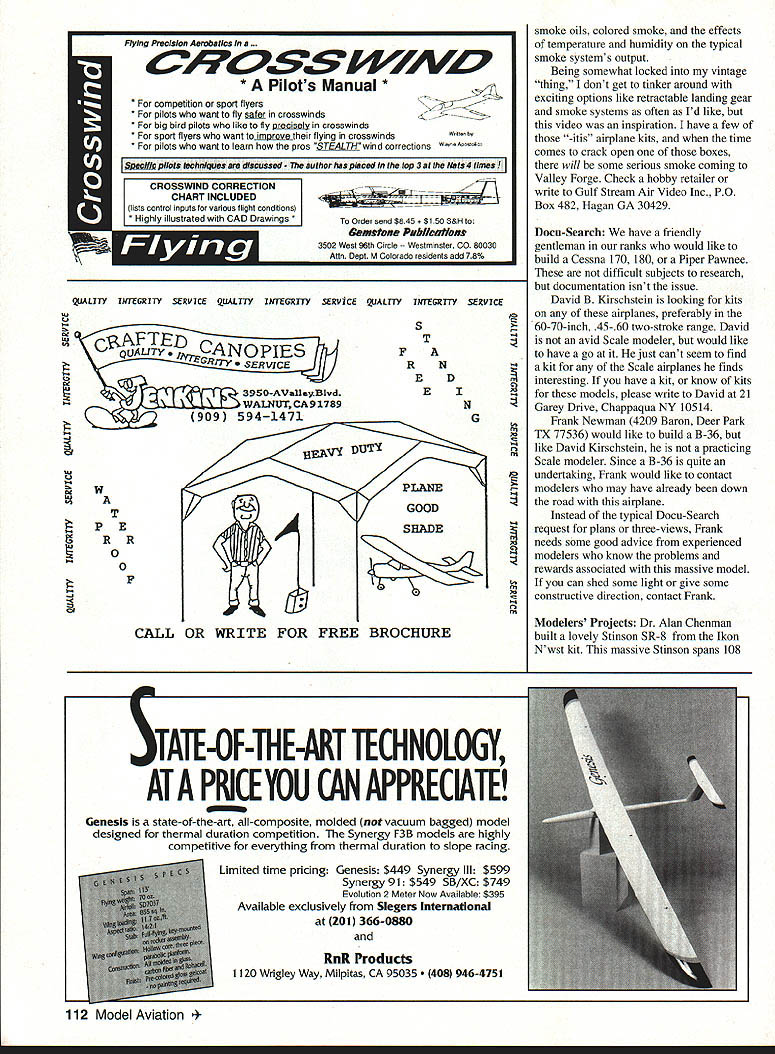
- The dummy engine detail is based on the inexpensive ABS accessory available from Bubba Spivey at Lanier R/C (P.O. Box 458, Oakwood, GA 30566). A few plug-wire and valve-pushrod dowel details were added; the dummy was then cut away from its background and painted with 21st Century metallic gray paint.
- The static display propeller comes from Advanced Marketing, Inc. (9889 W. Central, Wichita, KS 67212). It features manufacturers' logos, red tips, and leading edges painted to look like brass under two coats of clear urethane.
Alan's SR-8 is covered in cream and dark red 21st Century fabric; the wheel pants and fairings are painted to match. The McDaniel R/C lighting and mechanical on-board ignition system adds tremendously to the model's visual impact and engine reliability. The Stinson carries eight servos, and there is ample room in the cabin to hold the servos, transmitter, maybe a pilot, and maybe even the UPS truck that delivered the kit. It's a pretty large model, to say the least.
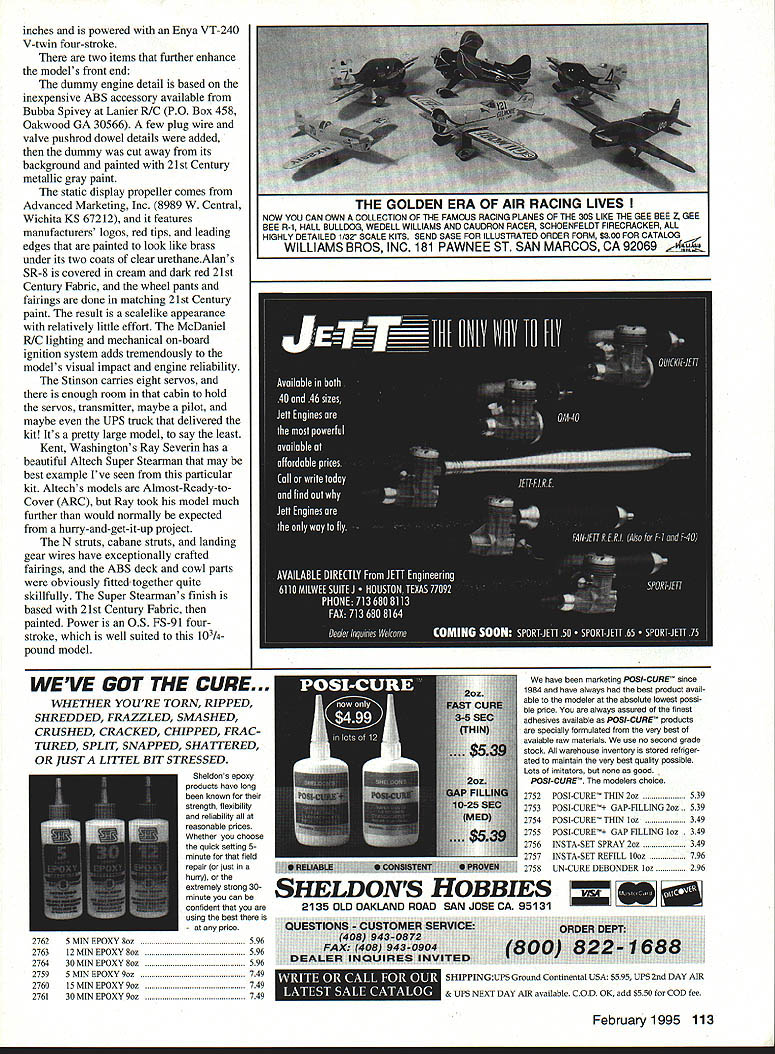
Kent, Washington's Ray Severin has a beautiful Altech Super Stearman that may be the best example I've seen from this particular kit. Altech's models are Almost-Ready-to-Cover (ARC), but Ray took his model much further than would normally be expected from a hurry-and-get-it-up project. The N-struts, cabane struts, and landing-gear wires have exceptionally crafted fairings, and the ABS deck and cowl parts were fitted together skillfully. The Super Stearman's finish is based with 21st Century fabric, then painted. Power is an O.S. FS-91 four-stroke, well suited to this 10-1/4-pound model.
I have received a number of Fokker D.VII photographs. My aeroplane has been temporarily placed on hold because my workbench has been overtaken by a right-now, work-related project. With a little luck, the accompanying reader photographs will be of some help until I can get the D.VII underway once again.
James H. Johnson's Fokker looks great. A black-and-white magazine photo doesn't do justice to the striking color combination: white, light green, and medium green on the fuselage, stab roots, vertical fin, and rudder; the lower wing is red, and the upper wing and outboard stab flashes are bright red and yellow. James mentioned a stabilizer error on the plan, where the right tip is 3/16" shorter than the left, and wondered if I was using the same plan. I am, but I am also building from the Aeroplane Works kit, which suffers none of the irregularities one might encounter when plan-building.
In the same tongue-in-cheek manner of Mr. Johnson's letter, I'll tell you that my right and left parts are exactly the same size because I cut them to the same size; I used the skillfully cut parts that came in the box for the rest of the model. I haven't measured to see if James' comments have merit, or even to see how my own stab holds up to the test, but if there's a problem with the plan, I guess it will be 3/32" short to the plan on the right and 3/32" over the plan on the left. I don't think it'll be a problem.
James' Fokker is covered with Sig Koverall and painted with Randolph dope. The radio is a JR Century VII, which James found exceptionally befitting a Fokker D.VII. His model weighs 15 lb 10 oz and is more than adequately powered by an O.S. .108 FSR. An interchangeable steerable tailwheel was mounted to counteract the effects of the 5–20 knot crosswinds at James' flying field. If our models finish up as well as this one, the project will have been appropriately rewarding.
Joseph Karpovich of Mahwah, New Jersey built his D.VII from the Rich Uravitch plan. This was Joseph's first large Scale model, and he was a bit surprised at the cost of such a project (as we all are the first time), but he was also quite impressed with how well it flew. There's a Zenoah G-38 for power. Joe didn't mention the finishing materials or other specifics, but it does cost more to build a large model than a small model—the pieces are bigger.
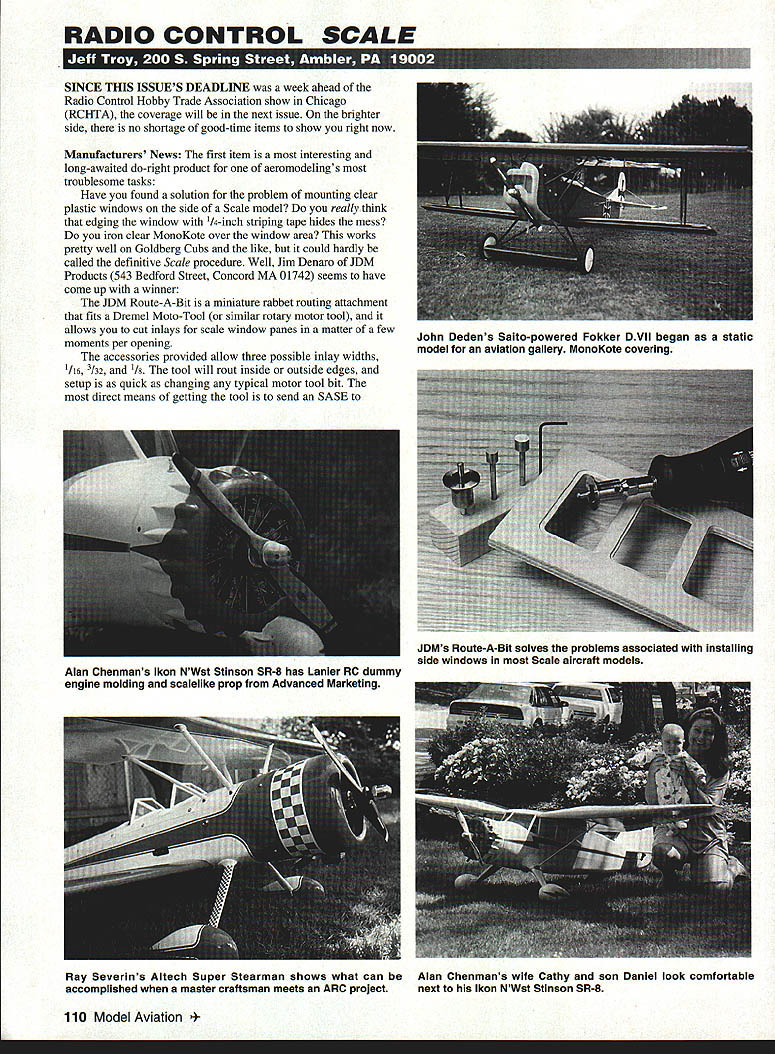
John Denzel's yellow, olive red, and white D.VII is not from the Uravitch plan or the Aeroplane Works kit; it's a great-looking 1/6-scale model built from his own plan, although John admits to taking several liberties with the full-scale aeroplane's true outline. Flight characteristics are quite friendly, although the model rolls very sloppily unless John can get it to build up a good head of steam before entering the maneuver.
John's D.VII was originally built on contract as a static-display model for a gentleman with an aviation gallery, but the deal went south and John decided to keep the model. He's powered the Fokker with a Saito .65 four-stroke and covered it with Top Flite MonoKote. At approximately 10 lb, with a 12x6 at 9,000 rpm, the model really hauls.
It's once again time for me to ride off into the sunset. As always: build straight and fly safely. I'll talk with you again.
Transcribed from original scans by AI. Minor OCR errors may remain.

