
RADIO CONTROL: SCALE
Jeff Troy, 200 S. Spring Street, Ambler, PA 19002
Editor's note
The following column was originally slated for our January 1995 youth/beginner issue.
WHATEVER YOUR AGE, aeromodeling interest, or experience level, I'm here to tell you that Scale modeling is fun.
Why Scale?
Have others led you to believe that Scale modeling is not for the squeamish? Have you heard that Scale models are difficult to build or fly? Are you under the impression that only the most skilled modelers are able to produce acceptable Scale models? If any of these views are embedded in your thought process, read on.
If the idea of building a flying Scale model is new to you or intimidates you for some reason, pay attention. Scale aeromodeling can never be any more or less than what you make of it. There are simple full-scale airplanes and complicated full-scale airplanes, and of course, there are models that behave nicely in the air and those that do not. All you have to do is select an airplane whose style and grace inspires you, and equally important, select one that is suited to your building and flying skills.
Your subject may be as elementary as the Volksplane or as complex as the Lockheed P-38 Lightning. If the plane has your abilities written into its description, you've got nothing to fear and every reward this hobby offers in front of you.
Sport and competition
As with other RC disciplines, your best rewards may be found in the sport or competition venues—maybe even both. Flying a Scale model at the local field can be a wonderful source of personal accomplishment and pride. Your Scale model may be much admired by your peers, and you will often enjoy the extra airborne "elbow room" when others opt to watch your Scale model fly instead of sending up their own models.
However, if the local skies can't quite fill all your RC ambitions, you may want to experience the tremendously rewarding competitive aspects of Scale modeling. You'll find some of the aeromodeling community's best examples of talent and good sportsmanship. What's more, the Scale competition field is unique in that the competing modeler calls the shots.
In RC Pattern or CL Aerobatics, for example, maneuvers and aircraft types are dictated by the rule book and whatever aircraft are presently in fashion. Scale modeling allows the competitor almost total independence. You're able to fly whatever model you enjoy. In AMA events, you even get to select five of the ten maneuvers you must perform.
What many modelers don't realize (even some who have been involved with Scale competition for awhile) is that contestants can provide Scale static and flight judges with the information by which they want their models to be judged. The bottom line is that Scale modeling can be whatever you'd like it to be. It does not have to be difficult unless you pick a difficult subject.
Choosing a subject and examples
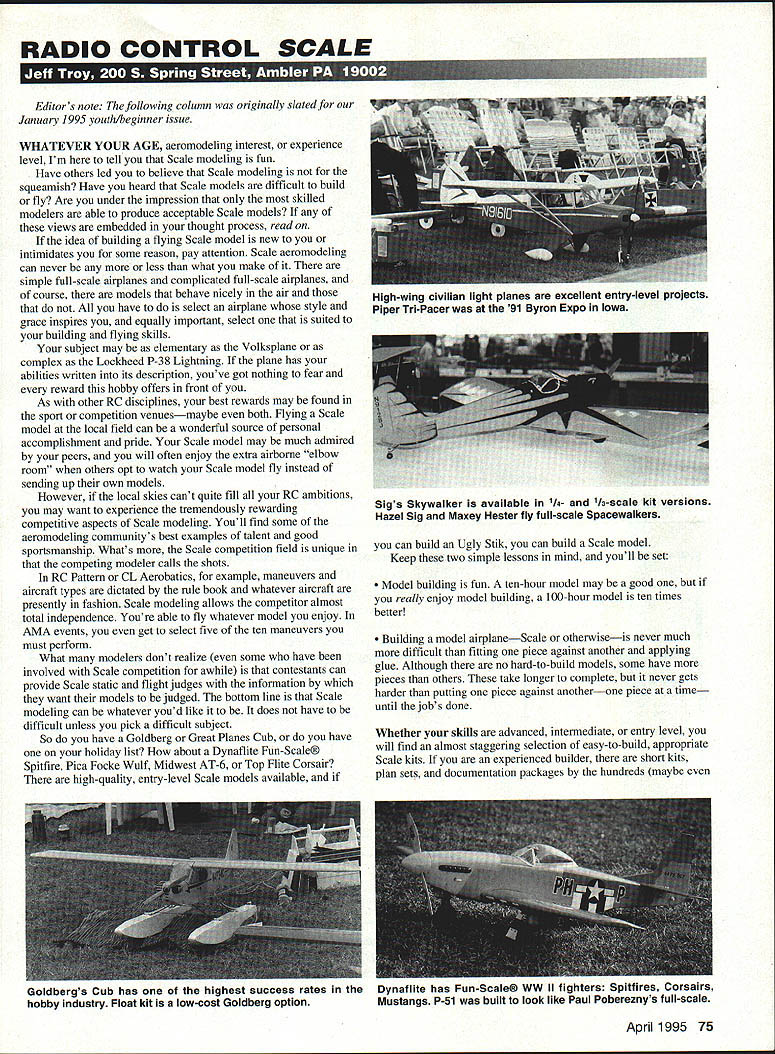
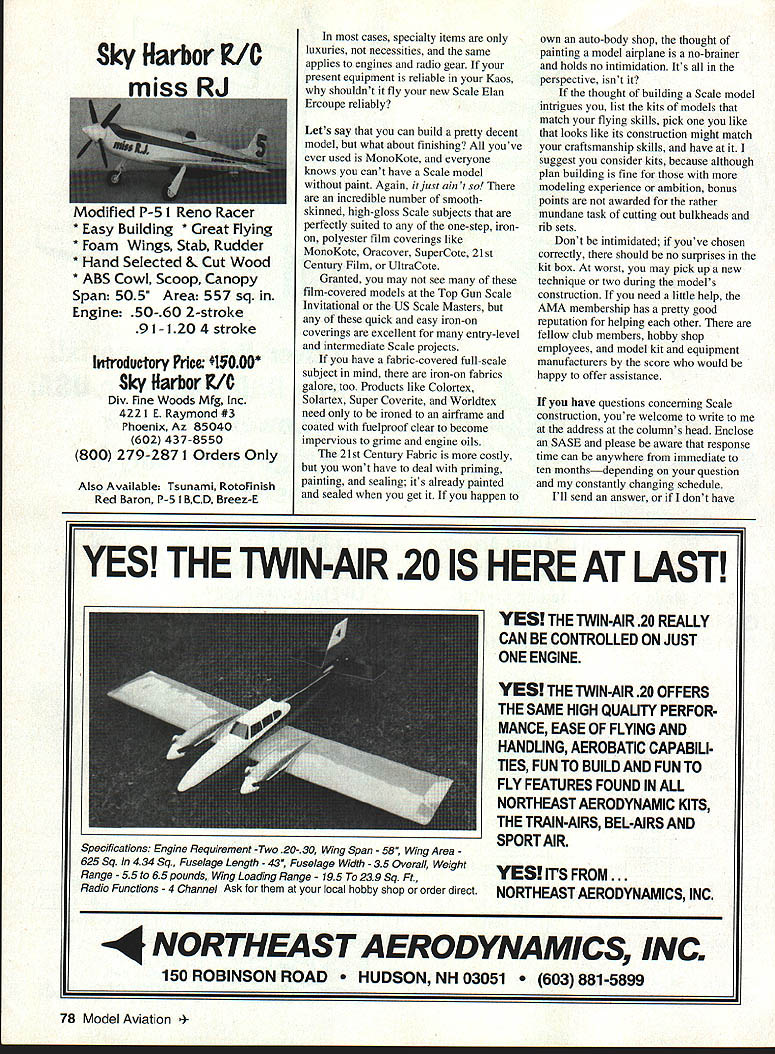
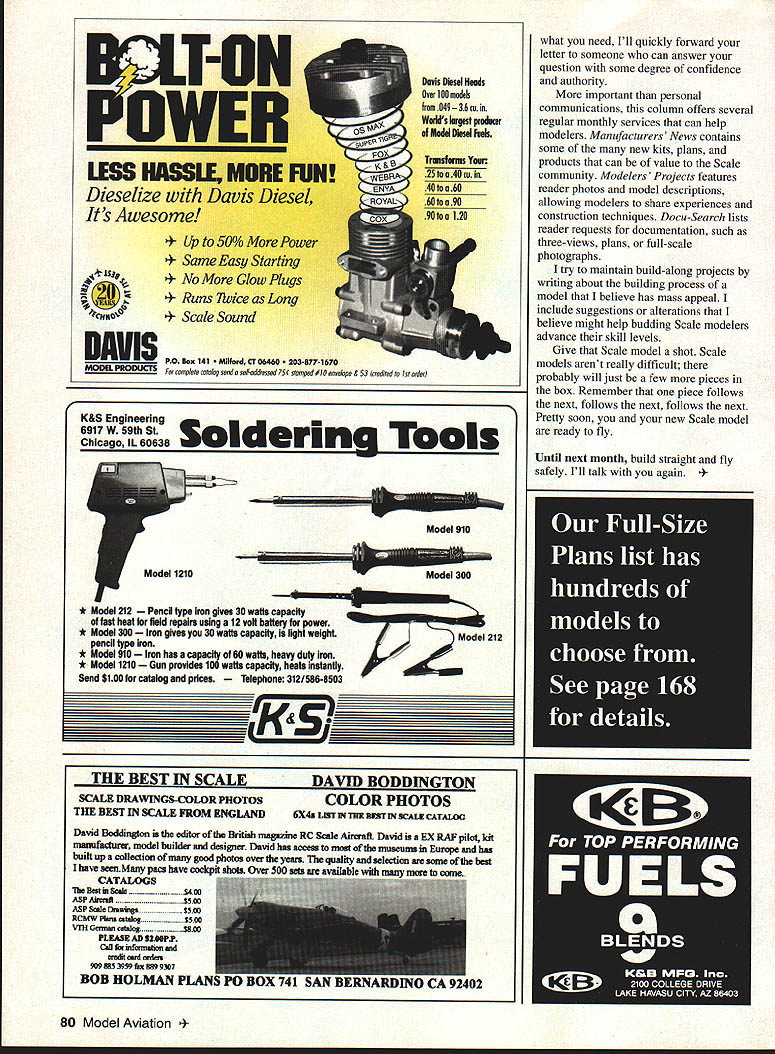
So do you have a Goldberg or Great Planes Cub, or do you have one on your holiday list? How about a Dynaflite Fun-Scale Spitfire, Pica Focke-Wulf, Midwest AT-6, or Top Flite Corsair? There are high-quality, entry-level Scale models available, and if you can build an Ugly Stik, you can build a Scale model.
Keep these two simple lessons in mind, and you'll be set:
- Model building is fun. A ten-hour model may be a good one, but if you really enjoy model building, a 100-hour model is ten times better!
- Building a model airplane—Scale or otherwise—is never much more difficult than fitting one piece against another and applying glue. Although there are no hard-to-build models, some have more pieces than others. These take longer to complete, but it never gets harder than putting one piece against another—one piece at a time—until the job's done.
Whether your skills are advanced, intermediate, or entry level, you will find an almost staggering selection of easy-to-build, appropriate Scale kits. If you are an experienced builder, there are short kits, plan sets, and documentation packages by the hundreds (maybe even thousands). These can yield any type of airplane from any era, country, or military theater you prefer.
If you can build and solo a high-wing trainer with some degree of confidence, you can certainly build and fly almost any manufacturer's J-3 Cub. (You'll discover during the first few moments of your first taxi that all the debate over tail-dragger vs. tricycle-geared airplanes can be put away.) Cubs, Taylorcrafts, Aeroncas, and similar high-wing models are generally easy to fly and usually don't throw too many curves on the building board.
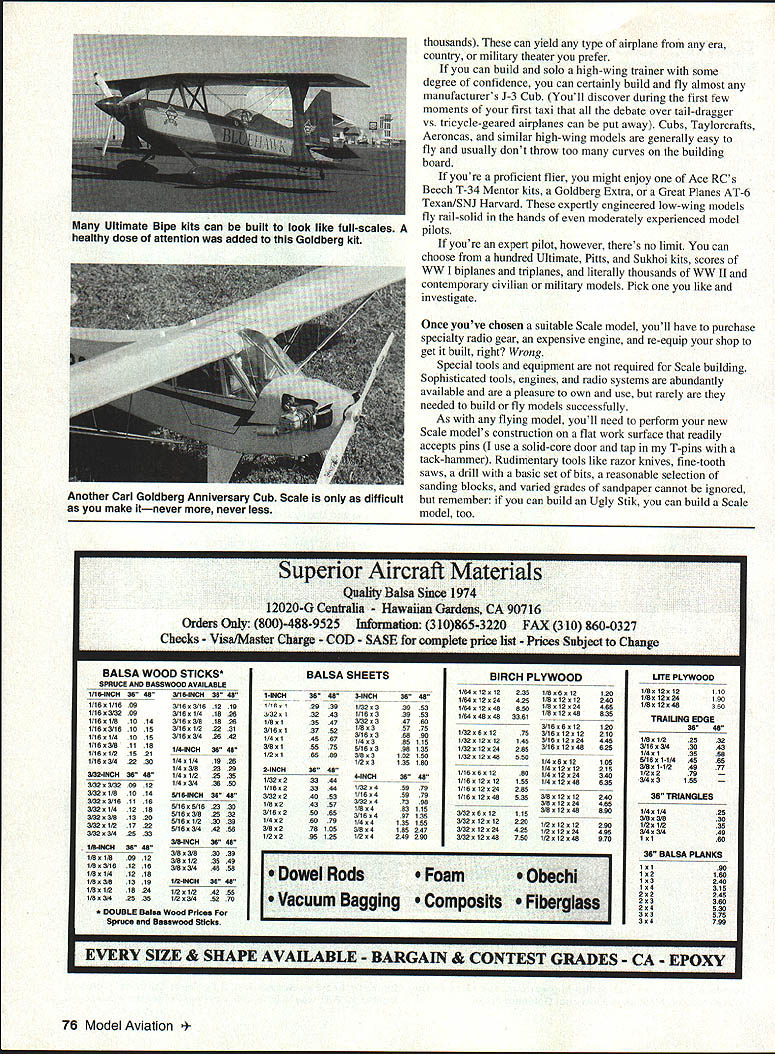
If you're a proficient flier, you might enjoy one of Ace RC's Beech T-34 Mentor kits, a Goldberg Extra, or a Great Planes AT-6 Texan/SNJ Harvard. These expertly engineered low-wing models fly rail-solid in the hands of even moderately experienced model pilots.
If you're an expert pilot, however, there's no limit. You can choose from a hundred Ultimate, Pitts, and Sukhoi kits, scores of WW I biplanes and triplanes, and literally thousands of WW II and contemporary civilian or military models. Pick one you like and investigate.
Tools and equipment
Once you've chosen a suitable Scale model, you'll have to purchase specialty radio gear, an expensive engine, and re-equip your shop to get it built, right? Wrong.
Special tools and equipment are not required for Scale building. Sophisticated tools, engines, and radio systems are abundantly available and are a pleasure to own and use, but rarely are they needed to build or fly models successfully.
As with any flying model, you'll need to perform your new Scale model's construction on a flat work surface that readily accepts pins (I use a solid-core door and tap in my T-pins with a tack-hammer). Rudimentary tools like razor knives, fine-tooth saws, a drill with a basic set of bits, a reasonable selection of sanding blocks, and varied grades of sandpaper cannot be ignored, but remember: if you can build an Ugly Stik, you can build a Scale model, too.
In most cases, specialty items are only luxuries, not necessities, and the same applies to engines and radio gear. If your present equipment is reliable in your Kaos, why shouldn’t it fly your new Scale Elan Escoupe reliably?
Coverings and finishing
Let’s say that you can build a pretty decent model, but what about finishing? All you’ve ever used is MonoKote, and everyone knows you can’t have a Scale model without paint. Again, it just ain’t so! There are an incredible number of smooth-skinned, high-gloss Scale subjects that are perfectly suited to any of the one-step, iron-on, polyester film coverings like MonoKote, Oracover, SuperCote, 21st Century Film, or UltraCote.
Granted, you may not see many of these film-covered models at the Top Gun Scale Invitational or the US Scale Masters, but any of these quick and easy iron-on coverings are excellent for many entry-level and intermediate Scale projects.
If you have a fabric-covered full-scale subject in mind, there are iron-on fabrics galore, too. Products like Colortex, Solartex, Super Coverlite, and Worldtex need only to be ironed to an airframe and coated with fuelproof clear to become impervious to grime and engine oils.
The 21st Century Fabric is more costly, but you won’t have to deal with priming, painting, and sealing; it’s already painted and sealed when you get it. If you happen to own an auto-body shop, the thought of painting a model airplane is a no-brainer and holds no intimidation. It’s all in the perspective, isn’t it?
Getting started and help
If the thought of building a Scale model intrigues you, list the kits or models that match your flying skills, pick one you like that looks like its construction might match your craftsmanship skills, and have at it. I suggest you consider kits, because although plan building is fine for those with more modeling experience or ambition, bonus points are not awarded for the rather mundane task of cutting out bulkheads and rib sets.
Don’t be intimidated; if you’ve chosen correctly, there should be no surprises in the kit. At worst, you may pick up a new technique or two during the model’s construction. If you need a little help, the AMA membership has a pretty good reputation for helping each other. There are fellow club members, hobby shop employees, and model kit and equipment manufacturers by the score who would be happy to offer assistance.
If you have questions concerning Scale construction, you’re welcome to write to me at the address at the column’s head. Enclose an SASE and please be aware that response time can be anywhere from immediate to ten months—depending on your question and my constantly changing schedule.
I’ll send an answer, or if I don’t have what you need, I'll quickly forward your letter to someone who can answer your question with some degree of confidence and authority.
Column services
More important than personal communications, this column offers several regular monthly services that can help modelers:
- Manufacturers' News: contains new kits, plans, and products of value to the Scale community.
- Modelers' Projects: features reader photos and model descriptions, allowing modelers to share experiences and construction techniques.
- Docu-Search: lists reader requests for documentation, such as three-views, plans, or full-scale photographs.
I try to maintain build-along projects by writing about the building process of a model that I believe has mass appeal. I include suggestions or alterations that I believe might help budding Scale modelers advance their skill levels.
Give that Scale model a shot. Scale models aren't really difficult; there probably will just be a few more pieces in the box. Remember that one piece follows the next, follows the next, follows the next. Pretty soon, you and your new Scale model are ready to fly.
Until next month, build straight and fly safely. I'll talk with you again.
Transcribed from original scans by AI. Minor OCR errors may remain.

