

Radio Control: Scale
Jeff Troy 200 S. Spring Street, Ambler PA 19002
From the bench / Shows
Building time is in full swing. Snow is falling just about everywhere it usually falls, and I'm happy to be lashed to my bench once again.
As you read this I will have attended the Puyallup, Washington show for the first time over the weekend of February 3–4. Scale activity in the Pacific Northwest is plentiful, so I should be able to have several show photos and a report for you next month. The WRAM show is also near; stay with us for a close look if you can't get there in person.
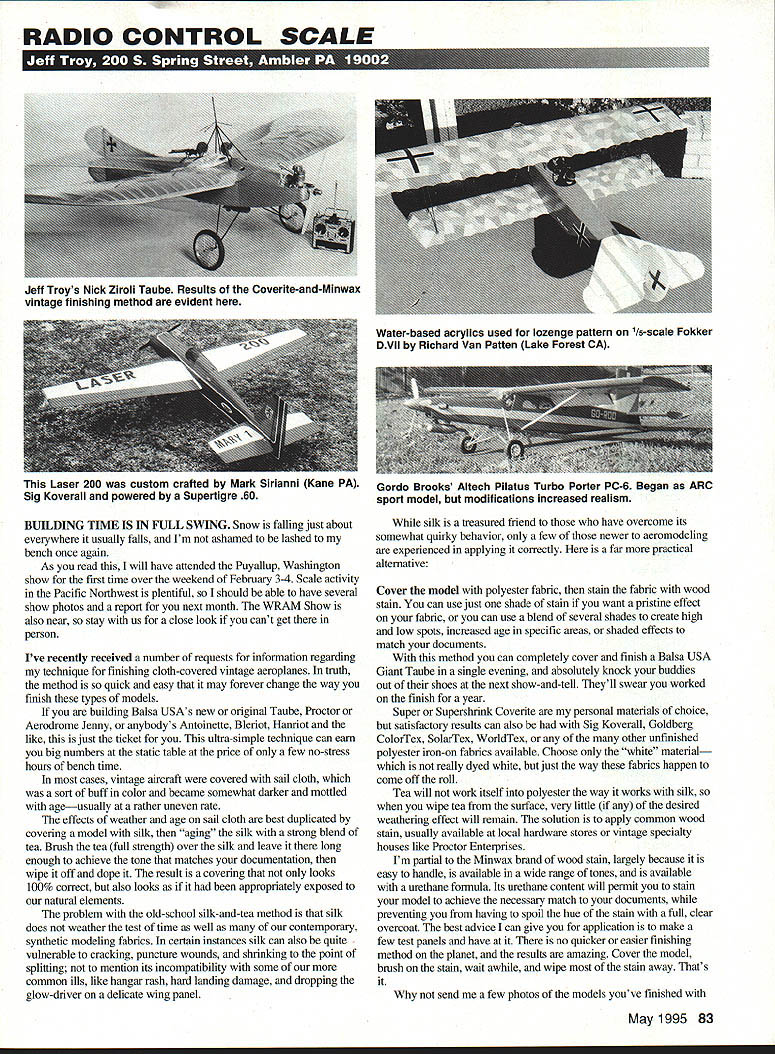
Finishing cloth-covered vintage aeroplanes
I've recently received a number of requests for information about my technique for finishing cloth-covered vintage aeroplanes. The method is so quick and easy it may forever change the way you finish these types of models.
If you are building Balsa USA's new or original Taube, Proctor or Aerodrome Jenny, or anybody's Antoinette, Bleriot, Hanriot and the like, this is just the ticket. This ultra-simple technique can earn you big numbers at the static table at the price of only a few no-stress hours of bench time.
In most cases, vintage aircraft were covered with sailcloth, a buff-colored fabric that darkened and mottled unevenly with age. The traditional way to duplicate that look is to cover with silk and "age" it using a strong brew of tea: brush the tea (full strength) over the silk, leave it until you achieve the desired tone, wipe it off, and dope. The result looks very correct and appropriately weathered.
The problem with the silk-and-tea method is that silk does not weather as well as many contemporary synthetic modeling fabrics. Silk can be vulnerable to cracking, punctures, shrinking or splitting, and it's more easily damaged by hangar rash, hard landings, or dropped glow drivers. Applying silk correctly is also a skill many newer modelers have not yet mastered.
A far more practical alternative:
- Cover the model with polyester fabric, then stain the fabric with wood stain.
- Use one shade for a pristine effect, or blend several shades to create high and low spots, localized aging, or shaded effects to match documentation.
- With this method you can completely cover and finish a Balsa USA Giant Taube in a single evening.
Materials that work well:
- Super Shrink (Coverite) — my personal choice.
- Sig Koverall, Goldberg ColorTex, SolarTex, WorldTex, or any other unfinished polyester iron-on fabric.
- Choose the "white" material (the way these fabrics come off the roll).
Why tea won't work: tea does not penetrate polyester the way it does silk; when wiped, very little weathering remains. The solution is common wood stain, available at hardware stores or hobby suppliers.
Stain recommendations and tips:
- I'm partial to Minwax wood stain — available in a wide range of tones and in a urethane formula. The urethane helps lock the tone in without needing to wipe it away with a full clear overcoat.
- Make test panels first. Brush on the stain, wait a while, then wipe most of it away until you match your documentation. That's all there is to it.
- You can layer or blend stains for more complex aging effects.
- After staining, dope or clear-coat as needed for durability.
Why this works: the result looks correct, ages convincingly, and is far more durable than silk for typical club flying and handling.
Why not send me a few photos of models you've finished with this method? It would make a good picture page.
Docu-Search
- Henry Bourgeois
25510 Hwy. 435, Abita Springs LA 70420 Looking for data on Marine Corps Fokker D-VII paint schemes. Henry has received helpful but limited information from the Aviation Curator of the Marine Corps History and Museums Division. If you have photos in your personal archives, they could be of great help.
- David Wright
783 Hwy. 1, W. #5, Iowa City IA 52246 Needs plans and a construction manual for Kyosho's Cessna 188 Agwagon. The kit is no longer available; logical sources have not panned out.
- Sidney W. Raper, Jr.
11338 Rustic Pines Circle East, Jacksonville FL 32257 Needs Fokker Dr.I triplane documents, especially an accurate three-view.
Note: I included the above requests even though some subjects are readily available commercially. Many modelers are not aware of how useful documentation services can be. Outfits such as Scale Model Research, Scale Plans and Photo Services, NASA (The National Association for Scale Aeromodelling), Bob Holman Plans, Nick Ziroli Plans, Wendell Hostetler Plans, and the monthly modeling magazines can be excellent sources. Check the advertising pages and give them a call.
If you send an SASE with your Docu-Search request, I will send you a form letter telling you which issue your item was submitted in. Lead time is approximately three months but can run longer. If you want a reply, include an SASE — otherwise please understand I may not be able to respond.
Modelers' Projects
- Mark Sirianni (Kane, Pennsylvania) sent a photo of his Laser 200 built from Model Aviation plans, powered by a SuperTigre .60 and covered with Sig Koverall. I wish Mark had included more details on methods and materials, but the photo was of interest.
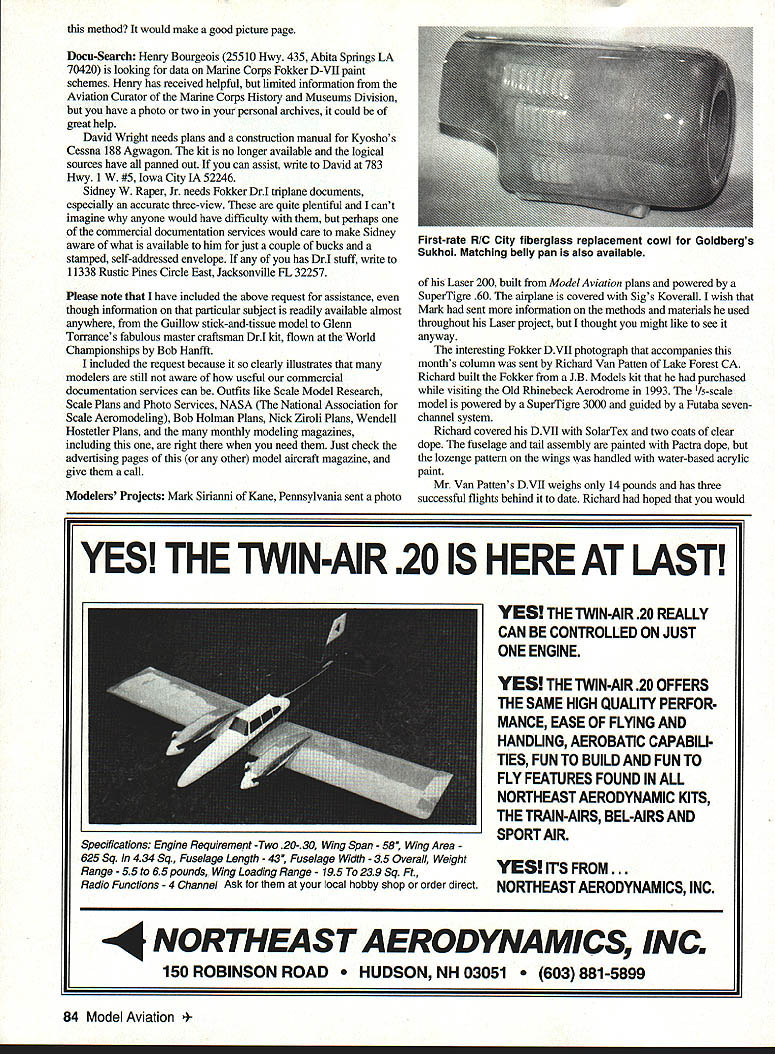
- Richard Van Patten (Lake Forest CA) sent an interesting Fokker D.VII photograph. Richard built the D.VII from a J.B. Models kit he purchased while visiting the Old Rhinebeck Aerodrome in 1993. The 1/5-scale model is powered by a SuperTigre 3000 and guided by a Futaba seven-channel system.
- Covering: SolarTex and two coats of clear dope.
- Fuselage and tail: painted with Pactra dope.
- Wing lozenge pattern: handled with water-based acrylic paint.
- Weight: 14 pounds. Three successful flights to date.
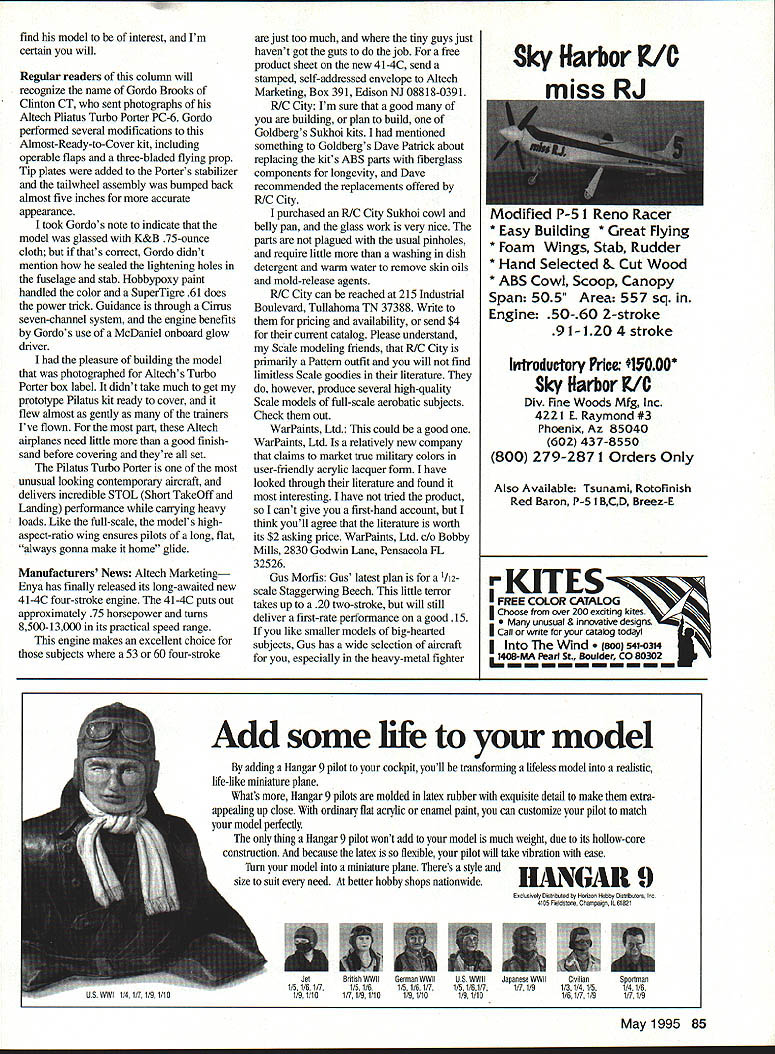
- Gordo Brooks (Clinton CT) sent photographs of his Altech Pilatus Turbo Porter PC-6. Modifications include operable flaps, a three-bladed flying prop, tip plates on the stabilizer, and the tailwheel assembly moved back almost five inches for more accurate appearance.
- Glassed with K & B .75-ounce cloth (note: sealing of lightening holes was not detailed).
- Finish: Hobbypox paint.
- Power: SuperTigre .61.
- Radio: Cimm's seven-channel system.
- Extras: McDaniel onboard glow starter.
I built the model that was photographed for Altech's Turbo Porter box label. Altech kits need little more than a good finish — sand before covering and they're ready to go. The Pilatus Turbo Porter is unusual looking and delivers impressive STOL performance while carrying heavy loads; the high-aspect-ratio wing produces a long, flat glide.
Manufacturers' News
Altech Marketing
Enya has released the new 41-4C four-stroke engine. The 41-4C puts out approximately .75 horsepower and turns in the practical speed range of about 8,500–13,000 rpm. It is an excellent choice where a 53 or 60 four-stroke is too much but smaller engines lack the torque.
For a free product sheet, send a stamped, self-addressed envelope to: Altech Marketing, Box 391, Edison NJ 08818-0391.
R/C City
Many of you are building—or plan to build—one of Goldberg's Sukhoi kits. I asked Goldberg's Dave Patrick about replacing the kit's ABS parts with fiberglass for longevity; he recommended replacements offered by R/C City.
I purchased an R/C City Sukhoi cowl and belly pan; the fiberglass work is very nice with few pinholes. Parts generally require only washing in dish detergent and warm water to remove skin oils and mold-release agents.
R/C City: 215 Industrial Boulevard, Tullahoma TN 37388. Write for pricing/availability or send $4 for their current catalog. Note: R/C City is primarily a pattern outfit; their catalog focuses on aerobatic subjects rather than extensive scale parts, but their quality is good.
WarPaints, Ltd.
WarPaints, Ltd. is a relatively new company marketing true military colors in a user-friendly acrylic lacquer. I found their literature interesting though I have not tried the product firsthand. The literature is worth the $2 price. Contact: WarPaints, Ltd., c/o Bobby Mills, 2830 Godwin Lane, Pensacola FL 32526.
Gus Morfis
Gus' latest plan is for a 1/12-scale Staggerwing Beech. The little model takes up to a .20 two-stroke but will perform first-rate on a good .15. Gus offers a wide selection of smaller models of big-hearted subjects, especially in heavy-metal fighters.
Closing
Puyallup next month. Until then, build straight and fly safely. I'll talk with you again.
Transcribed from original scans by AI. Minor OCR errors may remain.

