
RADIO CONTROL SCALE
Jeff Troy, 200 S. Spring Garden Street, Ambler PA 19002
IRVINE LTD.
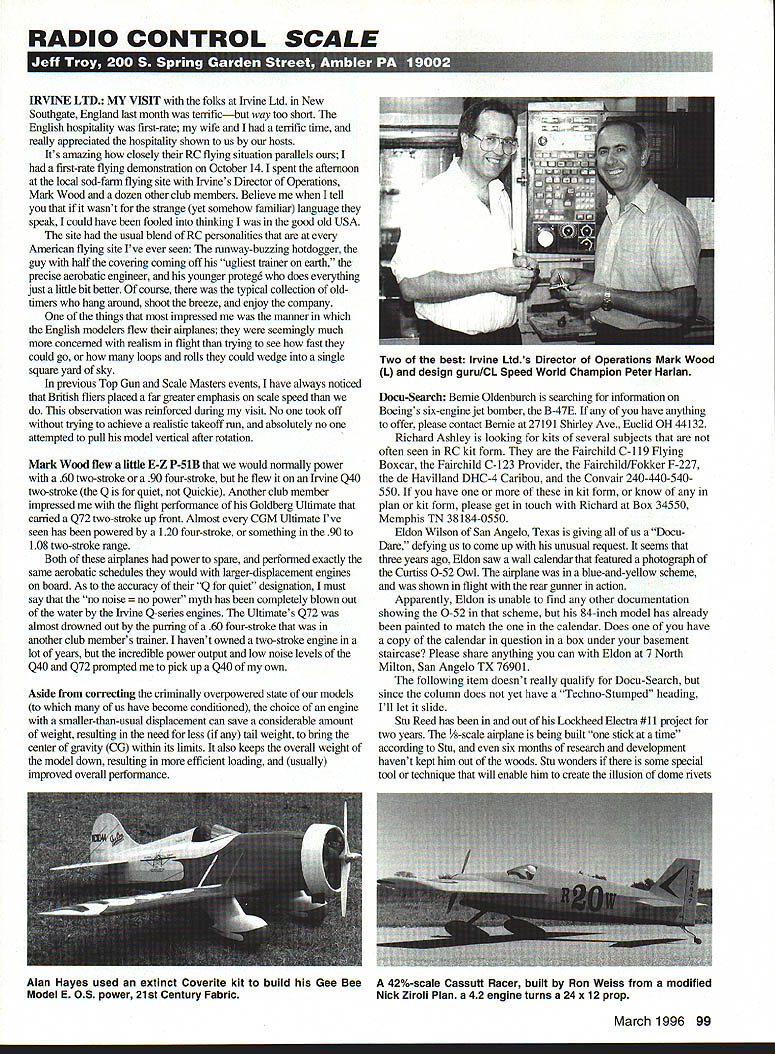
My visit with the folks at Irvine Ltd. in New Southgate, England last month was terrific—but way too short. The English hospitality was first-rate; my wife and I had a terrific time and really appreciated the hospitality shown to us by our hosts.
It's amazing how closely their RC flying situation parallels ours; I had a first-rate flying demonstration on October 14. I spent the afternoon at the local sod-farm flying site with Irvine's Director of Operations, Mark Wood, and a dozen other club members. Believe me when I tell you that if it wasn't for the strange (yet somehow familiar) language they speak, I could have been fooled into thinking I was in the good old U.S.A.
The site had the usual blend of RC personalities that are at every American flying site I've ever seen:
- the runway-buzzing hotdogger
- the guy with half the covering coming off his "ugliest trainer on earth"
- the precise aerobatic engineer and his younger protégé who does everything just a little bit better
- the typical collection of old-timers who hang around, shoot the breeze, and enjoy the company
One of the things that most impressed me was the manner in which the English modelers flew their airplanes; they were seemingly much more concerned with realism in flight than trying to see how fast they could go, or how many loops and rolls they could wedge into a single square yard of sky.
In previous Top Gun and Scale Masters events, I have always noticed that British fliers placed a far greater emphasis on scale speed than we do. This observation was reinforced during my visit. No one took off without trying to achieve a realistic takeoff run, and absolutely no one attempted to pull his model vertical after rotation.
Mark Wood flew a little E-Z P-51B that we would normally power with a .60 two-stroke or a .90 four-stroke, but he flew it on an Irvine Q40 two-stroke (the Q is for quiet, not Quickie). Another club member impressed me with the flight performance of his Goldberg Ultimate that carried a Q72 two-stroke up front. Almost every CGM Ultimate I've seen has been powered by a .120 four-stroke, or something in the .90 to 1.08 two-stroke range.
Both of those airplanes had power to spare, and performed exactly the same aerobatic schedules they would with larger-displacement engines on board. As to the accuracy of their "Q" or "quiet" designation, I must say that the "no noise = no power" myth has been completely blown out of the water by the Irvine Q-series engines. The Ultimate's Q72 was almost drowned out by the purring of a .60 four-stroke that was in another club member's trainer. I haven't owned a two-stroke engine in a lot of years, but the incredible power output and low noise levels of the Q40 and Q72 prompted me to pick up a Q40 of my own.
Aside from correcting the criminally overpowered state of our models (to which many of us have become conditioned), the choice of an engine with a smaller-than-usual displacement can save a considerable amount of weight, resulting in the need for less (if any) tail weight to bring the center of gravity (CG) within its limits. It also keeps the overall weight of the model down, resulting in more efficient loading, and (usually) improved overall performance.
On the skin of his Electra.
Pin heads or commercially available rivets will add too much weight; he has already tried thick cyanoacrylate on the end of a toothpick, but he cannot keep the dab uniform. If you can help Stu get his domes, drop him a line at 225 North Edgefield Avenue, Dallas TX 75208-5314.
Modelers' Projects:
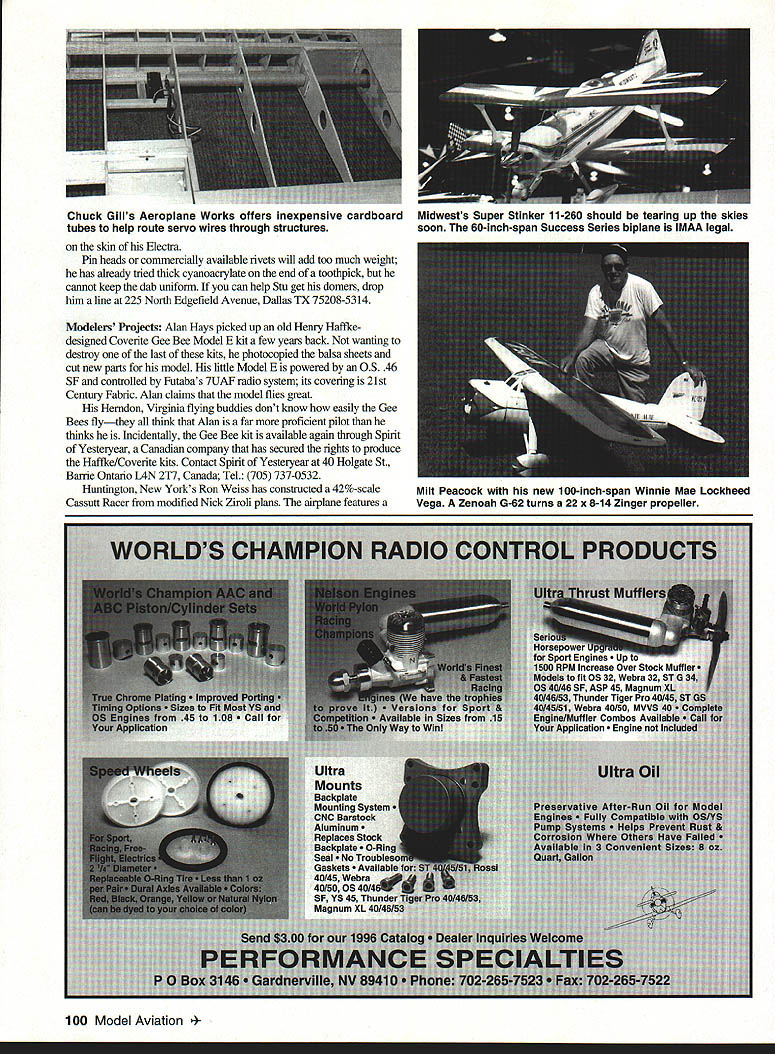
Alan Hays picked up an old Henry Haffke-designed Coverite Gee Bee Model E kit a few years back. Not wanting to destroy one of the last of these kits, he photocopied the balsa sheets and cut new parts for his model. His little Model E is powered by an O.S. .46 SF and controlled by Futaba's TUA4F radio system; its covering is 21st Century Fabric. Alan claims that the model flies great.
His Herndon, Virginia flying buddies don't know how easily the Gee Bees fly—they all think that Alan is a far more proficient pilot than he thinks he is. Incidentally, the Gee Bee kit is available again through Spirit of Yesteryear, a Canadian company that has secured the rights to produce the Haffke/Coverite kits. Contact Spirit of Yesteryear at 40 Holgate St., Barrie Ontario L4N 2T7, Canada; Tel.: (705) 737-0532.
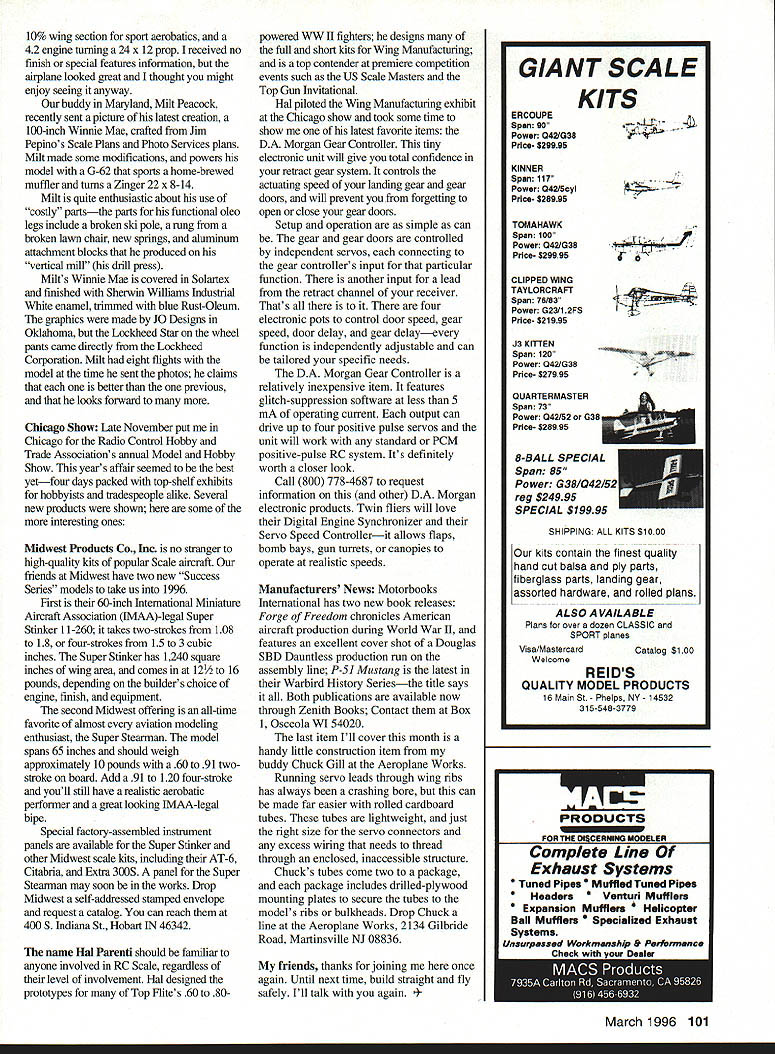
Huntington, New York's Ron Weiss has constructed a 42%-scale Cassutt Racer from modified Nick Ziroli plans. The airplane features a 10% wing section for sport aerobatics, and a .42 engine turning a 24 x 12 prop. I received no finish or special features information, but the airplane looked great and I thought you might enjoy seeing it anyway.
Our buddy in Maryland, Milt Peacock, recently sent a picture of his latest creation, a 100-inch Winnie Mae, crafted from Jim Pepino's Scale Plans and Photo Services plans. Milt made some modifications, and powers his model with a G-62 that sports a home-brewed muffler and a Zinger 22 x 8-14.
Milt is quite enthusiastic about his use of "costly" parts—the parts for his functional oleo legs include:
- a broken ski pole
- a rung from a broken lawn chair
- new springs
- aluminum attachment blocks he produced on his "vertical mill" (his drill press)
Milt's Winnie Mae is covered in Solartex and finished with Sherwin Williams Industrial White enamel, trimmed with blue Rust-Oleum. The graphics were made by I/O Designs in Oklahoma, but the Lockheed star on the wheel pants came directly from the Lockheed Corporation. Milt had eight flights with the model at the time he sent the photos; he claims that each one is better than the one previous, and that he looks forward to many more.
Chicago Show
Late November put me in Chicago for the Radio Control Hobby and Trade Association's annual Model and Hobby Show. This year's event seemed to be the best yet—four days packed with top-shelf exhibits for hobbyists and tradespeople alike. Several new products were shown; here are some of the more interesting ones:
Midwest Products Co., Inc. is no stranger to high-quality kits of popular scale aircraft. Our friends at Midwest have two new "Success Series" models to take us into 1996:
- Super Stinker 1-260
- 60-inch span
- IMAA-legal
- Accepts two-strokes from .18 to .61 and four-strokes from 1.5 to 3 cubic inches
- 1,240 square inches of wing area
- Estimated weight: 12 to 16 pounds, depending on engine, finish, and equipment
- Super Stearman
- 65-inch span
- Estimated weight: approximately 10 pounds with a .60 to .91 two-stroke
- Can accept a .91 to 1.20 four-stroke and still be a realistic aerobatic performer and great-looking IMAA-legal biplane
Special factory-assembled instrument panels are available for the Super Stinker and other Midwest scale kits, including their AT-6, Citabria, and Extra 300S. A panel for the Super Stearman may soon be in the works. Drop by Midwest's booth and pick up a free brochure or request a catalog. You can reach them at Midwest Products, P.O. Box 400S, Hobart IN 46342.
The name Hal Parenti should be familiar to anyone involved in RC Scale. Hal designed the prototypes for many of Top Flite's .60 to .80-powered WWII fighters; he designs many of the full and short kits for Wing Manufacturing; and he is a top contender at premiere competition events such as the US Scale Masters and the Top Gun Invitational.
Hal piloted the Wing Manufacturing exhibit at the Chicago show and took some time to show me one of his latest favorite items: the D.A. Morgan Gear Controller. This tiny electronic unit will give you total confidence in your retract gear system. It controls the actuating speed of your landing gear and gear doors, and will prevent you from forgetting to open or close your gear doors.
Setup and operation are as simple as can be. The gear and gear doors are controlled by independent servos, each connecting to the gear controller's input for that particular function. There is another input for a lead from the retract channel of your receiver. That's all there is to it. There are four electronic pots to control door speed, gear speed, door delay, and gear delay—every function is independently adjustable and can be tailored to your specific needs.
The D.A. Morgan Gear Controller is a relatively inexpensive item. It features glitch-suppression software and less than 5 mA of operating current. Each output can drive up to four positive-pulse servos and the unit will work with any standard or PCM positive-pulse RC system. It's definitely worth a closer look.
Call (800) 778-4687 to request information on this (and other) D.A. Morgan electronic products. Twin fliers will love their Digital Engine Synchronizer and their Servo Speed Controller—it allows flaps, bomb bays, gun turrets, or canopies to operate at realistic speeds.
Manufacturers' News:
Motorbooks International has two new book releases:
- Forge of Freedom chronicles American aircraft production during World War II, and features an excellent cover shot of a Douglas SBD Dauntless roll-out at the assembly plant
- P-51 Mustangs is the latest in their Warbird History Series
Both publications are available now through Zenith Books; contact them at Box 1, Osceola WI 54020.
The last item I'll cover this month is a handy little construction item from my buddy Chuck Gill at the Aeroplane Works. Running servo leads through wing ribs has always been a crashing bore, but this can be made far easier with rolled cardboard tubes. These tubes are lightweight and just the right size for the servo connectors and any excess wiring that needs to thread through an enclosed, inaccessible structure. Chuck's tubes come two to a package, and each package includes drilled-plywood mounting plates to secure the tubes to the spars or bulkheads. Drop Chuck a line at the Aeroplane Works, 2134 Gilbride Road, Martinsville NJ 08836.
My friends, thanks for joining me here once again. Until next time, build straight and fly safely. I'll talk with you again. +
Transcribed from original scans by AI. Minor OCR errors may remain.

