
Radio Control Scale
Byline
Jeff Troy 19 East Mt. Pleasant Avenue, Ambler, PA 19002
Photo captions
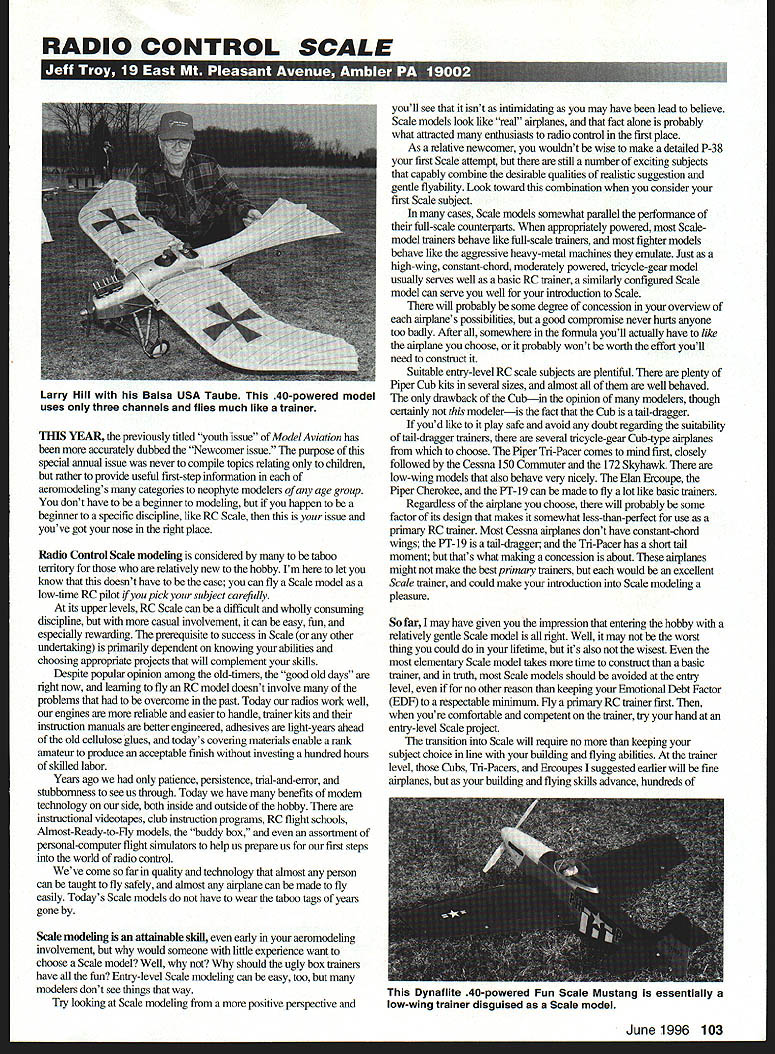
- Larry Hill with his Balsa USA Taube. This .40-powered model uses only three channels and flies much like a trainer.
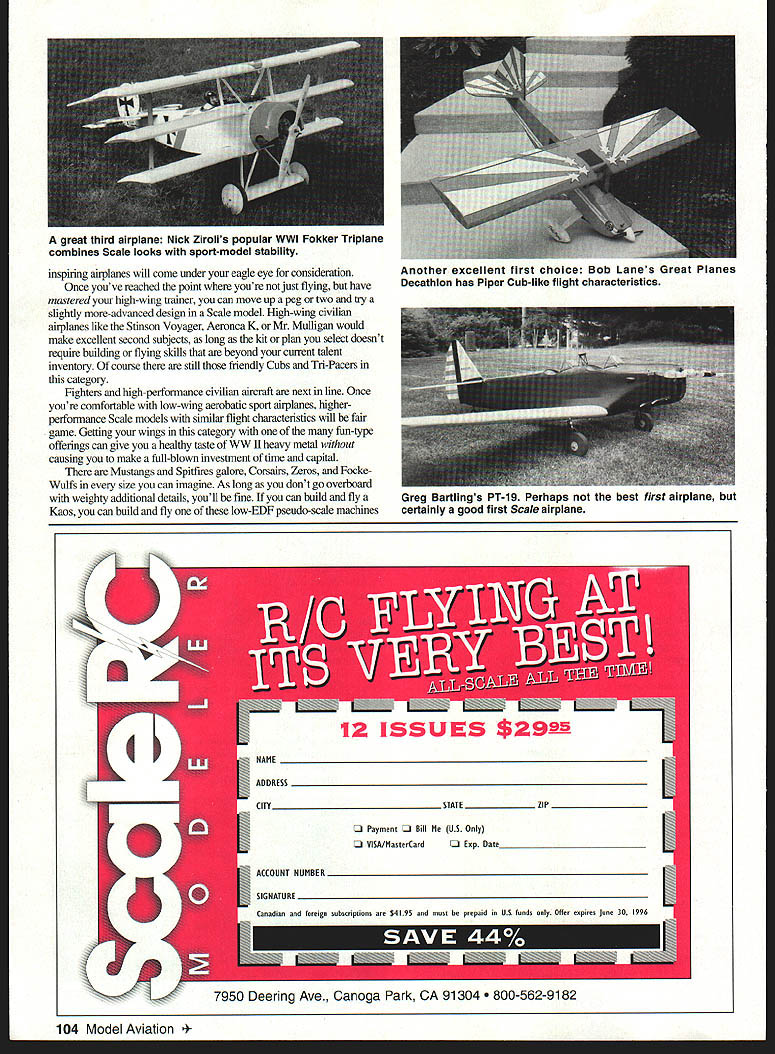
- This Dynaflite .40-powered Fun Scale Mustang is essentially a low-wing trainer disguised as a Scale model.
This year, the previously titled "youth issue" of Model Aviation has been more accurately dubbed the "Newcomer issue." The purpose of this special annual issue was never to compile topics relating only to children, but rather to provide useful first-step information in each of aeromodeling's many categories to neophyte modelers of any age. You don't have to be a beginner to modeling, but if you happen to be a beginner to a specific discipline, like RC Scale, then this is your issue and you've got your nose in the right place.
Radio Control Scale modeling is considered by many to be taboo territory for those who are relatively new to the hobby. I'm here to let you know that this doesn't have to be the case: you can fly a Scale model as a low-time RC pilot if you pick your subject carefully.
At its upper levels, RC Scale can be a difficult and wholly consuming discipline, but with more casual involvement it can be easy, fun, and especially rewarding. The prerequisite to success in Scale (or any other undertaking) is primarily dependent on knowing your abilities and choosing appropriate projects that will complement your skills.
Despite popular opinion among the old-timers, the "good old days" are right now, and learning to fly an RC model doesn't involve many of the problems that had to be overcome in the past. Today our radios work well, our engines are more reliable and easier to handle, trainer kits and their instruction manuals are better engineered, adhesives are light-years ahead of the old cellulosic glues, and today's covering materials enable a rank amateur to produce an acceptable finish without investing a hundred hours of skilled labor.
Years ago we had only patience, persistence, trial-and-error, and stubbornness to see us through. Today we have many benefits of modern technology on our side, both inside and outside of the hobby. There are instructional videotapes, club instruction programs, RC flight schools, Almost-Ready-to-Fly models, the "buddy box," and even an assortment of personal-computer flight simulators to help us prepare for our first steps into the world of radio control.
We've come so far in quality and technology that almost any person can be taught to fly safely, and almost any airplane can be made to fly easily. Today's Scale models do not have to wear the taboo tags of years gone by.
Scale modeling is an attainable skill, even early in your aeromodeling involvement, but why would someone with little experience want to choose a Scale model? Well, why not? Why should the ugly box trainers have all the fun? Entry-level Scale modeling can be easy, too, but many modelers don't see things that way.
Try looking at Scale modeling from a more positive perspective and you'll see that it isn't as intimidating as you may have been led to believe. Scale models look like "real" airplanes, and that fact alone is probably what attracted many enthusiasts to radio control in the first place.
As a relative newcomer, you wouldn't be wise to make a detailed P-38 your first Scale attempt, but there are still a number of exciting subjects that capably combine the desirable qualities of realistic suggestion and gentle flyability. Look toward this combination when you consider your first Scale subject.
In many cases, Scale models somewhat parallel the performance of their full-scale counterparts. When appropriately powered, most Scale-model trainers behave like full-scale trainers, and most fighter models behave like the aggressive heavy-metal machines they emulate. Just as a high-wing, constant-chord, moderately powered, tricycle-gear model usually serves well as a basic RC trainer, a similarly configured Scale model can serve you well for your introduction to Scale.
There will probably be some degree of concession in your overview of each airplane's possibilities, but a good compromise never hurts anyone too badly. After all, somewhere in the formula you'll actually have to like the airplane you choose, or it probably won't be worth the effort you'll need to construct it.
Suitable entry-level RC Scale subjects are plentiful. There are plenty of Piper Cub kits in several sizes, and almost all of them are well behaved. The only drawback of the Cub—in the opinion of many modelers, though certainly not this modeler—is the fact that the Cub is a tail-dragger.
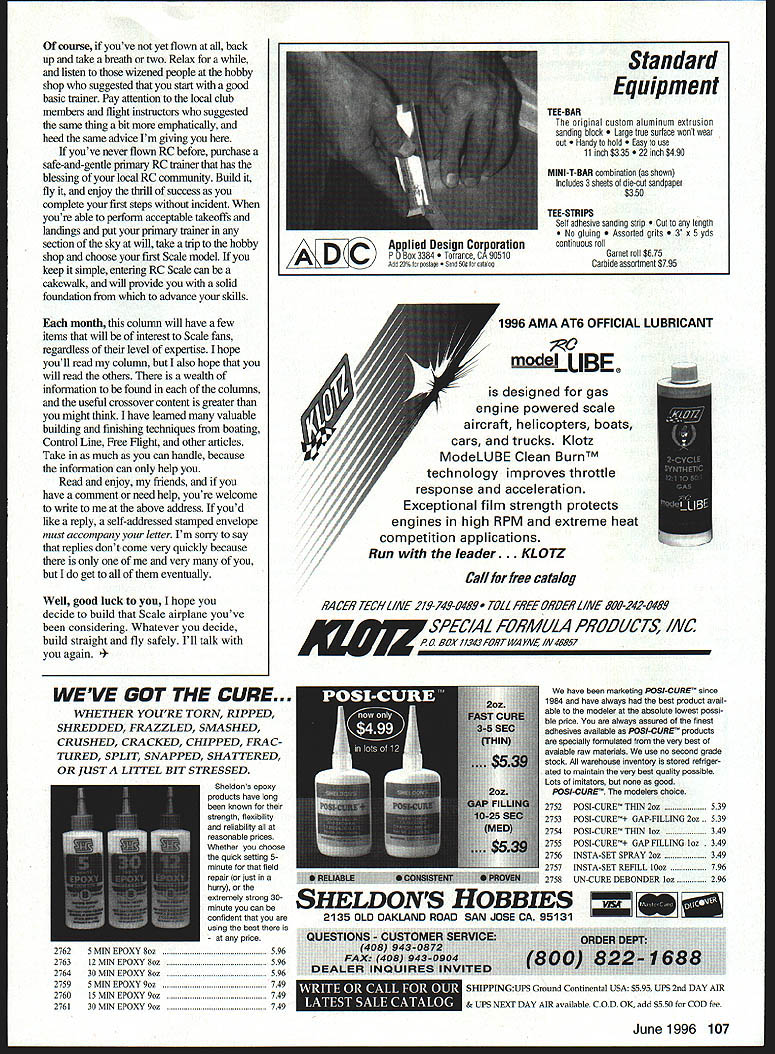
If you'd like to play safe and avoid any doubt regarding the suitability of tail-dragger trainers, there are several tricycle-gear Cub-type airplanes from which to choose. The Piper Tri-Pacer comes to mind first, closely followed by the Cessna 150 Commuter and the 172 Skyhawk. There are low-wing models that also behave very nicely. The Ercoupe, the Piper Cherokee, and the PT-19 can be made to fly a lot like basic trainers.
Regardless of the airplane you choose, there will probably be some factor of its design that makes it somewhat less-than-perfect for use as a primary RC trainer. Most Cessna airplanes don't have constant-chord wings; the PT-19 is a tail-dragger; and the Tri-Pacer has a short tail moment. Those considerations might make them less-than-ideal primary trainers, but each would be an excellent Scale trainer and could make your introduction to Scale modeling a pleasure.
So far, I may have given you the impression that entering the hobby with a relatively gentle Scale model is all right. Well, it may not be the worst thing you could do in your lifetime, but it's also not the wisest. Even the most elementary Scale model takes more time to construct than a basic trainer, and, in truth, most Scale models should be avoided at the entry level even if for no other reason than keeping your Emotional Debt Factor (EDF) to a respectable minimum. Fly a primary RC trainer first. Then, when you're more comfortable and competent on the trainer, try your hand at an entry-level Scale project.
The transition into Scale will require no more than keeping your subject choice in line with your building and flying abilities. At the trainer level, those Cubs, Tri-Pacers, and Ercoupes I suggested earlier will be fine airplanes, but as your building and flying skills advance, hundreds of inspiring airplanes will come under your eagle eye for consideration.
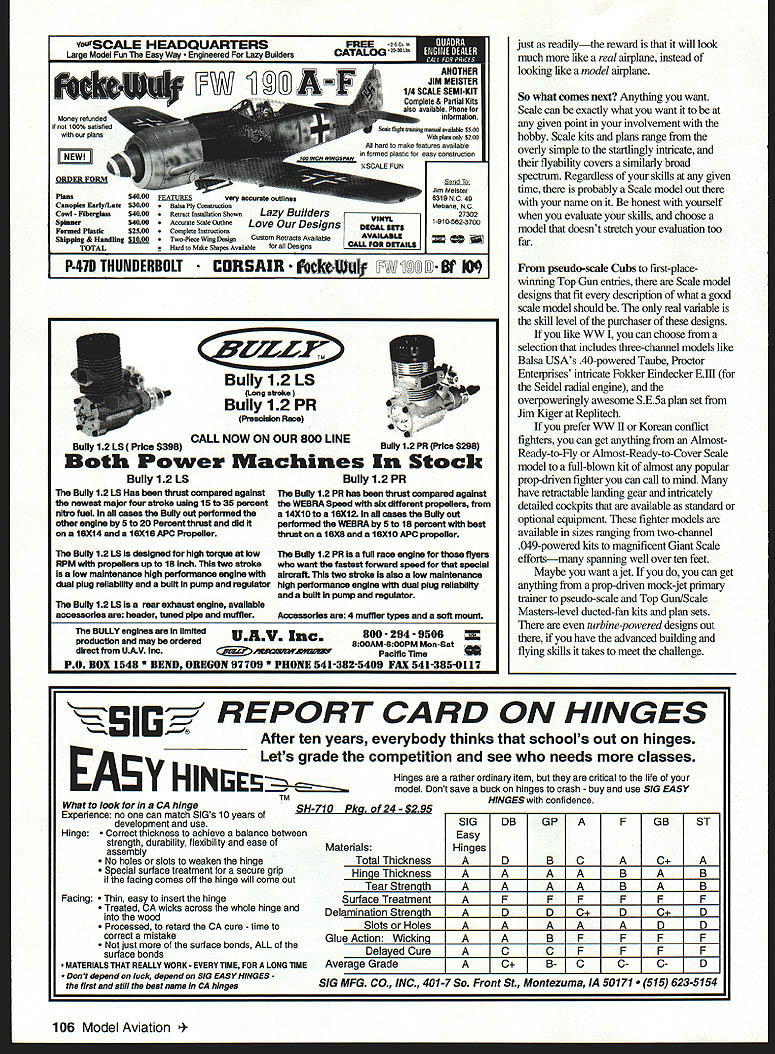
Once you've reached the point where you're not just flying, but have mastered your high-wing trainer, you can move up a peg or two and try a slightly more-advanced design in a Scale model. High-wing civilian airplanes like the Stinson Voyager, Aeronca K, or Mr. Mulligan would make excellent second subjects, as long as the kit or plan you select doesn't require building or flying skills that are beyond your current talent inventory. Of course there are still those friendly Cubs and Tri-Pacers in this category.
Fighters and high-performance civilian aircraft are next in line. Once you're comfortable with low-wing aerobatic sport airplanes, higher-performance Scale models with similar flight characteristics will be fair game. Getting your wings in this category with one of the many fun-type offerings can give you a healthy taste of WWII heavy metal without causing you to make a full-blown investment of time and capital.
There are Mustangs and Spitfires galore, Corsairs, Zeros, and Focke-Wulfs in every size you can imagine. As long as you don't go overboard with weighty additional details, you'll be fine. If you can build and fly a Kaos, you can build and fly one of these low-EDF pseudo-scale machines just as readily—the reward is that it will look much more like a real airplane, instead of looking like a model airplane.
So what comes next? Anything you want. Scale can be exactly what you want it to be at any given point in your involvement with the hobby. Scale kits and plans range from the very simple to the startlingly intricate, and their flyability covers a similarly broad spectrum. Regardless of your skills at any given time, there is probably a Scale model out there with your name on it. Be honest with yourself when you evaluate your skills, and choose a model that doesn't stretch your evaluation too far.
From pseudo-scale Cubs to first-place-winning Top Gun entries, there are Scale model designs that fit every description of what a good scale model should be. The only real variable is the skill level of the purchaser of these designs. If you like WW I, you can choose from a selection that includes three-channel models like Balsa USA's .40-powered Taube, Proctor Enterprises' intricate Fokker Eindecker E.III (for the Seidel radial engine), and the overpoweringly awesome S.E.5a plan set from Jim Kiger at Replicraft.
If you prefer WW II or Korean conflict fighters, you can get anything from an Almost-Ready-to-Fly or Almost-Ready-to-Cover Scale kit to a full-blown kit of almost any popular prop-driven fighter you can call to mind. Many have retractable landing gear and intricately detailed cockpits that are available as standard or optional equipment. These fighter models are available in sizes ranging from two-channel .049-powered kits to magnificent Giant Scale efforts—many spanning well over ten feet.
Maybe you want a jet. If you do, you can get anything from a prop-driven mock-jet primary trainer to pseudo-scale and Top Gun/Scale Masters-level ducted-fan kits and jet kits. There are even turbine-powered designs out there, if you have the advanced building and flying skills it takes to meet the challenge.
Of course, if you've not yet flown at all, back up and take a breath or two. Relax for a while, and listen to those wizened people at the hobby shop who suggested that you start with a good basic trainer. Pay attention to the local club members and flight instructors who suggested the same thing a bit more emphatically, and heed the same advice I'm giving you here.
If you've never flown RC before, purchase a safe-and-gentle primary RC trainer that has the blessing of your local RC community. Build it, fly it, and enjoy the thrill of success as you complete your first steps without incident. When you're able to perform acceptable takeoffs and landings and put your primary trainer in any section of the sky at will, take a trip to the hobby shop and choose your first Scale model. If you keep it simple, entering RC Scale can be a cakewalk, and will provide you with a solid foundation from which to advance your skills.
Each month, this column will have a few items that will be of interest to Scale fans, regardless of their level of expertise. I hope you'll read my column, but I also hope that you'll read the others. There is a wealth of information to be found in each of the columns, and the useful crossover content is greater than you might think. I have learned many valuable building and finishing techniques from Boating, Control Line, Free Flight, and other articles. Take in as much as you can handle, because the information can only help you.
Read and enjoy, my friends, and if you have a comment or need help, you're welcome to write to me at the above address. If you'd like a reply, a self-addressed stamped envelope must accompany your letter. I'm sorry to say that replies don't come very quickly because there is only one of me and very many of you, but I do get to all of them eventually.
Well, good luck to you. I hope you decide to build that Scale airplane you've been considering. Whatever you decide, build straight and fly safely. I'll talk with you again.
Transcribed from original scans by AI. Minor OCR errors may remain.

