
RADIO CONTROL: SCALE
Jeff Troy, 19 East Mt. Pleasant Avenue, Ambler, PA 19002
Tomorrow morning I'll be packing for Indianapolis, Indiana, for a visit with the good people of ISC International. ISC International is a familiar name to most of us, primarily as the North American distributor of Zenoah engines, GMS (Gemtec Machinery Systems) model engines of China, and that great ISC ARC/ARF 1/4-scale J-3 Cub.
Following my day at ISC, I'll drive to Muncie for the RC Scale portion of the National Aeromodeling Championships and my first look at AMA's new Indiana home. Everything on the grapevine says the new location is a marked improvement over the Reston, Virginia facility, and I honestly can't wait to see it. I'm taking along a lot of film, so you can share the experience.
The AMA Nats is always a good time. My first experience with the National Championships was as an RC soaring contestant in Chicopee, Massachusetts in 1983. Later I attended the 1985 event in Chicopee, and at the 1986 Lake Charles, Louisiana event I was the Nats soaring events director.
I also got to see a few more years of Nats operation from 1987 through 1989 while I was employed in AMA's Public Relations department with Geoff Styles and Judy DiLoretta. Careful planning and lots of sweat goes into putting the National Aeromodeling Championships together each year, but the contest is always worth the price of the ticket and then some.
The Nats is a contest, a tough contest, but it's also a great annual celebration of the aeromodeling sport. There are banquets, meetings, practice sessions, awards ceremonies, tall stories, short stories, and exchanges of character and sportsmanship in every facet of model aviation. Year after year, the AMA National Aeromodeling Championships continues to be the most exciting, stimulating, and enjoyable modeling event in the world.
Model Aviation's December issue will feature Nats coverage of every event; I'll bring you the RC Scale report on the action in Muncie.
Build-Along Project
This month's column was written in early July, and the question of which airplane to select for our next build-along project was posed in the July issue. Your choices for the next project were:
- 1/3-scale Dave Platt Focke-Wulf 190 A-8 (serious stuff)
- 33% Bleriot XI-2 (serious but of very limited interest)
- Nick Ziroli Fokker Dr.I Triplane
- Dynaflite 1/5-scale Fun Scale Spitfire
Your letters have just started to arrive, and it's a real pleasure to read your responses to the model-selection dilemma. Unfortunately, there is no clear-cut leader yet, so we'll have to wait for more letters to decide the matter.
The Bleriot and Focke-Wulf are a bit behind the Dr.I and Spitfire, as I expected. These competition-level projects are a bit intense and rather on the costly side for something as casual as the build-along exercises. Apparently it's going to be a race between the Spitfire and the Fokker, so when you write, try to limit your comments to these two aircraft.
Some of you wrote to suggest alternative aircraft, which is very much appreciated. However, let's see Spitfires vs. Triplanes and see which way the coin falls. Either model would offer a lot of opportunities for us to exchange scale-modeling suggestions and techniques. From the pursuit of basic documentation, through the various stages of construction, to the covering and finishing process, and finally to the first flight (which really should be considered the "last piece of the model"), these build-alongs would be fun and informative.
Ziroli's Triplane is a 1/4-scale model, but it's not an excessively large one. The model spans approximately 63 inches and could easily be powered by something in the 2.0- to 2.5-cid range. I don't have much experience with gasoline engines, but I've got an old Kioritz 2.4 on the shelf. Maybe it would be fun to use gas, and go through the gasoline learning curve together. Doing so would certainly make for interesting exchanges of suggestions and techniques.
If gas doesn't interest you, there are plenty of glow engines available that would suit the Fokker perfectly. I've got an Enya VT-240 twin, which won't have a place to go until I build that Platt Focke-Wulf, and I'm sure you have something suitable, too. In the finishing department the Dr.I would offer exercises in fabric application, rib taping, and various painting procedures.
The Dynaflite Spitfire is now being marketed by Great Planes. This model spans 81 inches and is intended for 1.20 two-stroke or four-stroke engines. Retracts and/or flaps could be considered, but are not necessary. Your letters and comments could give me some guidance here. Retract and flap options add to a model's cost, but also to the enjoyment of the finished airplane's capabilities. These options would also present us with greater opportunity for exchange of information, techniques, and suggestions.
In the finishing department, a Spitfire would normally be a definitive subject for fiberglassing techniques. However, Mark Smith's Dynaflite design is a Fun Scale model with open bays in every major component. If chosen, this particular airplane would be covered with fabric, detailed, and painted. The Spitfire would give us a lot of opportunity for low-key fun with various rivet, panel-line, and hatch-detailing methods.
These are the two finalists. The choice is yours. Which do you like?
- Gas or glow?
- Flaps or no flaps?
- Retracts or fixed gear?
- How about a fiberglassed, open-bay triplane with flaps, retracting floats, and electric power — via sailplane winch?
Modelers' Projects
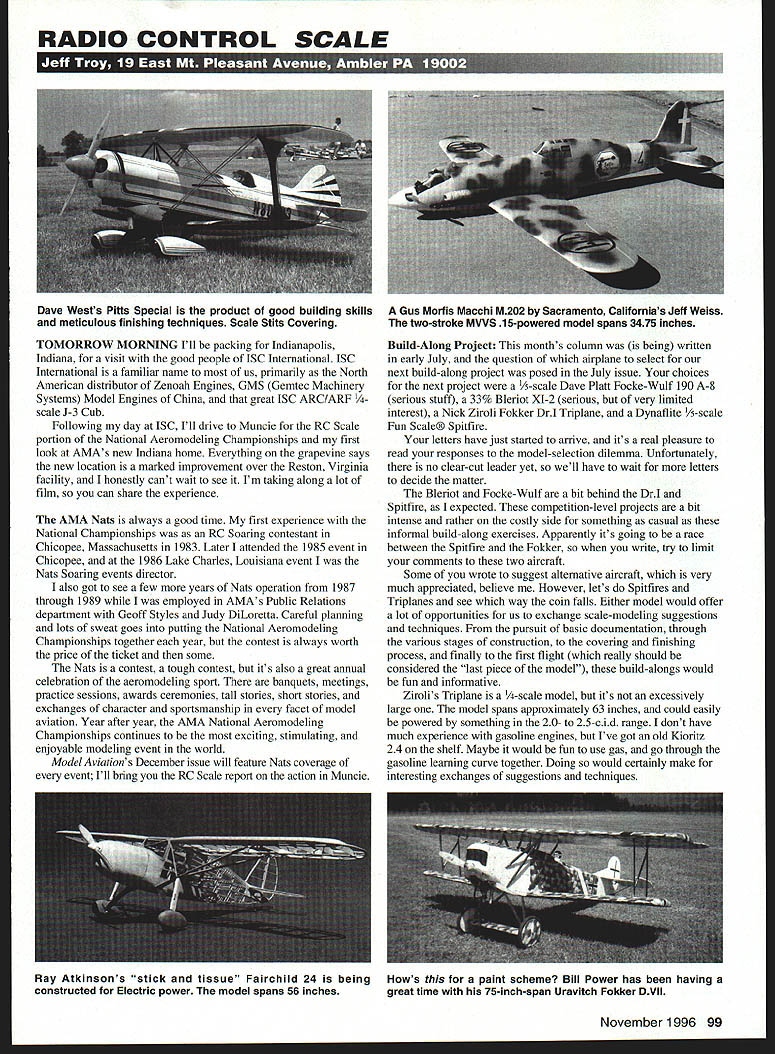
Dave West of Norristown, Pennsylvania has almost a dozen flights on his 80-inch Andy Sheeber Pitts Special. The model was covered, prepped, sealed, and painted with the Stits Scale Covering products and procedures (including the scale pinked tape) I described in last month's column. Dave flies with the Valley Forge Signal Seekers and the Delaware Gypsy Giants. His beautifully built Pitts is powered by a Q-82 and weighs 32 pounds.
Jeff Weiss' Macchi M.202 was built from a Gus Morfis 1/2-scale Combat kit. It spans 34.75 inches and is powered by an MVVS .15 two-stroke engine. You don't see finishes this nice on Combat airplanes every day, but this one shows that when the building skills are available, no one builds to lower standards than their ability allows. Jeff is from Sacramento, California.
What Scale builder doesn't appreciate slick construction? San Mateo, California's Ray Atkinson is completing a Fairchild 24 that spans 56 inches and sports 450 square inches of area. The model is being built for electric power. Ray didn't provide any of the model's particulars, because the purpose of his letter was of another nature (see Docu-Search). A good model, however, is always worth photo space in Model Aviation, even without all of the gritty details.
Bill Power lives in Priest River, Idaho; his Uravitch Fokker D.VII is powered by a G-38. The model spans 75 inches but weighs only 16.5 pounds. This D.VII was covered with Super Coverite, painted with latex enamel, and clear-coated with Varathane. Northern Idaho may not be the center of big-city culture, but look at that flying site! Seems like a decent tradeoff to me. Great paint scheme, Bill.
Docu-Search
Here's a Docu-Search in reverse. Ray Atkinson and Larry Hill wrote to add their names to the list of those who want more information on Jim Adams' Waterman Aerobile. Numerous inquiries have been made concerning this unusual model, but I haven't been able to find Mr. Adams' original letter, so I can't help make the connection. The Waterman photo was published in the February 1996 "RC Scale" column.
Jim Adams — if you're reading this, would you please give me your address again? Perhaps you would also be kind enough to contact Ray Atkinson (150 Sycamore Avenue, San Mateo, CA 94402) and Larry Hill (48 Sherwood Place, Southampton, NJ 08088).
Well, my friends, this one is a bit on the short side, so perhaps this month's photos can be a little larger than they usually are. There's a big trip coming, with lots of photos and action to report, so be sure to be here for the special Nats issue. Until then, build straight and fly safely. I'll talk with you again.
Transcribed from original scans by AI. Minor OCR errors may remain.

