
RADIO CONTROL SCALE
Jeff Troy 19 East Mt. Pleasant Avenue, Ambler PA 19002
Overview
RC Scale was held Friday, July 12 through Sunday, July 14. Friday was set aside for static judging of some of the finest RC scale models, while Saturday and Sunday hosted four rounds of precise scale flying by the same airplanes. The event was well organized by AMA with support from the Frank Ehling Museum and the Lee Renaud Library.
Classes and Judging
- Classes offered: Sportsman (Sport Scale), Sport Scale (with Sportsman and Expert levels), Expert Sport Scale, Designer Scale, and FAI (judged by international rules).
- Designer Scale is open to contestants who have designed — not merely built from plans — their own aircraft.
- Each model is evaluated by an impartial panel of static judges using full-scale documentation provided by the contestant.
- Static judging criteria include fidelity to scale in outline, finish, color and markings, and builder craftsmanship.
- Static scores are held until a contestant has flown his first flight.
Flying Format and Scoring
- Four flightlines were established, each with its own pair of flight judges. This keeps the contest moving and limits airborne models to four at a time.
- Each contestant could fly up to four flights, once before each pair of judges.
- Before each flight, the contestant submitted a flight plan listing mandatory and optional maneuvers and their order. Flight plans may change round to round, but all maneuvers must be prototypical (e.g., jumbo jets do not loop).
- In flight, models and pilot skills are judged for quality and realism.
- After the first official flight, static scores were frozen and flight scores posted. The lowest flight score was dropped; the two highest flight scores were averaged and added to the static score for a final total.
Highlights and Notable Flights
Robert Benson — Stinson L-5
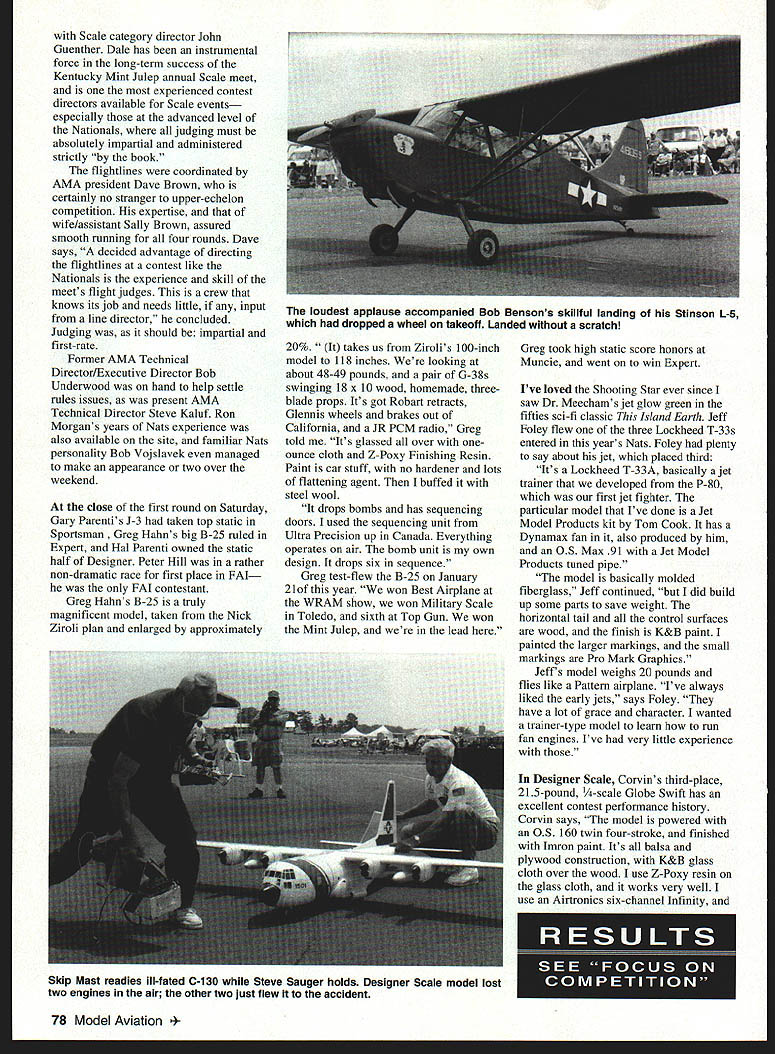
One of Saturday’s highlights was Robert Benson of Mansfield, Ohio, flying a 103-inch Quadra-powered Stinson L-5 (from Roy Vaillancourt plans). After losing a wheel on takeoff, Benson completed his flight plan. On final, with the landing gear missing, he throttled back and executed a controlled stall landing: the model slowed, touched down, rolled only a few feet, and came to a gentle halt upright and undamaged. The landing drew one of the loudest rounds of applause at the contest.
- Model finish: Super Shrink Coverite and Sherwin-Williams latex paint.
- Radio: Futaba nine-channel.
- The performance qualified Benson for the US Scale Masters.
Garland Hamilton — Turbine T-33
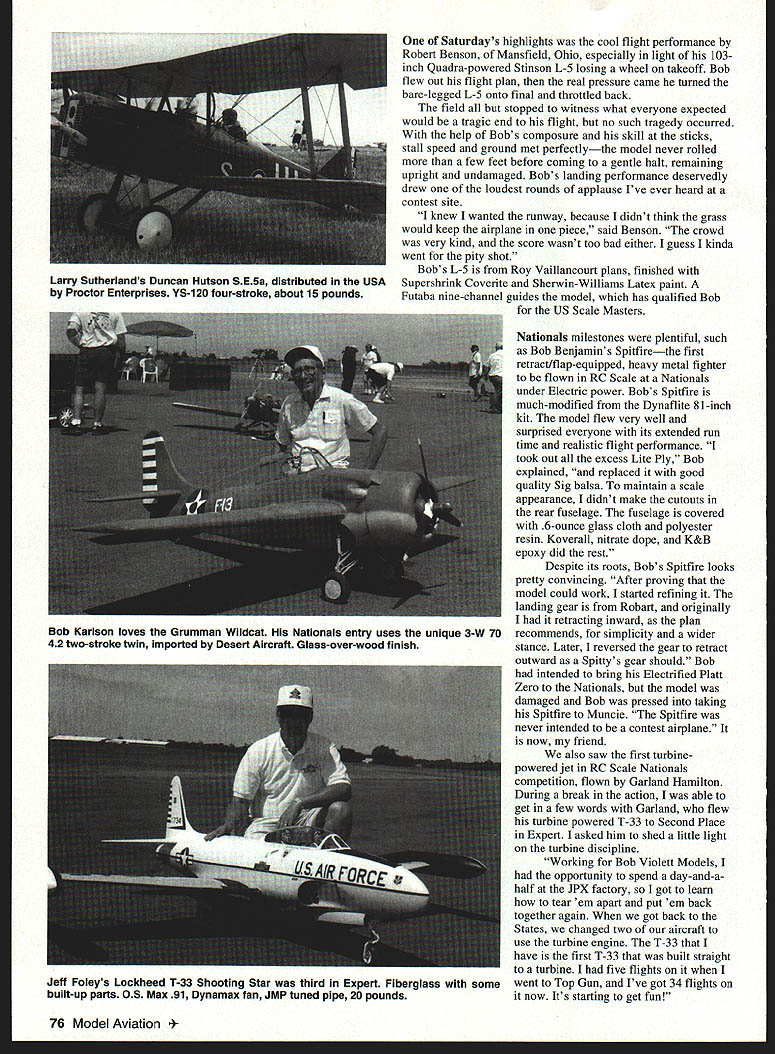
Garland Hamilton flew the first turbine-powered jet in RC Scale Nationals competition, placing Second in Expert with a turbine-powered T-33.
- Engine: JPX T-260 turbine (top end ~118,000 rpm; idle ~40,000 rpm).
- Thrust: about 0.9 pounds, reportedly producing usable thrust even at idle.
- Throttle: has a 5–7 second delay on throttle response, so in-flight throttle management is critical.
- Radio: Airtronics Infinity 10-channel (needed for fuel cutoffs, flaps, speed brakes, sequencing, and delay programming).
- Garland reported turbines can be easier to operate than ducted fans if operated responsibly with proper checklists. The turbine’s sound and performance are crowd-pleasing.
Bob Benjamin — Electric Spitfire
Bob Benjamin flew a much-modified Dynaflite 81-inch Spitfire under electric power — notable as the first retract/flap-equipped heavy metal fighter flown at the Nationals with electric power.
- Modifications: replaced excess Lite Ply with quality Sig balsa; retained a scale appearance by not making cutouts in the rear fuselage.
- Construction: fuselage covered with 6-ounce glass cloth and polyester resin; finished with Koverall, nitrate dope, and K&B epoxy.
- Landing gear: Robart retracts, modified to retract outward for scale appearance.
- Bob originally did not intend the Spitfire to be a contest airplane, but it flew convincingly with extended run time and realistic performance.
Notable Models and Winners
Winners and placings
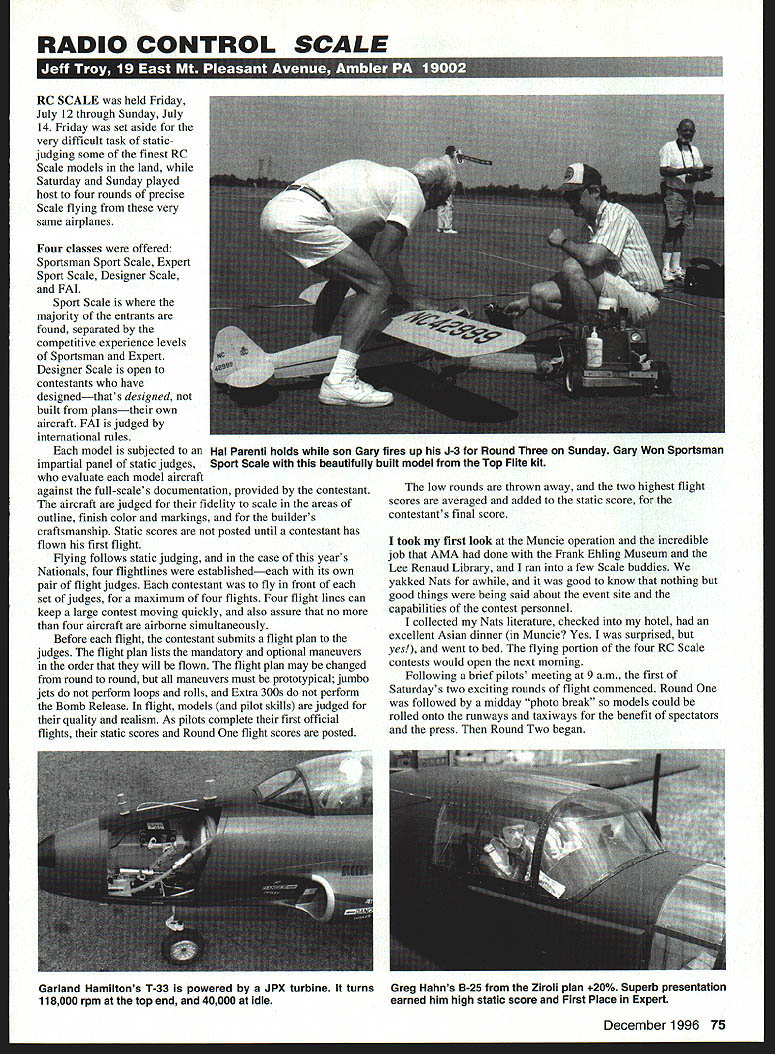
- Sportsman (Sport Scale): Gary Parenti — Top Flite J-3 (high static in Sportsman).
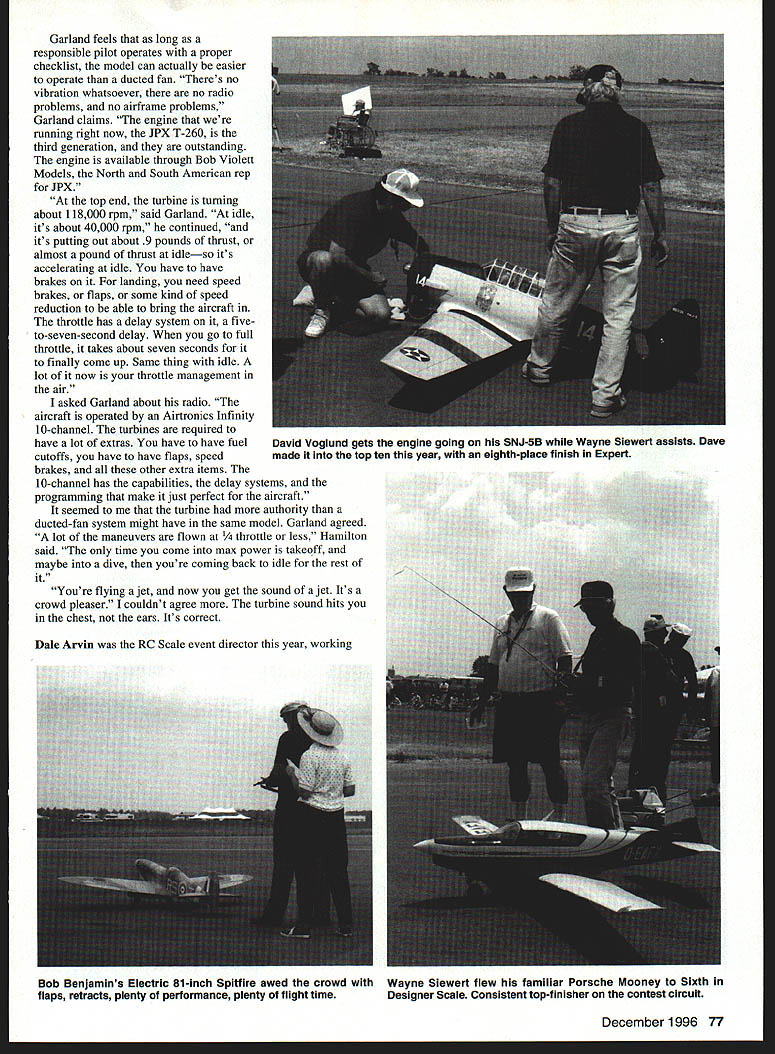
- Expert: Greg Hahn — B-25 (high static and First Place Expert).
- Designer Scale: Hal Parenti — high static in Designer (static half).
- FAI: Peter Hill — the only FAI contestant.
Greg Hahn — B-25
Greg Hahn’s B-25, built from a Nick Ziroli plan and enlarged about 20% to 118 inches, was a stunning contest winner.
- Weight: ~48–49 pounds.
- Power: twin G-33 engines with homemade 18x10 wood three-blade props.
- Hardware: Robart retracts; Glenn’s wheels and brakes; JR PCM radio.
- Finish: glassed with one-ounce cloth and Z-Poxy Finishing Resin; paint was automotive-style with flattening agent and buffed with steel wool.
- Features: bomb-release sequencing doors (sequencing unit from Ultra Precision), air-operated systems, custom bomb unit that drops six in sequence.
- Contest record: test-flown January 21; won Best Airplane at WRAM, Military Scale in Toledo, sixth at Top Gun, Mint Julep winner, and first at the Nationals.
Jeff Foley — T-33
Jeff Foley’s Lockheed T-33A placed third. Key details:
- Kit: Jet Model Products kit by Tom Cook.
- Power: Dynaflame fan and an O.S. Max .91 with a Jet Model Products tuned pipe.
- Construction: molded fiberglass with wood control surfaces; finish with K&B paint; larger markings painted, small markings by Pro Mark Graphics.
- Weight: 20 pounds; flies like a Pattern airplane.
Designer Scale — Globe Swift (Corvin)
- Model: 1/4-scale Globe Swift, 21.5 pounds.
- Power: O.S. 160 twin four-stroke.
- Construction: balsa and plywood, K&B glass cloth over wood, Z-Poxy resin, Imron paint.
- Radio: Airtronics six-channel Infinity.
- Details: rivet detail done with Sig yellow glue; full-scale plans available.
Charlie Nelson — WACO Model VKS-7F
Charlie Nelson’s WACO model is a highly detailed reproduction of a Model VKS-7F (built in 1941).
- Construction: birch ply and balsa, covered with Sig Koverall and finished with Sig dope.
- Parts: fiberglass ailerons (cast), fiberglass wheel pants and cowls, fiberglass and aluminum fairings.
- Engine: seven-cylinder Sydel ST-770 (4.1 cu in), ~4 hp at 6,000 rpm.
- Prop: 22x10 Zinger at ~6,300 rpm.
- Build time: approx. 1,600–2,000 hours.
Organization, Personnel, and Judging
- Event director: Dale Arvin (kept the event on schedule).
- Flightlines coordinated by AMA president Dave Brown, assisted by Sally Brown.
- Scale category director involvement and experienced contest directors ensured impartial, by-the-book judging.
- Rules and technical assistance: former AMA Technical Director/Executive Director Bob Underwood and AMA Technical Director Steve Kaul were on hand. Ron Morgan and Bob Vojislavek also contributed Nats experience during the weekend.
Event Atmosphere, Weather, and Closing
- The 1996 Nationals provided two days of excellent flying weather with comfortable temperatures, fair skies, and light-to-moderate winds.
- The meet was tightly organized and top-shelf in execution.
- Dave Brown indicated the Scale events would again be flown in Muncie in 1997. Start practicing now; hope to see you there.
Transcribed from original scans by AI. Minor OCR errors may remain.

