
RADIO CONTROL SCALE
Jeff Troy, 19 East Mt. Pleasant Avenue, Ambler PA 19002
Spitfire Build-Along
Last month the Dynaflite Spitfire was announced as the next build-along subject. The model and its destination, Fun Scale, are creations of RC industry icon Mark Smith. His big Spitfire was engineered like his .40-class pseudo fighters—to be built quickly and effortlessly, to fly forgivingly, and to bring modelers with little or no scale technique experience a relatively low-dollar project they could most likely succeed with. The classic Spitfire was the perfect airframe for such a project.
Mark's choice of the Spitfire was absolutely correct—few modelers can resist the airplane's graceful outline, its glorious contribution to history during the Battle of Britain, or one of the many color schemes and markings it exhibited throughout its long service life. The Spitfire is perceived by many to be the perfect airplane. Even if a modeler is not particularly a fan of WWII aircraft, it's hard not to fall victim to the Spitfire's charm.
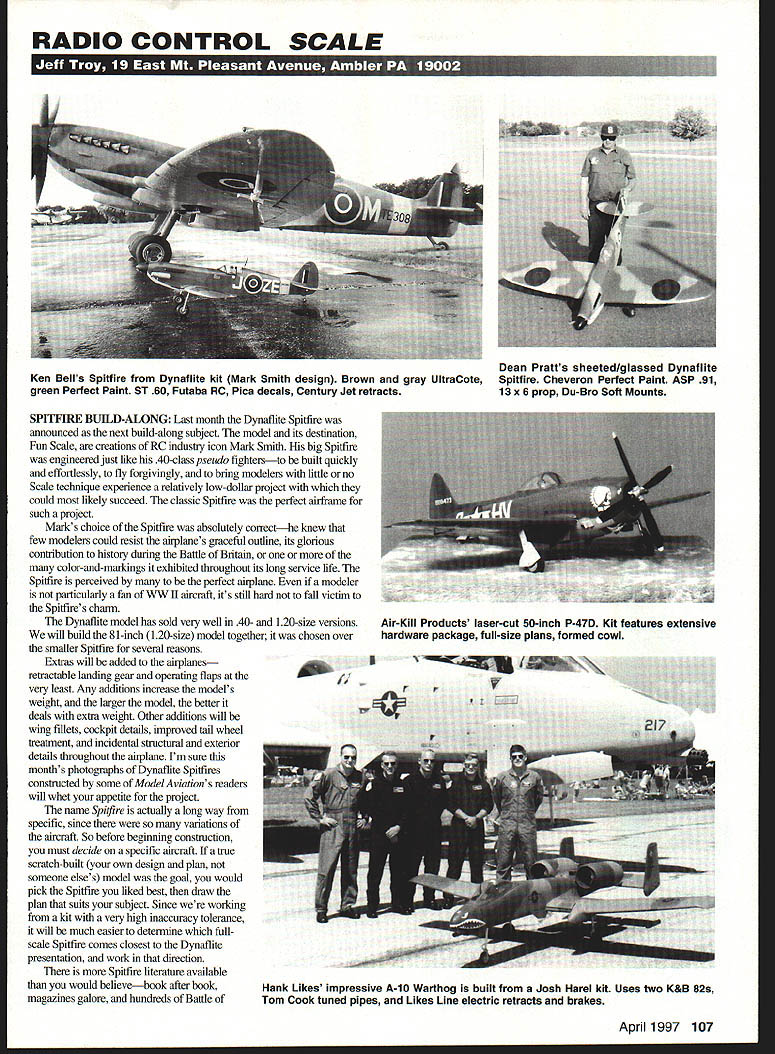
The Dynaflite model has sold very well in .40- and 1.20-size versions. We will build the 81-inch (1:20-size) model together; it was chosen over the smaller Spitfire for several reasons. Extras will be added to the airplane—retractable landing gear and operating flaps at the very least. Any additions increase the model's weight, and the larger the model, the better it deals with extra weight. Other additions will include wing fillets, cockpit details, improved tail-wheel treatment, and incidental structural and exterior details throughout the airplane. I’m sure this month's photographs of Dynaflite Spitfires constructed by some of Model Aviation's readers will whet your appetite for the project.
Plenty of Spitfire variations exist, so before beginning construction you must decide on a specific aircraft. If scratch-building your own design were the goal, you would pick the Spitfire you liked best and draw plans to suit that subject. Since we're working from a kit with a fairly high inaccuracy tolerance, it's much easier to determine which full-scale Spitfire comes closest to the Dynaflite presentation and work in that direction.
Documentation should be reasonably priced and readily available. Out-of-print references are not necessary, and no one needs to spend hundreds of hours and hundreds of dollars documenting a Fun Scale project more accurately than the finished model can reflect. We want some surface detail, but we’re not looking for a precise rivet count—just a few bells in the cockpit and simple details such as rudder pedals and a basic gunsight.
Squadron/Signal Publications' Aircraft #39, Spitfire in Action (publication #1039), written by Jerry Scutts and illustrated by Don Greer and Rob Stern, offers perfect low-cost documentation. This softcover book is less than $10 retail and is available through most hobby outlets. Using Spitfire in Action as a reference will help you understand what the Dynaflite kit represents. According to the drawings on pages 6, 8 and 25, Mark Smith's design incorporates the rounded rudder top of Mk I through early Mk VIII airplanes. Many Mk IX Spitfires, and almost all later variants, carried the higher, more pointed rudder top. Some Mk IX aircraft carried the rounded rudder top, but a closer look at the Mk IX reveals a much longer dorsal fin than the Mk V. A quick check of the model plan shows that the kit's nose resembles the Mk V's more than the Mk IX's.
The only ABS parts the Dynaflite kit has are dummy exhausts. Each exhaust carries six stacks per side rather than the three per side on earlier Spitfires. For the simplistic purpose of build-along features, rudder shape, nose length, and the exhaust configuration place Mark's design somewhere between the Mk Vb and the Mk VIII.
From there, it's a matter of picking an airplane with a color scheme that suits your fancy. The Spitfire I've selected will use the three-view found on page 18 of Spitfire in Action. Construction will start next month, so order your kits and documentation now. In the meantime, a small challenge would be to find a few good color schemes for Mk Vb Spitfires with six stacks per side. I'd like to see something with invasion stripes in tan and green.
- Planned extras: retractable landing gear, operating flaps, wing fillets, cockpit details, improved tail-wheel treatment
Manufacturers' News
Hank Likes, owner of the Likes Line of electrically operated jack‑screw‑type retracting landing gear, sent a photo of his A‑10 Thunderbolt II Warthog. The photo was taken at the Confederate Air Force Air Show in Frederick, Maryland, on August 29. Hank's Warthog is from a Josh Harel kit. Drop Hank a line for his latest catalog, where you'll find electric gear and struts able to handle most .90–1.20 through .36‑scale models. Send a courtesy buck to the Likes Line, 1601 Airport Drive, Mechanicsburg PA 17055.
Air‑Kill Products' short‑kit P‑47D Thunderbolt has finally been released in a full laser‑cut kit. Spanning 50 inches, the Air‑Kill kit is very stable at low speeds and includes a full set of hardware, down to the wheels and engine mount. The model is intended for .35–.45 two‑strokes or .45–.60 four‑strokes. For more information, send your courtesy buck to Air‑Kill Products, 14 Shady Lake Ct., Sacramento CA 95834.
Modelers' Projects
John Dedon sent a photo of his lovely little British scout. His S.E.5a is scratch‑built from plans he based on Wylam and other British drawings. The model spans 60 inches and carries a Saito 80 four‑stroke, an 18 x 6 Master Airscrew prop, and Williams Bros. five‑inch‑diameter vintage wheels.
Between preparation for the year‑end holidays and planning for our California trip to the IMS and Endless Horizons shows in January, December has been a rather busy month for me. I hope all of you enjoyed your holiday.
Until next time, build straight and fly safely.
Transcribed from original scans by AI. Minor OCR errors may remain.

