
RADIO CONTROL: SCALE
Jeff Troy, 19 East Mt. Pleasant Avenue, Ambler, PA 19002
SPITFIRE BUILD-ALONG
If you haven't purchased your Dynaflite Spitfire kit yet but are planning to join me in the build-along, there's good news. Great Planes purchased Dynaflite last year, and one of the first improvements made to Mark Smith's excellent 81-inch Spitfire was a quality construction manual. The original typed and photocopied pages are replaced by 16 pages of clearly written step-by-step instructions and detailed CAD-drawn illustrations.
I intended to begin construction of the Spitfire's fuselage in time for this month's installment, but after examining the Great Planes kit I felt it would be more prudent to see what changes have been made—especially since so many more of you will be working from the new kit than from the original. If you are building the original Dynaflite model, there is nothing to worry about; nothing in the Great Planes version renders the original obsolete. A large number of fine Spitfires have been built from the Dynaflite kit.
Improvements have been made, but little has been done to the design. Great Planes' wood appears to be better, but we're model builders—one or two good swipes with sandpaper can easily cure much of the "bad" wood. There is no truly bad wood in the original, but most of it isn't the same top quality found in the newer version.
The plans appear mostly unchanged, except that they have been printed crisply in black ink; the originals were in blue ink and were not as easily read. The new manual includes check-boxes that correspond with each procedure, allowing you to keep an accurate account of your progress and waste no time in getting back to the bench.
On page 14 in the manual, builders are alerted to one of the new kit's simplest and most thoughtful additions: a template sheet for the roundels and fuselage numerals is provided in the kit. I emptied the box, but I could not find my template. After years of getting in the shortest lines (that take the longest time), and having a $20 fall out of my pocket if I reach down to pick up a quarter, I describe this sort of thing as "getting it right for 30,000 people, but waiting for the right person (me) to get the goofball." I've come to accept these inconveniences as natural and I expect them. By the time you read this, I'm sure the template sheet will be here.
Great Planes still includes the wood and the instruction for the original design's beam-mounting system for the engine, but Great Planes' adjustable engine mount (GPMQ1091) is also recommended. Other suggested options are Robart's pneumatic retracts (606HD 85°) and a list of Robart accessories needed to actuate the gear. The build-along project will feature the installation modifications required for these superbly crafted retracts. It will have the retracting gear outward in Spitfire fashion rather than inward as shown on the plans, thanks to information from my friend Bob Benjamin.
The Spitfire is a fun Scale project, and it was never intended to get to Top Gun. Even with corrections and modifications, the model will still be far from a true-to-scale replication. It will, however, give the modeler who may be needlessly intimidated by Scale models (and Scale modelers) a chance to experience the satisfaction of getting involved in Scale one or two steps above entry level. If you have built a few models and have always wanted to try Scale but never felt you had what it takes, this project is for you.
You're going to receive a great deal of useful information, and you may like some or all of it. Either way, you will be exposed to techniques that may be different from your own—that's always interesting.
I've completed the construction of my Spitfire's tail feathers from the original Dynaflite kit. In my next installment, I will resume the project using the Great Planes model.
DOCU-SEARCH
There are no requests in the Docu-Search in-basket right now, but there is still a piece of interesting information. Noted designer, writer, and friend Jim Newman dropped me a line in February; he noticed that many Docu-Search inquiries seem to be for color-and-markings information.
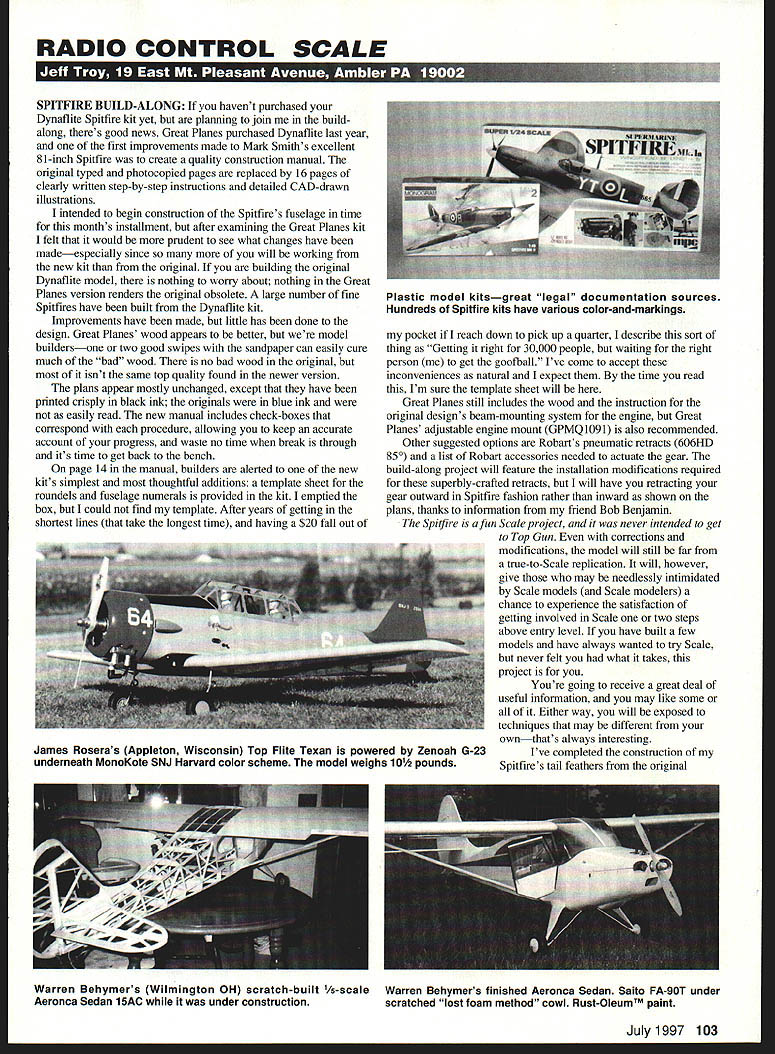
Jim suggested that I mention the use of plastic model kits as a documentation source since most of them include a wealth of information on color-and-markings, etc. The better kits provide intricate decal sheets, many of which are complete down to the cockpit placards and "no step" callouts.
Plastic model kits are recognized in the AMA rule book as proper "legal" documentation. If a three-view is unavailable, or if you prefer to offer the judges the three-dimensional visual advantages of a model kit, AMA Scale contest judges will accept such a presentation.
Plastic kits on almost every aviation subject can be found through sources such as Fine Scale Modeler, an excellent monthly magazine published by Kalmbach Publishing Co., or in various issues of the Squadron Shop mail-order catalog; you can phone Squadron at (214) 242-8663.
WRAM SHOW
Okay, so I live in Pennsylvania—I'm still a native New Yorker and I never feel quite right until I go back to hang with the WRAM (Westchester Radio Aero Modelers) guys each year. The 1997 show drew even larger crowds than usual, and exhibitors displayed several new products.
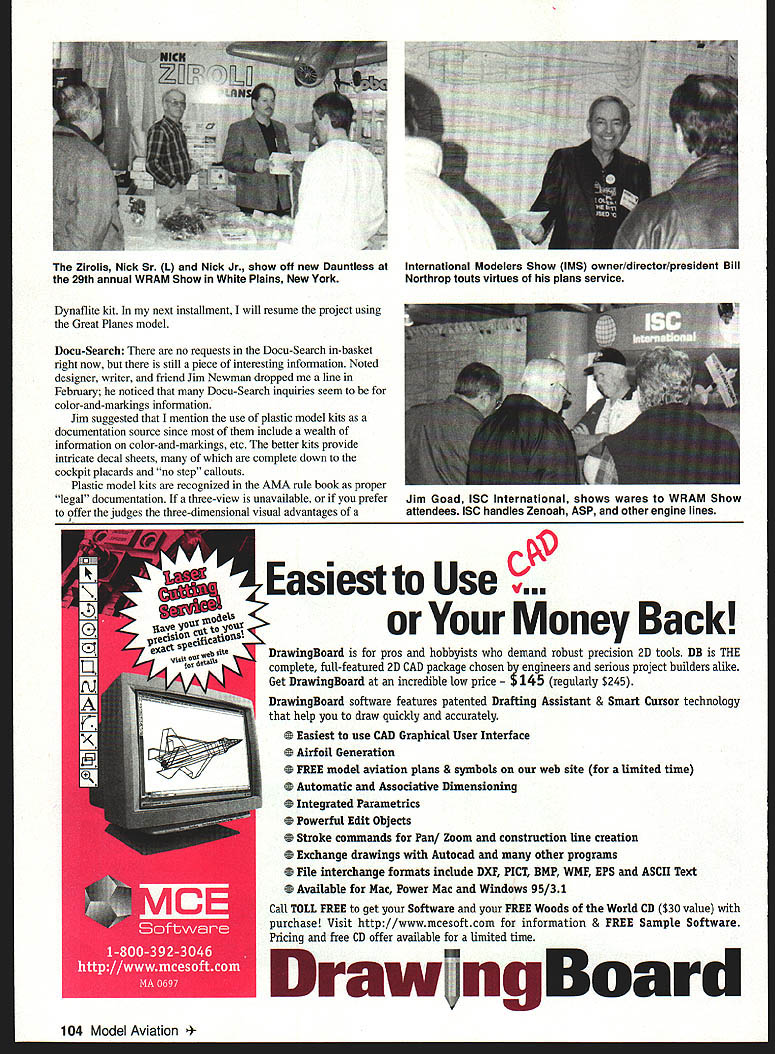
Nick Ziroli Sr. and Nick Ziroli Jr. unveiled their new large-scale Dauntless. I cornered "Sr." to get some particulars, but he designs so prolifically that he drew a blank on the model's specifications. Keep checking the column; I'll try to have the information as soon as it's available.
Bill Northrop showed off the many new additions to his plans service. There was an enticing P-38 spanning about 90 inches, if my memory serves me well, taped to the backdrop drape. Bill seemed happy to be attending someone else's show, taking a welcome break from the pressures of his own, the famous IMS (International Modeler Show) in Pasadena, California.
The WRAM Show grows each year, attracting a growing number of exhibitors. This year was the 29th, and I'm sure the 30th will be bigger and better than ever.
INDUSTRY NEWS
The US Scale team qualifications will be at the National Aeromodeling Center at Muncie, Indiana, July 7–9. The dates should be convenient for most Federation Aeronautique Internationale (FAI) F4C Scale hopefuls; the trials are during the National Aeromodelling Championships (Nats) at the AMA site. For more team trials information, contact John Guenther at 21609 Borden-Greenville Rd., Borden, IN 47106.
MODELERS' PROJECTS
James Rosera of Appleton, Wisconsin, sent photos of his Top Flite Texan, covered with MonoKote in an SNJ Harvard scheme. The airplane uses Spring Air retracts and is powered by a Zenoah G-23. At 10+ pounds, Jim claims that the airplane's performance is terrific—looking and sounding "like the real thing in the air." He said that it turned out to be a very worthwhile Scale project.
Warren Behymer is a prolific model builder from Wilmington, Ohio, and he recently sent photographs of his work. Under-construction and completed shots of his Aeronca Sedan 15AC show all of the care and talent he used to create the 1/5-scale aircraft. Powered by a Saito FA-90 twin, the scratchbuilt model is painted with Rust-Oleum. Warren says that the Aeronca flies very nicely.
Until next month, build straight and fly safely.
Transcribed from original scans by AI. Minor OCR errors may remain.

