
Radio Control: Scale
Bob and Dolly Wischer
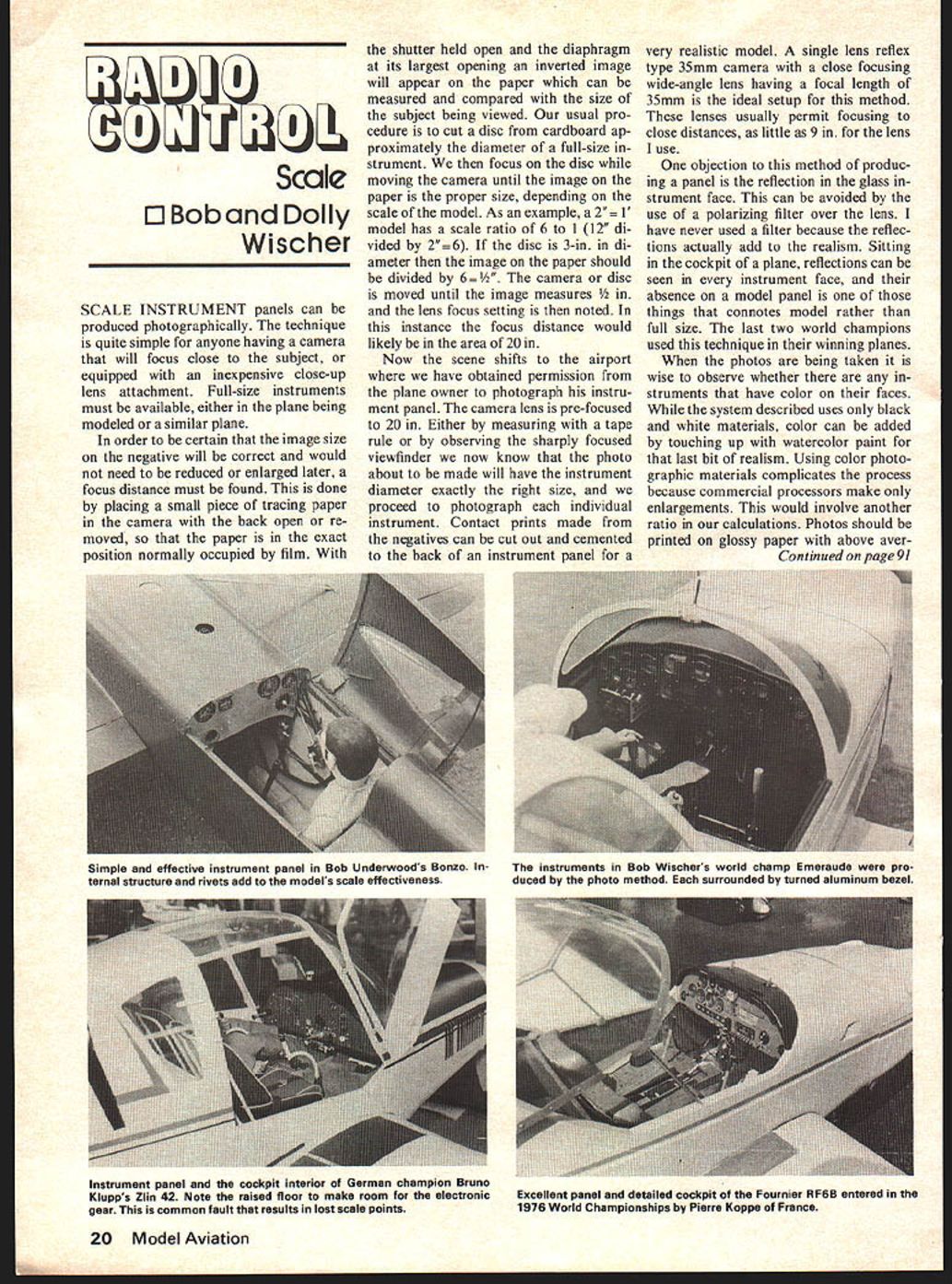
SCALE INSTRUMENT panels can be produced photographically. The technique is quite simple for anyone having a camera that will focus close to the subject, or equipped with an inexpensive close-up lens attachment. Full-size instruments must be available, either in the plane being modeled or a similar plane.
In order to be certain that the image size on the negative will be correct and would not need to be reduced or enlarged later, a focus distance must be found. This is done by placing a small piece of tracing paper in the camera with the back open or removed, so that the paper is in the exact position normally occupied by film. With the shutter held open and the diaphragm at its largest opening an inverted image will appear on the paper which can be measured and compared with the size of the subject being viewed. Our usual procedure is to cut a disc from cardboard approximately the diameter of a full-size instrument. We then focus on the disc while moving the camera until the image on the paper is the proper size, depending on the scale of the model. As an example, a 2" = 1' model has a scale ratio of 6 to 1 (12" divided by 2" = 6). If the disc is 3-in. in diameter then the image on the paper should be divided by 6 = 1/2". The camera or disc is moved until the image measures 1/2 in. and the lens focus setting is then noted. In this instance the focus distance would likely be in the area of 20 in.
Now the scene shifts to the airport where we have obtained permission from the plane owner to photograph his instrument panel. The camera lens is pre-focused to 20 in. Either by measuring with a tape rule or by observing the sharply focused viewfinder we now know that the photo about to be made will have the instrument diameter exactly the right size, and we proceed to photograph each individual instrument. Contact prints made from the negatives can be cut out and cemented to the back of an instrument panel for a very realistic model. A single lens reflex type 35mm camera with a close focusing wide-angle lens having a focal length of 35mm is the ideal setup for this method. These lenses usually permit focusing to close distances, as little as 9 in. for the lens I use.
One objection to this method of producing a panel is the reflection in the glass instrument face. This can be avoided by the use of a polarizing filter over the lens. I have never used a filter because the reflections actually add to the realism. Sitting in the cockpit of a plane, reflections can be seen in every instrument face, and their absence on a model panel is one of those things that connotes model rather than full size. The last two world champions used this technique in their winning planes.
When the photos are being taken it is wise to observe whether there are any instruments that have color on their faces. While the system described uses only black and white materials, color can be added by touching up with watercolor paint for that last bit of realism. Using color photographic materials complicates the process because commercial processors make only enlargements. This would involve another ratio in our calculations. image contrast for a maximum effectiveness. The usual clear plastic face over the instrument can then be omitted.
There are many things on panels other than instruments and photos are very useful also for data on precise locations and sizes of such things as knobs and switches. They can be photographed at the same focus setting as used for the instruments. Measurements taken from the photos will assure that each detail is the proper size. Nothing destroys scale effectiveness like switches that are obviously over or under size.
Choosing a subject: In selecting a subject the scale modeler is faced with important decisions. A trainer built from a kit can be constructed in a short time and will bring almost certain success. Chances of success for the experienced flier with a kit-built scale model are also good, and even better with a wise selection of subject. The best subjects are those that are simple in form and not too heavily loaded with surface detail. Also avoid subjects with a lot of compound curves or complex canopies. The subject should present an attractive silhouette and be one that you will enjoy building and flying. scratch builder, who is likely to be a contest flier, has a wide open choice. When someone builds and flies the Gee Bee Super Sportster it indicates that he is a top pilot and the same would be true of most multi-engine planes. The other extreme is a light plane such as the Piper Cub which places little demand on pilot ability. For contest work the element of apparent pilot ability is most important since judges will not believe him competent if his choice of subject makes him look bad.
Those planes with a long tail moment and slender, lightweight fuselage are most likely to possess the stability for smooth, effortless flight. The worst combination would be a short tail fuselage with small tail surfaces. The Gee Bee and other classic racing planes were examples of this type in which an approach to a stall usually ends in disaster. Takeoff and landing characteristics are such that only the most highly skilled pilots can expect success. Extreme opposites are World War I Sopwiths and Bristols whose monstrous stabilizers afford the greatest possible stability. My Sopwith 1½ Strutter has a stabilizer so large that it has never been possible to make a three-point landing, even with full up elevator, due to ground-cushion effect. The prototype aircraft had the same problem, partially solved by the use of barn-door flaps in the lower wing. As models these planes have the gentle and docile flight habits that make them a real pleasure to fly, particularly at slow speed where too many scale models exhibit their vicious natures.
There is a recent trend toward larger models, and while there are disadvantages due to higher cost and transportation difficulties, it has been my observation that these planes are more easily capable of scale-like flight. With the introduction of the new prop drive units, lack of power is no longer a reason not to build a larger model. The available kits in the large sizes begin to look more attractive and our choice of subject is widened considerably.
A sport-scale model can be expected to take twice the time required for a sport plane and a full-scale type five to ten times as long. Choosing a subject that has abundant information available decreases the research burden and thereby increases the chance of successful completion. The heavy investment in construction time means that selection of a subject should not be taken lightly.
An effort is being made to form a national scale organization similar to those formed by pattern, pylon, soaring and many other groups, working with the AMA. The purpose of the group is to provide technical help in areas such as subject selection, documentation, construction, competition, rules, material listings, evaluations, and aid in the team selection process. Interested scale modelers, whether they are free flight, control line or radio control should write to Bob Underwood, 4109 Concord Oaks Dr., St. Louis, Mo. 63128.
Transcribed from original scans by AI. Minor OCR errors may remain.

