
Radio Control: Scale
Jeff Troy 19 East Mt. Pleasant Avenue, Ambler PA 19002
RC Scale Modeling at the IMS
RC Scale Modeling at the International Modelers Show (IMS), run by Bill and Anita Northrop, has the distinction of being the industry's first show of the year; this one was held January 9–11. The weather helped encourage exhibitors and buyers to make the trip to the Pasadena Center in sunny Pasadena, California.
Primarily an aircraft show, IMS featured an excellent mix of RC, Control Line (CL), and Free Flight (FF) products. A selection of new and traditional RC Scale models and accessories made the trip especially enjoyable.
In previous years, a scheduling conflict between the IMS and the Endless Horizons Show in Long Beach caused both events to draw less-than-outstanding attendance. Manufacturers, distributors, and modelers were forced to choose where to exhibit and where to attend. This year the conflict was resolved and IMS drew a nice crowd.
The central area of the huge Pasadena Center hall was left open for numerous daily flying exhibitions capably conducted by Tony Naccarato and several members of the Black Sheep Squadron model airplane club. Demonstrations included entertaining indoor in-flight displays of everything from RC blimps to rubber-powered Free Flight models—even an RC electric Bleriot II, a Hobby Lobby International import monoplane that has received much attention from the electric scale-for-fun crowd.
Exhibitors' booths included many aircraft products, such as kits, ARFs (Almost Ready-to-Fly), ARCs (Almost Ready-to-Cover), tools, engines, radios, and more. Many of the scale-related goodies are included in the accompanying IMS pictorial.
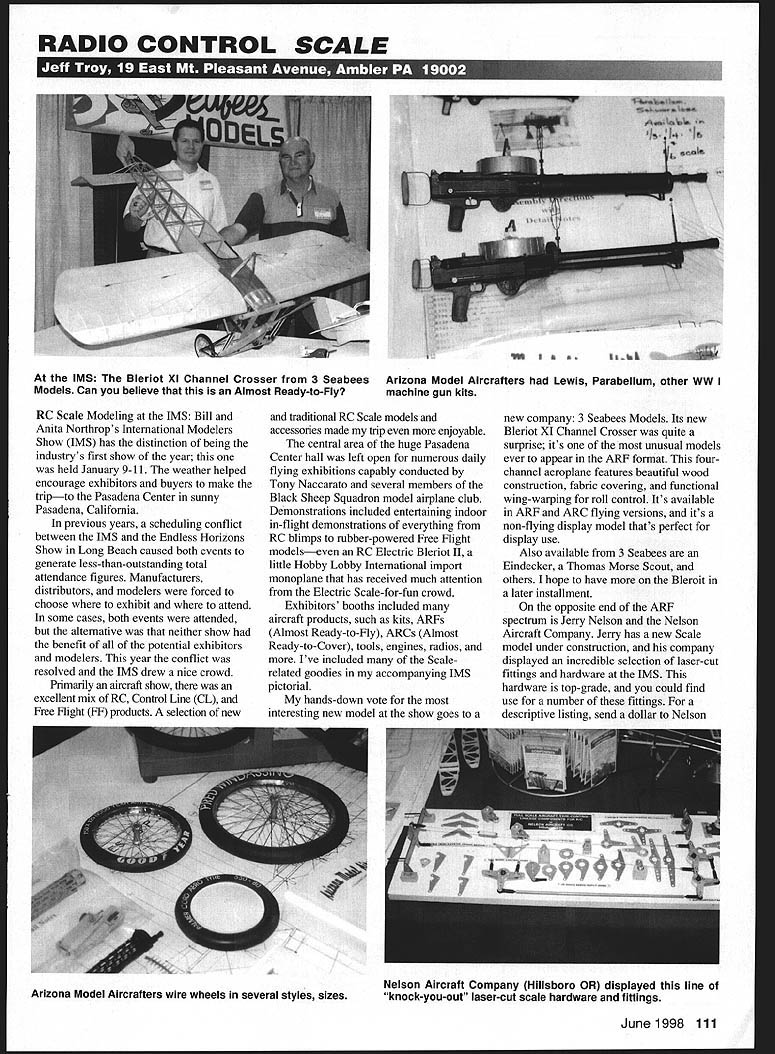
My hands-down vote for the most interesting new model at the show goes to a new company: 3 Seabees Models. Its new Bleriot XI Channel Crosser was a surprise; it's one of the most unusual models ever to appear in the ARF format. This four-channel aeroplane features beautiful wood construction, fabric covering, and functional wing-warping for roll control. It's available in ARF and ARC flying versions; a non-flying display model is also offered for display use.
Also available from 3 Seabees are an Eindecker, a Thomas Morse Scout, and others. I hope to have more on the Bleriot in a later installment.
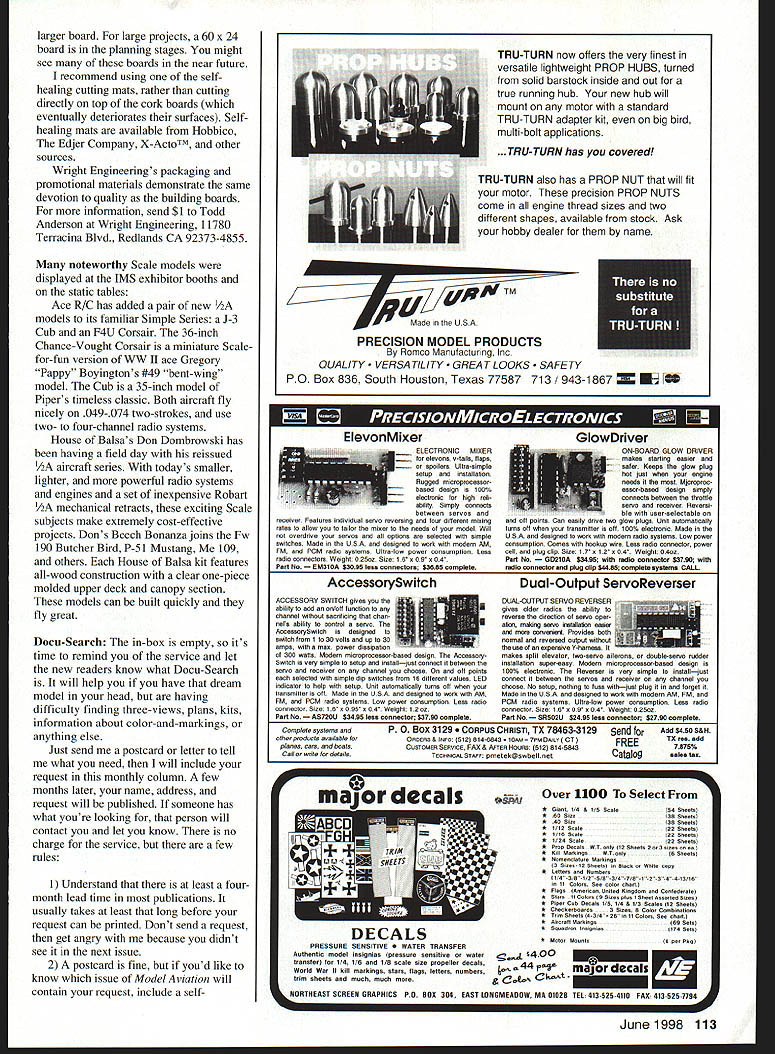
On the opposite end of the ARF spectrum is Jerry Nelson and the Nelson Aircraft Company. Jerry has a new scale model under construction, and his company displayed an incredible selection of laser-cut fittings and hardware at the IMS. This hardware is top-grade, and many builders will find uses for the fittings. For a descriptive listing, send $1 to: Nelson Aircraft Company 21550 NW Nicholas Court Unit D Hillsboro, OR 97124
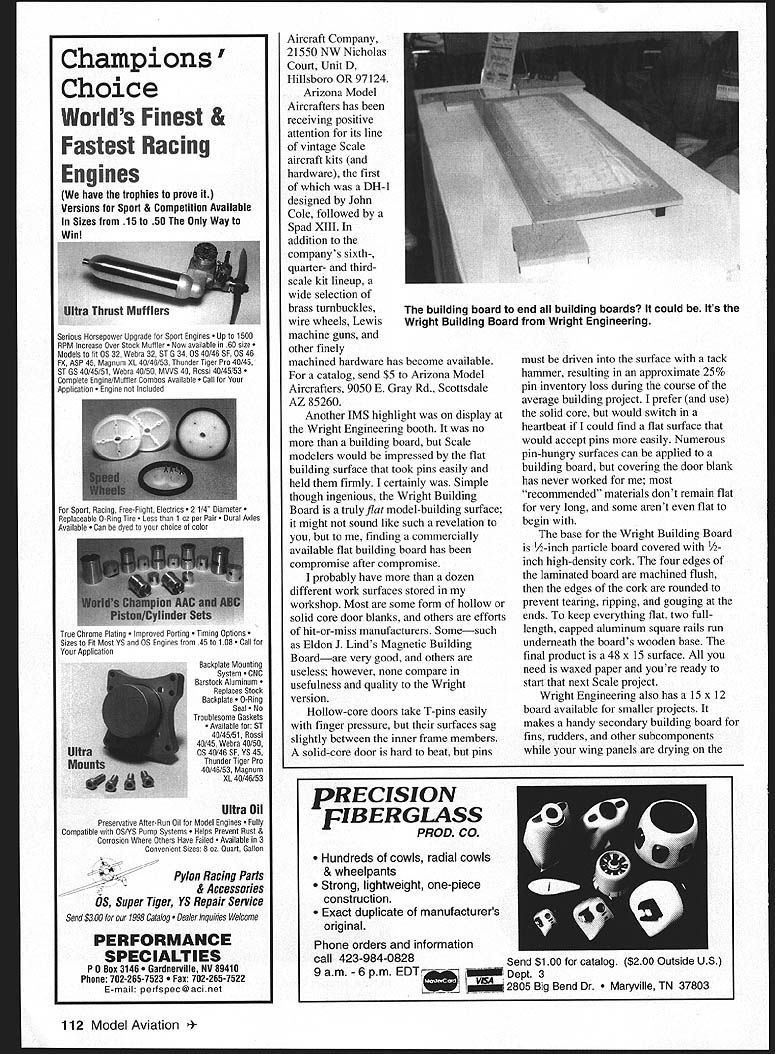
Arizona Model Aircrafters has been receiving positive attention for its line of vintage scale aircraft kits (and hardware), beginning with a DH-1 designed by John Cole, followed by a Spad XIII. In addition to the company's sixth-, quarter-, and third-scale kit lineup, a wide selection of brass turnbuckles, wire wheels, Lewis machine guns, and other finely machined hardware has become available. For a catalog, send $5 to: Arizona Model Aircrafters 9050 E. Gray Rd. Scottsdale, AZ 85260
Wright Building Board
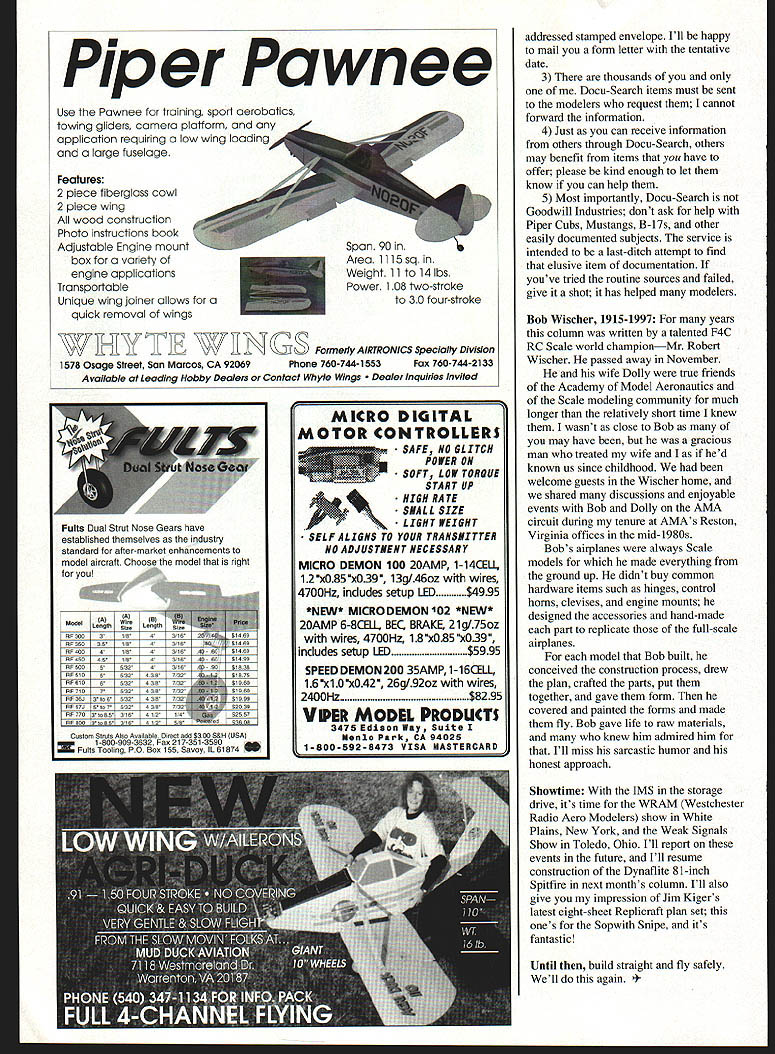
Another IMS highlight was on display at the Wright Engineering booth. It was no more than a building board, but scale modelers will be impressed by the flat building surface that takes pins easily and holds them firmly. Simple though ingenious, the Wright Building Board is a truly flat model-building surface—a welcome find after years of compromise.
I've tried more than a dozen different work surfaces. Most are some form of hollow- or solid-core door blanks; others are commercial efforts of hit-or-miss usefulness. Some—such as Eldon J. Lind's Magnetic Building Board—are very good, and others are useless; however, none compare in usefulness and quality to the Wright version.
Hollow-core doors accept T-pins easily with finger pressure, but their surfaces sag slightly between the inner frame members. A solid-core door is hard to beat for flatness, but pins must be driven with a tack hammer, resulting in an approximate 25% pin loss during the course of an average building project. I prefer (and use) the solid core, but would switch in a heartbeat if I could find a flat surface that accepted pins more easily. Covering a door blank has never worked well for me; most recommended materials don't remain flat for long, and some aren't even flat to begin with.
The base for the Wright Building Board is a 1/2-inch particle board covered with 1/2-inch high-density cork. The four edges of the laminated board are machined flush, then the edges of the cork are rounded to prevent tearing, ripping, and gouging. To keep everything flat, two full-length capped aluminum square rails run underneath the board's wooden base. The final product is a 48 x 15-inch surface. All you need is waxed paper and you're ready to start that next scale project.
Wright Engineering also offers a 15 x 12-inch board for smaller projects. It makes a handy secondary building board for fins, rudders, and other subcomponents while your wing panels dry on the main board.
Noteworthy Scale Models at the IMS
Many noteworthy scale models were displayed at exhibitor booths and on the static tables.
- Ace R/C has added a pair of new 1/2A models to its familiar Simple Series: a J-3 Cub and an F4U Corsair. The 36-inch Chance-Vought Corsair is a miniature scale-for-fun version of WWII ace Gregory "Pappy" Boyington's #49 "bent-wing" model. The Cub is a 35-inch model of Piper's classic J-3. Both aircraft fly nicely on .049–.074 two-strokes and use two- to four-channel radio systems.
- House of Balsa's Don Dombrowski has been reissuing a popular 1/2A trainer series. With today's smaller, lighter, and more powerful radio systems and engines, plus inexpensive Robart 1/2A mechanical retracts, these scale subjects make extremely cost-effective projects. Don's Beech Bonanza joins the Fw 190 Butcher Bird, P-51 Mustang, Me 109, and others. Each House of Balsa kit features all-wood construction with a clear one-piece molded upper deck and canopy section. These models can be built quickly and fly great.
Docu-Search
Docu-Search is a service to help if you have that dream model in your head but are having difficulty finding three-views, plans, kits, color-and-markings information, or anything else.
Send me a postcard or letter telling me what you need, and I will include your request in this monthly column. A few months later, your name, address, and request will be published. If someone has what you're looking for, that person will contact you. There is no charge for the service, but there are a few rules:
- Understand that there is at least a four-month lead time in most publications. It usually takes at least that long before your request can be printed. Don't send a request and then get angry because you don't see it in the next issue.
- A postcard is fine, but if you'd like to know which issue of Model Aviation will contain your request, include a self-addressed, stamped envelope. I'll be happy to mail you a form letter with the tentative date.
- There are thousands of you and only one of me. Docu-Search items must be sent to the modelers who request them; I cannot forward the information.
- Just as you can receive information from others through Docu-Search, others may benefit from items that you have to offer; please be kind enough to let them know if you can help.
- Most importantly, Docu-Search is not Goodwill Industries; don't ask for help with Piper Cubs, Mustangs, B-17s, and other easily documented subjects. The service is intended as a last-ditch attempt to find that elusive item of documentation. If you've tried the routine sources and failed, give it a shot; it has helped many modelers.
Send Docu-Search requests to: Jeff Troy 19 East Mt. Pleasant Avenue Ambler, PA 19002
Bob Wischer, 1915–1997
For many years this column was written by a talented F4C RC Scale world champion—Mr. Robert Wischer. He passed away in November.
He and his wife Dolly were true friends of the Academy of Model Aeronautics and of the scale modeling community for much longer than the relatively short time I knew them. I wasn't as close to Bob as many of you may have been, but he was a gracious man who treated my wife and me as if he'd known us since childhood. We had been welcome guests in the Wischer home, and we shared many discussions and enjoyable times with Bob and Dolly on the AMA circuit during my tenure at AMA's Reston, Virginia, offices in the mid-1980s.
Bob's airplanes were always scale models for which he made everything from the ground up. He didn't buy common hardware items such as hinges, control horns, clevises, and engine mounts; he designed the accessories and hand-made each part to replicate those of the full-scale airplanes.
For each model Bob built, he conceived the construction process, drew the plan, crafted the parts, assembled them, and finished the model. Bob gave life to raw materials, and many who knew him admired him for that. I'll miss his sarcastic humor and his honest approach.
Showtime
With IMS behind us, it's time for the WRAM (Westchester Radio Aero Modelers) show in White Plains, New York, and the Weak Signals Show in Toledo, Ohio. I'll report on these events in the future, and I'll resume coverage of the Dynaflite 98-inch Spitfire in next month's column. I'll also give my impressions of Jim Kiger's latest eight-sheet ReplicaJet plan set for the Sopwith Snipe—it's fantastic!
Until then, build straight and fly safely. We'll do this again.
Transcribed from original scans by AI. Minor OCR errors may remain.

