

RADIO CONTROL SCALE
Byline
Jeff Troy, 19 East Mt. Pleasant Avenue, Ambler PA 19002
Toledo R/C Expo
It was everything you'd expect—and more. The Weak Signals' 44th annual R/C Expo—commonly referred to by modelers as "the Toledo show"—took place April 2–5 at the SeaGate Center in downtown Toledo, Ohio.
It's the Radio Control (RC) airplane person's mecca, where modelers from around the world flock each year. Attendees renew acquaintances and see the latest products and innovations that the hobby has to offer. They can get great deals in the swap shop, at the Saturday auction, or from the hundreds of incredible manufacturer exhibits on the show floor.
As a bonus, patrons get an up-close look at some of the most magnificently crafted model airplanes they might ever see. Toledo's static tables are second to none. In each category—not only Scale—admirers could spend hours scrutinizing the painstaking detail of the models.
While looking at the airplanes and taking my photos each year, it's always somewhat of a surprise to hear a few unaware modelers comment snidely about airplanes being "hangar queens." Those modelers must not realize that it takes a long time to develop the skills needed to build models of this caliber, and that it's likely the builders' piloting skills have also developed—to the point where they are capable of competently guiding the models they've created.
True, static displays usually include a model or two that is "too pretty to fly," but at Toledo, most of the top models in the Scale categories are entered by modelers with more than adequate flying skills. People such as Greg Hahn, Terry Nitsch, Dave Platt, Graeme Mears, Mike Barbee, Keith Shaw, and Dennis Crooks don't build hangar queens; they build outrageously beautiful airplanes, then they fly them. It's simple logic—why bother to cook the food if you're not going to eat the meal?
I've collected photos of a few of this year's RC Scale entries. The static displays are usually the first of the show's attractions to catch a showgoer's eye, but there is also an impressive number of quality models on display in the manufacturers' exhibit booths.
Toledo's models share the spotlight with a long list of new and interesting airplane-related items, such as engines, hardware and detail accessories, tools, finishing materials, and guidance equipment. In spite of the show's three full days of floor time, it can be really tough to get it all in.
Notable models and exhibits
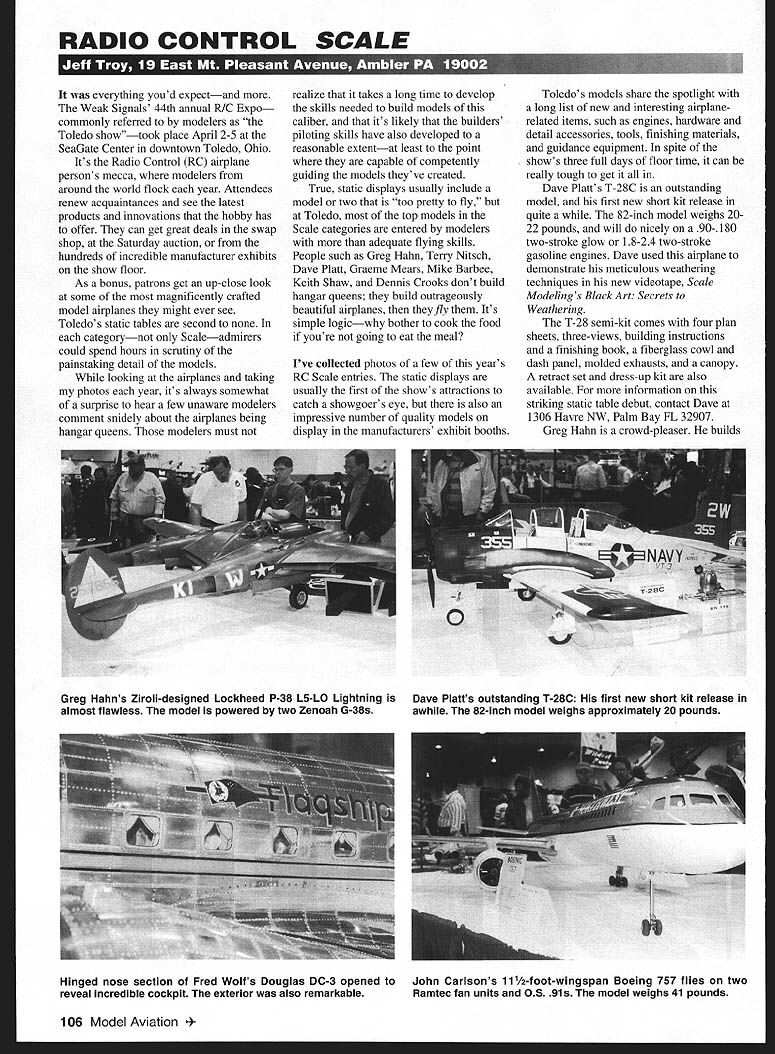
Dave Platt's T-28C is an outstanding model and his first new short-kit release in quite a while. The 82-inch model weighs approximately 20–22 pounds and will do nicely on a .90–.180 two-stroke glow or 1.8–2.4 two-stroke gasoline engine. Dave used this airplane to demonstrate meticulous weathering techniques in his videotape Scale Modeling's Black Art: Secrets to Weathering. The T-28 semi-kit comes with four plan sheets, three-views, building instructions and a finishing book, a fiberglass cowl, dash panel, molded exhausts, and a canopy. A retract set and dress-up kit are also available. For more information on this striking static table debut, contact Dave at 1306 Havre NW, Palm Bay FL 32907.
Greg Hahn is a crowd-pleaser. He builds large, highly detailed models; his display included a Ziroli-designed Lockheed P-38 L5-LO Lightning powered by two Zenoah G-38s, with Robart retract gear and Glennis wheel brakes.
Fred Wolf's Douglas DC-3 showed an incredible amount of work, with abundant attention to interior appointments as well as remarkable exterior surface detail. A hinged nose section opened to reveal the cockpit; add passenger figures, window service mechanics and an elaborately riveted surface and you've got a special attraction for the crowds.
John Carlson's 11½-foot-wingspan Boeing 757 flies on two Ramtec fan units and O.S. .91s. The model weighs 41 pounds.
Graeme Mears' Waco UPF-7 biplane, although incomplete, was a showstopper. Constructed from his own plan, it features a brazed stainless-steel fuselage. Graeme is from Toronto, Ontario, Canada.
Dave Grife's Fokker D.VII came to Toledo from Coldwater, MI. The 88-inch model is electric-powered and flies with a geared Astrolight Cobalt 60 motor. The motor's energy comes from 36 cells, and it uses AstroFlight's 3:1 Super Gearbox. The combination allows the 26 x 14 wooden propeller to be turned at 4,000 rpm.
I'll let the photos tell the rest of the story.
Docu-Search
Apparently my recent Docu-Search reminder has spurred a few of you to write for help. For those reading my column for the first time, Docu-Search is the free service of the RC Scale column. If you need something in documentation materials that has been particularly difficult to locate through commercial channels (NASA [National Association of Scale Aeromodelers], Scale Plans & Photo, Scale Model Research, etc.), drop me a letter or postcard. I'll submit your request for publication, and you'll have an audience of more than 100,000 modelers to help solve your dilemma.
This month's requests:
- James W. Kirk is looking for three-views and photographs of the radial-engined versions of the Northrop Beta (U.S., mid-1930s) and the Magni Vale (Italy, mid-1930s). If you have material on either or both of these airplanes, please contact Mr. Kirk at 15750 Chandelle Place, West Palm Beach FL 33414.
- H.W. Barclay is looking for a kit or plans for an RC Republic Seabee. Something in the 48–90 four-stroke power range would be ideal. I recall seeing ads for a kit, but I don't remember the manufacturer. If you know of anything, please contact H.W. at 6619 Boxelder Dr., Lincoln NE 68506.
If it isn't too much trouble, let me know, too. I love the Seabee and would really love to build one someday.
Next month I will have more from Toledo, including a few unusual new releases that were introduced at the exhibit booths. Please be here.
Until then, build straight and fly safely. We'll do this again.
Transcribed from original scans by AI. Minor OCR errors may remain.

