
Radio Control: Scale
Jeff Troy, 19 East Mt. Pleasant Avenue, Ambler, PA 19002
Docu-Search
- Dave Beazley is attempting to locate a set of plans for Benny Howard's Pete, a famed racer from the 1930s. Dave would prefer a quarter-scale plan, but at this point any plan would be welcome. If you know of anything, please write to Dave at Route 1, Box 3210, Palmyra, VA 22963.
- Duane Dahnert used this Docu-Search service to successfully locate documentation for the G-22 Gulfhawk, the Al Williams version of the Grumman F3F. To complete this project, Duane is still in need of a quarter-scale plan for the Gulfhawk. If you can help, contact him at 7209 Bryant Ave. S., Richfield, MN 55423.
- Wayne Terpstra wrote with an unusual request. He is interested in constructing a CB4-3 Loadmaster; he already has his three-view and the coordinate numbers, but he needs the NACA (National Advisory Committee on Aeronautics) coordinate charts or pictorials. Wayne's numbers are as follows:
- Wing root: NACA 23015-64
- Wingtip: NACA 23009-64
- Tail: NACA 23009-64
- Body: NACA 23020-64 Modified
If you can help, contact Wayne at 7729 Fairway Blvd., Miramar, FL 33023-5413.
More From Toledo
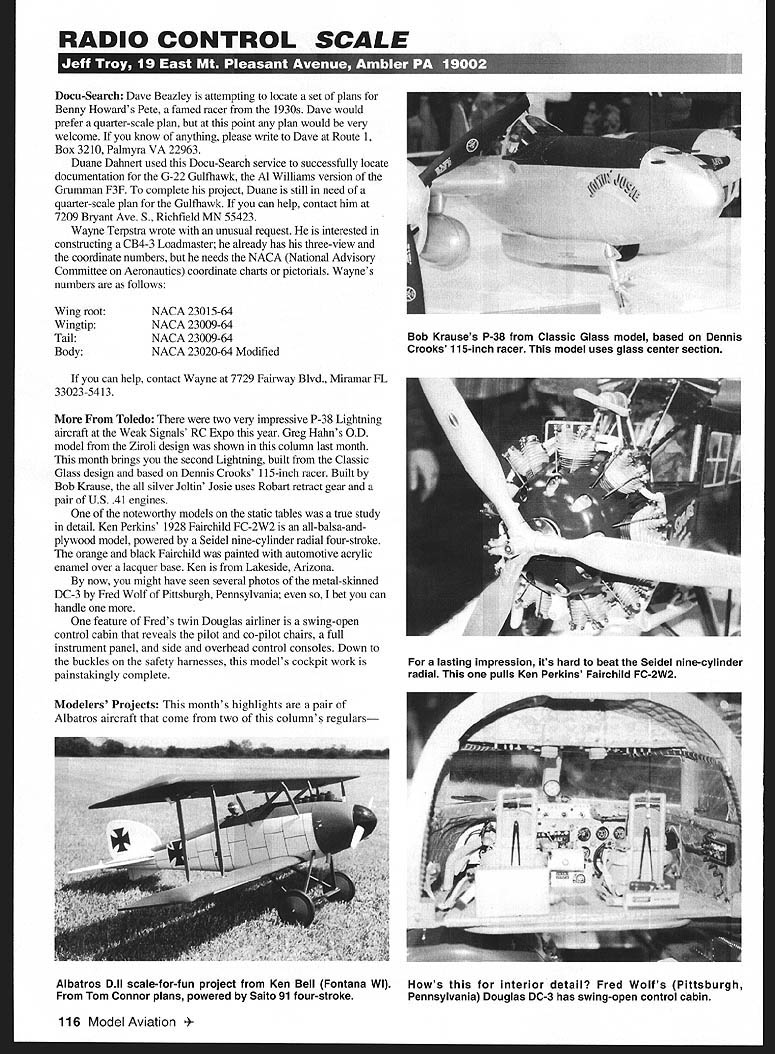
There were two very impressive P-38 Lightning aircraft at the Weak Signals' RC Expo this year. Greg Hahn's OD model from the Ziroli design was shown in this column last month. This month brings you the second Lightning, built from the Classic Glass design and based on Dennis Crooks' 115-inch racer. Built by Bob Krause, the all-silver Joltin' Josie uses Robart retract gear and a pair of U.S. .41 engines.
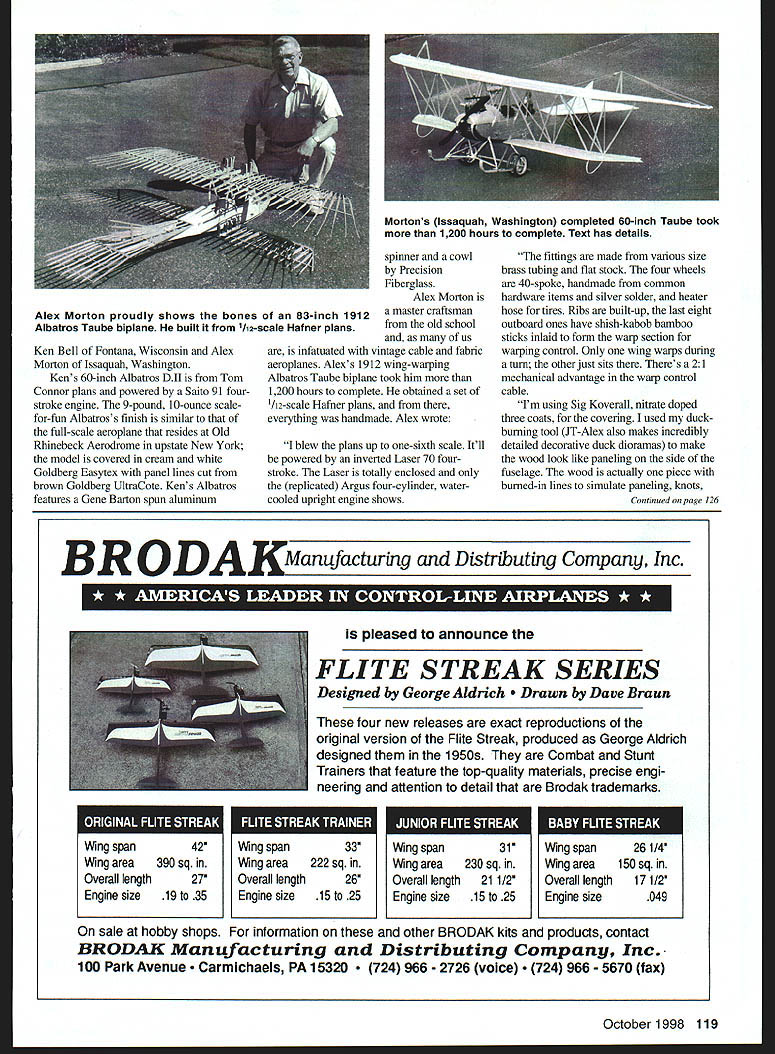
One of the noteworthy models on the static tables was a true study in detail. Ken Perkins' 1928 Fairchild FC-2W2 is an all-balsa-and-plywood model, powered by a Seidel nine-cylinder radial four-stroke. The orange-and-black Fairchild was painted with automotive acrylic enamel over a lacquer base. Ken is from Lakeside, Arizona.
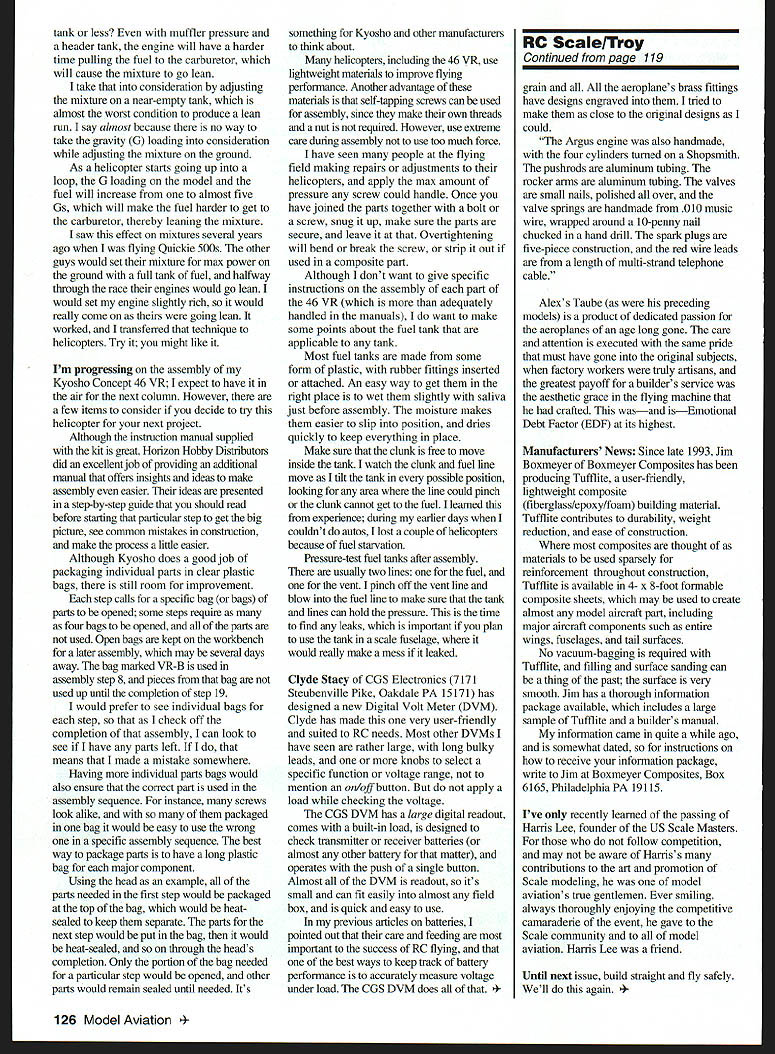
By now, you might have seen several photos of the metal-skinned DC-3 by Fred Wolf of Pittsburgh, Pennsylvania; even so, I bet you can handle one more. One feature of Fred's twin Douglas airliner is a swing-open control cabin that reveals the pilot and co-pilot chairs, a full instrument panel, and side and overhead control consoles. Down to the buckles on the safety harnesses, this model's cockpit work is painstakingly complete.
Modelers' Projects
This month's highlights are a pair of Albatros aircraft that come from two of this column's regulars—Ken Bell of Fontana, Wisconsin and Alex Morton of Issaquah, Washington.
Ken's 60-inch Albatros DII is from Tom Connor plans and powered by a Saito 91 four-stroke engine. The 9-pound, 10-ounce, scale-for-fun Albatros's finish is similar to that of the full-scale aeroplane that resides at Old Rhinebeck Aerodrome in upstate New York: the model is covered in cream and white Goldberg Easytex with panel lines cut from brown Goldberg UltraCote. Ken's Albatros features a Gene Barton spun aluminum spinner and a cowl by Precision Fibreglass.
Alex Morton is a master craftsman from the old school and, as many of us are, is infatuated with vintage cable-and-fabric aeroplanes. Alex's 1912 wing-warping Albatros Taube biplane took him more than 1,200 hours to complete. He obtained a set of 1/12-scale Hafner plans, and from there everything was handmade. Alex wrote:
"I blew the plans up to one-sixth scale. It'll be powered by an inverted Laser 70 four-stroke. The Laser is totally enclosed and only the (replicated) Argus four-cylinder, water-cooled upright engine shows.
"The fittings are made from various size brass tubing and flat stock. The four wheels are 40-spoke, handmade from common hardware items and silver solder, and heater hose for tires. Ribs are built-up; the last eight outboard ones have shish-kabob bamboo sticks inlaid to form the warp section for warping control. Only one wing warps during a turn; the other just sits there. There's a 2:1 mechanical advantage in the warp control cable.
"I'm using Sig Koverall, nitrate doped three coats, for the covering. I used my duck-burning tool to make the wood look like paneling on the side of the fuselage. The wood is actually one piece with burned-in lines to simulate paneling, knots, grain and all. All the aeroplane's brass fittings have designs engraved into them. I tried to make them as close to the original designs as I could.
"The Argus engine was also handmade, with the four cylinders turned on a Shopsmith. The pushrods are aluminum tubing. The rocker arms are aluminum tubing. The valves are small nails, polished all over, and the valve springs are handmade from .010 music wire, wrapped around a ten‑penny nail chucked in a hand drill. The spark plugs are five‑piece construction, and the red wire leads are from a length of multi‑strand telephone cable."
Alex's Taube (as were his preceding models) is a product of dedicated passion for the aeroplanes of an age long gone. The care and attention is executed with the same pride that must have gone into the original subjects, whose factory workers were truly artisans. The greatest payoff for a builder's service was the aesthetic grace in the flying machine that he had crafted. This was — and is — Emotional Debt Factor (EDF) at its highest.
Manufacturers' News
Since late 1993, Jim Boxmeyer of Boxmeyer Composites has been producing Tufflite, a user‑friendly, lightweight composite (fiberglass/epoxy/foam) building material. Tufflite contributes to durability, weight reduction, and ease of construction. Tufflite is available in 4- x 8-foot formable sheets, which may be used to create almost any model aircraft part, including major aircraft components such as entire wings, fuselages, and tail surfaces.
No vacuum‑bagging is required with Tufflite, and trimming and sanding can be a thing of the past; the surface is very smooth. Jim has a thorough information package available which includes a large sample of Tufflite and a builder's manual. For instructions on how to receive your information package, write to Jim at Boxmeyer Composites, Box 6165, Philadelphia, PA 19115.
I've only recently learned of the passing of Harris Lee, founder of the US Scale Masters. For those who do not follow competition, and may not be aware of Harris's many contributions to the art and promotion of Scale modeling, he was one of model aviation's true gentlemen. Ever smiling, always thoroughly enjoying the competitive camaraderie of the event, he gave to the Scale community and to all of model aviation. Harris Lee was a friend.
Until next issue, build straight and fly safely. We'll do this again.
Transcribed from original scans by AI. Minor OCR errors may remain.

