
RADIO CONTROL SCALE
Jeff Troy 19 East Mt. Pleasant Ave., Ambler PA 19002
Docu-Search
There's only one Docu-Search request this month; it comes from Walt Buskey. Walt is searching for a photograph of the Ord-Hume OH-7, an early British homebuilt airplane that looks much like a miniature J-3 Cub. Walt currently flies an OH-7 in Indoor Rubber events, but would enjoy building a larger model for RC. If you know of this airplane and have a photo available, please contact Walt Buskey at 100 King Road, Etna NH 03750-3521.
Simulators Part Two
If you're anything like me, your building skills enjoy some degree of superiority over your flying capabilities. Today's RC flight simulators have come a long way, and the good ones can really capture the feel of a large number of actual scale model airplanes.
February's column featured part one of my look into RC flight simulators with my longtime friend, Top Gun flight judge Tom Kozel. In that report, Great Planes' RealFlight R/C Simulator and RealFlight Add-Ons Volume One were the primary focus. In this issue, Tom and I have gone on to Version 10 of the English CSM 3-in-1 Simulator and Dave Brown's RCFS Version 5, which includes The Hangar, a CD-ROM compilation of more than 500 model aircraft, many of which are very popular scale models with a broad range of appeal.
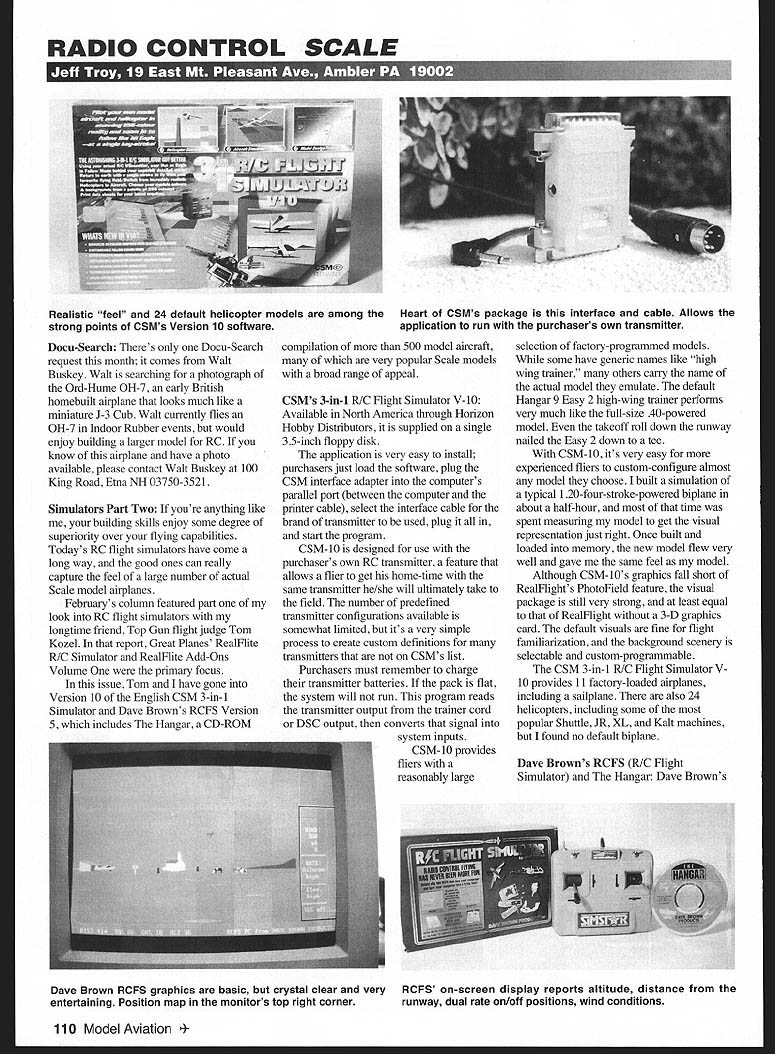
CSM's 3-in-1 R/C Flight Simulator V-10
Available in North America through Horizon Hobby Distributors, CSM's 3-in-1 R/C Flight Simulator V-10 is supplied on a single 3.5-inch floppy disk.
The application is very easy to install. Purchasers load the software, plug the CSM interface adapter into the computer's parallel port (between the computer and the printer cable), select the interface cable for the brand of transmitter to be used, plug it all in, and start the program.
CSM-10 is designed for use with the purchaser's own RC transmitter, a feature that allows a flier to get home-time with the same transmitter he or she will ultimately take to the field. The number of predefined transmitter configurations available is somewhat limited, but it's a very simple process to create custom definitions for many transmitters that are not on CSM's list.
Purchasers must remember to charge their transmitter batteries. If the pack is flat, the system will not run. This program reads the transmitter output from the trainer cord or DSC output, then converts that signal into system inputs.
CSM-10 provides fliers with a reasonably large selection of factory-programmed models. While some have generic names like "high wing trainer," many others carry the name of the actual model they emulate. The default Hangar 9 Easy 2 high-wing trainer performs very much like the full-size .40-powered model. Even the takeoff roll down the runway nailed the Easy 2 down to a tee.
With CSM-10, it's easy for more experienced fliers to custom-configure almost any model they choose. I built a simulation of a typical .120 four-stroke-powered biplane in about a half hour, and most of that time was spent measuring my model to get the visual representation just right. Once built and loaded into memory, the new model flew very well and gave me the same feel as my real model.
Although CSM-10's graphics fall short of RealFlight's PhotoField feature, the visual package is still very strong, and at least equal to that of RealFlight without a 3-D graphics card. The default visuals are fine for flight familiarization, and the background scenery is selectable and custom-programmable.
The CSM 3-in-1 R/C Flight Simulator V-10 provides 11 factory-loaded airplanes, including a sailplane. There are also 24 helicopters, including some of the most popular Shuttle, JR, XL, and Kalt machines, but I found no default biplane.
Dave Brown's RCFS (R/C Flight Simulator) Version 5 and The Hangar
RCFS Version 5 includes The Hangar, a CD-ROM compilation of more than 500 model aircraft. RCFS's graphics are basic, but crystal clear and very entertaining. RCFS's on-screen display reports altitude, distance from the runway, dual-rate on/off positions, and wind conditions.
RCFS is one of the easiest systems to install. Purchasers load the software, plug the transmitter cable into the game port, and start flying. A SimStar controller is provided and is configured through the system setup; it does have entries in the Game Controller directory.
Seven configured aircraft — ranging from a motor glider to a typical high-wing trainer, a delta wing and a ducted-fan jet — come with the basic package. They may be altered to suit specific performance parameters required by the pilot.
RCFS's selectable scenery includes a limbo pole, racing pylons and background scenery sufficient to maintain orientation on the flying field, so long as the pilot doesn't fly too high. The program provides a live map in the upper-right corner of the screen, lending a very helpful overview of the whole site relative to the position of the model. With pylons and the limbo pole present, experienced fliers have several fun-fly opportunities, and beginners can practice basic maneuvers.
Since the main east-west runway is smack-dab in the middle of the pylon racing circuit, the pylons are able to provide fun-seeking "reckless" pilots with countless midair opportunities.
The trainer is very easy to fly. It's a high-wing red-and-white machine that flies slowly enough to give the rank beginner and the somewhat-rusty veteran a chance to prevail.
Some of the other available aircraft include an intermediate trainer, advanced trainer, "Spitfire," a biplane, electric glider, and a helicopter. The selection provides purchasers with a good cross-section of models that maintain the element of challenge as a pilot's skill improves. The standard helicopter simulation is remarkably good. The default parameters provide a simulation that perfectly mimics my own .60-size training machine.
The greatest advantage to Brown's RCFS system is The Hangar, which provides pilots with more than 500 specific models and full-scale aircraft. As in the basic selection, all aircraft can be custom-configured.
The Hangar 3 on CD-ROM includes:
- 49 actual model biplanes
- 20 ducted-fan and turbine-powered jets (from BVM's F-86 to the U-2)
- 22 full-scale airplanes
- 29 fun-fly models
- 30 gliders
- 2 helicopters
- 28 Pattern models (from the Kaos to the Calypso)
- Pylon racers, sport models, and more than 90 different trainers, including the popular Sig Kadet family, Goldberg's Eagles, Midwest's Aero-Stars, and even the U.S. AirCore Family Trainer
RC flight simulators are not likely to ever take the place of a good instructor, but they sure make some of the fledgling pilot's mistakes a lot easier to live with. They also make it possible for modelers to become accustomed to a new scale model—without risk, and without financial or emotional penalty.
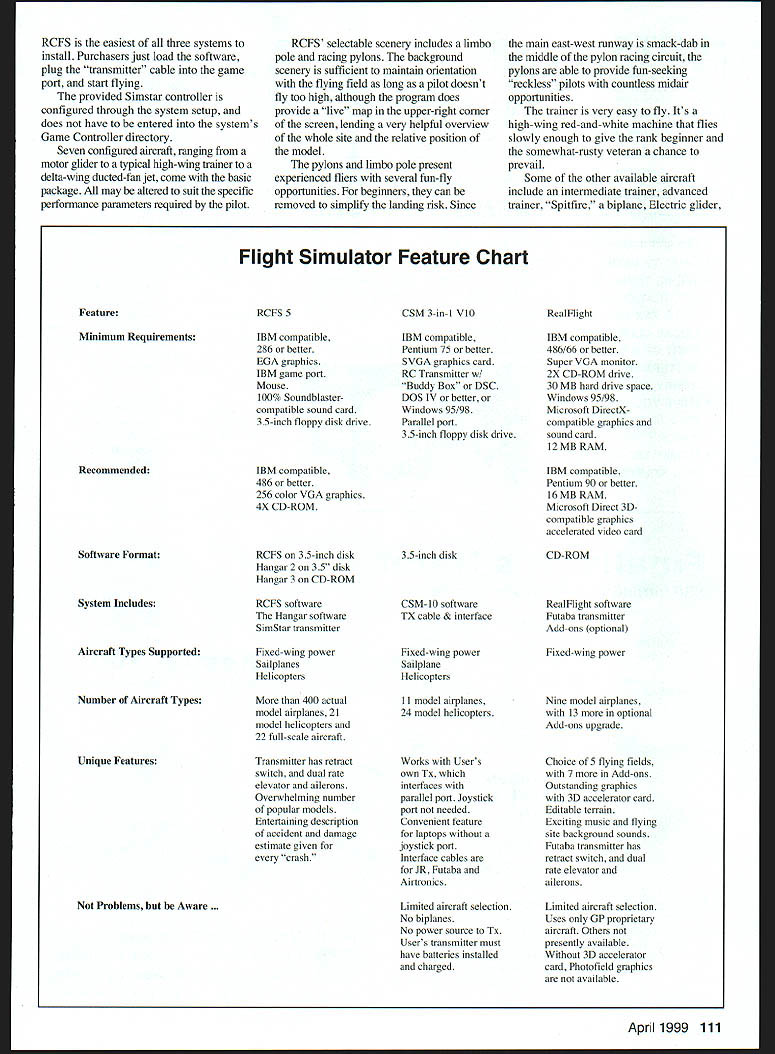
Flight Simulator Feature Chart
Minimum Requirements:
- RCFS 5: IBM compatible, 286 or better. EGA graphics. IBM game port. Mouse. 100% SoundBlaster-compatible sound card. 3.5-inch floppy disk drive.
- CSM 3-in-1 V10: IBM compatible, Pentium 75 or better. SVGA graphics card. RC transmitter with "Buddy Box" or DSC. DOS 5.0 or better, or Windows 95/98. Parallel port. 3.5-inch floppy disk drive.
- RealFlight: IBM compatible, 486/66 or better. Super VGA monitor. 2X CD-ROM drive. 30 MB hard drive space. Windows 95/98. Microsoft DirectX-compatible graphics and sound card. 12 MB RAM.
Recommended:
- RCFS 5: IBM compatible, 486 or better. 256-color VGA graphics. 4X CD-ROM.
- CSM 3-in-1 V10: IBM compatible, Pentium 90 or better.
- RealFlight: IBM compatible, Pentium 90 or better. 16 MB RAM. Microsoft Direct3D-compatible, graphics-accelerated video card.
Software Format:
- RCFS 5: RCFS on 3.5-inch disk. Hangar 2 on 3.5-inch disk. Hangar 3 on CD-ROM.
- CSM 3-in-1 V10: 3.5-inch disk.
- RealFlight: CD-ROM.
System Includes:
- RCFS 5: RCFS software, The Hangar software, SimStar transmitter.
- CSM 3-in-1 V10: CSM-10 software, TX cable and interface.
- RealFlight: RealFlight software, Futaba transmitter, add-ons (optional).
Aircraft Types Supported:
- RCFS 5: Fixed-wing power, sailplanes, helicopters.
- CSM 3-in-1 V10: Fixed-wing power, sailplane, helicopters.
- RealFlight: Fixed-wing power.
Number of Aircraft Types:
- RCFS 5: More than 400 actual model airplanes, 21 model helicopters and 22 full-scale aircraft.
- CSM 3-in-1 V10: 11 model airplanes, 24 model helicopters.
- RealFlight: Nine model airplanes, with 13 more in optional Add-Ons upgrade.
Unique Features:
- RCFS 5: Transmitter has retract switch, and dual rate elevator and ailerons. Overwhelming number of popular models. Entertaining description of accident and damage estimate given for every "crash."
- CSM 3-in-1 V10: Works with user's own transmitter, which interfaces with the parallel port. Joystick port not needed. Convenient feature for laptops without a joystick port. Interface cables available for JR, Futaba and Airtronics.
- RealFlight: Choice of 5 flying fields, with 7 more in Add-Ons. Outstanding graphics with 3D accelerator card. Editable terrain. Exciting music and flying-site background sounds. Futaba transmitter has retract switch, and dual rate elevator and ailerons.
Not Problems, but Be Aware:
- RCFS 5: Limited aircraft selection in the base package. No power source to TX; user's transmitter must have batteries installed and charged.
- CSM 3-in-1 V10: Limited aircraft selection in the base package. No power source to TX; user's transmitter must have batteries installed and charged.
- RealFlight: Limited aircraft selection. Uses only GP proprietary aircraft; others not presently available. Without a 3D accelerator card, PhotoField graphics are not available.
Transcribed from original scans by AI. Minor OCR errors may remain.

