
RADIO CONTROL SCALE
Jeff Troy, 19 East Mt. Pleasant Ave., Ambler, PA 19002
MANUFACTURERS' NEWS
If any aircraft was to challenge Piper's J-3 Cub for the distinction of being the most-recognized airplane of all time, it would have to be the Dakota—the Douglas DC-3.
In commercial service the DC-3 carried passengers and cargo to every corner of the globe. In military service the DC-3 was designated C-47 and was affectionately known by all who came in contact with it as the Gooney Bird. Gooney Birds flew transport duty, dropped supplies to troops in the field, and dropped the troops themselves—most memorably over the skies of Europe during World War II.
The DC-3 has always been a popular modeling subject. Almost every plastic kit and die-cast company has issued a model in one form or another. More recently, the radio-control world has become enamored with the DC-3. Top Flite has brought us a traditional wood kit; Kyosho offers a slightly larger airplane in an Almost Ready to Fly version; and Hirobo offers the graceful twin in a glass-and-sheeted-foam version for electric power.
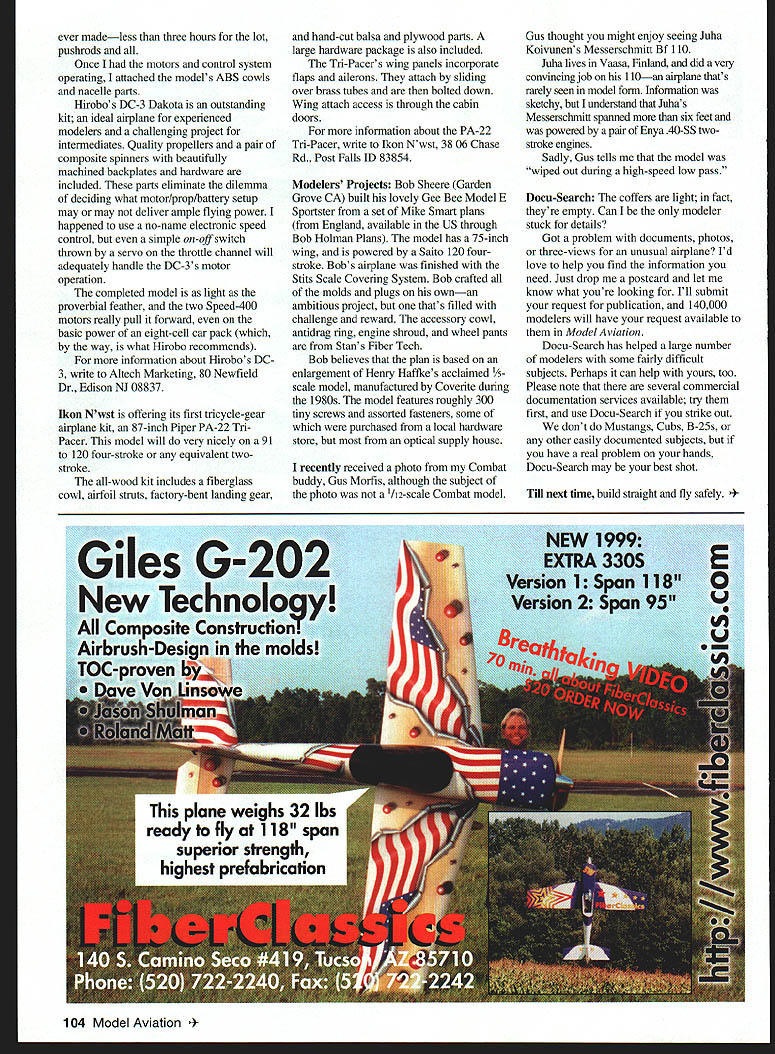
During the summer I had the pleasure of building Hirobo's DC-3. This was a very different kind of project for me, and I thought you might be interested in having a look at the model.
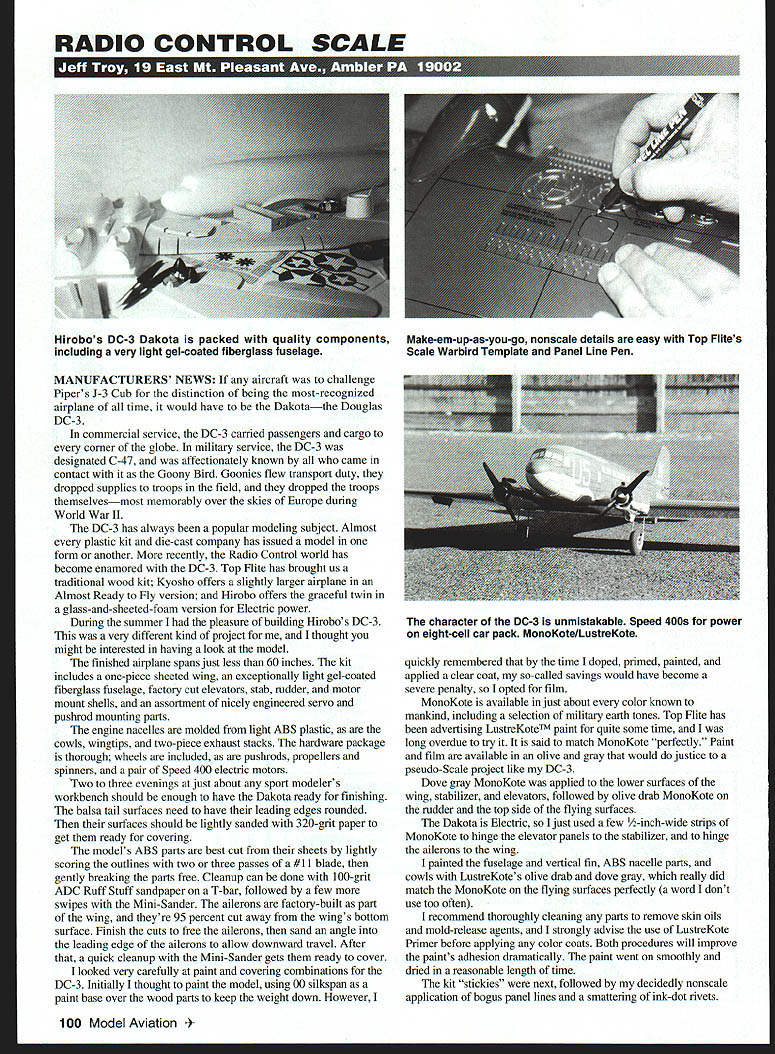
The finished airplane spans just under 60 inches. The kit includes a one-piece sheeted wing, an exceptionally light gel-coated fiberglass fuselage, factory-cut elevators, stab, rudder, and motor mount shells, and an assortment of nicely engineered servo and pushrod mounting parts.
Other kit features:
- ABS plastic engine nacelles, cowls, wingtips, and two-piece exhaust stacks
- Wheels, pushrods, propellers, and spinners
- A pair of Speed 400 electric motors
- Thorough hardware package
Two to three evenings at just about any sport modeler's workbench should be enough to have the Dakota ready for finishing. The balsa tail surfaces need their leading edges rounded and should be lightly sanded with 320-grit paper to get them ready for covering.
The ABS parts are best cut from their sheets by lightly scoring the outlines with two or three passes of a #11 blade, then gently breaking the parts free. Cleanup can be done with 100-grit ADC Ruff Stuff sandpaper on a T-bar, followed by a few more swipes with the Mini-Sander. The ailerons are factory-built as part of the wing and are 95 percent cut away from the wing's bottom surface. Finish the cuts to free the ailerons, then sand an angle into the leading edge of the ailerons to allow downward travel. After that, a quick cleanup with the Mini-Sander gets them ready to cover.
I looked carefully at paint and covering combinations for the DC-3. Initially I thought to paint the model, using 00 silkspan as a paint base over the wood parts to keep the weight down. However, I quickly remembered that by the time I doped, primed, painted, and applied a clear coat, my so-called savings would have become a severe penalty, so I opted for film.
MonoKote is available in just about every color known to man, including a selection of military earth tones. Top Flite has been advertising LustreKote™ paint for quite some time, and I was long overdue to try it. It is said to match MonoKote "perfectly." Paint and film are available in an olive and gray that would do justice to a pseudo-scale project like my DC-3.
I applied dove-gray MonoKote to the lower surfaces of the wing, stabilizer, and elevators, followed by olive-drab MonoKote to the rudder and the top side of the flying surfaces.
The Dakota is electric, so I used a few 1/2-inch-wide strips of MonoKote to hinge the elevator panels to the stabilizer and to hinge the ailerons to the wing.
I painted the fuselage and vertical fin, ABS nacelle parts, and cowls with LustreKote's olive drab and dove gray, which really did match the MonoKote on the flying surfaces.
I recommend thoroughly cleaning any parts to remove skin oils and mold-release agents, and I strongly advise the use of LustreKote Primer before applying any color coats. Both procedures will improve the paint's adhesion dramatically. The paint went on smoothly and dried in a reasonable length of time.
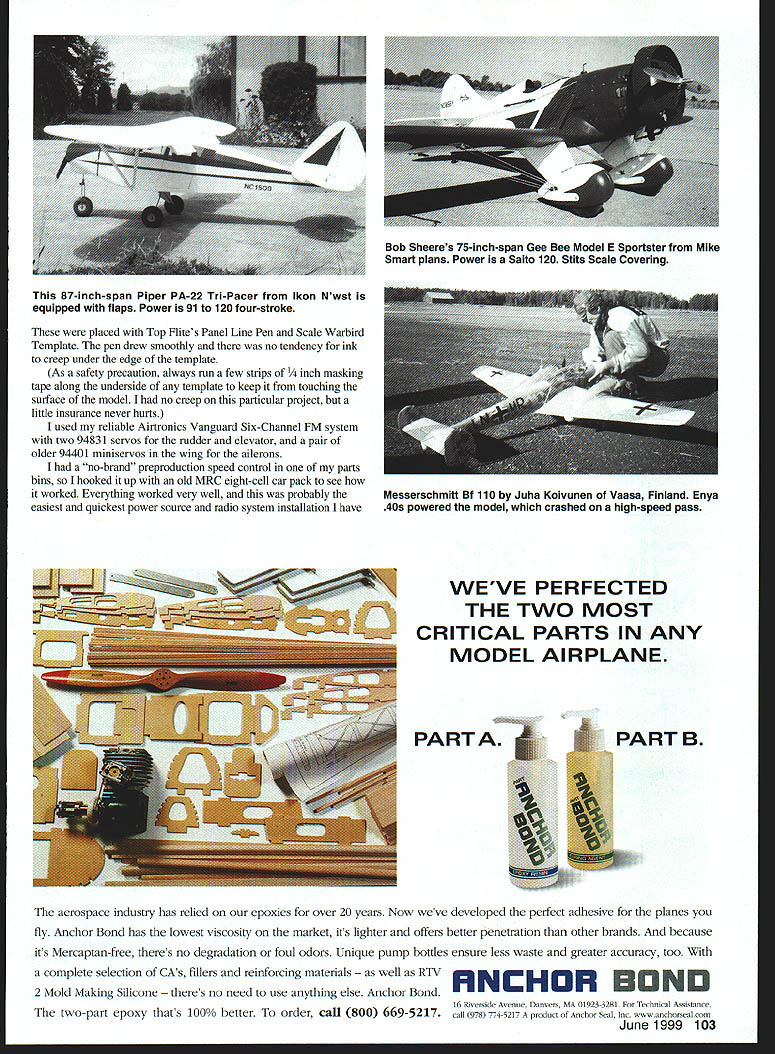
Next came the kit "stickies," followed by a decidedly nonscale application of bogus panel lines and a smattering of ink-dot rivets. Top Flite's Scale Warbird Template and Panel Line Pen drew smoothly with no tendency for ink creep under the edge of the template. As a safety precaution, always run a few strips of 1/4-inch masking tape along the underside of the template to keep it from touching the surface; no creep in this particular project, and a little insurance never hurts.
For radio and servos I used a reliable Airtronics Vanguard six-channel FM system, two 94831 servos for the rudder and elevator, and a pair of older 94401 mini servos in the wing for the ailerons.
I had a no-brand preproduction speed control in one of my parts bins, so I hooked it up with an old MRC eight-cell car pack to see how it worked. Everything worked very well, and this was probably the easiest and quickest power-source and radio-system installation I have done. Once I had the motors and control system operating, I attached the model's ABS cowl and nacelle parts.
Hirobo's DC-3 Dakota is an outstanding kit—an ideal airplane for experienced modelers and a challenging project for intermediates. Quality propellers and a pair of composite spinners with beautifully machined backplates and hardware are included. These parts eliminate the dilemma of deciding what motor/prop/battery setup may or may not deliver ample flying power. I happened to use a no-name electronic speed control, but even a simple on-off switch thrown by a servo on the throttle channel will adequately handle the DC-3's motor operation.
The completed model is light, and the two Speed 400 motors really pull it forward, even on the basic power of an eight-cell car pack (which, by the way, is what Hirobo recommends).
For more information about Hirobo's DC-3, write to: Altotech Marketing 80 Newfield Dr. Edison, NJ 08837
Ikon N'West is offering its tricycle-gear airplane kit, an 87-inch Piper PA-22 Tri-Pacer. This model will do very nicely on a .91 to .120 four-stroke or any equivalent two-stroke.
The all-wood kit includes:
- Fiberglass cowl
- Airfoil struts
- Factory-bent landing gear
- Hand-cut balsa and plywood parts
- Large hardware package
The Tri-Pacer's wing panels incorporate flaps and ailerons. They attach by sliding over brass tubes and are then bolted down. Wing-attach access is through the cabin doors.
For more information about the PA-22 Tri-Pacer, write to: Ikon N'West 3806 Chase Rd. Post Falls, ID 83854
Modelers' Projects
Bob Sheere (Garden Grove, CA) built his lovely Gee Bee Model E Sportster from a set of Mike Smart plans (from England, available in the U.S. through Bob Holman Plans). The model has a 75-inch wing and is powered by a Saito 120 four-stroke. Bob's airplane was finished with the Stits Scale Covering System. He crafted all of the molds and plugs on his own—an ambitious project but one filled with challenge and reward. The accessory cowl, antifreeze ring, engine shroud, and wheel pants are from Stan's Fiber Tech.
Bob believes that the plan is based on an enlargement of Henry Haffke's acclaimed 1/5-scale model, manufactured by Coverite during the 1980s. The model features roughly 300 tiny screws and assorted fasteners, some purchased from a local hardware store and most from an optical supply house.
I recently received a photo from my combat buddy Gus Morris, although the subject was not a 1/12-scale combat model. Gus thought you might enjoy seeing Juha Koivunen's Messerschmitt Bf 110. Juha lives in Vaasa, Finland, and did a very convincing job on his 110—an airplane that's rarely seen in model form. I understand Juha's Messerschmitt spanned more than six feet and was powered by a pair of Enya .40-SS two-stroke engines. Sadly, Gus tells me the model was "wiped out during a high-speed low pass."
Docu-Search
The coffers are light; in fact, they're empty. Can I be the only modeler stuck for details?
Got a problem with documents, photos, or a three-view for an unusual airplane? I'd love to help you find the information you need. Just drop me a postcard and let me know what you're looking for. I'll submit your request for publication, and 140,000 readers will have your request available to them in Model Aviation.
Docu-Search has helped a large number of modelers with some fairly difficult subjects. Perhaps it can help with yours, too. Please note that there are several commercial documentation services available; try them first and use Docu-Search if you strike out.
We don't do Mustangs, Cubs, B-25s, or any other easily documented subjects, but if you have a real problem on your hands, Docu-Search may be your best shot.
Till next time, build straight and fly safely.
Transcribed from original scans by AI. Minor OCR errors may remain.

