
RADIO CONTROL: SCALE
Stan Alexander 3709 Valley Ridge Dr. Nashville, TN 37211 E-mail: onawing@mindspring.com
Editor's note
We are pleased to welcome Stan Alexander as the part-time "RC Scale" columnist. He will be writing a bimonthly column, alternating with Jeff Troy.
Which came first: the chicken or the egg? That resembles my question for scale modelers this month.
Which comes first: documentation or the scale model? If your answer was the model, go back to the first question! The documentation should be gathered first, and this is the time of year that many modelers start thinking about their next project.
Documenting an aircraft is fun if you take your time, and you can accept the fact you may want to document several different aircraft at once. You could keep a file on future projects, and as you collect more material, drop it into the file folder. But by all means, collect three-views, photos, and color chips before building the model of your dreams.
After you make that all-important decision on which aircraft you want to model, make the decision to successfully complete your model. Many modelers might say, "Well, I'm not going to enter competition anyway." This may be true, but they would have effectively covered themselves if they ever changed their minds.
Trying to cover up mistakes or change the color of a P-51 Mustang isn't as easy as finding good photos of an example from World War II, a museum aircraft, or one that's still flying (all examples are acceptable).
Current Project
The project on my workbench now is a Fairchild PT-19. This airplane has appealed to me since my first Cox PT-19 control-line (CL) model many years ago. (I went through several.)
The particular aircraft I'm building is ED 64: a restored version that has been seen at Oshkosh, WI, the last two years, and has been photographed extensively. This U.S. Army trainer started service at Cimarron Field with the Oklahoma Air College late in 1942, but more on its history another time.
When I couldn't find a 1/5-scale Pilot kit (out of production) and had already bought the Jim Pepino plans, I ended up purchasing the Dynaflite kit. What can I say? I'm, uh, frugal. The kit is a good value, but it needs some alterations. (What scale modeler doesn't "highly modify" a kit?) I'm incorporating the slight changes as I go along.
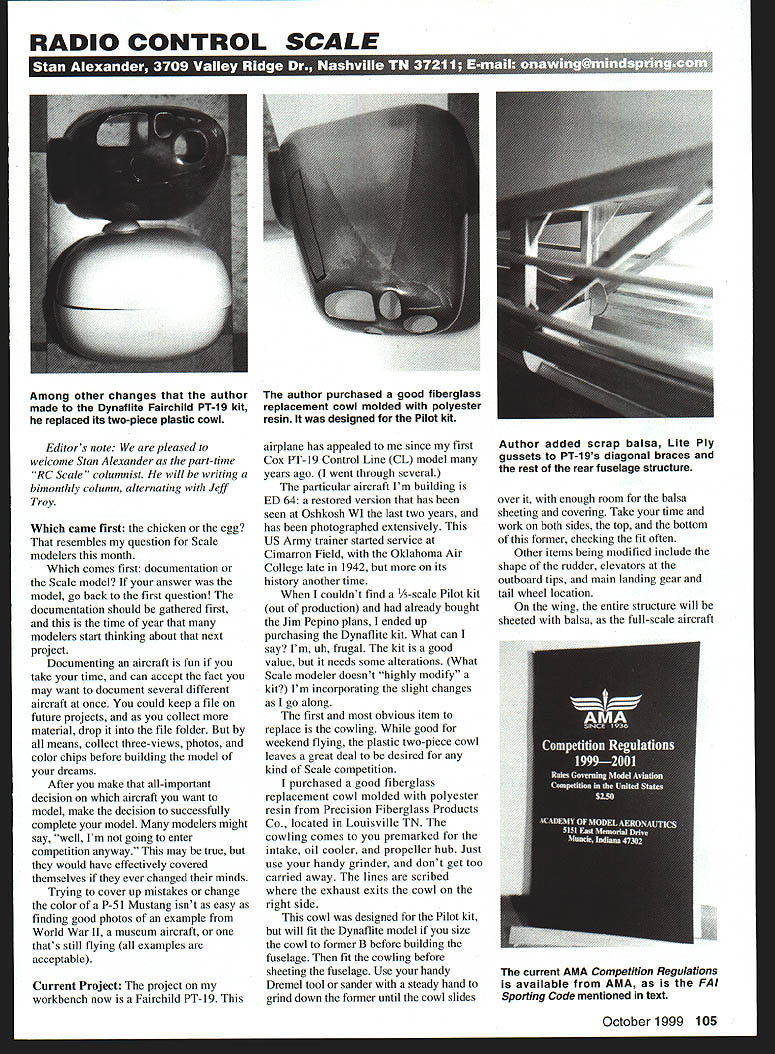
The first and most obvious item to replace is the cowling. While good for weekend flying, the plastic two-piece cowl leaves a great deal to be desired for any kind of scale competition.
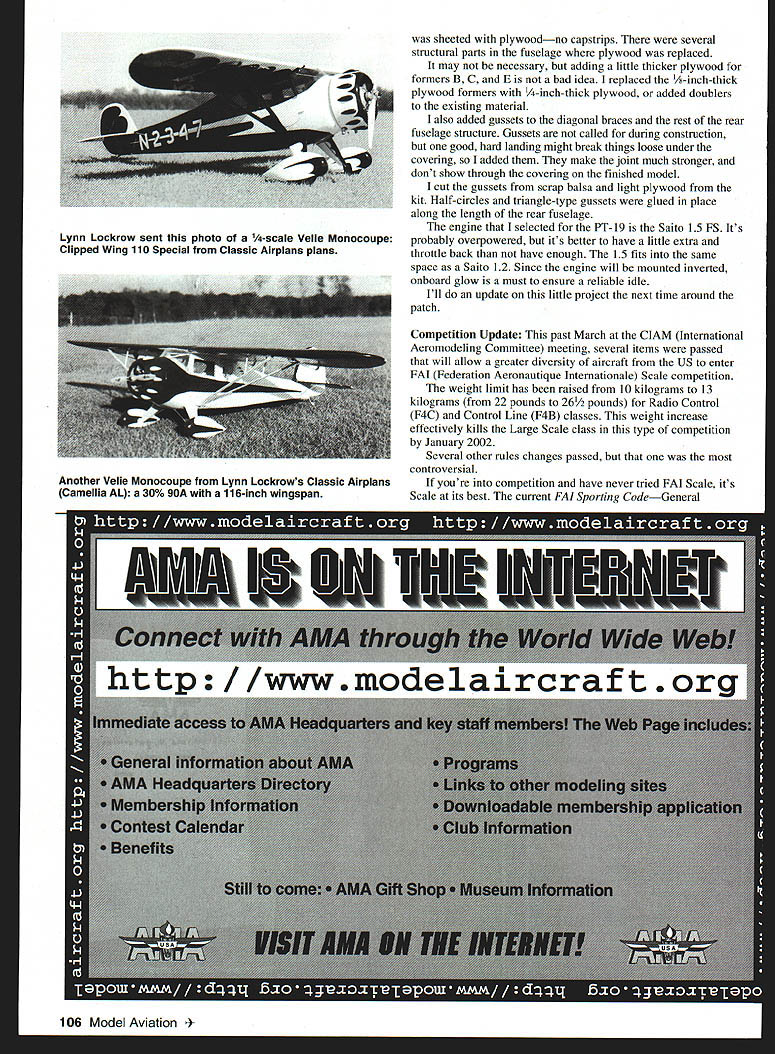
I purchased a good fiberglass replacement cowl molded with polyester resin from Precision Fiberglass Products Co., located in Louisville, TN. The cowling comes premarked for the intake, oil cooler, and propeller hub. Just use your handy grinder, and don't get carried away. The lines are scribed where the exhaust exits the cowl on the right side.
This cowl was designed for the Pilot kit, but will fit the Dynaflite model if you size the cowl to former B before building the fuselage. Then fit the cowling before sheeting the fuselage. Use a Dremel tool or sander with a steady hand to grind down the former until the cowl slides over it, with enough room for the balsa sheeting and covering. Take your time and work on both sides, the top, and the bottom, checking the fit often.
Other items being modified include the shape of the rudder, elevators, outboard tips, and main landing gear and tailwheel location. On the wing, the entire structure will be sheeted with balsa, as the full-scale aircraft.
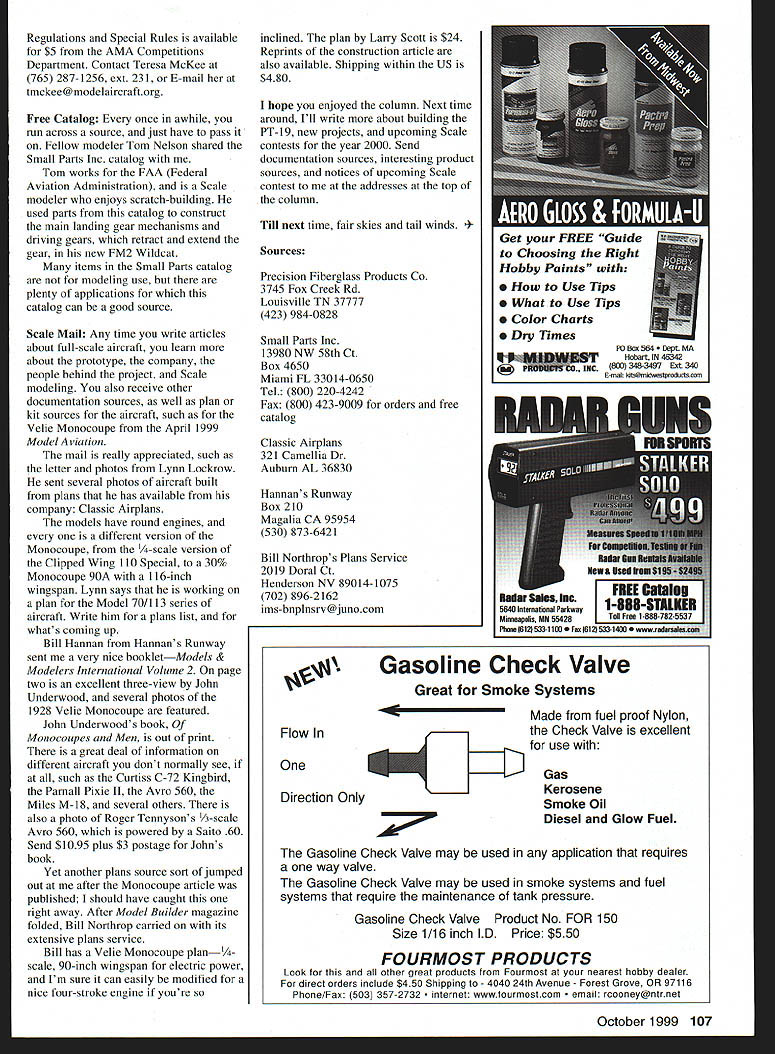
Several structural parts of the fuselage plywood in the kit were replaced. I replaced the 1/8-inch-thick plywood formers with 1/4-inch-thick plywood and added doublers to existing material. I also added gussets to the diagonal braces and the rest of the rear fuselage structure. Gussets added during construction are a good idea — a hard landing might break things loose under the covering. The gussets make the joint much stronger and won't show through the finished covering. Cut gussets from scrap balsa or light plywood. Half-circle, triangle-type gussets are glued in place along the length of the rear fuselage.
The engine selected for the PT-19 is a Saito 1.5 FS. It's probably overpowered, but it's better to have a little extra and throttle back; the 1.5 fits the same space as the Saito .12. Since the engine will be mounted inverted for on-board glow, you must ensure a reliable idle. I'll update the project next time around.
Competition Update
At the past CIAM (International Aeromodelling Committee) meeting, several items passed that will allow greater diversity of aircraft the U.S. can enter in FAI (Fédération Aéronautique Internationale) scale competition; the weight limit has been raised.
- The weight limit has been raised from 10 kilograms to 13 kilograms (from 22 pounds to 26½ pounds) for radio control (F4C) and control line (F4B) classes.
- This weight increase effectively kills the Large Scale class in this type of competition by January 2002.
Several other rules changes passed, but that one was the most controversial.
If you're into competition and have never tried FAI Scale, it's scale at its best. The current FAI Sporting Code — General Regulations and Special Rules is available for $5 from the AMA Competitions Department. Contact Teresa McKee at (765) 287-1256, ext. 231, or E-mail tmckee@modelaircraft.org.
Free Catalog
Every once in a while you run across a source and just have to pass it on. Fellow modeler Tom Nelson shared the Small Parts Inc. catalog with me.
Tom works for the FAA (Federal Aviation Administration) and is a scale modeler who enjoys scratch-building. He used parts from this catalog to construct the main landing gear mechanisms and driving gears, which retract and extend the gear in his PFW 2 Wildcat.
Many items in the Small Parts catalog are not for modeling use, but there are plenty of applications for which this catalog can be a good source.
Scale Mail
Any time you write articles about full-scale aircraft, you learn more about the prototype, the company, the people behind the project, and scale modeling. You also receive other documentation sources, as well as plan or kit sources for the aircraft, such as for the Velie Monocoque from the April 1999 Model Aviation.
The mail is really appreciated, such as the letter and photos from Lynn Lockrow. He sent several photos of aircraft built from plans that he has available from his company, Classic Airplans.
The models have round engines, and every one is a different version of the Monocoque, from the 1/4-scale version of the Clipped Wing 110 Special to a 30% Monocoque 90A with a 116-inch wingspan. Lynn says that he is working on a plan for the Model 701/13 series of aircraft. Write him for a plans list and for what's coming up.
Bill Hannan from Hannan's Runway sent me a very nice booklet — Models & Modelers International Volume 2. On page two is an excellent three-view by John Underwood, and several photos of the 1928 Velie Monocoque are featured. John Underwood's book, Of Monocoques and Men, is out of print. There is a great deal of information on different aircraft that you don't normally see, such as the Curtiss C-72 Kingbird, the Parnall Pixie II, the Avro 560, the Miles M-18, and several others. There is also a photo of Roger Tennyson's 1/3-scale Avro 560, which is powered by a Saito .60. Send $10.95 plus $3 postage for John's book.
Yet another plans source sort of jumped out at me after the Monocoque article was published; I should have caught this one right away. After Model Builder magazine folded, Bill Northrop carried on with its extensive plans service.
Bill has a Velie Monocoque plan — 1/4 scale, 90-inch wingspan for electric power — and I'm sure it can easily be modified for a nice four-stroke engine if you're so inclined. The plan by Larry Scott is $24. Reprints of the construction article are also available. Shipping within the U.S. is $4.80.
I hope you enjoyed the column. Next time around, I'll write more about building the PT-19, new projects, and upcoming scale contests for the year 2000. Send documentation sources, interesting product sources, and notices of upcoming scale contests to me at the addresses at the top of the column.
Till next time, fair skies and tailwinds.
Sources
- Precision Fiberglass Products Co.
3745 Fox Creek Rd. Louisville, TN 37777 (423) 984-0828
- Small Parts Inc.
13980 NW 58th Ct., Box 4650 Miami, FL 33014-0650 Tel.: (800) 220-4242 Fax: (800) 423-9009 (for orders and free catalog)
- Classic Airplans
321 Camellia Dr. Auburn, AL 36830
- Hannan's Runway
Box 210 Magalia, CA 95954 (530) 873-6421
- Bill Northrop's Plans Service
2019 Dorall Ct. Henderson, NV 89014-1075 (702) 896-2162 E-mail: b-nplans@juno.com
Transcribed from original scans by AI. Minor OCR errors may remain.

