
RADIO CONTROL Scale
Bob and Dolly Wischer
MORE ON scale instruments: There seems to be no limit to the ingenuity of scale modelers. Bob Lopshire offers an alternate method of producing scale instrument faces. Try using Kodak High Contrast Copy Film. This will eliminate reflections. Photos are made as outlined in the September column, then the negatives are placed under glass on a copy stand and re-photographed to obtain a film positive. The positive is then mounted over a white backing for white on black faces which yields a glass-covered effect. Should the real instrument have a black face with luminous markings, a sheet of very pale blue-green backing gives an instant reproduction.
Another offering from Bob, discovered while producing a scale Fairchild, is his method of making instrument panel knobs. They are made from artists' push pins, turned at slow speed in a drill press using rough sandpaper. For aluminum knobs he uses files, then various grades of sandpaper. All are brought to a polished finish using wet or dry paper with lighter fluid as the wetting agent, and finally the appropriate polishing compound on small cheesecloth pads.
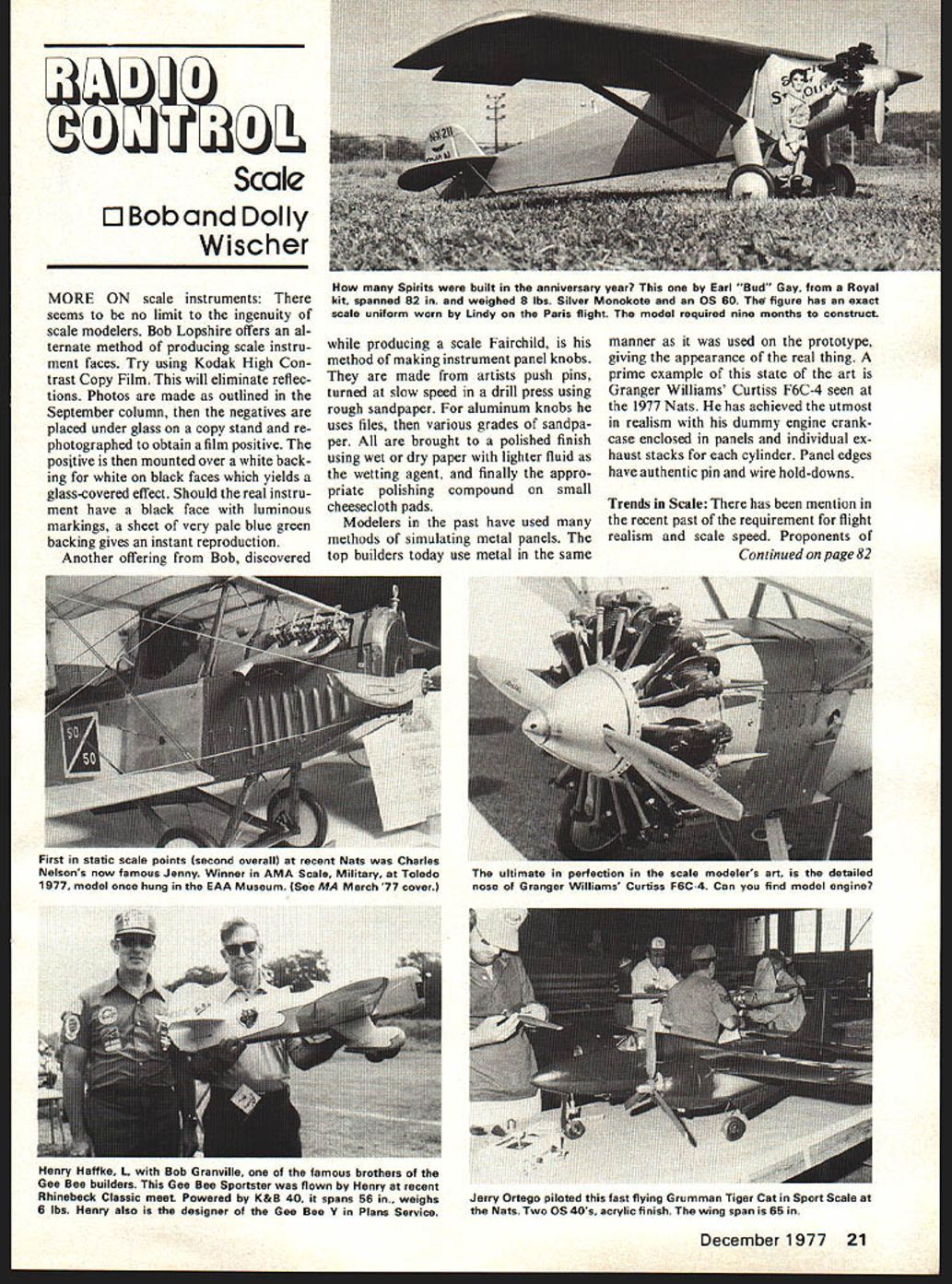
Modelers in the past have used many methods of simulating metal panels. The top builders today use metal in the same manner as it was used on the prototype, giving the appearance of the real thing. A prime example of this state of the art is Granger Williams' Curtiss F6C-4 seen at the 1977 Nats. He has achieved the utmost in realism with his dummy engine crankcase enclosed in panels and individual exhaust stacks for each cylinder. Panel edges have authentic pin and wire hold-downs.
Trends in Scale: There has been mention in the recent past of the requirement for flight realism and scale speed. Large, lightly built planes are convinced that these will produce the flight characteristics desired. At the Riverside Nats, where the usual winds were strong enough to cause taxi problems on the ground, a large lightly built plane would have been very difficult to manage. Only in the early morning were conditions ideal for light wing loadings.
The fact is that a model plane, built to the scale ratio of 5 to 1 for example, could fly at scale speed if it were given scale air. That would mean 75 pounds per square inch pressure and velocity no greater than 3 miles per hour. Imagine the destructive force of a high wind at this pressure. Since we are not offered scale air for our flights, we compromise on scale speed and merely throttle back in our quest for realistic speed. Wind velocity at Riverside was 20 miles per hour during most of each day. To a 1/5-size plane this is equivalent to a gale. Full-size plane pilots, confronted with scale equivalent wind speed, wouldn't even open the hangar doors. Since we can seldom find ideal conditions, our planes do their best to penetrate average winds with wing loadings in the 25 to 30 ounce per square foot range. True scale speed then becomes a mythological dream. The Piel Beryl made its winning flight at Riverside under the worst wind conditions. A three-point landing would have been imprudent, so it was set down in the landing circle with the tail high. The expected trend to large, light models did not materialize at the 1977 Nats.
Radio control scale modeling is enjoying greater popularity than ever before, yet our recent Nats had a decline in entries. Only a tiny percentage of the thousands of scale modelers compete. Can it be that they read in the model press of stringent requirements for scale speed and are thereby turned off for competition? It is true that enjoyment of scale flying is satisfaction enough without competing. The Kitchener-Waterloo Scale Rally in Canada is an example of the popularity of noncompetitive scale flying. The attendance there is double that of our Nats.
The modeler who does not compete has an advantage over those who do. He can build the planes he likes with no thought toward their potential chances to win. The competitor views the rules with an eye for plane types that have an advantage. His choice must also be a plane that he likes since he cannot spend a year building something he finds repulsive. This results in a heavy emphasis on World War II types for contests, especially in Sport Scale. Most of these are capable of flying in a manner similar to a pattern plane.
One of the more interesting new products seen recently is a starting motor system mounted in a plane and actuated from the transmitter. This was demonstrated at the Springfield World Championships in a Sig Cessna flown by Bob Underwood. The system begins with a small electric motor powered by a nickel cadmium battery. The motor output shaft drives the engine crankshaft through a gear reduction and an over-running clutch. Bob made numerous flights with the demonstration plane, making a number of engine re-starts on the ground and in the air. This is a real crowd pleaser and evoked applause even when everyone knew it was about to happen. Bob's only problem was getting the model engine to stop by means of a very slow idle. Windmilling effect in the air tended to keep the engine running until the plane was near a stall close to the ground, but this only made the demonstration more exciting.
The potential of this device as a means of obtaining additional points would be limited to the proto taxi maneuver in AMA Scale. In Sport Scale it would be of doubtful value. A similar system was used in the 1976 Sweden World Contest by USSR contestant Viktor Yougov in his control-line YAK 18. The Eastcraft Lectra Start is available in three sizes for planes, boats or cars, from Eastcraft Specialty Products, P.O. Box 25, Irwin, Pa. 15642. The systems weigh between 13 and 16 ounces for planes and up to 40 ounces for cars or boats.
Some additional thoughts about the Nats:
Very impressive was the muffler buried inside the cowl of a modified Stafford Chipmunk which had taken builder Bob Wilde 45 hours to construct. It used all the available space between the K&B .61 and the cowl inside surface. The plane had a high gloss finish with K&B Super Poxy and large amounts of pressed-on lettering. Dave Platt spent many hours with interested modelers expounding the virtues of his latest Douglas SBD-3 only to answer the ultimate question: "No, it isn't a kit yet." The high-speed flight of Scale Squadron member Jerry Ortego's Grumman Tiger Cat was positively fearful. He made numerous passes before the judges at speeds well in excess of 100 mph.
Innumerable planes had trouble taxiing in the high winds, particularly those with tail wheels. It was almost impossible to turn down-wind after landing to garner those all-important proto taxi points. Most common complaint was the absence of score sheets as at previous Nats. Fliers like to know how to improve static point scores for the next meet and to know which maneuvers are not paying off in their flight scores. Flight maneuvers could not be changed between rounds.
Bob Wischer, Rt. 1, S-221 Lapham Peak Rd., Delafield WI 53018.
Transcribed from original scans by AI. Minor OCR errors may remain.

